Back extension on elbows
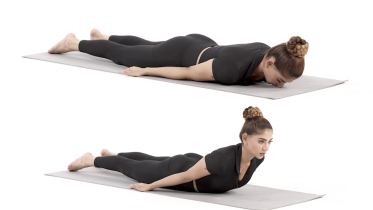
The back extension on elbows is a gentle back strengthening exercise done lying face down. With your forearms flat on the floor and your chin tucked, you press through your arms and raise your head and chest a small way, then lower back down. Because your forearms stay on the floor and share the work, it is an easier lift than the prone back extension with your arms by your sides.
How to do the back extension on elbows
- Lie on your stomach on a mat with your legs straight. Bend your elbows and place your hands palms down in front of your head, making a diamond shape with your arms, and rest your forehead on the backs of your hands.
- Look down at the backs of your hands and gently tuck your chin, so the back of your neck stays long.
- Press your hands and forearms into the floor and lift your head and chest a small way off the mat. Your forearms stay down the whole time.
- Keep your chin tucked and your eyes on your hands. Your hips and legs stay heavy on the mat.
- Hold the position while breathing steadily, then slowly lower your chest and rest your forehead back on your hands.
What you should feel
Work along your spine, mostly in the middle and upper back. The muscles of your neck work a little to hold your head in line with your chin tucked. There should be no pinching in your lower back.
Common mistakes
- Pushing up as high as your arms allow. A small lift keeps the work in your back muscles instead of bending the lower back further.
- Lifting your face to look forward, which bends the neck back.
- Holding your breath while you stay up.
- Lifting your hips or legs off the mat.
How often
A common starting point is 1 to 3 sets of 5 to 10 lifts, each held for about 5 seconds, building up toward 10 seconds as it gets easier. Your physio will adjust this.
Stop and check with your physio if
- Pain spreads into your buttock or down a leg, or you get numbness or tingling in a leg.
- A sharp or pinching pain in your lower back that does not ease once you lie flat again.
- Neck pain during the lift, or pain, numbness or tingling spreading into an arm.
- Pins and needles in your arm or hand that do not go away after you stop, or part of your arm or hand goes numb. Get medical advice the same day. If one side of your face or body suddenly goes numb or weak, or your speech becomes slurred or muddled, call emergency services, even if it goes away.
From the clinic
The chin tuck keeps your head in line with your spine, so the effort stays in your back rather than your neck. The voice guide says to tuck your chin into your chest. A gentle tuck with your eyes on your hands, as in the video, is enough. If lying face down is new or uncomfortable, spend a few sessions on prone lying first. When this feels easy, the prone back extension, with your arms by your sides, is a common next step.
Back extension work like this is generally encouraged for people with low bone density (osteoporosis). If you have had a fracture in your spine, check with your physio before you begin. Getting down to the floor and back up counts too: roll onto your side and push up with your arms rather than twisting or curling straight up, much like the log roll out of bed. If you have high blood pressure, breathe steadily through every hold and never hold your breath. Lying face down is one to clear with your physio if you are pregnant.
Arching backward can irritate spinal stenosis (a narrowing of the space around the nerves in the spine) or a slipped vertebra (spondylolisthesis). With either diagnosis, ask your physio before you try this. After recent back surgery, follow your surgeon's plan. If you have had heart or chest surgery in the last few months, check with your medical team before lying face down and pushing up through your arms, as both put pressure on the healing breastbone.
Written and checked by the PocketPhysio editorial team. Last updated 2026-09-28.
This page is general education, not a diagnosis or a personal treatment plan. If you have pain, an injury or a health condition, see a physiotherapist or doctor before starting new exercises.