Ball sitting steering wheel turns
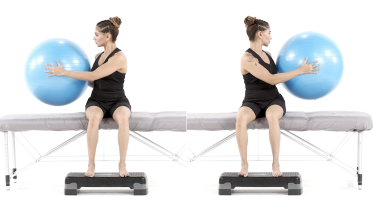
Ball sitting steering wheel turns are a seated trunk control exercise. Sitting on an exercise ball with both feet on the floor, you hold your arms out in front as if gripping a large steering wheel, then turn the wheel to the left and to the right. As one hand rises and the other drops, your weight shifts a little, so the muscles around your trunk have to work to keep you upright and the ball still.
How to do the ball sitting steering wheel turns
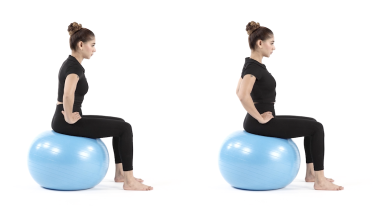
- Put the ball on a mat or non-slip floor with a wall, counter or sturdy chair beside you. Sit on top with both feet flat on the floor, a little wider than your hips.
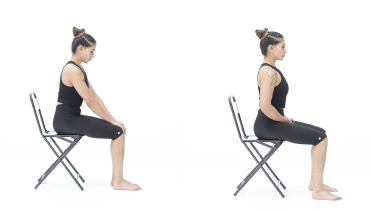
- Sit tall in your neutral position, with a small hollow in your lower back, and tighten your stomach gently.
- Lift both arms straight out in front of you to about shoulder height, hands in loose fists, as if holding the top of a large steering wheel.
- Turn the wheel slowly to the left: your right hand rises to about eye level and crosses toward the middle while your left hand drops to about belly height. Hold the elbows straight, without locking them.
- Come back through the middle and turn the wheel to the right. Your hips, trunk and the ball stay still while the arms move.
What you should feel
Work in the front of your shoulders from holding the arms up, and steady work around your stomach, sides and lower back to keep the ball from rolling.
Common mistakes
- Twisting your whole trunk or leaning to one side with the arms, instead of keeping the body still.
- Letting the hands drift down toward your lap as your shoulders get tired.
- Hunching the shoulders toward your ears.
- Turning fast, so the ball starts to roll.
How often
A common starting point is 5 to 10 slow turns to each side, for 1 to 3 sets, resting whenever your shoulders tire. Your physio will adjust this.
Stop and check with your physio if
- You start to wobble and the ball keeps moving under you. Lower your arms, plant both feet and take hold of your support before you try again.
- Sharp pain in your back, a pinch in your shoulder, or pain, tingling or numbness spreading into an arm or leg.
- Pins and needles in your arm or hand that do not go away after you stop, or part of your arm or hand goes numb. Get medical advice the same day. If one side of your face or body suddenly goes numb or weak, or your speech becomes slurred or muddled, call emergency services, even if it goes away.
- You feel dizzy, faint or unsteady. Stop and get medical advice the same day. If you faint, it does not settle within a few minutes of sitting still, or you cannot stand or walk steadily, call emergency services.
- Numbness around your genitals or bottom, new trouble with your bladder or bowels, pain, tingling, numbness or weakness in both legs, or loss of feeling in one leg. Call emergency services or go to an emergency department straight away.
- Your leg or foot gets weaker, for example your foot drags, catches on the ground or slaps down when you walk (foot drop). Get medical advice the same day. If the weakness is getting worse by the hour, go to an emergency department.
From the clinic
The voice guide asks for straight elbows throughout. If holding the arms up and straight tires your shoulders before your trunk has had any work, bend the elbows slightly or make the turns smaller. The challenge here is keeping your body quiet while the arms move, so a small, slow turn done well beats a big one. If you are new to sitting on a ball, find your neutral position first with the seated pelvic tilt on a ball. The seated ball arm raise and seated ball reach forward work the same trunk control with simpler arm movements.
Use a firm, anti-burst ball of a size that puts your hips level with your knees or slightly higher when your feet are flat. The video shows bare feet on a mat, and shoes with a grippy sole work too. Clear the floor around you of rugs, cables and hard furniture edges. If you have fallen in the past year, get spells of dizziness or have low bone density (osteoporosis), try the arm movement sitting on a firm chair first and ask your physio when you are ready for the ball. For your first few sessions on the ball, have someone close by.
If you have high blood pressure, breathe steadily through every repetition and never hold your breath. After shoulder surgery, including a rotator cuff repair, or after a shoulder fracture or dislocation, follow your surgeon's or physio's plan, and do only the movements and range they have cleared. Many plans allow only passive movement at first, where the arm is moved for you and its muscles stay relaxed. If you have had a fracture in your spine, check with your physio before you begin. If you have had surgery on your spine, chest or heart in recent months, get the go-ahead from your surgical team or physio first.
If you have had a hip replacement, get the go-ahead from your surgeon or physio before you try ball sitting steering wheel turns. A ball that is too low for you, or bending forward to stand up from it, can take the hip past a right angle, and many surgeons ask you to avoid that for the first months after some operations.
Written and checked by the PocketPhysio editorial team. Last updated 2026-09-28.
This page is general education, not a diagnosis or a personal treatment plan. If you have pain, an injury or a health condition, see a physiotherapist or doctor before starting new exercises.