Seated ball twist
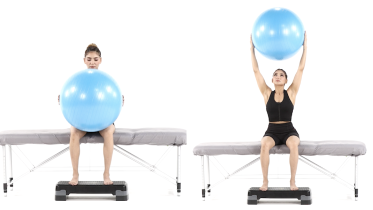
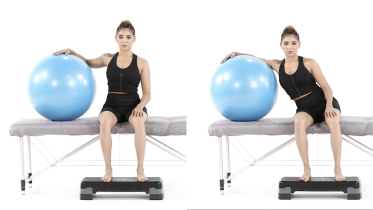
The seated ball twist is a trunk strengthening exercise where you sit on a firm seat, hold a large gym ball in front of you and turn your upper body to carry the ball round to one side, then the other. With the ball held away from your body, the muscles at the sides of your waist (obliques) have a light load to turn, and then to stop. You sit on a bench or chair for this one, not on the ball.
How to do the seated ball twist
- Sit upright on a firm seat that does not roll, such as a sturdy chair or bench, with most of your thighs resting on it. Put your feet flat, hip width apart. The seat in the video is high, so her feet rest on a low step. If your feet do not reach the floor, use a firm step that will not slide.
- Hold the ball in both hands, one hand on each side, in front of your chest. Keep it clear of your knees.
- Turn your chest and shoulders to one side, carrying the ball with you as far round as you comfortably can. Let your eyes follow the ball. In the video the ball ends up out to her side.
- Keep your hips and knees pointing straight ahead, with your weight even on both sitting bones.
- Hold the turn for a few seconds, as in the video, breathing steadily.
- Bring the ball back to the middle under control, then turn the same way to the other side.
What you should feel
Work along the sides of your waist and through the middle of your back, with your shoulders and arms busy holding the ball. You may feel a light stretch at the end of each turn.
Common mistakes
- Swinging the ball round fast and letting its weight carry you past a comfortable turn.
- Moving the ball with your arms alone, so your chest never really turns.
- Letting the knees drift toward the side the ball is going.
- Slumping or leaning back to take the weight of the ball.
How often
Many programs start with 5 to 10 slow turns to each side, holding each turn for a few seconds, for 1 to 3 sets. A large, light gym ball is enough to begin with. Your physio will adjust this.
Stop and check with your physio if
- Sharp pain in your back or ribs during a turn, or pins and needles, numbness or pain running into an arm or down a leg.
- You feel dizzy, faint or unsteady. Stop and get medical advice the same day. If you faint, it does not settle within a few minutes of sitting still, or you cannot stand or walk steadily, call emergency services.
- Things look double, your vision suddenly blurs or goes, your speech slurs or becomes muddled, swallowing becomes hard, your face or lips go numb, one side of your face droops or one side of your body goes weak or numb, you suddenly become so dizzy or unsteady that you fall or cannot stand or walk, your legs suddenly give way but you do not black out (a drop attack), or you get a sudden severe headache. Stop and call emergency services, even if it goes away.
- A pinch at the front or top of the shoulder from holding the ball. Bring the ball in closer to your chest, and stop if the pinch returns.
From the clinic
The voice guide asks you to take the ball as far behind you as you can, but in the video it only reaches her side. Read that as the direction to turn, not a target. Go only as far as your back turns smoothly, and let the range grow over the weeks. A slow turn with a pause at the end is harder on your trunk than a fast swing, because in a swing the ball's momentum does some of the work for you. For a first step with no load, try the seated trunk rotation with your arms crossed.
Use a seat that stays put, with no wheels or swivel, and clear the space around you so the ball does not knock into furniture or people. The ball goes in your hands, never under you. If your balance is unsteady or you have fallen in the past year, keep the turns small and ask someone to stay close for your first sessions, as carrying the ball out to the side moves your weight toward the edge of the seat.
Twisting while you hold a load out in front of you is a movement people with low bone density (osteoporosis) are often told to limit. With osteoporosis, ask your physio whether this exercise suits you and how far to turn. If you have had a fracture in your spine, check with your physio before you begin. If you have had surgery on your spine, chest or heart in recent months, get the go-ahead from your surgical team or physio first. Once you are ready for resistance, the seated band trunk rotation works the same turn against a band.
Written and checked by the PocketPhysio editorial team. Last updated 2026-09-26.
This page is general education, not a diagnosis or a personal treatment plan. If you have pain, an injury or a health condition, see a physiotherapist or doctor before starting new exercises.