Correct sitting posture
Correct sitting posture, as shown here, means sitting tall on your sitting bones with a gentle natural curve in your lower back, relaxed shoulders, your head balanced over your body and your feet flat on the floor. Think of it as a habit you practice through the day rather than an exercise. It is one comfortable way to sit, not the only one, and moving between positions is part of sitting well too.
How to do the correct sitting posture
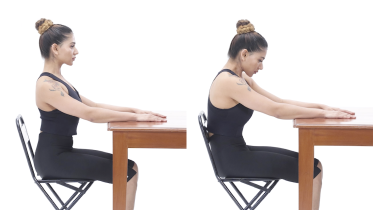
- Choose a firm chair. Place both feet flat, roughly shoulder width apart, with your knees at about the height of your hips.
- Let yourself slump for a moment, as in the start of the video, so you can feel the difference when you sit up.
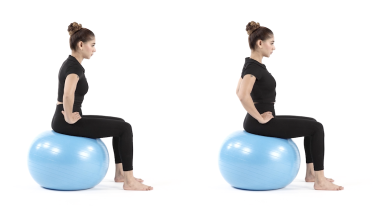
- Sit up tall from the base of your spine. Roll your pelvis forward a little so you are sitting on top of your sitting bones and your lower back finds its gentle inward curve, without arching hard.
- Let your shoulders settle back and down, loose rather than pinned. Your head sits level above your shoulders.
- Rest your hands on your lap and breathe normally. Stay for a few easy breaths, then carry on with what you were doing.
What you should feel
Upright with very little effort. If your back muscles feel tight or you notice yourself holding your breath, ease off to about halfway between the slump and full height.
Common mistakes
- Pushing your chest out and arching your lower back too far.
- Pulling the shoulders back hard and holding them there.
- Letting your feet dangle because the seat is too high. A footrest or a firm cushion under your feet fixes this.
- Treating the position as something to hold rigidly for hours.
How often
Practice finding this position several times a day, for example each time you sit down to work, eat or watch a screen, and stay there for a few relaxed breaths. In between, shift position freely and get up to move around regularly. Your physio will adjust this.
Stop and check with your physio if
- Pain, tingling or numbness that spreads into an arm or a leg.
- Pins and needles in your arm or hand that do not go away after you stop, or part of your arm or hand goes numb. Get medical advice the same day. If one side of your face or body suddenly goes numb or weak, or your speech becomes slurred or muddled, call emergency services, even if it goes away.
- Sitting up brings on sharp or worsening pain in your back or neck instead of easing it.
From the clinic
There is no single right way to sit, and bodies come in different shapes. Some people feel best a little more upright, others a little further back against a backrest. The position in the video is a comfortable base you can come back to, not a pose to lock yourself into. Hold any one position for a long spell, even this one, and many people start to feel stiff. A change is usually welcome.
In the video she sits upright without resting against the backrest. If you prefer a backrest, sit all the way back so it meets your lower back, and a small cushion or rolled towel there can help some people keep the gentle curve. To practice parts of this, try the seated pelvic tilt for the lower back and the chin tuck for the head and neck.
Written and checked by the PocketPhysio editorial team. Last updated 2026-09-28.
This page is general education, not a diagnosis or a personal treatment plan. If you have pain, an injury or a health condition, see a physiotherapist or doctor before starting new exercises.