Seated overhead ball lift
The seated overhead ball lift is a simple strengthening exercise for the upper back. You sit tall with a gym ball resting on your knees, lift it up in front of you until it is above your head, then bring it back down. Holding the ball up asks the muscles along your spine and around your shoulder blades to keep you upright. Upright back strengthening of this kind is often suggested for people with low bone density (osteoporosis).
How to do the seated overhead ball lift
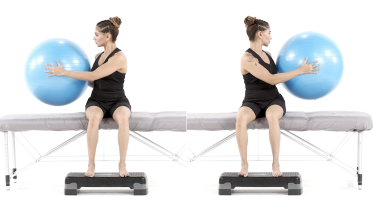
- Sit on a sturdy chair, bench or firm bed edge, far enough back that your thighs are supported. Place your feet flat, about hip width apart. If the seat is high, as in the video, rest your feet on a step.
- Hold a gym ball with one hand on each side and let it rest on your knees.
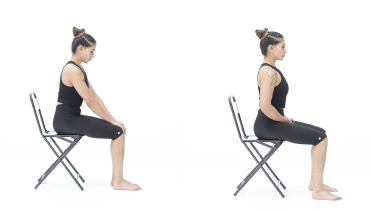
- Sit up tall. Breathe out and lift the ball up in front of you, straightening your arms until it is above your head.
- Hold the ball up for a few seconds, breathing steadily, and stay tall through your upper back. Your head stays level with your eyes looking forward, so you are not tipping it back to watch the ball.
- Lower the ball slowly in front of you until it rests on your knees again.
What you should feel
Work along your upper back and around your shoulder blades, plus effort in the shoulders as they hold the ball up. Your lower back and neck should feel comfortable.
Common mistakes
- Slumping forward as the ball comes down to your knees. Your trunk stays upright on the way down as well.
- Arching the lower back or pushing the ribs forward to get the ball higher.
- Tipping the head back to look up at the ball.
- Hitching your shoulders up by your ears as the ball rises.
- Holding your breath while the ball is up.
How often
Many programs start with 1 to 3 sets of 5 to 10 lifts, holding the ball up for about 3 to 5 seconds each time, once a day or on most days. A light ball is all you need to begin. Your physio will adjust this.
Stop and check with your physio if
- Sharp pain or a pinch at the top or front of your shoulder as the ball goes up.
- Sharp pain in your back, or pain, numbness or tingling spreading into your arms.
- Pins and needles in your arm or hand that do not go away after you stop, or part of your arm or hand goes numb. Get medical advice the same day. If one side of your face or body suddenly goes numb or weak, or your speech becomes slurred or muddled, call emergency services, even if it goes away.
From the clinic
The work here comes from sitting tall while your arms are up, not from how high the ball goes. If your shoulders do not reach overhead comfortably, stop the lift at a height that feels fine, such as forehead level, and let the range build over time. For more upper back work, wall angels and the seated thoracic extension cover similar ground.
Upright back extension work like this is generally encouraged in exercise for osteoporosis. What people with low bone density are usually told to avoid is loaded or repeated forward bending and twisting, so keep your trunk upright as the ball comes down and do not swing it off to one side. Pick the ball up from a table, or have someone hand it to you, rather than bending to the floor for it. Anyone who has broken a bone in the spine should ask their physio first.
Choose a seat that does not roll or tip, and if your balance is unsteady, have someone nearby the first few times. If you have high blood pressure, breathe steadily through every hold and never hold your breath. After shoulder surgery, check with your surgeon or physio before lifting anything overhead. After heart or chest surgery in the last few months, ask your cardiac rehab team first, as holding a weight above your head with both arms loads the healing breastbone.
Written and checked by the PocketPhysio editorial team. Last updated 2026-09-28.
This page is general education, not a diagnosis or a personal treatment plan. If you have pain, an injury or a health condition, see a physiotherapist or doctor before starting new exercises.