Seated pelvic tilt on a ball
The seated pelvic tilt on a ball is a posture exercise for finding the middle position of your lower back, often called neutral spine. Sitting on an exercise ball with your hands on your hips, you roll your pelvis forward into an arch, then back into a rounded slump, and then settle halfway between the two. The ball moves a little with each tilt, so you feel the change clearly and your trunk muscles work gently to keep you centered.
How to do the seated pelvic tilt on a ball
- Put the ball on a grippy mat, close to something solid you can grab, such as a kitchen counter or a wall. Sit in the middle of the ball, feet planted firmly and a little wider apart than your hips.
- Place your hands on your hips, resting on the bony rims of your pelvis, as in the video. They let you feel which way it is tipping.
- Roll your hips forward so your lower back arches and you rise up tall. The ball will shift slightly under you.
- Now roll your hips the other way, tucking your tailbone under and letting your back round. Stop at the point where it is still comfortable.
- Rock slowly between the two a few times, keeping your head level and your shoulders over your hips.
- Finish halfway between the arch and the slump. That middle point, with a gentle hollow low in your back, is your neutral sitting position.
What you should feel
Smooth movement low in your back and pelvis, with the muscles along your spine working lightly when you arch and your stomach working when you round. The middle position should feel easy to hold.
Common mistakes
- Moving your head and shoulders forward and back while the pelvis stays put. Your hands should feel the hip bones tip.
- Shuffling your whole body across the ball rather than tipping the pelvis.
- Forcing either end until your back pinches or aches.
- Settling in a big arch and calling it sitting tall. Neutral is the middle, not the end.
- Sitting on an underinflated or undersized ball that leaves your knees higher than your hips.
How often
The voice guide does not give a number. Programs often use 5 to 10 slow tilts each way, finishing in the middle, once or twice a day. Some people also do one or two tilts during the day as a quick posture check. Your physio will adjust this.
Stop and check with your physio if
- Sharp or pinching pain in your back as you arch or round, or pain, tingling or numbness spreading into one leg.
- You feel dizzy, faint or unsteady. Stop and get medical advice the same day. If you faint, it does not settle within a few minutes of sitting still, or you cannot stand or walk steadily, call emergency services.
- Numbness around your genitals or bottom, new trouble with your bladder or bowels, pain, tingling, numbness or weakness in both legs, or loss of feeling in one leg. Call emergency services or go to an emergency department straight away.
- Your leg or foot gets weaker, for example your foot drags, catches on the ground or slaps down when you walk (foot drop). Get medical advice the same day. If the weakness is getting worse by the hour, go to an emergency department.
From the clinic
Start with the ball. With your feet flat, your hips should end up at knee height or just above. That usually means a firmly pumped ball of the right size, and an anti-burst ball is the safer choice. Bare feet on a non-slip mat, as in the video, or shoes with grip both work. Move rugs, cables and furniture with hard edges out of the way.
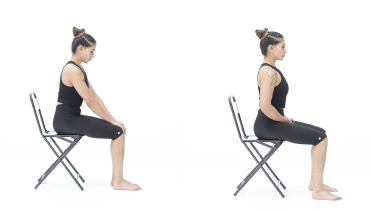
Keep your support close enough to grab without leaning. After a fall in the last 12 months, with dizzy spells, or with low bone density (osteoporosis), learn the tilt on a firm chair first, as in the seated pelvic tilt, then move to the ball once your physio agrees. For your first sessions on the ball, ask someone to stay nearby. If the ball starts to roll and you cannot settle it, stop tilting, put both feet flat and hold your support.
With osteoporosis, keep the rounded end of the tilt small, since repeated slumping is a form of forward bending that is often limited. If you have had a fracture in your spine, check with your physio before you begin. If you have had surgery on your spine, chest or heart in recent months, get the go-ahead from your surgical team or physio first.
If you have had a hip replacement, get the go-ahead from your surgeon or physio before you try pelvic tilts on a ball. A ball that is too low, or tipping well forward to stand up from it, bends the hip beyond a right angle, and many surgeons ask you to avoid that for the first months after some operations.
Once you can find the middle without hunting for it, take that position into seated ball marching or the seated ball reach forward, where your legs or arms move while your spine stays put.
Written and checked by the PocketPhysio editorial team. Last updated 2026-09-26.
This page is general education, not a diagnosis or a personal treatment plan. If you have pain, an injury or a health condition, see a physiotherapist or doctor before starting new exercises.