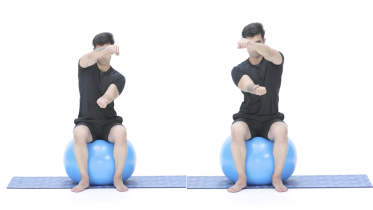
Seated ball reach forward
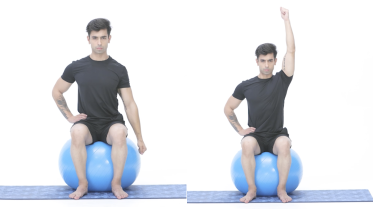
The seated ball reach forward teaches you to keep your back still on an exercise ball while your arms move. You find your neutral sitting position, lift a small ball in both hands out in front of you and up, then lower it again, and neither your back nor the big ball should shift. Raising the arms moves your weight forward, so the muscles around your spine have to work to keep your posture steady.
How to do the seated ball reach forward
- Sit on the exercise ball with your feet flat and slightly apart, and keep a wall, counter or sturdy chair at your side to hold if you wobble.
- Hold a small, light ball in both hands and rest it on your lap.
- Sit tall in your neutral position, with a gentle hollow in your lower back, and tighten your stomach lightly.
- Keeping your elbows almost straight, lift the ball out in front of you to about shoulder height. If that feels steady and your shoulders are comfortable, carry on up above your head, as in the video.
- Pause for a moment, then bring the ball back down the same way to your lap. Your back should not arch, slump or lean while the arms move.
What you should feel
Your deep tummy and back muscles working quietly to hold your posture, and your shoulders doing the lifting. Expect a little wobble on the ball at first.
Common mistakes
- Arching your lower back, with the ribs pushing forward, when the arms rise.
- Slumping or tipping back as you lower the ball.
- Swinging the ball up fast, so the exercise ball rolls under you.
- Letting your shoulders creep up by your ears.
How often
Many programs start with 5 to 10 slow lifts for 1 to 3 sets, with a brief pause at the top. A light ball, or no ball at all, is enough at first. Your physio will adjust this.
Stop and check with your physio if
- Sharp pain in your back, a pinch in your shoulder as your arms lift, or pain, tingling or numbness running into an arm or one leg.
- Pins and needles in your arm or hand that do not go away after you stop, or part of your arm or hand goes numb. Get medical advice the same day. If one side of your face or body suddenly goes numb or weak, or your speech becomes slurred or muddled, call emergency services, even if it goes away.
- You feel dizzy, faint or unsteady. Stop and get medical advice the same day. If you faint, it does not settle within a few minutes of sitting still, or you cannot stand or walk steadily, call emergency services.
- Numbness around your genitals or bottom, new trouble with your bladder or bowels, pain, tingling, numbness or weakness in both legs, or loss of feeling in one leg. Call emergency services or go to an emergency department straight away.
- Your leg or foot gets weaker, for example your foot drags, catches on the ground or slaps down when you walk (foot drop). Get medical advice the same day. If the weakness is getting worse by the hour, go to an emergency department.
From the clinic
The voice guide says to lift the ball forward and slightly upward to a comfortable height, while the video goes further, all the way overhead. Treat overhead as the later stage. Stop at the height where your back stays quiet and your shoulders feel easy, and add height over the weeks as that gets easier. The seated ball arm raise lifts one arm at a time instead. If you have not yet found your neutral position on a ball, start with the seated pelvic tilt on a ball.
Pick a firm, anti-burst ball. Sitting on it with your feet flat, your hips should be level with your knees or slightly higher. Clear rugs, cables and anything hard from the floor around you. Bare feet on a mat, like the video shows, are fine, and so are grippy shoes.
If you have had a fall in the last year, get dizzy spells or have low bone density (osteoporosis), practice the lift on a firm chair first, using the seated overhead ball lift, and move to the exercise ball when your physio says you are ready. Have someone close by for your first few tries. Should the big ball begin to roll and you cannot steady it, bring the small ball down to your lap, plant both feet flat and hold on to your support.
If you have high blood pressure, breathe steadily through every repetition and never hold your breath. If you have had a fracture in your spine, check with your physio before you begin. After shoulder surgery, including a rotator cuff repair, or after a shoulder fracture or dislocation, follow your surgeon's or physio's plan, and do only the movements and range they have cleared. Many plans allow only passive movement at first, where the arm is moved for you and its muscles stay relaxed. If you have had surgery on your spine, chest or heart in recent months, get the go-ahead from your surgical team or physio first.
If you have had a hip replacement, get the go-ahead from your surgeon or physio before you try the seated ball reach forward. Sitting on an exercise ball that is too small, or leaning forward to get up from it, can bend the hip past a right angle, and many surgeons ask you to avoid that for the first months after some operations.
Written and checked by the PocketPhysio editorial team. Last updated 2026-09-28.
This page is general education, not a diagnosis or a personal treatment plan. If you have pain, an injury or a health condition, see a physiotherapist or doctor before starting new exercises.