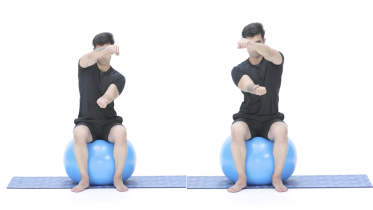
Seated ball arm raise
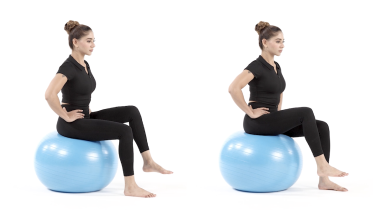
The seated ball arm raise is a trunk control exercise done sitting on a large exercise ball. With one hand on your hip, you lift the other arm straight up in front of you, thumb leading, as high as is comfortable, then lower it slowly. Lifting the arm is the easy part. What your trunk has to do is stay tall and relaxed, and keep the ball from rolling as the arm goes up.
How to do the seated ball arm raise
- Place the ball on a mat or non-slip floor next to a wall, counter or heavy chair you can grab. Sit on top with both feet flat on the floor, about hip width apart or a little wider for a steadier base.
- Sit upright with your spine in its natural shape: a gentle hollow in the lower back, neither slumped nor arched.
- Rest one hand on your hip. Let the other arm hang by your side.
- Keeping that arm straight, lift it up in front of you with your thumb pointing up and leading the way, as high as it goes comfortably. Pause there for a moment. Your trunk and the ball should stay still.
- Lower the arm slowly back to your side. Do your repetitions, then switch arms.
What you should feel
Steady work around your stomach and lower back to keep you upright, and the front of the shoulder lifting the arm. A little wobble while you learn it is fine.
Common mistakes
- Tipping backward, or letting your lower back hollow out more, as the arm goes overhead.
- Hitching the working shoulder up as the arm rises.
- Bending the elbow to get the arm higher.
- Lifting fast, so the ball rolls and you have to grab for balance.
How often
A common starting point is 5 to 10 slow raises with each arm, for 1 to 3 sets. Your physio will adjust this.
Stop and check with your physio if
- The ball rolls or you wobble and cannot settle it. Put both feet flat, hold your support and rest before you try again.
- You feel dizzy, faint or unsteady. Stop and get medical advice the same day. If you faint, it does not settle within a few minutes of sitting still, or you cannot stand or walk steadily, call emergency services.
- Sharp pain or a pinch in your shoulder as the arm goes up, or sharp pain in your back.
From the clinic
Check the ball before you sit on it. It needs to be the right size and firmly pumped, so that with your feet flat your hips sit level with your knees or a little above. Anti-burst balls are safer. Go barefoot, as in the video, on a mat that does not slip, or wear shoes that grip, and clear away rugs, cables and anything with sharp edges.
Keep your support on one side, close enough to grab at any moment. If you have fallen in the past year, have spells of dizziness, or have low bone density (osteoporosis), which makes a fall more serious, do the arm raise on a firm chair first and ask your physio when the ball is right for you. Have someone with you the first few times you use the ball.
How you sit on the ball matters more than how high the arm goes. If your shoulder will not go overhead without pain, or only gets there when your back arches, stop at a height that feels easy. Shoulder flexion with a stick is a gentler way to work on that range. After shoulder surgery, check with your surgeon or physio before lifting your arm overhead. If you have had surgery on your spine, chest or heart in recent months, get the go-ahead from your surgical team or physio first.
If you have had a hip replacement, get the go-ahead from your surgeon or physio before you try the seated ball arm raise. Getting on and off a ball, or sitting on one that is too small, can take the hip past a right angle, and many surgeons ask you to avoid that for the first months after some operations. When this feels steady, seated ball marching moves the challenge to your legs.
Written and checked by the PocketPhysio editorial team. Last updated 2026-09-26.
This page is general education, not a diagnosis or a personal treatment plan. If you have pain, an injury or a health condition, see a physiotherapist or doctor before starting new exercises.