Prone multifidus activation
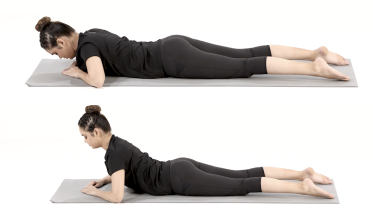
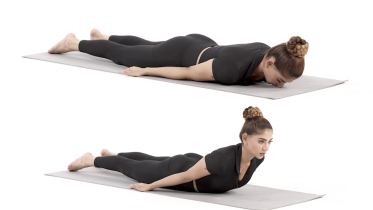
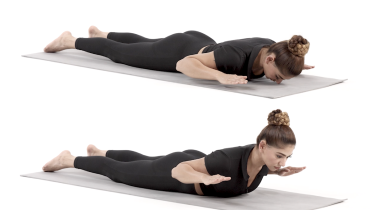
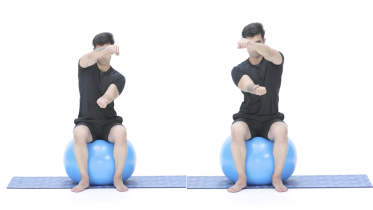
Prone multifidus activation is a back exercise done lying face down near the edge of a firm bed or table. One arm hangs down over the side, and you lift it with the elbow straight, forward and up until it is level with the bed beside your head, then lower it again. Physios use it to get the small muscles along the spine (multifidus) and the longer back muscles working to hold your trunk still while the arm moves. The lift also works the muscles around the shoulder blade.
How to do the prone multifidus activation
- Lie on your stomach on a firm bed or a sturdy table, close enough to one edge that the arm on that side can hang straight down toward the floor. Keep your legs straight and relaxed.
- Rest your head in a comfortable position, either turned to one side or with your forehead on a small folded towel. Let the hanging arm relax completely.
- Keeping your elbow straight, lift the arm forward and up in a slow arc until it reaches the level of the bed, pointing past your head.
- Keep your chest, hips and head resting where they are as the arm rises, and hold the arm up there for a moment.
- Lower the arm slowly until it hangs relaxed again, then repeat.
- When you finish, move to the other edge of the bed, or turn round so your head is at the other end, and work the other arm.
What you should feel
Work around the shoulder blade and at the front and top of the shoulder as the arm rises, and a steady tension in the muscles beside your spine as they hold your body still. Nothing should pull or pinch in your lower back.
Common mistakes
- Rolling your body toward the lifting arm, or raising your chest to get the arm higher.
- Swinging the arm up with momentum instead of lifting it slowly.
- Letting the elbow bend as the arm tires.
- Shrugging your shoulder up toward your ear.
How often
Many programs use 1 to 3 sets of 8 to 12 slow lifts with each arm, with a pause of 2 to 3 seconds at the top, once a day. Your physio will adjust this.
Stop and check with your physio if
- Your lower back hurts sharply while you lie there or lift, or you get pain, tingling or numbness running into a leg.
- A catch or sharp pain in the shoulder as the arm lifts.
- Pain, pins and needles or numbness spreading down your arm or into your hand.
- Pins and needles in your arm or hand that do not go away after you stop, or part of your arm or hand goes numb. Get medical advice the same day. If one side of your face or body suddenly goes numb or weak, or your speech becomes slurred or muddled, call emergency services, even if it goes away.
From the clinic
The arm is only the load here. The real task is keeping your trunk quiet, so your back and hips do not twist or lift as the arm rises. Lift only as high as you can while staying flat, and stopping short of bed level is fine at first. If lying face down is uncomfortable for your back, a pillow under your stomach may help. Bird dog trains the same idea of a still trunk while a limb moves, on your hands and knees, and the prone Y raise lifts both arms from the floor.
Use a bed or table that is firm and will not tip when you lie near its edge. A high treatment table like the one in the video is harder to get on and off at home. To get up, roll onto your side, lower your legs over the edge and push yourself up to sitting, as shown in log roll out of bed. Lying on your stomach usually becomes uncomfortable as a pregnancy goes on, so ask your physio for another position if that applies to you.
If you have had surgery on your spine, chest or heart in recent months, get the go-ahead from your surgical team or physio first. After shoulder surgery, including a rotator cuff repair, or after a shoulder fracture or dislocation, follow your surgeon's or physio's plan, and do only the movements and range they have cleared. Many plans allow only passive movement at first, where the arm is moved for you and its muscles stay relaxed. Lifting a straight arm above shoulder height against gravity, as here, usually comes later.
Written and checked by the PocketPhysio editorial team. Last updated 2026-09-28.
This page is general education, not a diagnosis or a personal treatment plan. If you have pain, an injury or a health condition, see a physiotherapist or doctor before starting new exercises.