Prone W raise
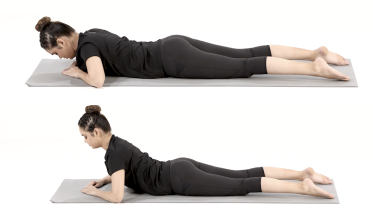
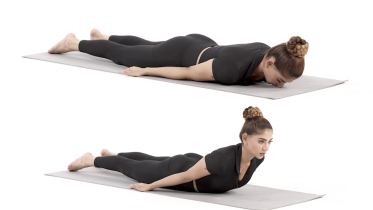
The prone W raise is a face-down exercise for the upper back. Your elbows are tucked in by your sides and your hands sit near your shoulders, so your arms make a W. You squeeze your shoulder blades together to lift your hands, then raise your chest a little off the mat. It works the muscles between and below the shoulder blades (middle and lower trapezius, rhomboids) and the long muscles beside the spine.
How to do the prone w raise
- Lie on your stomach on a mat with your legs straight and your forehead resting down.
- Bend your elbows and tuck them in close to your ribs, with your palms on the floor beside your shoulders, so your arms form a W.
- Squeeze your shoulder blades back and down, and let that squeeze lift your hands and forearms just clear of the floor.
- Tighten your buttocks and raise your chest and head a little way off the mat. Keep your chin slightly tucked so your head rises with your chest instead of tipping back.
- Your hips and legs stay down the whole time. Pause at the top, then lower slowly and relax before the next one.
What you should feel
Work between and just below your shoulder blades, and along the muscles on either side of your spine. Your buttocks work too.
Common mistakes
- Letting the elbows flare out away from your ribs.
- Pushing through your hands to lift your chest, as in a push-up. The hands leave the floor.
- Throwing your head back to look forward.
- Lifting too high and pinching your lower back. A small lift is plenty.
- Letting your feet or thighs come off the mat.
How often
A typical starting point is 2 to 3 sets of 8 to 12, holding the top for 2 to 5 seconds, once a day or every other day. Your physio will adjust this.
Stop and check with your physio if
- Sharp or pinching pain in your lower back.
- Pain, pins and needles or numbness in an arm, or pain running down a leg.
- Pins and needles in your arm or hand that do not go away after you stop, or part of your arm or hand goes numb. Get medical advice the same day. If one side of your face or body suddenly goes numb or weak, or your speech becomes slurred or muddled, call emergency services, even if it goes away.
- Neck pain that builds as you go.
From the clinic
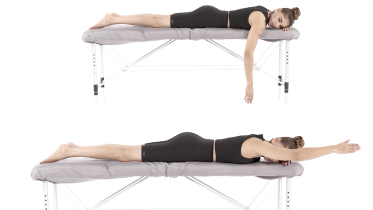
This is harder than lifting the arms alone, because your back muscles also have to raise your chest. If the chest lift is too much at first, leave your forehead on the mat and just do the shoulder blade squeeze with the hands lifting. The prone T raise and prone Y raise train the shoulder blades with the arms in other positions.
If bending backward usually sets off your back pain or brings on pain in your leg, ask your physio before you add the chest lift. After shoulder surgery, your surgeon or physio should clear you for this first. If you are pregnant, check with your physio too, since face-down positions get harder as the pregnancy goes on.
Written and checked by the PocketPhysio editorial team. Last updated 2026-09-28.
This page is general education, not a diagnosis or a personal treatment plan. If you have pain, an injury or a health condition, see a physiotherapist or doctor before starting new exercises.