
Costochondritis treatment: exercise for chest wall pain
Warning signs, and when to get help
Chest pain: when to call emergency services, and what must be ruled out first
Read this section even if you were given the diagnosis months ago.
The NHS puts the instruction on its own costochondritis page: if you think you have costochondritis, contact NHS 111, because it is important to get chest pain checked to rule out other, more serious conditions. It also says to get medical advice for any unexplained chest pain that does not go away. That is not red tape. It is the reason this section sits above everything else here.
Call emergency services straight away, and do not drive yourself, for any of these. They follow the routes the NHS prints on that same page, with the tearing pain route at the stricter level used in the warning signs at the foot of this page. The last one comes from the NHS page on broken and bruised ribs, because a chest that was hit is a different problem from a chest that started hurting on its own.
- Chest pain that started suddenly, a chest that feels tight, or pain spreading into your arm, neck or jaw. This can be a heart attack. The NHS does not ask you to wait and see whether sudden chest pain settles first.
- Chest pain with trouble breathing, a heart beating fast, or coughing up blood. This can be a blood clot on the lung.
- Sudden, severe chest or back pain that feels as though something inside is being torn or ripped. This can be a tear in the main blood vessel leaving the heart, and it needs emergency services on its own, whether or not you are also breathless or have trouble walking, seeing or speaking.
- Chest pain that started with a fall, a blow, a crush or a seatbelt in a car accident, if the accident was a serious one such as a car crash, or if your breathlessness or chest pain is getting worse, you have pain in your tummy or your shoulder, or you cough up blood. A broken rib can damage a lung, the liver or the spleen.
A heart attack does not always announce itself the way films suggest. Alongside crushing or squeezing chest pain, the NHS lists breathlessness, feeling or being sick, sweating, pale, blue or gray skin, and feeling as though you have indigestion, with a burning or full feeling in the chest. The British Heart Foundation says symptoms differ between people, that you may not have all of them, and that the pain is very bad for some people and only uncomfortable for others. It also says women and men generally get the same symptoms, but that women tend to be slower to recognize them as a heart attack.
What follows from that applies to everybody, not to particular groups. NICE tells clinicians not to judge the symptoms of a heart attack differently in men and women, and says plainly that not everyone having one has central chest pain as the main feature. The 2023 European guideline goes a step further and says the descriptor "atypical" should be avoided, listing breathlessness, pain high in the stomach, and pain in either arm or in the neck or jaw as chest pain equivalents. That guideline also names the pattern the public should act on, which is chest pain lasting more than 15 minutes, or pain that keeps coming back within the hour. Shorter pain is not evidence that your heart is fine, so the warning signs at the foot of this page apply whatever the clock says.
This page cannot help you work out whether your pain is coming from your heart, and no page can. Costochondritis is a label a clinician reaches after considering the dangerous causes, with an examination and usually an ECG. The warning signs at the foot of this page are for the day something changes.
What is costochondritis?
It is pain and inflammation where the cartilage of your ribs meets your breastbone, at the joints called the costochondral and chondrosternal junctions. The NHS describes sharp pain at the front or the side of the chest, worse when you move your upper body, lie down, breathe deeply, or press on the middle of your chest or your ribs. The 2021 rapid evidence review in American Family Physician puts the usual age at 40 to 50, slightly more often in women (Mott and colleagues, 2021).
The pattern of the tenderness is worth knowing, because it is one of the things that separates this from a broken bone. The same review says the second to the fifth of those joints are the ones usually involved, that the tenderness is normally found at more than one of them on the same side of the chest, and that the sore area is not generally hot, red or visibly swollen. Pain pinned to one single point, particularly after a fall or a blow, fits a cracked rib or a bruised breastbone better than it fits costochondritis, and that is a difference you cannot settle at home.
Why it starts is often unclear. The NHS links it to an injury to the chest, repeated upper body movements such as lifting, coughing a lot, and infection. In clinic those four cover most of the stories: a long chest infection, a month of heavy pressing in the gym, a seatbelt in a minor shunt, or a job that involves reaching and lifting all day.
Tietze syndrome is the near relative. The 2021 review separates the two on one finding: Tietze syndrome comes with visible swelling at the affected joint, and costochondritis does not. It adds that Tietze syndrome is usually on one side only, usually at the second or third rib joint, and is often set off by an infection or an injury.
Why chest wall tenderness does not rule out a heart problem
Press on the sore spot, get your own pain back, and the natural conclusion is that the pain must be coming from the chest wall. That conclusion is where this condition becomes dangerous.
The clearest study on it is old and has not been bettered. In an emergency department in New York, 122 consecutive people arriving with chest pain that was not from trauma, fever or cancer were assessed prospectively. Thirty six of them, 30%, had costochondritis. Within that group, 6% were having an acute heart attack, against 28% of the chest pain patients who did not have costochondritis (Disla and colleagues, 1994).
Read those two numbers together. Having a tender chest wall made a heart attack less likely. It did not make it go away. About 1 in 17 of the people diagnosed with costochondritis in that department was having a heart attack at the same time.
The 2009 review in the same journal puts a second figure on the same point. Between 3 and 6 percent of adults who arrive with chest pain and a chest wall that hurts to press have coronary artery disease (Proulx and Zryd, 2009). The two studies are different and so are their denominators, and they land in the same place: the tenderness tells you that the chest wall is involved, and nothing at all about the heart.
The 2021 review reaches the same practical conclusion: because the clinical examination lacks specificity, most people with chest pain still need a thorough evaluation, with electrocardiography at a minimum, and a chest radiograph or rib series if the story includes breathlessness or a blow to the chest. The 2009 review in the same journal adds that patients over 35, anyone with cardiac risk and anyone with cardiopulmonary symptoms should have an ECG and possibly a chest X-ray (Proulx and Zryd, 2009).
The other causes a clinician considers
Read this section as a reason to be examined, not as a list to work through. Not one of these can be ruled in or out at home, which is the whole point of it, and if reading it is making you more frightened rather than better informed then the parts of this page you actually need are the first section and the warning signs at the foot.
Chest wall pain is what is left once the dangerous causes have been thought about. The 2021 review groups the differential into cardiovascular, psychogenic, pulmonary, gastrointestinal, and miscellaneous or unknown sources, in that order, from the most common down to the least, and says the list for chest pain is broad and has to be worked through carefully before anyone settles on this diagnosis.
The ones that turn up in a musculoskeletal clinic are these. A heart problem, angina or a heart attack. A blood clot on the lung. A tear in the main blood vessel leaving the heart. Inflammation of the sac around the heart, or of the lining of the lung. A collapsed lung, or pneumonia. Shingles, which can burn and tingle for days before any rash appears. A cracked rib, or a bruised or broken breastbone. Cancer that has spread to a rib. Reflux and gallbladder pain, which both sit close enough to confuse anyone.
The bone and cartilage ones matter most here, because they are the group a page like this one could let somebody miss, and the group where stretching the sore area is the wrong idea. The NHS says broken or bruised ribs usually come from a fall, a blow to the chest or severe coughing, and that the pain is strong when you breathe in or cough, with tenderness or swelling over the rib and sometimes the feeling of a crack. The breastbone can be broken by the same kind of blunt blow, a steering wheel, a seatbelt or a fall onto something hard, and it hurts in the same place costochondritis does. What matters there is less the bone than what comes with it: a chest injured hard enough to break the sternum can also have a bruised lung or an injury inside the tummy, while a sternal fracture on its own is managed with pain relief and time (Yuan, 2022). A rib can also break with very little force if the bone is thin, after long term steroid tablets or with osteoporosis, and in rowers and throwers a rib can fail slowly as a stress fracture from repeated pulling.
The 2021 review names three more chest wall problems that get mistaken for costochondritis and are managed differently. Arthritis of the joint where the collarbone meets the breastbone, or of the joint across the top of the breastbone. Painful xiphoid syndrome, at the small tip of bone at the bottom of the breastbone. And slipping rib syndrome, where the front end of one of the lower rib cartilages has become loose and moves, giving pain low at the front of the chest or at the top of the tummy, often with a click that a clinician can reproduce by hooking their fingers under the rib edge. The same review lists tumors and infection of the chest wall. None of these is sorted out by how the pain feels to you.
Fibromyalgia is in that same list and is the one most easily missed in a musculoskeletal clinic. It makes the rib joints beside the breastbone tender on both sides, with tender spots in the neck, back, hips and limbs as well, and pain in many places at once. In the 1994 emergency department study, widespread pain was far more common among the people with costochondritis than among the other chest pain patients, 42% against 5%, and 8% of them met the criteria for fibromyalgia while none of the others did (Disla and colleagues, 1994). It matters because the plan changes: graded exercise for the whole body, not work on one sore joint, which is what fibromyalgia sets out.
Ankylosing spondylitis belongs on the list too, because it is treated completely differently. Chest wall pain with early morning stiffness that eases as you move, in someone under 45 with a history of back or buttock pain, may not be mechanical at all, and the ankylosing spondylitis page sets out what that picture looks like and why it needs a rheumatology opinion, not a stretching program.
That list is not here to frighten anyone. It is here because it explains why a clinician makes this diagnosis and a web page cannot, and why the warning signs below are longer than you would expect on a page about a joint problem. If you want the general version of which symptoms need checking before any exercise program, red flags in physiotherapy covers it.
How is costochondritis diagnosed?
From your story and an examination, not from a test. The 2021 review is explicit that there are no laboratory tests, imaging tests or electrocardiography findings specific to the diagnosis. What makes it is pain reproduced by pressing the area beside the breastbone, sometimes with two positioning tests: the crowing rooster maneuver, where the examiner lifts your arms up and back while you extend your neck, and crossed chest adduction, where the arm comes across the chest and the head turns toward that shoulder.
Tests get done anyway, and that is the point of them. They are not looking for costochondritis. They are ruling out what is on the list above.
If you have not had that assessment yet, this is the wrong page to start on. Go and get the chest pain looked at, then come back.
How long does costochondritis last?
Longer than most people are told, and less predictably.
The NHS says it can last from a few weeks to several months. The 2021 review says most people have complete resolution of symptoms in a few weeks with conservative therapy. Those two are not in conflict so much as describing the two ends of the same spread.
The only longer follow up we found is in the 1994 study. Of 21 people with costochondritis who could be reached at one year, 11 still had chest pain, although only about a third of them still had clear costochondritis (Disla and colleagues, 1994). Small numbers, from one department, three decades ago, so hold it loosely. It is still the only figure here with a year attached.
There is a widely repeated claim that 91% of people are better after three weeks, and it is worth knowing where it comes from. The source is one report from 2017 on 431 people with costochondritis seen in a single thoracic surgery clinic, published in a journal that is not indexed in PubMed and whose own page for the article now returns a missing page. We read the whole paper through a web archive, not the abstract alone. It does say pain had gone within three weeks in 91.3% of that group, and then adds 6.1% at one month and 11.0% at three months, three figures that add up to more than everybody, while its own conclusion states the three week result as a range of 86% to 91%. Take the precision accordingly.
The recurrence figure quoted beside it, about 4% at two years, is in that paper: 18 of the 431 over a two year follow up, against 3 of the 24 patients with Tietze syndrome, which is where the 12.2% sometimes seen for this condition actually belongs. The headline figure travels without its conditions. Everyone in that group took anti-inflammatory tablets for at least two to three weeks and was asked to cut out what provoked the pain, and anybody with a recent chest injury, chest surgery or cancer follow up was excluded before the counting started. So one department says most people are better inside a month, the one year follow up above says more than half of a small group still had chest pain, and neither is a schedule for you.
Does exercise help costochondritis?
Barely anyone has studied it. That is the state of the evidence, and a page that sounds more certain than that is guessing.
The 2021 review states that no high quality studies have examined the effectiveness of any treatment option for costochondritis, and it puts heat, anti-inflammatory tablets, lidocaine patches, capsaicin cream, physical therapy and acupuncture in the same sentence on that basis. It notes that local heat is often recommended and lacks evidence from clinical trials. The 2009 review said the same: clinical trials of treatment are lacking.
Rest is easy to miss on that list, because it is not a treatment you do. The same review says a period of rest from the activities that make the pain worse is often recommended, and that is the piece most likely to get dropped once somebody has a program to work through. It is also part of what produced the only encouraging recovery figure anybody quotes for this condition, because everyone in that group was resting from what provoked their pain and taking anti-inflammatory tablets at the same time.
The study in that review that comes closest to this page is worth stating at its real size. Rovetta and colleagues gave stretching exercises to outpatients who had pain at the third to seventh rib joints and compared them with a matched group who did not get them, and pain scores improved more in the stretching group (Rovetta and colleagues, 2009). The 2021 review describes that result as a small reduction in pain in people whose symptoms had already lasted more than a year, and describes the program as targeted stretching under the direction of a physical therapist. That last detail matters on a page you are reading alone, because the one study of stretching for this condition was not a self-directed program.
Look at the design before you lean on it: nobody was randomized, nobody was blinded, it was put together from records after the event, and the published summary's own patient numbers do not add up. So it is a reason to try gentle movement, not proof that movement is the treatment.
So why is there a program below? Because of what a painful chest does to the way you move. People splint. The breath goes shallow and high into the upper chest, the shoulders round forward, the mid back stiffens because nothing rotates through it any more, and the sore side of the ribcage stops taking its share of the breath. Four or six weeks of that leaves you with a second, mechanical problem sitting on top of the first one. The exercises are aimed at that, and that part does respond to movement.
Keep the distinction in mind, because it changes what success looks like. This is gentle movement and normal breathing while something settles on its own clock. It is not a cure, and if it is making your chest pain worse then it is the wrong thing this week.
The nearest systematic review covers musculoskeletal thoracic spine and chest wall pain as a whole group, and it is not encouraging reading: the OPTIMa reviewers screened nearly 7,000 papers, found two worth including, and concluded that good evidence for treating this region is sparse (Southerst and colleagues, 2015). In the one trial that was about chest wall pain, a multimodal program of manual therapy, soft tissue work, exercise, heat or ice and advice brought pain down about as much as a single education session did, though more of the people who got it said their chest pain had improved. So that review sits here as background, not as support.
How to use this program, and the symptoms that mean stop
Start at stage 1 whatever your pain level, and only once a clinician has told you this is costochondritis.
If your chest pain started with an injury instead of arriving on its own, this program waits. A fall, a blow, a crush or a seatbelt in a car accident can crack a rib or the breastbone, the tender spot sits in the same place, and the difference is settled by an assessment and sometimes an X-ray, not by trying the exercises to see what happens. Say the injury out loud when you are seen, because a history of a blow to the chest, or of breathlessness, is what prompts a chest X-ray or rib views rather than an examination on its own (Mott and colleagues, 2021). If a rib has been cracked, the NHS puts healing at 2 to 6 weeks, and over those weeks it asks you not to strain yourself, not to lift heavy things and not to do any exercise that makes the pain worse, while still breathing normally, coughing when you need to with a pillow held against your chest, and walking about and moving your shoulders to keep the chest clear. That is close to the opposite emphasis from the stretching and loading set out below, which is why the order matters.
Stage 1 is breathing and gentle shoulder movement. Stage 2 opens the upper back first and the front of the chest after it. Stage 3 loads the muscles around the ribcage, and it waits until last on purpose, because pushing and pulling tug directly on the joints that hurt.
As a rough guide, the breathing and mobility work suits most days, often a few minutes of breathing and 5 to 10 slow repetitions of each movement. Stretches are commonly held 20 to 30 seconds, 2 to 3 times each, once a day to begin with. The stage 3 strength work is usually 2 to 3 sets of 8 to 15 slow repetitions, 2 to 3 days a week. Your physio or physical therapist will adjust all of this, and in this condition how your chest feels the next morning matters far more than the numbers.
Mild chest wall soreness during a movement, settling soon after you stop and leaving you no worse by morning, is the level to work at. Sharp pain, pain that builds through a set, or a chest that is clearly worse the next day means the load was too much. Drop back a stage for a few days instead of stopping altogether.
Stop at once for any of these: chest pain or pressure, dizziness or feeling faint, a racing or irregular heartbeat, or being far more out of breath than the effort should cause. Stopping is the right call even if it turns out to have been the same pain you came with, because nothing you can do at home separates one from the other, and a session missed costs you nothing. Then follow the chest pain warning signs at the foot of this page, which say what to do next and how fast.
Stop the breathing work as well if your fingers or the skin around your mouth start to tingle, or you feel light-headed or spaced out, and let your breathing go back to normal. That one comes from breathing too fast or too deeply rather than from your ribs, and the warning signs at the foot of this page say what to do if it has not settled within a few minutes.
Check with your doctor before you start if you have a heart or lung condition, or blood pressure that is not under control. If you have low bone density (osteoporosis), or have had a fracture in your spine or ribs, ask your physio before you lean back over a chair or lie along a rolled towel. Leaning back over a chair bends the mid back over a support, and the towel, which runs along the spine and not across it, presses on the spine while your arms stretch out across the front of the chest. Your physio may keep the range small or give you a gentler version of either.
After chest, heart or lung surgery, follow the program from your surgical team and physio instead of this one, because a breastbone that has been cut takes months to heal and the pressing and pulling here is exactly what those plans hold back. If you are pregnant, check with your midwife, doctor or physio first. Breathe normally through every repetition rather than holding your breath.
Read the warning signs at the foot of this page before your first session rather than after it. They are at the end because that is where this site keeps them, not because they come last.
The exercise program
Stage 1: Calm it down and get the breath low again
For a chest that hurts to breathe into. A sore chest wall makes people splint: the breath goes shallow and high, the shoulders creep forward and the ribs stop moving much. These three work against that without putting any stretch across the painful joints. Breathing control and diaphragmatic breathing rebuild a breath that starts low, and low is the aim rather than big, because breathing deeply is on the NHS list of things that make this pain worse. Backward shoulder rolls keep the shoulder girdle moving. There is no chest stretch here on purpose: the 2021 review in American Family Physician names stretching, along with deep breaths and coughing, as what sets this pain off, so the rolled towel chest opener waits for stage 2. Diaphragmatic breathing is filmed lying on your back, and lying down is also on the NHS list of things that make this pain worse, so do it sitting upright in a chair, hands in the same place, if lying flat hurts your chest. What you are changing is where the breath starts, not the position you do it in. Many programs use these most days, often a few minutes of breathing work and 5 to 10 slow shoulder rolls, two or three times a day. Your physio will adjust this. Stop the breathing work and let your breathing settle back to normal if your fingers or the skin around your mouth start to tingle, or you feel light-headed or spaced out: that comes from breathing too fast or too deeply rather than from your ribs, and the warning signs at the foot of this page say what to do if it has not settled within a few minutes.
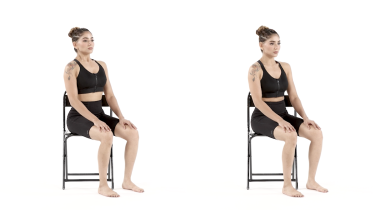 Breathing control
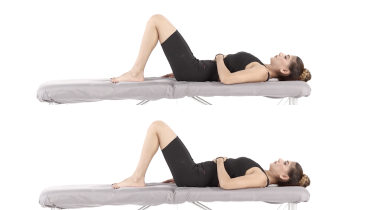 Diaphragmatic breathing
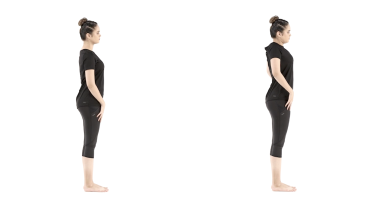 Backward shoulder rolls
Stage 2: Gentle upper back and chest movement
When stage 1 feels settled, often after one to two weeks. Judge that on the things you do anyway rather than on a test breath, because stage 1 asks you to keep the breaths low rather than big: getting out of bed, rolling over at night, coughing and reaching across your body no longer bring on the sharp pain at your breastbone, and your chest is no worse the morning after a stage 1 session. Nothing is lost by waiting another week. Add these in the order they are listed, one every few days, rather than starting all seven at once. Breathing with arm raises carries the breathing on: lift the arms forward and up rather than out and back, and stop the lift at the height where the front of your chest stays quiet, which may be shoulder height at first, because arms up and back with the neck extended is one of the movements a clinician uses to reproduce this pain. The upper back stretch, thoracic rotation and thoracic extension over a chair work the joints behind the ribs, which stiffen while you guard the front, and give you most of the same movement without pulling on the sore ones. Keep the chair one small: of those three it is the one that also opens the front of the chest. The rolled towel chest opener is the mildest way back into opening the chest. Use a thin towel, not a foam roller, keep your arms at or below shoulder height, start with one hold of about 30 seconds rather than the 1 to 3 minutes its own page allows, and leave it out if it pulls across your breastbone. Lie back with your hands taking your weight, and get up by rolling onto your side: getting down and up is the part that pulls across the chest. The pec stretch and the chest opener stretch go to a mild pull and no further: a stretch on an inflamed rib joint is the thing on this page most likely to set you back, so stay well short of your end range at first. If either brings on the sharp pain at your breastbone, not a pull across the muscle, leave it out for another week or two and do the upper back work instead. Stretches are commonly held 20 to 30 seconds, 2 to 3 times each, once a day to start, and the movements done slowly for 5 to 10 repetitions. If the front of your chest is sharper afterward, come back to stage 1 for a few days.
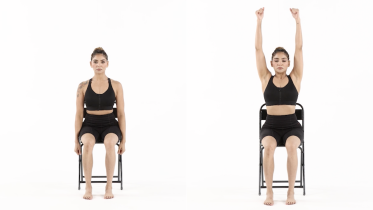 Breathing with arm raises
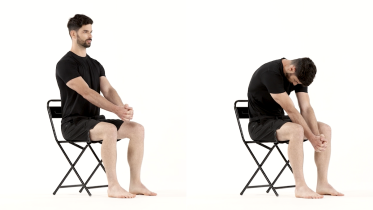 Upper back stretch
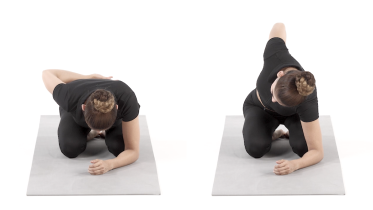 Thoracic rotation
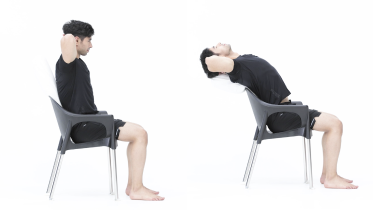 Thoracic extension over a chair
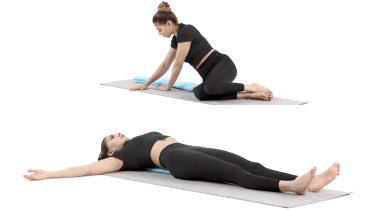 Rolled towel chest opener
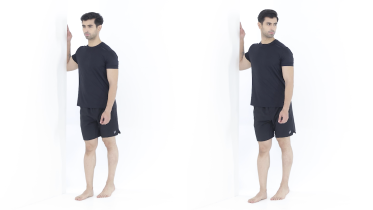 Pec stretch at a wall
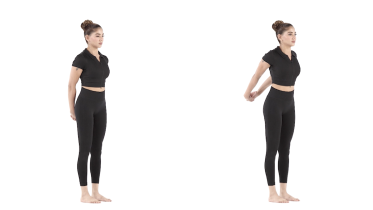 Chest opener stretch
Stage 3: Strength around the ribcage
Last on purpose. Pushing and pulling pull directly on the joints between your ribs and your breastbone, which is why this stage waits until stage 2 is comfortable and your chest is no worse the morning after it. Band pull aparts and seated scapular retraction work the muscles between the shoulder blades, and the band row adds a pulling load with the elbows close to the body. Wall push ups and the wall push up plus put weight through the arms at an angle you can control: stand further from the wall to make them harder, and stop at the depth where the front of your chest stays quiet. Many programs use 2 to 3 sets of 8 to 15 slow repetitions, 2 to 3 days a week. Build the repetitions before you reach for a stronger band, and keep breathing out as you push or pull rather than holding your breath.
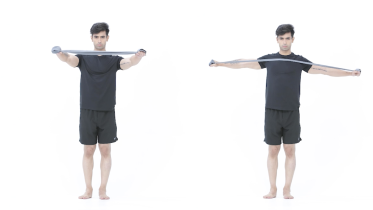 Band pull-apart
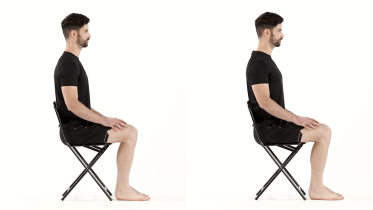 Scapular squeeze
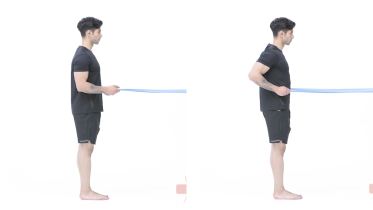 Resistance band row
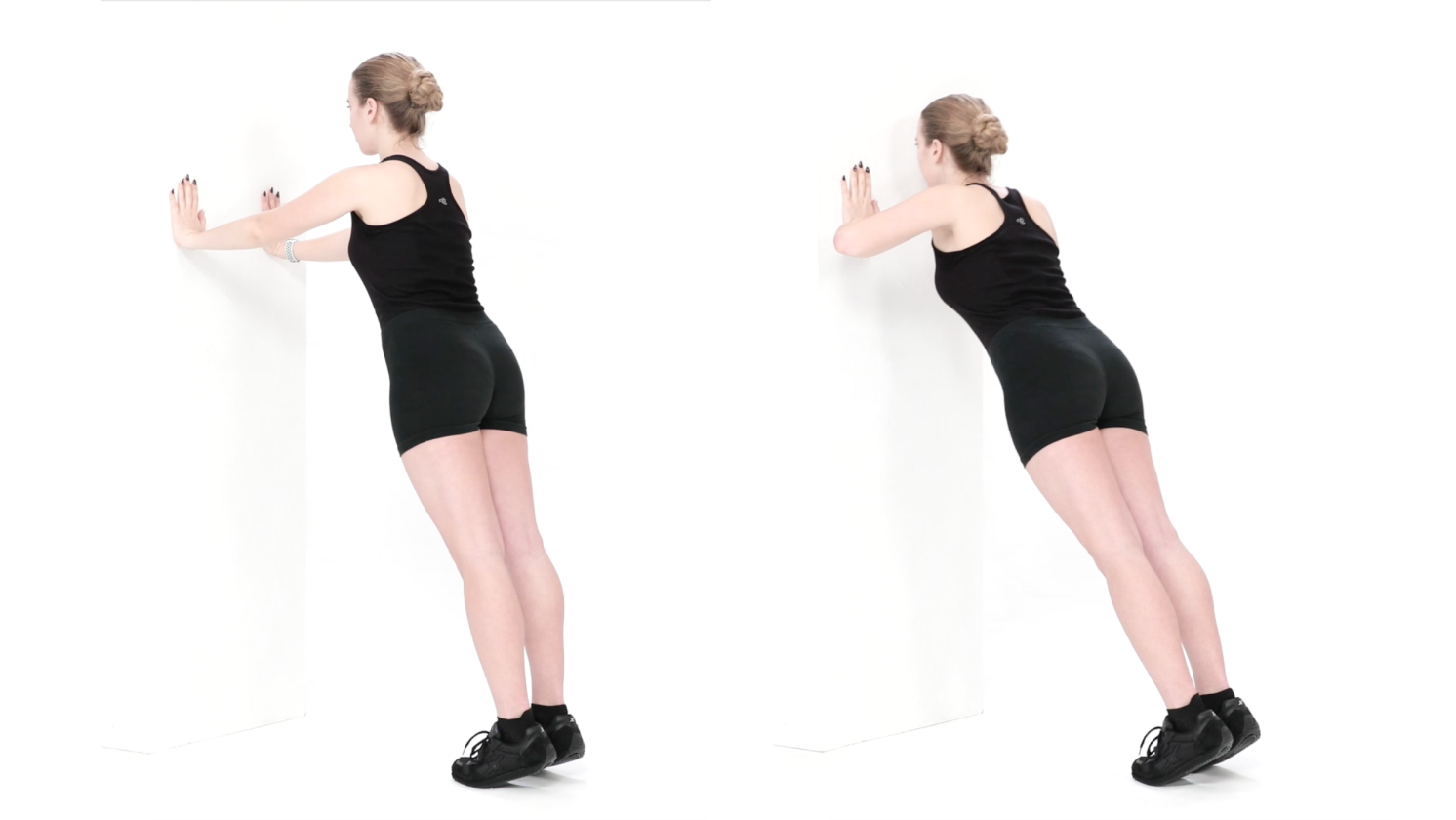 Wall push-ups
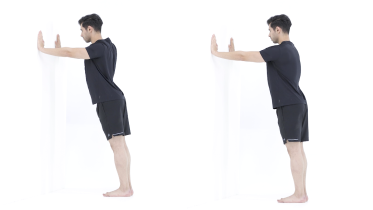 Wall push up plus
Sleeping, coughing, driving and lifting
The night is usually the worst part, because lying down is on the NHS list of things that make the pain worse. Most people settle better propped slightly up, on the unaffected side, with a pillow hugged in front of them so the top arm is supported instead of hanging across the sore joints. Getting out of bed hurts more than lying in it: roll onto your side first and push up with the lower arm. Sitting straight up from your back fires everything across the front of the chest at once.
Coughing is the one that undoes a good week. If you still have the chest infection that started this, hold a folded towel or a cushion firmly against the sore area as you cough. It is an old trick from post-operative chest care and it works for the same reason: it supports the chest wall so the joints move less. A cough that cracks a rib is a real thing, and the warning signs on this page describe what that feels like.
Driving is about the seatbelt and the reach, not the pedals. A soft pad between the belt and the sore spot helps, and so does reversing with your mirrors instead of twisting round. Reaching into the back of a car for a bag is one of the most reliable ways to set this off.
Lifting rules are simple while it hurts. Keep loads close to your body with your elbows bent in, split a heavy bag into two lighter ones, and avoid carrying anything across the front of your chest on one side. At the gym, pressing is the thing to park: shoulder pain on the bench press goes into how to change a pressing session instead of dropping it, and most of that applies here too.
Breathing without guarding
Ask most people with a sore chest to take a deep breath and they will lift their shoulders and fill the top of the chest. That is guarding, and it keeps the painful joints working all day.
The pattern to rebuild is a breath that starts low. Sit upright, or lie down if that does not hurt your chest, with one hand on your lower ribs at the side and one on your belly, breathe in through your nose, and aim to feel the lower hand move out sideways before anything happens at the top. Breathe out slowly and let the ribs settle. Keep the breaths slow and only a little fuller than usual, rather than as big as you can manage, because what you are changing is where the breath starts and not how much air you move. Breathing control and diaphragmatic breathing are the two exercises in stage 1 that teach this, and a few minutes two or three times a day is more useful than one long session.
Expect this at first. A deep breath is on the NHS list of aggravating factors for this condition, so even a breath kept deliberately small will sometimes be uncomfortable at first while you are moving where it starts. Uncomfortable is workable. Sharp is not, and breathlessness that arrives on its own, with no effort behind it, is a warning sign and not a breathing habit. There is one more thing to watch for, and it comes from breathing too hard rather than from your ribs: if your fingers or the skin around your mouth start to tingle, or you feel light-headed or spaced out, stop, let your breathing go back to normal, and follow the warning signs at the foot of this page. If you have a long term lung condition, the breathing work on COPD and breathing is set up for that situation and your respiratory team's plan comes first.
Treatments other than exercise
The NHS says costochondritis usually improves on its own over time, and that anti-inflammatory painkillers such as ibuprofen may be recommended. Ask a pharmacist whether an anti-inflammatory suits you, because they do not suit everyone, particularly with stomach, kidney, heart or asthma problems.
For pain that is very bad and not improving, the NHS says you may be offered a steroid injection, or a local anaesthetic to ease the pain. The 2021 review is more cautious on the steroid: it says there is inadequate evidence supporting corticosteroid injection specifically for costochondritis, and that it should be considered only when the usual treatments have failed. That is a conversation for your doctor, not a box to tick.
Heat gets recommended by almost everybody, us included, and the same review points out that it lacks clinical trial evidence. Use it if it helps you move and sleep, and do not expect it to change the course of anything.
Hands on treatment of the mid back and ribs is common in physiotherapy for this area. The OPTIMa review assessed noninvasive treatment for musculoskeletal thoracic spine and chest wall pain as a category and found the evidence thin: compared with a placebo, spinal manipulation reduced pain by an amount the reviewers judged too small to matter to a patient, and acupuncture did no better than the placebo (Southerst and colleagues, 2015). That is also not evidence about costochondritis, and we are not going to pretend it is.
When to go back to your doctor
Go back if the pain is not improving over a few weeks, if it is stopping you sleeping, or if it is changing in character and not simply still there. Go back sooner if the pain is spreading, if you have become breathless, or if anything in the warning signs below has appeared. Any new or different chest pain gets assessed again from scratch, never filed under the diagnosis you already have.
It is also worth a second look if the picture does not fit. Pain mostly between the shoulder blades, not at the front, is covered on pain between the shoulder blades and on upper back pain. A stiff, rounded upper back that makes the front of the chest ache is on kyphosis. Pain with pins and needles into the arm, or a hand that goes pale or heavy with the arm overhead, points toward thoracic outlet syndrome instead. And if you have had a cardiac event or heart surgery, your rehabilitation plan takes priority over this page: cardiac rehab explains how that program is built.
This page is education, not advice about your chest. Nothing here overrides what your own doctor or physiotherapist has told you, and nothing here is a way of deciding at home whether chest pain is safe.
For physiotherapists
Treat this page as a framework for a patient who arrives with a clinician's diagnosis already made, and re-screen anyway. The Disla cohort is the figure worth carrying into the room: 36 of 122 consecutive non-traumatic chest pain presentations had costochondritis, and 6% of those were concurrently infarcting. The AAFP review reads the same cohort as 12%, over the narrower denominator of emergency department chest pain patients found to have chest wall tenderness, and Disla's own abstract reports 6% within the costochondritis group. The abstract holds two candidate denominators and does not say which of them AAFP used: the 36 patients with costochondritis, and the 17 of 122 (15%) in whom the induced pain reproduced the original pain. The full text is paywalled to us, so the two figures cannot be reconciled with confidence, and both are stated here as their own sources state them. They are not two estimates of one quantity and should not be averaged or chosen between. Proulx and Zryd (2009) give 3% to 6% for coronary artery disease in adults with chest pain and chest wall tenderness. Reproduction of pain on parasternal palpation is a positive finding for chest wall involvement and not a negative finding for anything else. Note also what that cohort excluded: chest pain due to trauma, fever or malignancy was screened out before anyone was counted, so none of its reassurance transfers to the patient whose chest was hit. The same goes for the three week recovery figure. Boran and colleagues (2017) excluded recent trauma, chest surgery and malignancy follow up in the same way, and every patient in it had anti-inflammatory medication for two to three weeks and was asked to drop the activities that provoked the pain, so that cohort says nothing in favor of loading a chest wall early either.
Treat the bony presentations as a separate question from progression. Pain localized to a single point instead of spread across two or three junctions on one side, a palpable step or crepitus over a rib or the sternum, focal pain after even a trivial fall in a patient on long term corticosteroids, and focal pain that is worsening without any injury all belong in that group. Where the history includes chest wall trauma or dyspnea, a chest radiograph or rib series may be indicated (Mott and colleagues, 2021), and the AAFP review carries no fracture entry in its chest wall differential at all, which is worth holding in mind when using it as the screening list.
The evidence base for treatment is effectively absent. Mott and colleagues (2021) found no high quality studies of any intervention, and their SORT table grades physical therapy, acupuncture and corticosteroid injection for recalcitrant symptoms at C on expert opinion, with heat, oral or topical NSAIDs, capsaicin and lidocaine patches also at C as usual practice; the only A grade anywhere in that review is for the chest pain prediction rules. Proulx and Zryd (2009) said the same about treatment twelve years earlier. The only study of our own treatment is Rovetta and colleagues (2009): a retrospective, unblinded comparison of stretching against no stretching, significant in favor of stretching, with sample numbers that do not reconcile inside its own abstract, in patients whose symptoms had already run past a year. That is a chronic population, not the acute chest wall the early stages here are written for. Quote it with those caveats attached or not at all. The OPTIMa review (Southerst and colleagues, 2015) is the nearest usable evidence, is written for musculoskeletal thoracic spine and chest wall pain as a group and not for this diagnosis, and yielded two studies at low risk of bias out of 6,988 screened: manipulation beat placebo electrotherapy by a margin its own authors called clinically unimportant, and multimodal care matched one education session on pain intensity while producing more self rated improvement in chest pain.
What that leaves is impairment based practice. The reliable findings are a shallow, apical breathing pattern, reduced lower rib excursion on the symptomatic side, loss of thoracic rotation and extension, and an anterior chest wall that has not been loaded in weeks. Stage the program against the 24 hour response, keep end range pectoral stretching out of the early weeks, and bring pressing back through wall angle, not through repetitions. The order inside stage 2 is deliberate and not alphabetical: posterior thoracic work before any anterior chest stretch, and the arm raise height capped at the point the parasternal junctions stay quiet, because the aggravator list in the review itself is deep breaths, coughing and stretching, and the crowing rooster maneuver is arm elevation with posterior traction. Where a patient is still painful at three months, send them back for review instead of progressing load, and consider the inflammatory and bony differentials again before settling on the same soft tissue explanation.
Warning signs
Get emergency help now
- If chest pain, pressure or tightness does not ease quickly when you rest, spreads to your arm, neck, jaw, stomach or back, or comes with sweating, feeling sick, feeling light-headed or being short of breath, call emergency services straight away, as this can be a heart attack. If it eases quickly and none of these happen, get medical advice the same day, and do not exercise again until you have been checked.
- Emergency: chest pain, pressure or tightness, which may spread to your arm, neck, jaw, stomach or back, or upper back pain that comes with shortness of breath, sweating, feeling sick or feeling light-headed. Call emergency services straight away, as this can be a heart attack. The same applies to sudden, severe pain in your chest or between your shoulder blades that feels sharp, tearing or ripping, as this can be a tear in the main blood vessel from the heart (aortic dissection).
- Emergency: you suddenly become short of breath, you get chest pain or pain in your upper back that may be worse when you breathe in, you cough up blood, your heart is beating very fast, or you faint. Call emergency services straight away, even if your leg looks normal. These can be signs of a blood clot in the lungs (pulmonary embolism).
- A sudden sharp or stabbing pain in one side of your chest or shoulder that is worse when you breathe in. Stop and call emergency services, and say what you were doing. This can be a collapsed lung (pneumothorax) or a blood clot in the lungs, and both need treating quickly.
Get help today
- Same day: sharp pain in your upper back or around your ribs that has been coming and going when you breathe in or cough, or back pain with a cough, a high temperature or yellow or green mucus. Get medical advice the same day. These can be signs of inflammation of the lining of the lungs (pleurisy) or a chest infection. If the pain came on suddenly, or you find it hard to breathe, call emergency services straight away.
- Same day: a sharp pain in one spot on your ribs or the side of your chest that started during a bout of coughing or huffing, is worse when you breathe in or cough, and is tender or swollen when you press on it. Get medical advice the same day. Coughing hard can crack a rib, which happens more easily if your bones are thin, for example after years of steroid tablets, and it is easy to put down to a pulled muscle. Get medical advice the same day as well if you then start bringing up yellow or green phlegm or you feel hot, cold or shivery, because a painful rib stops you clearing your chest and a chest infection can follow. Call emergency services instead if your breathlessness or your chest pain is getting worse, you have pain in your tummy or your shoulder, or you cough up blood (NHS).
- Chest or breastbone pain that started with a fall, a blow to the chest, a crush, or a seatbelt in a car accident, rather than coming on by itself. Get medical advice the same day, and do not start this program until your chest has been checked, because the same knock can crack a rib or the breastbone and the sore spot sits in the same place as costochondritis. Call emergency services or go to an emergency department straight away if the injury was a serious accident such as a car accident, your breathlessness is getting worse, your chest pain is getting worse, you have pain in your tummy or your shoulder, or you cough up blood, as a broken rib can damage something else such as a lung, the liver or the spleen (NHS).
- New pain in one spot on your ribs or your breastbone after a minor fall, a knock, a cough or a sneeze, or pain in one spot that keeps getting worse with no injury at all, if you are older, have low bone density (osteoporosis) or have taken steroid tablets for a long time. Get medical advice the same day. A thin rib can break under very little force. Until it has been checked, leave out the chest opener, the backward bends over a chair and any pushing or pulling, because those load a rib that may be broken.
- Severe pain that comes on suddenly or is getting worse quickly. Get medical advice the same day.
- A burning, tingling or painful patch of skin on one side of your back, chest or tummy, with or without a rash of blisters on the same side. Get medical advice the same day, from your doctor or NHS 111, if you are pregnant, you are breastfeeding and the rash is on your breasts, you have a severely weakened immune system, you are 17 or younger, the rash is on your eye or your nose, or your vision has changed, because shingles around the eye can affect your sight. Otherwise see a pharmacist or doctor within a day or two, as treatment for shingles works best when it starts within 3 days of the rash appearing.
- Your fingers or the skin around your mouth start to tingle, or you feel light-headed or spaced out. This can mean you are breathing too fast or too deeply, so stop and let your breathing go back to normal. If it has not settled within a few minutes, get medical advice the same day. If you faint, or the numbness or tingling is on one side of your face or body, call emergency services, even if it goes away.
- Same day: pain that is worse at night, or does not ease at all when you rest. If you have had cancer, now or in the past, or you have lost weight without trying, get medical advice the same day.
Book an appointment
- Within a few days: pain that is worse at night, or does not ease at all when you rest. See your doctor within a few days.
Common questions
What is the best treatment for costochondritis?
There is no best treatment, and the honest answer is that nobody has proved one works. The 2021 rapid evidence review in American Family Physician states that no high quality study has examined the effectiveness of any treatment option for costochondritis, and it lists heat, anti-inflammatory tablets, lidocaine patches, capsaicin cream, physical therapy and acupuncture side by side on that basis (Mott and colleagues, 2021). The 2009 review in the same journal said the same thing: clinical trials of treatment are lacking (Proulx and Zryd, 2009). The NHS says it usually gets better on its own over time, and that anti-inflammatory painkillers such as ibuprofen may be recommended. Ask a pharmacist whether an anti-inflammatory is safe for you, because they do not suit everybody. What the program on this page is for is the stiffness and shallow breathing that build up while a sore chest is being guarded, not the inflamed joint itself.
How long does costochondritis last?
The NHS says it can last from a few weeks to several months. The 2021 review says most people have their symptoms resolve in a few weeks with conservative treatment. The longest follow up we could find is the 1994 emergency department study: of 21 people with costochondritis they reached at one year, 11 still had chest pain, although only about a third still had clear costochondritis (Disla and colleagues, 1994). So most people settle, but in that small group more than half still had some chest pain a year on, and nothing at the start tells you which you will be. You will also see a claim that 91% of people are better in three weeks. It comes from one 2017 report on 431 patients from a single thoracic surgery clinic, in a journal that is not indexed in PubMed and whose own page for the article has gone. We have read the archived paper, and its own conclusion gives the figure as a range of 86% to 91%, not the single number that gets quoted, in a group who all took anti-inflammatory tablets and were asked to cut back what provoked the pain. Hold it as one department's experience alongside the one year follow up above, not as a timetable.
Can I exercise with costochondritis?
Usually yes, once a clinician has made the diagnosis, and gently at first. It goes alongside a spell off whatever sets the pain off, which the 2021 review in American Family Physician says is often recommended (Mott and colleagues, 2021). Those two are not opposites here, because what aggravates this is mostly pressing, reaching and carrying, not breathing work and gentle mobility. Start at stage 1 on this page and judge it by the next morning, not by how it feels during the set. Mild chest wall soreness that settles soon after you stop, leaving you no worse the next day, is the level to work at. Sharp pain, pain building through a set, or a chest clearly worse the following morning means the load was too much, so drop back a stage. Hold off on heavy pressing, dips, bench press and loaded overhead work until stage 3 is comfortable, because those pull hardest on the joints between the ribs and the breastbone. If chest pain or pressure comes on while you exercise, with dizziness, a racing heartbeat or breathlessness out of proportion to the effort, stop and follow the warning signs on this page.
Is costochondritis the same as Tietze syndrome?
No, although they feel much the same. The 2021 review separates them on one finding: Tietze syndrome has visible swelling at the affected joint and costochondritis does not. The review lists simple painkillers for Tietze syndrome, describes it as usually self limiting, and notes that steroid injections are rarely used for it (Mott and colleagues, 2021). From the patient's side the distinction changes very little about what you do, and from a clinician's side it is one of the things the examination is looking for.
Does costochondritis show up on a scan?
No. The 2021 review is explicit that there are no laboratory tests, imaging tests or electrocardiography findings specific to the diagnosis of costochondritis. That does not mean tests are pointless: they are how the serious causes get ruled out. The same review says that because examining the chest wall is not specific, most people with chest pain still need a thorough assessment including an ECG at a minimum, with a chest X-ray or rib views if the story includes breathlessness or a blow to the chest. The 2009 review adds that an ECG, and possibly a chest X-ray, is for anyone over 35, anyone with cardiac risk factors and anyone with cardiopulmonary symptoms.
What makes costochondritis worse?
The NHS lists moving your upper body, lying down, breathing deeply, and pressing on the middle of your chest or your ribs. The 2021 review adds coughing and stretching, which is the reason stage 1 of the program below has no chest stretch in it. In clinic the reliable aggravators are a bad coughing spell, a night spent on the sore side, reaching into the back of a car, lifting a toddler or a shopping bag across the body, and the first few sets of a pressing session. Sneezing catches people out because you cannot brace for it. None of those is damaging the joint, but all of them will tell you whether you have pushed the week too hard.
Can costochondritis come back?
It can. The figure usually quoted, about 4% at two years, comes from the 2017 report described in the question above, and we have read that paper in a web archive: 18 of its 431 people with costochondritis had the pain come back inside a two year follow up, against 3 of the 24 with Tietze syndrome. Read it as one clinic's experience and not as your odds. Everyone in it was on anti-inflammatory tablets and was asked to cut back what provoked the pain, a recurrence was whatever that clinic recorded as one, and nobody with a recent chest injury, chest surgery or cancer follow up was counted in the first place. What we see in practice is that it tends to return in the circumstances it arrived in, which is usually a long coughing illness, a jump in pressing volume at the gym, or a spell of heavy, repetitive lifting. The follow up in the 1994 emergency department study is a useful corrective to the idea of a clean recovery: 11 of the 21 people reached at one year still had chest pain, although only about a third still had clear costochondritis. Any chest pain that comes back is checked again and never assumed to be the old problem, and that is the one rule on this page with no exceptions.
References
- NHS. Costochondritis. Page last reviewed 14 August 2026. https://www.nhs.uk/conditions/costochondritis/
- Mott T, Jones G, Roman K. Costochondritis: rapid evidence review. American Family Physician. 2021;104(1):73-78. https://www.aafp.org/pubs/afp/issues/2021/0700/p73.html
- Proulx AM, Zryd TW. Costochondritis: diagnosis and treatment. American Family Physician. 2009;80(6):617-620. https://pubmed.ncbi.nlm.nih.gov/19817327/
- Disla E, Rhim HR, Reddy A, Karten I, Taranta A. Costochondritis: a prospective analysis in an emergency department setting. Archives of Internal Medicine. 1994;154(21):2466-2469. https://doi.org/10.1001/archinte.154.21.2466
- NHS. Chest pain. Page last reviewed 8 August 2023. https://www.nhs.uk/symptoms/chest-pain/
- National Institute for Health and Care Excellence (NICE). Chest pain of recent onset: assessment and diagnosis. NICE guideline CG95. Recommendations 1.2.1.3 and 1.2.1.5. https://www.nice.org.uk/guidance/cg95
- Byrne RA, Rossello X, Coughlan JJ, et al. 2023 ESC Guidelines for the management of acute coronary syndromes. European Heart Journal. 2023;44(38):3720-3826. https://doi.org/10.1093/eurheartj/ehad191
- NHS. Heart attack. Page last reviewed 31 March 2026. https://www.nhs.uk/conditions/heart-attack/
- British Heart Foundation. Heart attack. Page updated 27 March 2026. https://www.bhf.org.uk/informationsupport/conditions/heart-attack
- NHS. Pulmonary embolism. https://www.nhs.uk/conditions/pulmonary-embolism/
- NHS. Pleurisy. https://www.nhs.uk/conditions/pleurisy/
- NHS. Shingles. https://www.nhs.uk/conditions/shingles/
- NHS. Broken or bruised ribs. Page last reviewed 10 January 2024. https://www.nhs.uk/conditions/broken-or-bruised-ribs/
- Boran M, Boran E. Tietze syndrome and idiopathic costochondritis, treatment modalities, recurrence rates, seasonality. World Journal of Pharmaceutical Research. 2017;6(8):76-85. Not indexed in PubMed; the publisher's page for it returns an error, so the abstract was read in the Internet Archive snapshot of 2 June 2018 and the full paper in the snapshot of 21 July 2018. https://doi.org/10.20959/wjpr20178-9026
- Yuan SM. Sternal fractures due to blunt chest trauma. Journal of the College of Physicians and Surgeons Pakistan. 2022;32(12):1591-1596. https://pubmed.ncbi.nlm.nih.gov/36474381/
- Asthma + Lung UK. Pneumothorax (collapsed lung). Page last reviewed 27 November 2025. https://www.asthmaandlung.org.uk/conditions/pneumothorax-collapsed-lung
- Rovetta G, Sessarego P, Monteforte P. Stretching exercises for costochondritis pain. Giornale Italiano di Medicina del Lavoro ed Ergonomia. 2009;31(2):169-171. https://pubmed.ncbi.nlm.nih.gov/19827277/
- Southerst D, Marchand AA, Côté P, et al. The effectiveness of noninvasive interventions for musculoskeletal thoracic spine and chest wall pain: a systematic review by the Ontario Protocol for Traffic Injury Management (OPTIMa) collaboration. Journal of Manipulative and Physiological Therapeutics. 2015;38(7):521-531. https://doi.org/10.1016/j.jmpt.2015.06.001
Written and checked by the PocketPhysio editorial team. Last updated 2026-10-24.
This page is general education, not a diagnosis or a personal treatment plan. See a physiotherapist or doctor for advice about your own situation.