
Part of Weightlifting injuries: common gym injuries by body area and lift
Bench press shoulder pain: where it hurts and how to keep pressing
Warning signs, and when to get help
Why does your shoulder hurt when you bench?
The bottom of the press is where shoulders complain. With the bar on your chest, the upper arm sits out to the side and behind the line of your body, holding the full weight, and the front of the joint is stretched as far as it goes in the lift. The rotator cuff, four small muscles that keep the ball of the shoulder centered in its shallow socket, works hard there, and so does the long tendon of the biceps where it runs over the front of the joint. A wide grip, and elbows flared out at right angles to your body, take the arm deeper into that position.
Sore shoulders are common among people who bench. A review of shoulder problems linked to weight training found that up to 36% of the documented injuries and disorders involved the shoulder (Kolber and colleagues, 2010). A narrative review of powerlifting injuries tied the start of shoulder injuries mostly to bench press training. The bench-related problems it lists include wear at the end of the collarbone, torn chest muscle tendons, unstable shoulders and rotator cuff injury (Bengtsson and colleagues, 2018).
This page covers pressing only. If the shoulder hurts when you raise the arm through the day, reaching for a shelf or putting on a coat, shoulder pain when lifting your arm covers that.
Where does it hurt? Sorting bench press shoulder pain
Put a finger on the sore spot. Where it lands narrows things down more than anything else you can do at home. Treat what follows as common patterns, not a diagnosis.
The front of the shoulder
A deep ache at the front or front and outer side, worst at the bottom of the press and as you drive the bar off your chest, sometimes arriving the morning after rather than during the set. This is a common pattern in lifters. It fits rotator cuff related pain or an irritated biceps tendon, and it usually follows a jump in pressing: more sets, an extra bench day, or incline work and dips added at the same time as the flat bench.
A 2025 physical therapy guideline for rotator cuff tendinopathy, published with the support of the American Physical Therapy Association, puts exercise therapy at the center of treatment (Desmeules and colleagues, 2025), so the aim is to load the shoulder differently rather than to rest it completely. The rotator cuff tendinopathy program and the biceps tendinopathy program set out the staged work, and the shoulder impingement page explains why the old pinching explanation has been dropped.
The top of the shoulder
Pain you can cover with one fingertip on top of the shoulder, at the outer end of the collarbone, points to the AC joint. It tends to bite at the bottom of a bench or a dip, and when you reach across your chest. People who bench a lot can develop soreness and thinning at the end of the collarbone (distal clavicle osteolysis). In a scoping review, bench pressing was the activity most often linked with it, and most people improved without surgery (Wilkinson and colleagues, 2026). The AC joint sprain program includes the order in which pressing usually comes back.
The chest and the front of the armpit
A pulled feeling across the chest, tender to press and sore to stretch, with the arm still working, fits a mild strain of the chest muscle. A tear is a different event. It usually happens at the bottom of a heavy press, with a pop or tearing feeling and sudden pain, followed by bruising and swelling in the chest, armpit or upper arm, a change in the shape of the fold at the front of the armpit, and weakness when you push or bring the arm across your body (Long and colleagues, 2022).
A systematic review of reported tears found weight training, and the bench press in particular, to be the activity most often behind them (ElMaraghy and Devereaux, 2012). Timing matters here. A meta-analysis found that tendons repaired soon after the injury gave better function and appearance than repairs done later (Bodendorfer and colleagues, 2020). So a pop with bruising or weakness afterward means stopping the session and going to an urgent care center or emergency department the same day, and the warning signs below give the full description.
Pain down the arm, or a shoulder that feels loose
Pain that spreads from the neck, or tingling into the hand, may not be the shoulder at all, and is worth having checked. A shoulder that feels as if it shifts forward at the bottom of the press, especially one that has dislocated before, needs a different plan, set out in the dislocated shoulder program. If it ever feels as if it has slipped out of place, go to an emergency department straight away without driving yourself. The warning signs below give that line in full.
Can you keep benching with shoulder pain?
Usually yes, with changes, unless one of the warning signs applies. Stopping all pressing for weeks lets the shoulder lose the strength it needs to come back, and most physios prefer a smaller, kinder version of the lift. The changes below are listed from least to most disruptive, and changing one at a time shows you which one helped:
- Bring the grip in. A well cited clinical paper suggested keeping the hands no wider than about one and a half times the width of your shoulders when the shoulder is irritated, which keeps the upper arm closer to your body at the bottom (Fees and colleagues, 1998).
- Tuck the elbows partway, so the upper arms come down at an angle to your body rather than straight out to the sides.
- Shorten the range. The same paper advised stopping the bar short of the chest. In the gym that means a board press, a pin press in a rack, or a floor press, where the floor stops your elbows before the shoulder reaches its most stretched position.
- Swap the bar for dumbbells. Dumbbells let your palms turn in toward each other and let each arm find its own path, which many sore shoulders tolerate better. That is clinical experience, not a tested finding.
- Cut volume before load. Fewer sets, fewer pressing days, and one pressing exercise in a session rather than three.
These suggestions come from biomechanics and clinical reasoning. No trial has tested them in lifters with sore shoulders, so let your own shoulder's response decide what stays. Keep the ache mild during a set, gone within a few hours and no worse the next morning. A sharp catch, or an ache that grows with every rep, means that variation stops for today. The pain monitoring model explains how physios put numbers on that next-day check.
How do you build back to your working bench?
Come back in steps, and let the morning after each session decide the next one. In practice that often looks like this. If your work sets were 80 kg (about 176 lb), start with the empty bar, 20 kg (44 lb), or light dumbbells on the floor press, using a narrower grip and the shortened range. Add a small step of load each session, often 2.5 to 5 kg (about 5.5 to 11 lb) on the bar, while the shoulder stays quiet the next day. Use the smaller step as you get closer to your old working weight, and widen the grip and lengthen the range only once your old working weight feels comfortable in the shortened version.
Keep pulling throughout. Rows and band work for the back of the shoulder rarely irritate a sore front of shoulder, and they keep the shoulder blade muscles strong while pressing is reduced. Heavy singles, paused reps and a wide competition grip come back last. For planning the load in more detail, returning to the gym after injury covers the same idea for any lift.
Exercises for bench press shoulder pain
These five load the rotator cuff and the shoulder blade muscles, and finish with a light push that rehearses pressing. They fit around a reduced bench week, on the same day or on rest days. Some effort or a mild ache is fine as long as it fades soon after and the shoulder is no worse the next morning.
Exercises that can help
These keep the shoulder working while the bench is cut back. Common starting points are 2 to 3 sets of 10 to 15 slow repetitions once a day for the band rotation, 2 to 3 sets of 10 to 15 once a day or every other day for the band row, 2 to 3 sets of 8 to 12 with a 3 to 5 second hold once a day for the prone T, 2 to 3 sets of 8 to 12 with a 2 to 5 second hold a few days a week for the push-up plus, and 2 sets of 10 to 15 building to 3 sets on most days or every other day for the band chest press. Your physio will adjust this.
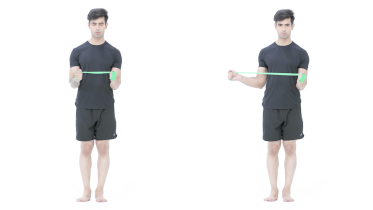 Shoulder external rotation with band
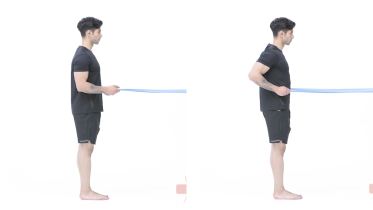 Resistance band row
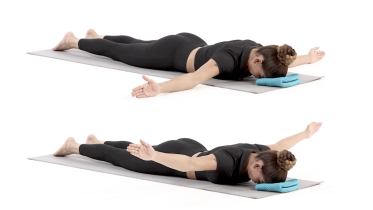 Prone T raise
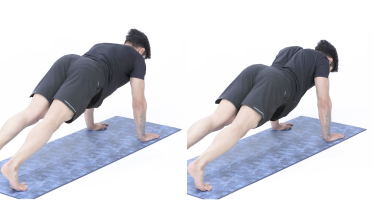 Push-up plus
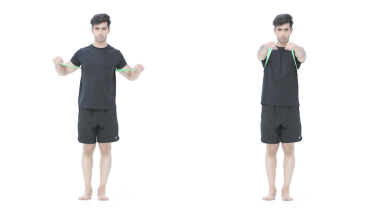 Chest press with band
After shoulder surgery, including a rotator cuff repair, or after a shoulder fracture or dislocation, follow your surgeon's or physio's plan, and do only the movements and range they have cleared. Many plans allow only passive movement at first, where the arm is moved for you and its muscles stay relaxed. Band rotation, rows, lifting the arms lying face down and any pressing usually come later, so ask your surgical team when each one may start. If your shoulder has dislocated before, check with your physio before you add pressing work of any kind.
If you have high blood pressure, breathe steadily through every repetition and never hold your breath. That matters on heavy bench sets too, because an American Heart Association statement advises against holding your breath during resistance exercise (Williams and colleagues, 2007). In practice that means choosing a weight you can press while breathing out as the bar goes up. With a heart condition or high blood pressure, check with your doctor before you start. Chest pain or tightness during a set that does not ease quickly with rest means calling emergency services straight away, and the warning signs below give the full line.
The push-up plus is done in a plank, which loads the stomach wall, so ask your physio or doctor first if you are pregnant, have recently given birth, have had stomach surgery or have a hernia. The prone T is done lying face down, which usually becomes uncomfortable somewhere in the middle months of pregnancy, and your physio can give you a version done leaning forward instead. If you are pregnant and past the first three months, check with your physio before exercising flat on your back. That includes the bench press and the floor press.
When to see a physio (physical therapist)
NHS advice is to see a doctor if shoulder pain is getting worse, has not improved after 2 weeks, or makes moving the arm very difficult. Go sooner if the arm has been weak since a heavy rep or a fall, because that changes the urgency, as the warning signs explain.
A physio will test the strength of turning the arm in and out, check whether your neck reproduces the pain, press on the AC joint, and usually watch you press with an empty bar. From there they can set grip, range and load for this month rather than leaving you to guess. For the other common lifting problems, start at the gym and lifting hub, and if your elbows rather than your shoulders object to pressing, see elbow pain when lifting.
Related exercise programs
Warning signs
Get emergency help now
- Emergency: if chest pain, pressure or tightness does not ease quickly when you rest, spreads to your arm, neck, jaw, stomach or back, or comes with sweating, feeling sick, feeling light-headed or being short of breath, call emergency services straight away, as this can be a heart attack. If it eases quickly and none of these happen, get medical advice the same day, and do not exercise again until you have been checked.
- Emergency: chest pain or tightness, which may spread to your arm, neck or jaw, or shoulder or arm pain that comes with shortness of breath, sweating or feeling sick. This can be a heart attack. Call emergency services straight away.
- Emergency: after a fall or a blow to the shoulder or collarbone, bone is sticking out through the skin, the shoulder swells up very quickly, you are bleeding heavily, or you find it hard to breathe, have chest pain or cough up blood. Call emergency services straight away.
- Emergency: the shoulder feels as if it has slipped out of place, looks a different shape or suddenly locks so you cannot move the arm, or the pain is severe after a fall or an injury. Go to an emergency department straight away, without driving yourself, and do not try to put the shoulder back in yourself.
- Emergency: your arm, hand or fingers turn cold, pale, blue or gray compared with the other side. Call emergency services or go to an emergency department straight away, and do not drive yourself. The blood supply to the arm may be blocked.
- Emergency: if you faint while exercising, call emergency services, even if you feel fine again quickly.
Get help today
- Same day: a sudden pop, snap or tearing feeling with sharp pain in your chest, at the front of your armpit or at the top of your arm during a press or a dip, often followed by bruising or swelling in the chest, armpit or upper arm, a fold at the front of your armpit that looks different from the other side, or weakness when you push or bring the arm across your body. Stop pressing and go to an urgent care center or emergency department the same day, even if you can still move the arm, as this can be a torn chest muscle or its tendon (pectoralis major). When a repair is needed, it usually does better if it is done early.
- Same day: a sudden pop or tearing feeling in the shoulder that brings sharp pain, new weakness or trouble lifting the arm. Stop and contact your surgical team the same day, or get medical advice the same day if you have not had surgery.
- Same day: sudden, very bad shoulder pain, or you suddenly cannot lift or move your arm at all. Get medical help the same day.
- Same day: after a fall or a blow to the shoulder, the shoulder is very swollen or bruised, or you cannot use your arm normally. Get it checked the same day, as the collarbone or the top of the arm may be broken.
- Same day: the shoulder is hot, red and swollen, or you have a fever or feel unwell. This can be a joint infection, which needs treatment quickly. Go to an emergency department the same day, and call emergency services if you feel very unwell.
- Same day: pins and needles or numbness in the arm that does not go away, no feeling in part of the arm, or weakness that is getting worse. Get medical advice the same day. For pain spreading down the arm from your neck, ask for an urgent appointment with your doctor. If one side of your face or body suddenly goes numb or weak, or your speech becomes slurred or muddled, call emergency services, even if it goes away.
- Same day: severe pain in both shoulders that has come on recently. Get medical advice the same day.
- Same day: you are over 50 and have aching and stiffness in both shoulders, often in the neck or hips too, that is worst in the morning and lasts more than 45 minutes after you get up. This can be an inflammatory condition (polymyalgia rheumatica) rather than a local shoulder problem. If you also get a new headache, pain or tenderness at your temples or on your scalp, or jaw pain when you eat or talk, get medical advice the same day, and if your vision changes, call emergency services. Even without those extra signs, see your doctor within a few days about the aching and stiffness.
- Same day: pain at night or at rest that is constant, that no rest or change of position eases at all, and that keeps getting worse. If you are being treated for cancer now, contact your cancer team the same day.
Book an appointment
- Within a day or two: new shoulder pain and you have had cancer, now or in the past, or you are losing weight without trying. See your doctor within a day or two and mention it.
- Within a few days: the pain started after a fall, a pull or another injury, especially if the arm has been weak since, for example you cannot lift it out to the side or hold it up. This can be a broken bone or a torn tendon. Ask for an urgent appointment with your doctor, within days rather than weeks, because UK shoulder surgeons advise urgent referral for a rotator cuff tear caused by an injury.
- Within a day or two: pain at night or at rest that is constant, that no rest or change of position eases at all, and that keeps getting worse. If you have had cancer, now or in the past, or are losing weight without trying, see your doctor sooner, within a day or two, and mention it. This applies even if the pain is not getting worse.
- Within a few days: night pain is common with shoulder problems, but get checked within a few days if the pain is constant, no rest or change of position eases it at all, and it keeps getting worse.
Common questions
Why does the front of my shoulder hurt after bench press?
With the bar touching your chest, the upper arm is out to the side and behind your body under full load, and the front of the joint is stretched as far as it goes in the lift. The rotator cuff and the long tendon of the biceps, which runs over the front of the shoulder, are doing a lot of work in that spot. A sudden rise in pressing, such as extra sets, an added pressing day or a new incline and dip routine on top of the bench, is the usual trigger. A deep ache there that settles within a day is common and tends to respond to a lighter, narrower, shorter press for a few weeks plus cuff and shoulder blade work.
Should I keep benching with shoulder pain?
Usually you can keep some pressing, changed rather than dropped: bring the grip in, stop the bar short of your chest or press from the floor, swap to dumbbells if they feel easier, and cut sets before you cut weight. Keep the ache mild during the set and settled by the next morning. A sudden pop, snap or tearing feeling with sharp pain in your chest, at the front of your armpit or at the top of your arm during a press or a dip, often followed by bruising or swelling in the chest, armpit or upper arm, a fold at the front of your armpit that looks different from the other side, or weakness when you push or bring the arm across your body. Stop pressing and go to an urgent care center or emergency department the same day, even if you can still move the arm, as this can be a torn chest muscle or its tendon (pectoralis major). When a repair is needed, it usually does better if it is done early.
Does grip width matter for shoulder pain on bench?
It can. A wider grip takes the upper arm further out to the side at the bottom of the lift and asks more of the front of the shoulder and of the joint on top of it. A well cited clinical paper on lifting with an injured shoulder suggested keeping the hands no wider than about one and a half times the width of your shoulders (Fees and colleagues, 1998). That advice rests on biomechanics and clinical experience rather than trials, so use it as a starting point and let your shoulder's response guide the final width.
Is it my rotator cuff, my AC joint or a pec injury?
Where it hurts is the best first clue. A deep ache at the front or outer side of the shoulder fits the rotator cuff or the biceps tendon. Pain at one spot on top of the shoulder, at the outer end of the collarbone, that bites at the bottom of the press or when you reach across your chest fits the AC joint. Pain in the chest or the front of the armpit is the chest muscle: tightness and tenderness that let you keep using the arm fit a mild strain. Only an examination confirms which one you have. A sudden pop, snap or tearing feeling with sharp pain in your chest, at the front of your armpit or at the top of your arm during a press or a dip, often followed by bruising or swelling in the chest, armpit or upper arm, a fold at the front of your armpit that looks different from the other side, or weakness when you push or bring the arm across your body. Stop pressing and go to an urgent care center or emergency department the same day, even if you can still move the arm, as this can be a torn chest muscle or its tendon (pectoralis major). When a repair is needed, it usually does better if it is done early.
References
- Kolber MJ, Beekhuizen KS, Cheng MS, Hellman MA. Shoulder injuries attributed to resistance training: a brief review. Journal of Strength and Conditioning Research. 2010;24(6):1696-1704. https://doi.org/10.1519/JSC.0b013e3181dc4330
- Bengtsson V, Berglund L, Aasa U. Narrative review of injuries in powerlifting with special reference to their association to the squat, bench press and deadlift. BMJ Open Sport and Exercise Medicine. 2018;4(1):e000382. https://doi.org/10.1136/bmjsem-2018-000382
- Fees M, Decker T, Snyder-Mackler L, Axe MJ. Upper extremity weight-training modifications for the injured athlete: a clinical perspective. American Journal of Sports Medicine. 1998;26(5):732-742. https://doi.org/10.1177/03635465980260052301
- Desmeules F, Roy JS, Lafrance S, et al. Rotator cuff tendinopathy diagnosis, nonsurgical medical care, and rehabilitation: a clinical practice guideline. Journal of Orthopaedic and Sports Physical Therapy. 2025;55(4):235-274. https://doi.org/10.2519/jospt.2025.13182
- Wilkinson M, Groch N, Freestone CA, Clements A, Obst S. Risk factors and management of atraumatic distal clavicular osteolysis: a scoping review. Shoulder and Elbow. 2026. https://doi.org/10.1177/17585732261479715
- ElMaraghy AW, Devereaux MW. A systematic review and comprehensive classification of pectoralis major tears. Journal of Shoulder and Elbow Surgery. 2012;21(3):412-422. https://doi.org/10.1016/j.jse.2011.04.035
- Bodendorfer BM, Wang DX, McCormick BP, et al. Treatment of pectoralis major tendon tears: a systematic review and meta-analysis of repair timing and fixation methods. American Journal of Sports Medicine. 2020;48(13):3376-3385. https://doi.org/10.1177/0363546520904402
- Long MK, Ward T, DiVella M, Enders T, Ruotolo C. Injuries of the pectoralis major: diagnosis and management. Orthopedic Reviews. 2022;14(4). https://doi.org/10.52965/001c.36984
- Williams MA, Haskell WL, Ades PA, et al. Resistance exercise in individuals with and without cardiovascular disease: 2007 update. A scientific statement from the American Heart Association. Circulation. 2007;116(5):572-584. https://doi.org/10.1161/CIRCULATIONAHA.107.185214
- NHS. Shoulder pain. Page last reviewed 22 May 2023. https://www.nhs.uk/symptoms/shoulder-pain/
- NHS. Dislocated shoulder. Page last reviewed 16 September 2026. https://www.nhs.uk/conditions/dislocated-shoulder/
- NHS. Chest pain. Page last reviewed 8 August 2023. https://www.nhs.uk/symptoms/chest-pain/
- NHS. Heart attack. Page last reviewed 31 March 2026. https://www.nhs.uk/conditions/heart-attack/
- NHS. Polymyalgia rheumatica. Page last reviewed 23 April 2023. https://www.nhs.uk/conditions/polymyalgia-rheumatica/
Written and checked by the PocketPhysio editorial team. Last updated 2026-10-18.
This page is general education, not a diagnosis or a personal treatment plan. See a physiotherapist or doctor for advice about your own situation.