
Part of Weightlifting injuries: common gym injuries by body area and lift
Returning to the gym after injury: how to bring the weights back
Warning signs, and when to get help
Why the first session back is the risky one
In clinic, the lifter who gets hurt again has rarely come back too early. Far more often they came back at their old numbers. The weights on the bar feel familiar, the program is still written in the notebook, and two or three weeks off does not feel long enough to have lost anything. Then the sore area takes the full load on day one, and the next morning it is worse than before.
The fix is to plan the return in stages instead of picking a date. The 2016 Bern consensus on return to sport makes the same point: going back is a gradual process that overlaps with rehab, and the decision is revisited at each stage (Ardern and colleagues, 2016). A gym suits that well, because every stage can be written down as a weight, a set count and a rep count.
What has to be true before you load the injured area?
Healing sets the pace here, not how the area feels on a good day. After surgery, a fracture, a dislocation or a torn tendon, your surgical or fracture team decides when lifting starts and what the repair can take, and their plan overrides everything on this page. The ACL reconstruction rehab and rotator cuff repair rehab pages show how those stages usually run. If you have had a hip or knee replacement, ask your surgeon before you put a loaded barbell on your back or pull one from the floor, because surgeons differ on heavy lifting after a new joint.
For a strain or an overload problem with none of the warning signs below, physios commonly look for a few things before the affected lift comes back:
- Daily life no longer provokes it: stairs, carrying shopping or reaching overhead feel normal or close to it.
- The area moves through the range the lift needs, or very nearly.
- A light, unloaded version of the lift, such as a bodyweight squat or an empty bar, causes no more than mild discomfort and no flare the next morning.
- There is no swelling after activity and nothing gives way.
These come from clinical habit, and nobody has validated them as a test. Expect a physio to change them for a tendon, a disc or a muscle tear, and for how heavy you plan to go.
How much weight should I start with?
Split the program in two. Lifts that do not load the injured area can usually return close to normal straight away. Keeping them going matters more than people expect: in one trial, young adults who trained three times a week for 16 weeks kept their gains in muscle size over the next 32 weeks on as little as one ninth of that weekly dose, although older adults needed more to hold on to theirs (Bickel and colleagues, 2011). It was not a study of injured lifters, but it does suggest that a little training keeps a lot.
Lifts that load the injury start lighter. A common practice starting point is about half to two thirds of your old working weight. For a squat that used to be 100 kg (220 lb) for 5, that would mean somewhere around 50 to 65 kg (110 to 143 lb), and for a 20 kg (44 lb) dumbbell press, roughly 10 to 13 kg (22 to 29 lb). No trial has tested that figure, so treat it as an opening guess and let the next morning tell you whether it was right.
Sets and reps first, then weight
Rebuild the work before you rebuild the load. Keep the starting weight, and over the first sessions add reps and then sets until the old session's volume feels easy. Only then start adding weight.
For that part, the American College of Sports Medicine's 2009 position stand on progression gives a usable rule: once you can lift the current weight for one or two more reps than you planned, add about 2 to 10% (Ratamess and colleagues, 2009). On a 60 kg (132 lb) squat, that is roughly 1.2 to 6 kg (about 2.5 to 13 lb), so in practice the smallest plates you have. After an injury, stay at the low end of that range on the affected lift. Pick one dial per session, the weight, the sets or the depth, and leave the other two where they were, so a bad morning points straight at its cause. Your physio will adjust this.
Which lifts come back first?
Order the lifts by how much they ask of the injured part, and bring them back from the least demanding to the most.
- Lifts that leave the injury alone, at close to normal effort.
- Gentler versions of the affected pattern: a goblet squat before a back squat, a trap bar or a raised pull before a deadlift from the floor, a dumbbell or floor press before a full barbell bench, a band or cable row before a heavy bent-over row.
- The full barbell lift through the full range, at the reduced weight.
- Heavier sets of fewer reps, singles and maximal attempts, last of all.
Lifters with a back injury will find the deadlift version of this laid out on lower back pain after deadlifts, and pressing after a sore shoulder is covered on shoulder pain on bench press. For knees, knee pain when squatting goes through depth and load. A back that has had a disc problem has its own considerations, explained on the lumbar disc herniation page.
How much pain is OK when returning to the gym?
Expect some discomfort on the way back. Holding out for a completely pain-free lift often costs weeks for no gain. A 2017 meta-analysis pooled trials in people with long-standing muscle and joint pain. Letting the exercise hurt a little gave a small short-term edge over keeping it pain-free, and no real difference further out (Smith and colleagues, 2017). Those trials were not in lifters returning from a fresh injury, so use the finding as reassurance, not as permission to push.
The practical test is the next morning. If the sore area is back to its usual level by then, and the pain is not creeping up from week to week, the load was about right. Our pain monitoring model guide explains the scale physios use and how thin the evidence is behind any exact number. The allowance covers the old, familiar ache only. Numbness, a joint that gives way, or pain that has moved somewhere new are outside it.
Keep a weekly check
Write down three things for the affected lift every session: the weight in kg or lb, the sets and reps, and a score out of 10 for how the area felt the next morning. Once a week, look back. Rising numbers with a steady morning score mean keep going. A morning score that climbs two weeks running means drop back to the last week that felt fine, and hold there.
The same approach works for other sports, but the steps differ. Runners have a walk-run plan in return to running after injury, and court players have the return to pickleball after injury guide. The general rules for making an exercise harder in small steps are in our guide to exercise progression.
Rebuilding the main patterns
These five cover a squat, a hip lift, a trunk hold, a pull and a push, at loads light enough to control. Many lifters use them in the first weeks back, before the barbell versions return, or as a warm-up for the affected pattern.
Exercises that can help
These five rebuild the main patterns of a weights program at loads you can control before the bar comes back: a squat, a hip lift, a trunk hold, a pull and a push. Goblet squats often start with a light weight or none for 2 to 3 sets of 8 to 12 a few days a week, glute bridges at 2 to 3 sets of 10 to 12 with a short hold at the top, bird dogs at 1 to 2 sets of 6 to 10 on each side, band rows at 2 to 3 sets of 10 to 15 once a day or every other day, and incline push-ups at 2 to 3 sets of 8 to 15 on 2 or 3 days a week. The numbers on each exercise page come first. Your physio will adjust this.
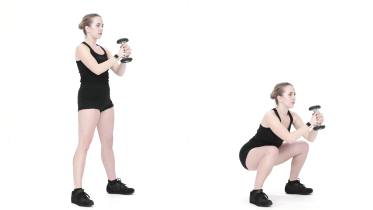 Goblet squat
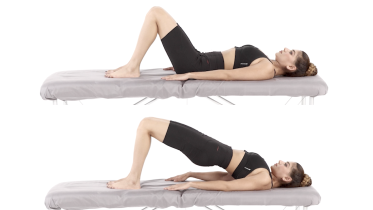 Glute bridge
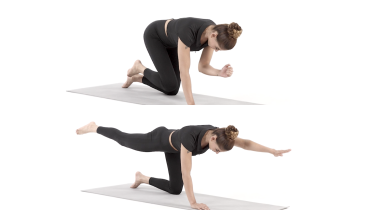 Bird dog
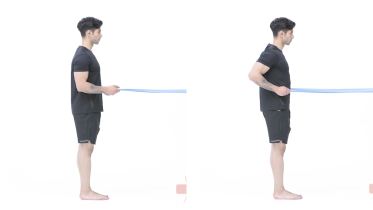 Resistance band row
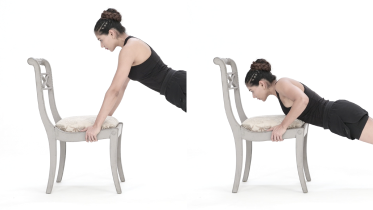 Incline push-ups
Read the precautions on each exercise page before you start, because they take priority over this list. If you have had a hip or knee replacement, get the go-ahead from your surgeon or physio before you try goblet squats. A deep squat bends the hip well past a right angle, and many surgeons ask you to avoid that for the first months after some operations.
If you are pregnant and past the first three months, check with your physio before exercising flat on your back. The glute bridge, the bench press and the floor press are done in that position. If you are pregnant or have given birth in the last few months, ask your physio, midwife or doctor before you go back to heavy lifting. After back surgery, keep the bird dog to its simplest version until your surgeon and physio say bending the spine is fine. With low bone density (osteoporosis), or if you have had a broken bone in your spine, ask your physio before you go back to heavy pulls from the floor or a loaded bar on your back, and keep the lower back from rounding under load.
After shoulder surgery, including a rotator cuff repair, or after a shoulder fracture or dislocation, follow your surgeon's or physio's plan, and do only the movements and range they have cleared. Many plans allow only passive movement at first, where the arm is moved for you and its muscles stay relaxed. Rows and push-ups usually come later in those plans, so ask before you add them.
If you have high blood pressure, breathe steadily through every repetition and never hold your breath. On the barbell lifts that means choosing a weight you can move while breathing out through the hardest part. With a heart condition or high blood pressure, check with your doctor before you start. Stop at once for chest pain, pressure or tightness during a set: if it does not ease quickly when you rest, call emergency services straight away, and if it eases quickly, get medical advice the same day and do not exercise again until you have been checked. The warning list below gives the full set of signs.
When to see a physio (physical therapist)
Book a session before you load the injured area heavily, ideally in the week you plan to restart it. A physio can compare the strength of both sides, watch the lift that hurt, and set your opening weights so the first month is planned rather than guessed.
Do not wait if every attempt to build up ends in the same flare, if the lift has turned weak rather than sore, or if the injury never had a name. If the old injury is still worse a few days after you dropped the weight back, leave that lift out and see your physio before you load it again. Your notebook or training app is worth taking along: the loads you lifted in the fortnight before it happened often show the jump that started it. Anything on the warning list below overrides this page and gets help at the speed that line gives.
Related exercise programs
- Low back pain
- Lumbar disc herniation
- Rotator cuff tendinopathy
- ACL reconstruction rehab
- Rotator cuff repair rehab
Warning signs
Get emergency help now
- Emergency: if chest pain, pressure or tightness does not ease quickly when you rest, spreads to your arm, neck, jaw, stomach or back, or comes with sweating, feeling sick, feeling light-headed or being short of breath, call emergency services straight away, as this can be a heart attack. If it eases quickly and none of these happen, get medical advice the same day, and do not exercise again until you have been checked.
- Emergency: if you faint while exercising, call emergency services, even if you feel fine again quickly.
- Emergency: any sign of a stroke, even if it goes away. That means a face that droops on one side, an arm you cannot lift or keep up, slurred or muddled speech, weakness or numbness on one side of your body or face, sudden blurred vision, double vision or loss of sight, trouble swallowing, sudden dizziness with unsteadiness or falling over, a sudden severe headache, or a sudden fall where your legs give way but you do not black out (a drop attack). Call emergency services straight away.
- Emergency: pain, tingling, numbness or weakness in both legs, numbness or altered feeling around your genitals or bottom, or new trouble peeing or controlling your bladder or bowels. The same applies if you lose feeling in one leg. Call emergency services or go to an emergency department straight away. These can be signs of pressure on the nerves at the base of the spine (cauda equina syndrome).
- Emergency: dark pee (brown, red or tea-colored) after exercise, or muscles that become badly swollen, extremely painful or too weak to use, are not normal soreness. Go to an emergency department straight away, as these can be signs of serious muscle damage (rhabdomyolysis).
- Emergency: the shoulder feels as if it has slipped out of place, looks a different shape or suddenly locks so you cannot move the arm, or the pain is severe after a fall or an injury. Go to an emergency department straight away, without driving yourself, and do not try to put the shoulder back in yourself.
- Emergency: your arm, hand or fingers turn cold, pale, blue or gray compared with the other side. Call emergency services or go to an emergency department straight away, and do not drive yourself. The blood supply to the arm may be blocked.
Get help today
- Same day: a sudden pop or snap at the front of your elbow, sudden sharp pain there, or the muscle at the front of your upper arm bunches up or changes shape. Stop and go to an urgent care center or emergency department the same day, even if you can still bend the elbow, as this can be a torn biceps tendon.
- Same day: a sudden pop, snap or tearing feeling with sharp pain in your chest, at the front of your armpit or at the top of your arm during a press or a dip, often followed by bruising or swelling in the chest, armpit or upper arm, a fold at the front of your armpit that looks different from the other side, or weakness when you push or bring the arm across your body. Stop pressing and go to an urgent care center or emergency department the same day, even if you can still move the arm, as this can be a torn chest muscle or its tendon (pectoralis major). When a repair is needed, it usually does better if it is done early.
- Same day: a calf or thigh that is newly swollen or getting more swollen, warm, tender, red or darker than usual, has swollen veins that are sore to touch, or has a throbbing or cramping pain that does not fit your injury or condition, or that feels different from normal muscle soreness after exercise. This can be a sign of a blood clot (deep vein thrombosis), especially after surgery, an injury, time in a cast or boot, a long trip or a spell of being much less mobile than usual. Get medical advice the same day. If you are also short of breath or have chest pain, call emergency services.
- Same day: a leg or foot that is getting weaker, for example your foot drags, catches on the ground or slaps down when you walk (foot drop). Get medical advice the same day. If the weakness is getting worse by the hour, go to an emergency department.
- Same day: pins and needles, numbness or weakness in an arm or leg that does not go away after you stop. Get medical advice the same day. If one side of your face or body suddenly goes numb or weak, or your speech becomes slurred or muddled, call emergency services, even if it goes away.
- Same day: your wound becomes more red, hot, swollen or painful, or starts to leak. Contact your medical team the same day.
- Same day: a joint that locks, keeps giving way under load, or swells up after a session when you have not hurt it again. Stop the lift that brings it on and get medical advice the same day.
Common questions
How long after an injury can I go back to the gym?
Often sooner than people think, because the gym is not one thing. Many people can train the parts of the body that are not injured within days, and doing so keeps strength and fitness from slipping while the sore part settles. The lifts that load the injury come back when it is calm in daily life, has nearly full movement and tolerates a light version of the lift without a flare the next morning. Healing sets a minimum that no plan can shorten, so a fracture, a torn tendon or an operation follows the timeline your surgeon or fracture team gives you.
How much weight should I lift after an injury?
On the lift that loads the injured area, many physios start at about half to two thirds of your old working weight and build reps and sets before adding weight. That is a practice habit rather than a tested rule, so treat it as a starting guess you adjust by how the next morning feels. For a squat you used to do at 100 kg (220 lb), that would mean starting somewhere around 50 to 65 kg (110 to 143 lb). Lifts that do not load the injury can usually go back closer to normal. Your physio will adjust this.
Do I need clearance from a physio or doctor before going back to the gym?
After surgery, a broken bone, a dislocation or a torn tendon, yes: your surgical or fracture team decides when lifting starts and how heavy it can be, because the repair has limits that a pain-free day does not show. After a strain or an overload injury with no warning signs, many people manage the return themselves using the steps on this page. An assessment is still worth it if you have tried to come back and been stopped more than once, or if you are not sure what the injury was.
Can I train around an injury?
Usually, and it is one of the best things you can do. An injured shoulder does not stop you squatting, and a sore knee does not stop you pressing or rowing. Keeping the rest of the program going holds on to strength you would otherwise lose, and it keeps the habit of training intact. Pick versions that leave the injured part alone, such as a machine or a seated lift in place of a standing one, and keep the effort well within what you can control.
References
- Ardern CL, Glasgow P, Schneiders A, et al. 2016 consensus statement on return to sport from the First World Congress in Sports Physical Therapy, Bern. British Journal of Sports Medicine. 2016;50(14):853-864. https://doi.org/10.1136/bjsports-2016-096278
- Ratamess NA, Alvar BA, Evetovich TK, Housh TJ, Kibler WB, Kraemer WJ, Triplett NT. American College of Sports Medicine position stand. Progression models in resistance training for healthy adults. Medicine and Science in Sports and Exercise. 2009;41(3):687-708. https://doi.org/10.1249/MSS.0b013e3181915670
- Bickel CS, Cross JM, Bamman MM. Exercise dosing to retain resistance training adaptations in young and older adults. Medicine and Science in Sports and Exercise. 2011;43(7):1177-1187. https://doi.org/10.1249/MSS.0b013e318207c15d
- Smith BE, Hendrick P, Smith TO, et al. Should exercises be painful in the management of chronic musculoskeletal pain? A systematic review and meta-analysis. British Journal of Sports Medicine. 2017;51(23):1679-1687. https://doi.org/10.1136/bjsports-2016-097383
- Bak K, Cameron EA, Henderson IJP. Rupture of the pectoralis major: a meta-analysis of 112 cases. Knee Surgery, Sports Traumatology, Arthroscopy. 2000;8(2):113-119. https://doi.org/10.1007/s001670050197
- NHS. Chest pain. Page last reviewed 8 August 2023. https://www.nhs.uk/symptoms/chest-pain/
- NHS. Symptoms of a stroke. Page last reviewed 12 September 2024. https://www.nhs.uk/conditions/stroke/symptoms/
- NHS. Fainting. Page last reviewed 17 August 2026. https://www.nhs.uk/symptoms/fainting/
- NHS. DVT (deep vein thrombosis). Page last reviewed 30 April 2026. https://www.nhs.uk/conditions/deep-vein-thrombosis-dvt/
- American Academy of Orthopaedic Surgeons. Biceps tendon tear at the elbow. OrthoInfo. https://www.orthoinfo.org/en/diseases--conditions/biceps-tendon-tear-at-the-elbow/
- Cleveland Clinic. Rhabdomyolysis. Last updated 24 February 2023. https://my.clevelandclinic.org/health/diseases/21184-rhabdomyolysis
- Brooke-Wavell K, Skelton DA, Barker KL, et al. Strong, steady and straight: UK consensus statement on physical activity and exercise for osteoporosis. British Journal of Sports Medicine. 2022;56(15):837-846. https://doi.org/10.1136/bjsports-2021-104634
- Williams MA, Haskell WL, Ades PA, et al. Resistance exercise in individuals with and without cardiovascular disease: 2007 update. A scientific statement from the American Heart Association. Circulation. 2007;116(5):572-584. https://doi.org/10.1161/CIRCULATIONAHA.107.185214
Written and checked by the PocketPhysio editorial team. Last updated 2026-10-16.
This page is general education, not a diagnosis or a personal treatment plan. See a physiotherapist or doctor for advice about your own situation.