
Part of Running injuries: where they happen and what to do
Return to running after injury: a walk-run plan with checks
Warning signs, and when to get help
Why the calendar is a poor guide
People coming back from an injury usually ask how many weeks it takes. The better question is what the leg can do now. Two runners with the same injury on the same day can be ready weeks apart, depending on how sore it was, how long they stopped, how strong they were before and how much running they hope to go back to.
That thinking is behind the 2016 Bern consensus statement on return to sport, which describes the return as a continuum that runs alongside rehabilitation rather than a single green light at the end of it (Ardern and colleagues, 2016). For a runner, that means you can be doing something useful at every stage. Walking, cycling, strength work and, later, short running spells all count as steps on the same path.
What has to be true before the first run?
Healing comes first. If you had a bone stress injury, a muscle tear or any surgery, the person treating it decides when running is allowed, and that comes before anything on this page. A stress fracture in particular needs a doctor's go-ahead, because some sites, such as the front of the shinbone and the neck of the thighbone, are classed as high risk (Patel and colleagues, 2011). Tell your doctor or physio before you start if you have had a stress fracture before, have low bone density (osteoporosis), or your periods have stopped or become irregular while training, because these raise the risk of another bone stress injury (Patel and colleagues, 2011).
After that, physios commonly look for a short list of things:
- You can walk briskly for a good stretch with no pain and no limp, and the next morning is no worse.
- The injured leg can rise onto its toes again and again, close to the number the other leg manages.
- You can stand on the injured leg, step down from a stair, or do a shallow single leg squat with the knee steady.
- Low hops on the spot on the injured leg are pain free.
There is no single agreed test battery for every running injury, and the exact numbers differ between clinics. Your physio will adjust the checks to the injury you had and the running you want to get back to.
A sample walk-run plan
What follows is an example of the usual shape, not a prescription. It borrows the structure of the graded program tested in a Dutch trial of athletes with shin splints, which used three runs a week with a rest day between and alternated 2 minutes of running with 2 minutes of walking at the start (Moen and colleagues, 2012).
- Stage 1: 1 to 2 minutes of easy running, then 1 to 2 minutes of walking, repeated for 15 to 20 minutes in all, three times a week.
- Stage 2: longer running spells of 3 to 5 minutes with shorter walks, still for about 20 minutes in all.
- Stage 3: continuous easy running, starting around 10 to 20 minutes on flat ground.
- Stage 4: build distance toward your usual runs, then bring back hills, speed work and races one at a time.
Repeat a stage until it feels comfortable during the run and the next morning. Change only one thing at a time, so that if something flares you know what caused it. Big jumps in weekly distance have been linked with some running injuries in new runners, which is a good reason to keep each step small (Nielsen and colleagues, 2014). Your physio will adjust this.
How much pain is OK when returning to running?
Some discomfort is common on the way back, and waiting for it to reach zero can hold you up for weeks. The question is whether the load is about right. In the shin splints trial, runners stayed at a level until their pain stayed below 4 out of 10 during runs, and cut back if it reached 4 after a run or the next day (Moen and colleagues, 2012). An Achilles trial used a similar idea with a ceiling of about 5 out of 10, and runners who kept training within it did as well as those who rested from running and jumping (Silbernagel and colleagues, 2007).
Both trials looked at one injury each, so treat the numbers as a guide rather than a rule for every problem. Our pain monitoring model guide explains how physios use it and where the evidence runs thin. Bone pain is the exception that matters most. Pain at one spot on a bone, or pain that makes you limp, means stop, not count.
After surgery, a fracture or having a baby
These returns follow their own rules. After an ACL reconstruction, the timing of the first run is set by your surgeon's protocol and your rehab team, and the ACL reconstruction rehab page explains the stages. After a torn Achilles tendon, running comes late, and the Achilles tendon rupture page covers why. After any fracture, your fracture clinic or surgeon decides when the bone is ready for impact.
Returning to running after having a baby is a separate question with its own guidance, and our postnatal core and pelvic floor program is the place to start. If you have had a hip or knee replacement, get the go-ahead from your surgeon before you try running. Many surgeons advise against running and jogging after a joint replacement for good, not just for the first months, because each step sends impact through the new joint.
Rebuilding strength alongside the running
Running alone does not always bring a weak calf or hip back to where it was. Keep the strength work going through the whole return, on the days between runs. The four exercises below double as the checks above, and our guide to exercise progression shows how to make each one harder in small steps. If your injury has its own program, such as shin splints or Achilles tendinopathy, use that first, and the running hub's strength training for runners page once you are back to regular runs.
Set the balance work up safely. Stand within arm's reach of a counter or a sturdy chair, and clear rugs and clutter out of the way. Wear flat shoes that fit well and grip the floor, not socks, tights or bare feet. If you have fallen in the past year or feel unsteady, keep a hand on the support throughout and ask your physio about a falls check.
A sudden loss of balance is different. Call emergency services straight away for any sign of a stroke, even if it goes away: sudden dizziness with unsteadiness or falling over, a face that droops on one side, an arm you cannot lift or keep up, slurred or muddled speech, weakness or numbness on one side of your body or face, sudden blurred vision, double vision or loss of sight, or a sudden severe headache.
Exercises that can help
These four work as both training and tests on the way back to running: standing on one leg, rising onto the toes, stepping up and low hops. Single leg stance often starts with 5 to 10 lifts on each leg, held for a few seconds, single leg heel raises with 2 to 3 sets of 8 to 15 on each leg a few days a week, and step ups with 2 to 3 sets of 8 to 12 on each leg from a height you can control. Pogo hops come last, often 2 to 3 sets of 10 to 20 low hops a few times a week, once the heel raises are comfortable. The numbers on each exercise page come first. Your physio will adjust this.
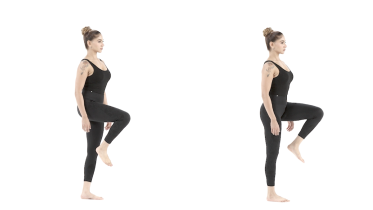 Single leg stance
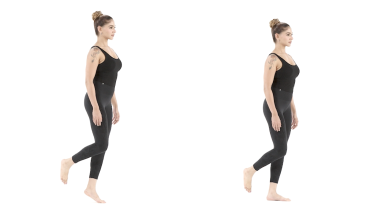 Single leg heel raise
 Step up
 Pogo hops
Check the precautions on each exercise page first, as they take priority over anything here. If you have had a hip or knee replacement, get the go-ahead from your surgeon or physio before you try single leg stance or step ups. Some operations limit this kind of work for the first months, so the timing depends on your surgery. After an Achilles tendon repair or ankle surgery, single leg heel raises and hops come at set stages of rehab, so wait until your surgeon's protocol and your physio say you are ready. After a shin stress fracture or a calf tear, wait until your physio clears you to hop.
If chest pain, pressure or tightness does not ease quickly when you rest, spreads to your arm, neck, jaw, stomach or back, or comes with sweating, feeling sick, feeling light-headed or being short of breath, call emergency services straight away, as this can be a heart attack. If it eases quickly and none of these happen, get medical advice the same day, and do not exercise again until you have been checked.
When to see a physio (physical therapist)
The most useful appointment comes before the first run, not after the second setback. A physio can test both legs, set the checks that fit your injury and write the walk-run steps around your week.
Go sooner if you have tried to come back twice and been stopped twice, if a joint gives way or swells, or if you are not sure what the injury was in the first place. Bring your running log if you keep one, since the weeks before the injury often explain it. The warning signs below come first, at the speed each one sets.
Related exercise programs
- Shin splints
- Achilles tendinopathy
- Patellofemoral pain
- Hamstring strain
- Ankle sprain
- ACL reconstruction rehab
- Achilles tendon rupture
- Postnatal core and pelvic floor
Warning signs
Get emergency help now
- Emergency: if chest pain, pressure or tightness does not ease quickly when you rest, spreads to your arm, neck, jaw, stomach or back, or comes with sweating, feeling sick, feeling light-headed or being short of breath, call emergency services straight away, as this can be a heart attack. If it eases quickly and none of these happen, get medical advice the same day, and do not exercise again until you have been checked.
- Emergency: if you faint while exercising, call emergency services, even if you feel fine again quickly.
- Emergency: any sign of a stroke, even if it goes away. That means a face that droops on one side, an arm you cannot lift or keep up, slurred or muddled speech, weakness or numbness on one side of your body or face, sudden blurred vision, double vision or loss of sight, trouble swallowing, sudden dizziness with unsteadiness or falling over, a sudden severe headache, or a sudden fall where your legs give way but you do not black out (a drop attack). Call emergency services straight away.
- Emergency: the knee became very swollen very quickly, within a few hours of a twist, fall or blow, or you felt a pop or snap. Go to an emergency department straight away. Do not drive yourself: ask someone to drive you or call an ambulance.
Get help today
- Same day: a sudden pop or snap at the back of your ankle or heel, a feeling that someone kicked you there, or sudden pain there after which you cannot push off or rise onto your toes on that leg. Stop, take the weight off that leg carefully and go to an urgent care center or emergency department the same day, even if you can still walk, as this can be a torn Achilles tendon.
- Same day: groin pain that built up with running, marching or jumping, often after you increased your training, and now hurts when you walk, makes you limp, or aches at rest or at night. Stop running and jumping and keep walking to a minimum until it has been checked. Get medical advice the same day and mention your training. If you cannot put weight on the leg, go to an emergency department. This can be a stress fracture in the neck of the thighbone (femoral neck stress fracture), which is easy to miss at first and can become a full break if you keep loading it.
- Same day: a calf or thigh that is newly swollen or getting more swollen, warm, tender, red or darker than usual, has swollen veins that are sore to touch, or has a throbbing or cramping pain that does not fit your injury or condition, or that feels different from normal muscle soreness after exercise. This can be a sign of a blood clot (deep vein thrombosis), especially after surgery, an injury, time in a cast or boot, a long trip or a spell of being much less mobile than usual. Get medical advice the same day. If you are also short of breath or have chest pain, call emergency services.
- Same day: you cannot walk or put weight on the leg, whether or not there was a fall or injury, or you have very bad knee pain after a fall or injury, or very bad knee pain that came on suddenly with no injury at all. Get medical advice the same day.
Book an appointment
- Within a few days: the pain sits at one small spot on a bone that you can point to with a finger, such as the shinbone or a bone in the foot, the bone aches at rest or at night, or hopping on that leg hurts at that one spot. Stop running, jumping and any exercise that hurts at that spot, and see a doctor within a few days, as this can be a stress fracture. This matters even more if the spot is on the front of the shinbone or the top of the foot in the middle, just in front of the ankle (the navicular bone), because doctors treat stress fractures there as high risk. If walking hurts or makes you limp, get it checked the same day. An X-ray can look normal for the first 2 to 3 weeks, so a normal early X-ray does not rule it out.
- Within a few days: sharp pain during an exercise, a joint that gives way, new swelling, or pain that is still worse a few days after you drop back a step. Stop that exercise and check with your physio before you do it again.
Common questions
How long before I can run after an injury?
It depends on what was injured and how long it stopped you, so there is no honest single number. Healing sets the minimum: a stress fracture or a torn muscle needs its own time, and your doctor or physio will tell you when the first run is allowed. After that, the speed of the return comes from passing the checks on this page. As one example, athletes in a Dutch shin splints trial whose pain had lasted more than 3 weeks took on average about 3 to 4 months to work through a graded running program (Moen and colleagues, 2012). A short niggle caught early usually takes far less.
How much pain is OK when returning to running?
Mild, familiar pain is usually acceptable if it stays low during the run, is back to its normal level by the next morning, and is not creeping up from week to week. In the shin splints trial, runners moved up a level only when pain stayed below 4 out of 10 during their runs (Moen and colleagues, 2012). In an Achilles tendinopathy trial, runners who kept training with pain allowed up to about 5 out of 10, settling by the next morning, did as well as those who rested from running (Silbernagel and colleagues, 2007). Pain at one spot on a bone, a new pain, or pain that makes you limp is never part of that allowance.
What tests show I am ready to run?
Common checks before a first run are brisk walking without pain or a limp, single leg heel raises on the injured side that are close in number to the other side, a steady single leg squat or step down, and low hops on the injured leg without pain. Physios set their own numbers for these, and there is no single agreed test battery for every injury. Your physio will adjust the checks to your injury.
How do I build back up with walk-run intervals?
Start with short spells of easy running between walking breaks, for example 1 to 2 minutes of each for 15 to 20 minutes in all, about three times a week with a rest day between. Lengthen the running spells and shorten the walks only after a session has felt fine during and the next morning. Add time before speed, and leave hills and fast running until last. Your physio will adjust this.
References
- Ardern CL, Glasgow P, Schneiders A, et al. 2016 consensus statement on return to sport from the First World Congress in Sports Physical Therapy, Bern. British Journal of Sports Medicine. 2016;50(14):853-864. https://doi.org/10.1136/bjsports-2016-096278
- Moen MH, Holtslag L, Bakker E, Barten C, Weir A, Tol JL, Backx F. The treatment of medial tibial stress syndrome in athletes; a randomized clinical trial. Sports Medicine, Arthroscopy, Rehabilitation, Therapy and Technology. 2012;4:12. https://doi.org/10.1186/1758-2555-4-12
- Silbernagel KG, Thomeé R, Eriksson BI, Karlsson J. Continued sports activity, using a pain-monitoring model, during rehabilitation in patients with Achilles tendinopathy: a randomized controlled study. American Journal of Sports Medicine. 2007;35(6):897-906. https://doi.org/10.1177/0363546506298279
- Nielsen RØ, Parner ET, Nohr EA, Sørensen H, Lind M, Rasmussen S. Excessive progression in weekly running distance and risk of running-related injuries: an association which varies according to type of injury. Journal of Orthopaedic and Sports Physical Therapy. 2014;44(10):739-747. https://doi.org/10.2519/jospt.2014.5164
- Bertelsen ML, Hulme A, Petersen J, Brund RK, Sørensen H, Finch CF, Parner ET, Nielsen RO. A framework for the etiology of running-related injuries. Scandinavian Journal of Medicine and Science in Sports. 2017;27(11):1170-1180. https://doi.org/10.1111/sms.12883
- Patel DS, Roth M, Kapil N. Stress fractures: diagnosis, treatment, and prevention. American Family Physician. 2011;83(1):39-46. https://www.aafp.org/pubs/afp/issues/2011/0101/p39.html
- NHS. Chest pain. Page last reviewed 8 August 2023. https://www.nhs.uk/symptoms/chest-pain/
- NHS. Symptoms of a stroke. Page last reviewed 12 September 2024. https://www.nhs.uk/conditions/stroke/symptoms/
- NHS. DVT (deep vein thrombosis). Page last reviewed 30 April 2026. https://www.nhs.uk/conditions/deep-vein-thrombosis-dvt/
Written and checked by the PocketPhysio editorial team. Last updated 2026-10-16.
This page is general education, not a diagnosis or a personal treatment plan. See a physiotherapist or doctor for advice about your own situation.