
Running injuries: where they happen and what to do
Warning signs, and when to get help
What causes most running injuries?
Running is the same movement repeated thousands of times, so the damage in most running injuries is done in small amounts rather than in one moment. A framework published in 2017 describes it plainly: every structure in the leg can tolerate a certain amount of load over a certain time, and an injury appears when the running asks for more than that structure can take (Bertelsen and colleagues, 2017). The way you run decides where the load lands. How much you run, and how fast you add to it, decides whether it is too much.
That second part is the one you can change this week. In a Danish study that followed 874 new runners for a year, those who added more than 30% to their weekly distance over a two-week stretch had more of some injuries, including kneecap pain, IT band pain and shin splints, than runners who added less than 10% (Nielsen and colleagues, 2014). It was an observational study, so it shows a link and not a rule. Still, the pattern fits what physios hear in clinic almost every week: the pain began a fortnight after a race entry, a new running group or a holiday spent catching up on missed miles.
New runners carry more risk for the hours they put in. A meta-analysis that pooled 13 studies found about 17.8 injuries per 1,000 hours of running in novices, against 7.7 in recreational runners (Videbæk and colleagues, 2015). In your first few months of running, start with our page on beginner running injuries.
Where runners get hurt, by body area
The knee leads the list in the 2021 review, with kneecap pain the single largest share (Kakouris and colleagues, 2021). A dull ache around or behind the kneecap that is worse on stairs, hills and after sitting is often patellofemoral pain, and our runner's knee page covers what to change in your running while the patellofemoral pain program holds the exercises. Sharp pain on the outside of the knee that starts at the same point in every run fits IT band syndrome better. Not sure which one you have? The symptom sorter for knee pain after running goes spot by spot.
Below the knee, pain along the inner edge of the shinbone is usually shin splints. The running with shin splints page deals with whether to keep running, while the shin splints program sets out the staged rehab and the test that separates it from a stress fracture. Pain and morning stiffness in the cord above the heel belong on the Achilles pain when running page, and heel pain under the foot that is worst for the first steps of the day usually fits plantar fasciitis.
Hip pain in runners sits in three main places: the outside of the hip, the front of the hip or groin, and the buttock or back of the thigh. Hip pain when running sorts those by spot and points to greater trochanteric pain, hamstring strain and the other hip programs. Groin pain that builds with running and starts to make you limp is the exception: it goes to the warning list below, because it can be a stress fracture of the thighbone.
Can you keep running with an injury?
Often yes, in a smaller amount, and that is usually better than stopping everything. Most overuse problems settle when you cut the running back to a level the sore part can tolerate and keep the rest of your fitness going on a bike or in the pool. The aim is the right dose, not zero.
Physios use a simple rule for this. Some familiar discomfort during a run can be acceptable if it stays mild, is back to its usual level by the next morning and is not creeping up from week to week. Our pain monitoring model guide explains where that rule comes from and how thin the evidence behind the exact number is. A few injuries do not fit this approach at all. Bone stress injuries are the main one, which is why pain at one spot on a bone, or pain that makes you limp, means stop and get it checked.
When you have stopped and want to build back, the return to running after injury page gives a walk-run plan with the checks to pass before each step.
Does strength training prevent running injuries?
Probably a little. The running evidence is weaker than people assume, though. Across many sports, a 2014 meta-analysis found that strength training programs cut sports injuries to less than a third of the rate in control groups, while stretching programs made no significant difference (Lauersen and colleagues, 2014). Those trials came from many sports, not running alone. A 2024 review limited to endurance runners found that, pooled together, exercise programs did not clearly lower injury risk or injury rate, although programs that were supervised did seem to lower the risk (Wu and colleagues, 2024).
So strength work is worth doing, mainly because the calf, thigh and hip muscles take a large share of the load in every stride, and stronger tissue has more room before it is overloaded. Two short sessions a week that you keep up are worth more than an ambitious plan that lasts a month. The strength training for runners page lays out a home plan with kg and lb loads and how to fit it around your runs.
Exercises that can help
Four exercises for the parts of a runner that take the most load: the calf and Achilles, the back of the hip, the side of the hip and the thigh. Single leg heel raises often start at 2 to 3 sets of 8 to 15 on each leg a few days a week, single leg bridges at 2 to 3 sets of 8 to 12 on each side with a 2 to 5 second hold, side-lying hip abduction at 2 to 3 sets of 10 to 15 on each side, and step ups at 2 to 3 sets of 8 to 12 on each leg from a height you can control. The numbers on each exercise page come first. Your physio will adjust this.
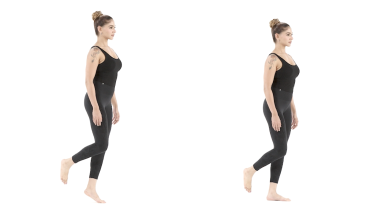 Single leg heel raise
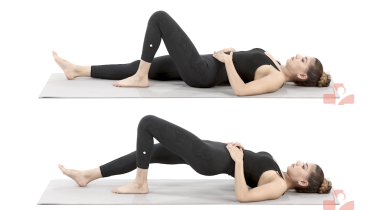 Single leg bridge
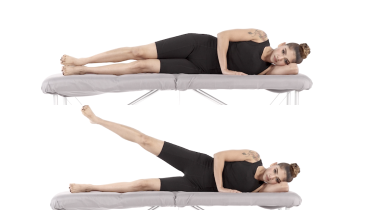 Side lying hip abduction
 Step up
Every exercise page has its own precautions, and they come before this paragraph. Keep your fingertips on a wall or counter for the heel raises and step ups, and hold on throughout if your balance is poor or you have had falls. After an Achilles tendon repair or ankle surgery, single leg heel raises come later in rehab, once your surgeon's protocol and your physio both say you are ready. If you have had a hip replacement or other hip surgery, get the go-ahead from your surgeon or physio before you try side-lying hip abduction. Some operations limit this kind of work for the first months, so the timing depends on your surgery.
If you are pregnant and past the first three months, check with your physio before exercising flat on your back. That includes the single leg bridge. If you have had a hip or knee replacement, get the go-ahead from your surgeon before you try running. Many surgeons advise against running and jogging after a joint replacement for good, not just for the first months, because each step sends impact through the new joint.
If chest pain, pressure or tightness does not ease quickly when you rest, spreads to your arm, neck, jaw, stomach or back, or comes with sweating, feeling sick, feeling light-headed or being short of breath, call emergency services straight away, as this can be a heart attack. If it eases quickly and none of these happen, get medical advice the same day, and do not exercise again until you have been checked.
When to see a physio (physical therapist)
Book an appointment when the same pain has lasted two weeks despite running less, when it comes back every time you build your distance, or when you notice you have changed the way you run to get round it. A limp is a reason to go sooner. So is pain at night.
A physio will usually ask about the month before the pain started, because that is where the cause tends to sit. They will test the strength of each leg, watch you hop, squat and possibly run, and then set a running dose you can keep while the sore part recovers. Bring your training log or running app if you use one. The warning signs below come first, at the speed each one sets.
In this topic
- Achilles pain when running: keep going, cut back or stop?
Achilles pain when running: how much running is OK, when to drop hills and speed, when to stop, and the snap that means urgent care today.
- Beginner running injuries: what is normal and what is not
Beginner running injuries explained by a physio: which aches are normal in your first weeks, which spot points to which problem, and how to build up.
- Hip pain when running: where it hurts and what to do
Hip pain when running: what pain on the outside, front or back of the hip suggests, how to adjust your runs, and when groin pain means stop.
- Return to running after injury: a walk-run plan with checks
A return to running after injury plan: the checks to pass before your first run, a staged walk-run example, how much pain is OK, and when to wait.
- Runner's knee: should you keep running, and how?
Runner's knee rarely means stopping for good. How to trim distance, hills and pace so kneecap pain stays mild, and when to get it checked.
- Running with shin splints: when to stop and how to start again
Running with shin splints: when to stop, how far to cut back, which surfaces and shoes help, and the signs of a stress fracture that mean no running.
- Strength training for runners: a physio plan for calves, hips and thighs
Strength training for runners from a physio: six one-leg exercises, how often to do them, loads in kg and lb, and what the injury evidence really shows.
Related exercise programs
- Patellofemoral pain
- Shin splints
- Achilles tendinopathy
- IT band syndrome
- Plantar fasciitis
- Greater trochanteric pain syndrome
- Hamstring strain
Warning signs
Get emergency help now
- Emergency: if chest pain, pressure or tightness does not ease quickly when you rest, spreads to your arm, neck, jaw, stomach or back, or comes with sweating, feeling sick, feeling light-headed or being short of breath, call emergency services straight away, as this can be a heart attack. If it eases quickly and none of these happen, get medical advice the same day, and do not exercise again until you have been checked.
- Emergency: if you faint while exercising, call emergency services, even if you feel fine again quickly.
- Emergency: sudden, severe pain in your lower leg that is much worse than you would expect, especially after an injury or with a plaster cast or tight bandage on the leg. It may come with a tight, swollen leg, pain that gets worse when the muscle is stretched, numbness, pins and needles or weakness. Call emergency services or go to an emergency department straight away, and do not drive yourself. This can be acute compartment syndrome, which needs urgent surgery.
- Emergency: the knee became very swollen very quickly, within a few hours of a twist, fall or blow, or you felt a pop or snap. Go to an emergency department straight away. Do not drive yourself: ask someone to drive you or call an ambulance.
Get help today
- Same day: a sudden pop or snap at the back of your ankle or heel, a feeling that someone kicked you there, or sudden pain there after which you cannot push off or rise onto your toes on that leg. Stop, take the weight off that leg carefully and go to an urgent care center or emergency department the same day, even if you can still walk, as this can be a torn Achilles tendon.
- Same day: groin pain that built up with running, marching or jumping, often after you increased your training, and now hurts when you walk, makes you limp, or aches at rest or at night. Stop running and jumping and keep walking to a minimum until it has been checked. Get medical advice the same day and mention your training. If you cannot put weight on the leg, go to an emergency department. This can be a stress fracture in the neck of the thighbone (femoral neck stress fracture), which is easy to miss at first and can become a full break if you keep loading it.
- Same day: you cannot walk or put weight on the leg, whether or not there was a fall or injury, or you have very bad knee pain after a fall or injury, or very bad knee pain that came on suddenly with no injury at all. Get medical advice the same day.
- Same day: a calf or thigh that is newly swollen or getting more swollen, warm, tender, red or darker than usual, has swollen veins that are sore to touch, or has a throbbing or cramping pain that does not fit your injury or condition, or that feels different from normal muscle soreness after exercise. This can be a sign of a blood clot (deep vein thrombosis), especially after surgery, an injury, time in a cast or boot, a long trip or a spell of being much less mobile than usual. Get medical advice the same day. If you are also short of breath or have chest pain, call emergency services.
- Same day: the pain is there at night or at rest and keeps getting worse. If you are being treated for cancer now, contact your cancer team the same day.
Book an appointment
- Within a few days: the pain sits at one small spot on a bone that you can point to with a finger, such as the shinbone or a bone in the foot, the bone aches at rest or at night, or hopping on that leg hurts at that one spot. Stop running, jumping and any exercise that hurts at that spot, and see a doctor within a few days, as this can be a stress fracture. This matters even more if the spot is on the front of the shinbone or the top of the foot in the middle, just in front of the ankle (the navicular bone), because doctors treat stress fractures there as high risk. If walking hurts or makes you limp, get it checked the same day. An X-ray can look normal for the first 2 to 3 weeks, so a normal early X-ray does not rule it out.
- Within a day or two: the pain is there at night or at rest and keeps getting worse. If you have had cancer, now or in the past, or are losing weight without trying, see your doctor sooner, within a day or two, and mention it. This applies even if the pain is not getting worse.
- Within a few days: the pain is there at night or at rest and keeps getting worse. See your doctor within a few days.
Common questions
What are the most common running injuries?
Across the studies pooled in a 2021 systematic review, the five with the largest share were pain around the kneecap (patellofemoral pain, 16.7%), shin splints (medial tibial stress syndrome, 9.1%), plantar fasciitis (7.9%), iliotibial band syndrome on the outside of the knee (7.9%) and Achilles tendinopathy (6.6%) (Kakouris and colleagues, 2021). Those are shares of the injuries reported in very different groups of runners, so read them as an order, not as your own chance of getting one. Hip pain is common enough to have its own page in this hub as well.
Why do runners get injured?
The working model is load against capacity. Each tissue, whether bone, tendon or muscle, can take a certain amount of load over a certain time before it starts to fail, and an injury follows when the running asks for more than that tissue can currently give (Bertelsen and colleagues, 2017). That is why the timing matters so much. In a year-long study of 874 new runners, those who increased their weekly distance by more than 30% over two weeks were more likely to get some distance-related injuries, including kneecap pain, IT band pain and shin splints, than those who increased it by less than 10% (Nielsen and colleagues, 2014).
Is it normal to hurt after running?
Some muscle soreness in the day or two after a longer or harder run is normal, especially in the first months, and it fades as you get used to the load. Pain that builds while you run, pain that changes the way you walk, or pain that is worse each morning is a different thing and is worth acting on early. Our page on muscle soreness or injury goes through the difference in more detail.
When should I stop running and see someone?
Stop and get help the same day for a pop at the back of the ankle, a leg you cannot put weight on, or groin pain that makes you limp after a build in training. Book a physio when the same pain is still there after two weeks of running less, when it comes back every time you build up, or when it has started to change how you run. The warning list on this page gives the timing for each sign.
References
- Kakouris N, Yener N, Fong DTP. A systematic review of running-related musculoskeletal injuries in runners. Journal of Sport and Health Science. 2021;10(5):513-522. https://doi.org/10.1016/j.jshs.2021.04.001
- Bertelsen ML, Hulme A, Petersen J, Brund RK, Sørensen H, Finch CF, Parner ET, Nielsen RO. A framework for the etiology of running-related injuries. Scandinavian Journal of Medicine and Science in Sports. 2017;27(11):1170-1180. https://doi.org/10.1111/sms.12883
- Nielsen RØ, Parner ET, Nohr EA, Sørensen H, Lind M, Rasmussen S. Excessive progression in weekly running distance and risk of running-related injuries: an association which varies according to type of injury. Journal of Orthopaedic and Sports Physical Therapy. 2014;44(10):739-747. https://doi.org/10.2519/jospt.2014.5164
- Videbæk S, Bueno AM, Nielsen RO, Rasmussen S. Incidence of running-related injuries per 1000 h of running in different types of runners: a systematic review and meta-analysis. Sports Medicine. 2015;45(7):1017-1026. https://doi.org/10.1007/s40279-015-0333-8
- Lauersen JB, Bertelsen DM, Andersen LB. The effectiveness of exercise interventions to prevent sports injuries: a systematic review and meta-analysis of randomised controlled trials. British Journal of Sports Medicine. 2014;48(11):871-877. https://doi.org/10.1136/bjsports-2013-092538
- Wu H, Brooke-Wavell K, Fong DTP, Paquette MR, Blagrove RC. Do exercise-based prevention programs reduce injury in endurance runners? A systematic review and meta-analysis. Sports Medicine. 2024;54(5):1249-1267. https://doi.org/10.1007/s40279-024-01993-7
- Patel DS, Roth M, Kapil N. Stress fractures: diagnosis, treatment, and prevention. American Family Physician. 2011;83(1):39-46. https://www.aafp.org/pubs/afp/issues/2011/0101/p39.html
- NHS. Chest pain. Page last reviewed 8 August 2023. https://www.nhs.uk/symptoms/chest-pain/
- NHS. DVT (deep vein thrombosis). Page last reviewed 30 April 2026. https://www.nhs.uk/conditions/deep-vein-thrombosis-dvt/
- NHS. Compartment syndrome. Page last reviewed 4 September 2026. https://www.nhs.uk/conditions/compartment-syndrome/
Written and checked by the PocketPhysio editorial team. Last updated 2026-10-16.
This page is general education, not a diagnosis or a personal treatment plan. See a physiotherapist or doctor for advice about your own situation.