
Part of Running injuries: where they happen and what to do
Beginner running injuries: what is normal and what is not
Warning signs, and when to get help
Why do new runners get injured?
The story in clinic is often the same one. A few weeks in, the runs start to feel easier on your breathing, so you add a longer one or a fourth day, and the legs have not caught up yet. Each tissue in the leg can take only so much load over a given time, and an injury follows when the running asks for more than that tissue can handle at the moment (Bertelsen and colleagues, 2017).
That gap shows up in the numbers. A meta-analysis of 13 studies found about 17.8 injuries per 1,000 hours of running in novice runners, more than twice the 7.7 found in recreational runners who were already used to it (Videbæk and colleagues, 2015). Those figures come from mixed groups and different injury definitions, so they say nothing exact about you. What they do say is that the first months are when most care is needed.
The size of the jumps seems to matter more than the plan's exact shape. In a Danish study of 874 new runners, people who added more than 30% to their weekly distance over two weeks had more kneecap pain, IT band pain and shin splints than people who added less than 10% (Nielsen and colleagues, 2014). Yet a Dutch trial of 532 beginners training for a 4 mile (6.7 km) event found that a slower 13-week plan built on the 10% rule gave the same injury rate as a standard 8-week plan, 20.8% against 20.3% (Buist and colleagues, 2008). So there is no magic percentage. Avoid big jumps, and listen to the morning after.
Is it normal to hurt after running?
Some aches are part of starting. Tight, tender calves and thighs that peak a day or two after a run and then fade are muscle soreness, and they get milder as the weeks go on. A general stiffness on the first few steps the next morning that eases within minutes is also common. Neither needs you to stop, though it may be a sign to repeat the week instead of moving on.
Other pain is a message to change something. Watch for pain that comes on during the run and gets worse the longer you go, pain that is worse each morning than the one before, pain at one spot on a bone, swelling, or anything that makes you limp or change your stride. Those are the early signs of an overuse injury, and they are much easier to settle in week one than in week six. Our page on muscle soreness or injury explains the difference for any kind of exercise.
Which spot points to which problem
Where it hurts is the best first clue. These are the usual patterns in new runners, and a physio can confirm which one fits you.
An ache around or behind the kneecap, worse on stairs, hills or after sitting through a film, is often patellofemoral pain, which runners call runner's knee. Pain on the outside of the knee that starts at a predictable point in each run fits IT band syndrome better. If you cannot tell which, the knee pain after running page sorts it by spot.
A sore inner edge of the shinbone that aches during and after runs is usually shin splints, and it is the classic complaint of the first month. Pain and stiffness in the cord just above the heel, worst first thing in the morning, points to the Achilles tendon. Sharp pain under the heel for the first steps out of bed suggests plantar fasciitis.
How do I build up without getting hurt?
Use a plan that mixes walking and running. The NHS Couch to 5K program has 3 runs a week for 9 weeks, starts with short bursts of gentle running between walking breaks, and lets you repeat any week until you feel ready to move on. That last part is the most useful rule in the whole plan.
Run slowly enough to hold a conversation. Keep at least one rest day between runs, and give your legs a lighter week if life gets in the way of sleep. When a run leaves a pain that is worse the next morning, stay on the same week, or drop back one, rather than pushing through to the next.
Strength work on two of your non-running days helps the calves and hips cope with the extra load, although the evidence that it prevents running injuries on its own is mixed. The four exercises below are a simple place to start, and the strength training for runners page takes it further once running is part of your week.
If you have had a hip or knee replacement, get the go-ahead from your surgeon before you try running. Many surgeons advise against running and jogging after a joint replacement for good, not just for the first months, because each step sends impact through the new joint.
With a heart condition or high blood pressure, check with your doctor before you start.
Tell your doctor or physio before you start if you have had a stress fracture before, have low bone density (osteoporosis), or your periods have stopped or become irregular, because these raise the risk of bone stress injuries (Patel and colleagues, 2011). If you are pregnant, or have had a baby in the past year, check with your midwife, doctor or physio before you take up running for the first time. After a birth, the postnatal core and pelvic floor program covers when running can start.
Exercises that can help
Four simple exercises for the first weeks of running, done on two or three non-running days. Calf raises often start at 2 to 3 sets of 10 to 15 on both legs, glute bridges at 2 to 3 sets of 10 to 12 with a short hold at the top, squats at 2 to 3 sets of 8 to 12 at a depth that feels controlled, and clamshells at 2 to 3 sets of 10 to 15 on each side. The numbers on each exercise page come first. Your physio will adjust this.
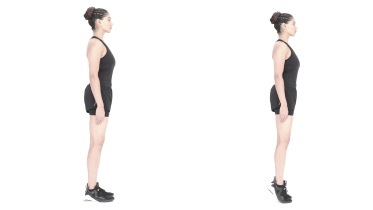 Calf raises
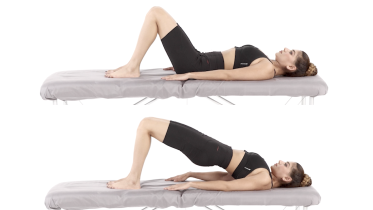 Glute bridge
 Squat
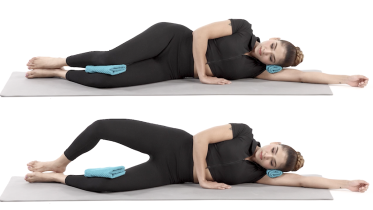 Clamshell
Each exercise page has its own precautions, and they come first. Keep a hand on a counter or a sturdy chair for the calf raises and squats if your balance is unsteady.
If you have had a hip or knee replacement, get the go-ahead from your surgeon or physio before you try squats. A deeper squat bends the hip well past a right angle, and many surgeons ask you to avoid that for the first months after some operations. If you have had a hip replacement or other hip surgery, get the go-ahead from your surgeon or physio before you try clamshells. Opening the knee turns the thigh outward, and many surgeons ask you to avoid that for the first months after some operations.
If you are pregnant and past the first three months, check with your physio before exercising flat on your back. That includes the glute bridge.
If chest pain, pressure or tightness does not ease quickly when you rest, spreads to your arm, neck, jaw, stomach or back, or comes with sweating, feeling sick, feeling light-headed or being short of breath, call emergency services straight away, as this can be a heart attack. If it eases quickly and none of these happen, get medical advice the same day, and do not exercise again until you have been checked.
When to see a physio (physical therapist)
Go when a pain has not eased after a week or two of running less, when it is making you limp, or when it comes back every time you move on to the next week of your plan. One visit early on often saves a month of stop-start running.
A physio will ask about your plan and the week the pain began, check the sore spot and test the strength of each leg, and then set a running dose you can keep up while it settles. Bring your plan or your running app. If you are aiming for a first 5K or a race, say so, because it changes how the weeks are arranged. The warning signs below come first, at the speed each one sets.
Related exercise programs
Warning signs
Get emergency help now
- Emergency: if chest pain, pressure or tightness does not ease quickly when you rest, spreads to your arm, neck, jaw, stomach or back, or comes with sweating, feeling sick, feeling light-headed or being short of breath, call emergency services straight away, as this can be a heart attack. If it eases quickly and none of these happen, get medical advice the same day, and do not exercise again until you have been checked.
- Emergency: if you faint while exercising, call emergency services, even if you feel fine again quickly.
- Emergency: sudden, severe pain in your lower leg that is much worse than you would expect, especially after an injury or with a plaster cast or tight bandage on the leg. It may come with a tight, swollen leg, pain that gets worse when the muscle is stretched, numbness, pins and needles or weakness. Call emergency services or go to an emergency department straight away, and do not drive yourself. This can be acute compartment syndrome, which needs urgent surgery.
Get help today
- Same day: a sudden pop or snap at the back of your ankle or heel, a feeling that someone kicked you there, or sudden pain there after which you cannot push off or rise onto your toes on that leg. Stop, take the weight off that leg carefully and go to an urgent care center or emergency department the same day, even if you can still walk, as this can be a torn Achilles tendon.
- Same day: groin pain that built up with running, marching or jumping, often after you increased your training, and now hurts when you walk, makes you limp, or aches at rest or at night. Stop running and jumping and keep walking to a minimum until it has been checked. Get medical advice the same day and mention your training. If you cannot put weight on the leg, go to an emergency department. This can be a stress fracture in the neck of the thighbone (femoral neck stress fracture), which is easy to miss at first and can become a full break if you keep loading it.
- Same day: a calf or thigh that is newly swollen or getting more swollen, warm, tender, red or darker than usual, has swollen veins that are sore to touch, or has a throbbing or cramping pain that does not fit your injury or condition, or that feels different from normal muscle soreness after exercise. This can be a sign of a blood clot (deep vein thrombosis), especially after surgery, an injury, time in a cast or boot, a long trip or a spell of being much less mobile than usual. Get medical advice the same day. If you are also short of breath or have chest pain, call emergency services.
- Same day: the pain is there at night or at rest and keeps getting worse. If you are being treated for cancer now, contact your cancer team the same day.
Book an appointment
- Within a few days: the pain sits at one small spot on a bone that you can point to with a finger, such as the shinbone or a bone in the foot, the bone aches at rest or at night, or hopping on that leg hurts at that one spot. Stop running, jumping and any exercise that hurts at that spot, and see a doctor within a few days, as this can be a stress fracture. This matters even more if the spot is on the front of the shinbone or the top of the foot in the middle, just in front of the ankle (the navicular bone), because doctors treat stress fractures there as high risk. If walking hurts or makes you limp, get it checked the same day. An X-ray can look normal for the first 2 to 3 weeks, so a normal early X-ray does not rule it out.
- Within a day or two: the pain is there at night or at rest and keeps getting worse. If you have had cancer, now or in the past, or are losing weight without trying, see your doctor sooner, within a day or two, and mention it. This applies even if the pain is not getting worse.
- Within a few days: the pain is there at night or at rest and keeps getting worse. See your doctor within a few days.
Common questions
Is shin pain normal when you start running?
A mild ache along the inner edge of both shins after your first few runs is common and often settles as your legs adapt, provided you hold the plan steady or repeat a week. It is shin splints when that ache starts to come on during runs, lasts into the next day or makes the edge of the bone tender to touch, and then the running needs to drop back for a while. Pain at one small spot on the bone that you can point to with a finger is a different matter, because it can be a stress fracture. Our running with shin splints page covers how to adjust your runs.
What are the most common injuries for new runners?
In a year-long study of 874 new runners in Denmark, the injuries most clearly linked with adding distance too quickly were kneecap pain, pain on the outside of the knee from the IT band, and shin splints (Nielsen and colleagues, 2014). Achilles tendon pain and heel pain under the foot are also among the most often reported running injuries overall (Kakouris and colleagues, 2021). Most of them are overuse problems that build over days or weeks rather than injuries from a single step.
How do I avoid getting injured in Couch to 5K?
Follow the plan as written, keep a rest day between runs, and repeat a week whenever the last one felt hard or left you sore the next morning. The NHS plan allows you to repeat any week, and there is no prize for finishing in exactly 9 weeks. Run at a pace where you could still talk, and add two short strength sessions on your days off. If a pain changes how you run, stop that session and walk home rather than finishing it.
What aches are normal when you start running?
Sore, tight calves and thighs that are worst a day or two after a run and then fade are normal, and so is mild stiffness on your first steps the next morning that wears off within minutes. Both tend to get milder as the weeks pass. Pain that builds during a run, pain at one spot on a bone, swelling, or anything that makes you limp is not part of getting used to running, and it means easing off and getting it checked if it does not settle.
References
- Videbæk S, Bueno AM, Nielsen RO, Rasmussen S. Incidence of running-related injuries per 1000 h of running in different types of runners: a systematic review and meta-analysis. Sports Medicine. 2015;45(7):1017-1026. https://doi.org/10.1007/s40279-015-0333-8
- Nielsen RØ, Parner ET, Nohr EA, Sørensen H, Lind M, Rasmussen S. Excessive progression in weekly running distance and risk of running-related injuries: an association which varies according to type of injury. Journal of Orthopaedic and Sports Physical Therapy. 2014;44(10):739-747. https://doi.org/10.2519/jospt.2014.5164
- Buist I, Bredeweg SW, van Mechelen W, Lemmink KAPM, Pepping GJ, Diercks RL. No effect of a graded training program on the number of running-related injuries in novice runners: a randomized controlled trial. American Journal of Sports Medicine. 2008;36(1):33-39. https://doi.org/10.1177/0363546507307505
- Kakouris N, Yener N, Fong DTP. A systematic review of running-related musculoskeletal injuries in runners. Journal of Sport and Health Science. 2021;10(5):513-522. https://doi.org/10.1016/j.jshs.2021.04.001
- Bertelsen ML, Hulme A, Petersen J, Brund RK, Sørensen H, Finch CF, Parner ET, Nielsen RO. A framework for the etiology of running-related injuries. Scandinavian Journal of Medicine and Science in Sports. 2017;27(11):1170-1180. https://doi.org/10.1111/sms.12883
- NHS. Couch to 5K running plan. Better Health. https://www.nhs.uk/better-health/get-active/get-running-with-couch-to-5k/couch-to-5k-running-plan/
- Patel DS, Roth M, Kapil N. Stress fractures: diagnosis, treatment, and prevention. American Family Physician. 2011;83(1):39-46. https://www.aafp.org/pubs/afp/issues/2011/0101/p39.html
- NHS. Chest pain. Page last reviewed 8 August 2023. https://www.nhs.uk/symptoms/chest-pain/
- NHS. DVT (deep vein thrombosis). Page last reviewed 30 April 2026. https://www.nhs.uk/conditions/deep-vein-thrombosis-dvt/
Written and checked by the PocketPhysio editorial team. Last updated 2026-10-16.
This page is general education, not a diagnosis or a personal treatment plan. See a physiotherapist or doctor for advice about your own situation.