
Part of Running injuries: where they happen and what to do
Runner's knee: should you keep running, and how?
Warning signs, and when to get help
Can you keep running with runner's knee?
For most runners, yes, at a smaller dose. The ache sits around or behind the kneecap and builds with anything that bends the knee under your body weight: running, squats, stairs, and for plenty of people a long drive or a film with the knees bent (Crossley and colleagues, 2016). Running is one trigger among several. So the aim is to bring the knee back under the amount it will currently tolerate, not to take running away.
The clearest test of this idea is a trial by Esculier and colleagues (2018). They split 69 runners with kneecap pain into three groups for 8 weeks. Every group was taught to manage symptoms through training: shorter and slower runs, spread across more days, with pain held at 2 out of 10 or lower during the run and back to its usual level within an hour, and the volume raised again as the knee allowed. One group added strength exercises. Another learned to change the way they ran.
All three improved, by similar amounts, and the extras did not beat the training advice on its own.
That does not make strength work pointless. Only the exercise group got stronger at straightening the knee, and the US physical therapy guideline still puts hip and knee exercise at the center of treatment (Willy and colleagues, 2019). What the trial shows is that the running plan matters as much as the gym plan.
How to change your running while the knee settles
Change one thing at a time, so you know what helped. A sensible order, starting with the changes that cost you least:
- Shorten every run to a distance that stays at 2 out of 10 or below, and run on more days to keep your weekly total respectable. That was the core of the Esculier advice. It is lower than the 5 out of 10 the pain monitoring model allows for tendon pain, and in line with the lower ceiling many physios use for a joint such as the kneecap.
- Slow down. The trial runners cut their pace as well as their distance.
- Take the downhills out. In a treadmill study of 20 recreational runners, a gentle downhill slope loaded the joint behind the kneecap more than flat or uphill running (Ho and colleagues, 2018). Walk the steep descents for now.
- Cap the long run. Keep any single run within about 10% of your longest run from the past 30 days. Above that line, a cohort of 5,205 runners tracked by their watches picked up more overuse injuries (Frandsen and colleagues, 2025).
- Leave intervals, races and trail descents until last.
Use the next morning as your gauge. A knee that is no stiffer and no sorer on the stairs the day after a run is coping with the dose. If it is worse, the next run gets shorter; it does not get cancelled. The pain monitoring model sets out this kind of next-day check in more detail.
On days you would have run further, swap in exercise that does not stir the knee up, which OrthoInfo suggests for runner's knee. A bike or a pool session keeps your fitness ticking over while the knee catches up.
Does changing how you run help runner's knee?
It is worth trying if the simpler changes stall. The change with the most lab work behind it is a slightly quicker, shorter step. In 30 healthy runners, raising the step rate by 10% cut the peak force behind the kneecap by 14% (Lenhart and colleagues, 2014). Those runners had no knee pain, though. In a small series of 12 runners who did have kneecap pain, one session of stepping 10% quicker to a metronome was followed by less pain at 4 weeks and at 3 months, but there was no comparison group (Bramah and colleagues, 2019).
Set that against the Esculier trial, where the runners taught to change their technique raised their step rate by about 7% and still did no better than the runners given training advice alone. The honest summary: a quicker step is a sensible thing to test, not a fix.
If you want to try it, have a physio count your current steps per minute on an easy run and set a target a little above it. Then give it a few weeks, and let the knee tell you whether it helped.
How long does runner's knee take to settle?
Nobody can give you a date. In the Esculier trial, runners in every group were better by the end of the 8 week program and better again at 20 weeks. The 2016 international consensus warns that kneecap pain is not always the short problem it was once thought to be, and lasts for years in some people (Crossley and colleagues, 2016).
So a long layoff with no plan is a poor bet. A reduced running week, steady strength work and patience usually beat it. See a physio or doctor if the knee is no better after a few weeks of trimming your running (NHS).
Strength work that fits around your running
Exercise is the treatment with the strongest support for kneecap pain, and programs that work the hip and the thigh together are recommended over knee exercises alone (Willy and colleagues, 2019). The patellofemoral pain program lays that work out in three stages, from lying down to lunges, and this page does not repeat it. The five below are a starting set that slots around a reduced running week.
Put them on easy days or after a short run, so a tired thigh is not then asked to run long. Mild discomfort at the kneecap during the wall sit or the split squat is acceptable as long as it settles soon after; go less deep if it climbs. If you have high blood pressure, breathe steadily through every hold and never hold your breath. If you are pregnant and past the first three months, check with your physio before exercising flat on your back. That includes the single leg bridge.
If you have had a hip replacement or other hip surgery, get the go-ahead from your surgeon or physio before you try standing hip abduction with a band, step ups or split squats. Some operations limit this kind of work for the first months, so the timing depends on your surgery. If you have had a hip or knee replacement, get the go-ahead from your surgeon before you try running. Many surgeons advise against running and jogging after a joint replacement for good, not just for the first months, because each step sends impact through the new joint.
Exercises that can help
A starting set for a runner who is still running, taken from the hip and thigh work in the patellofemoral program. Many programs start with 2 to 3 sets of 10 to 15 on each side for the band work, 2 to 3 sets of 8 to 12 on each leg for the bridge, step up and split squat, and wall sit holds of 10 to 30 seconds repeated 3 to 5 times. Check each exercise page for how often. Your physio will adjust this.
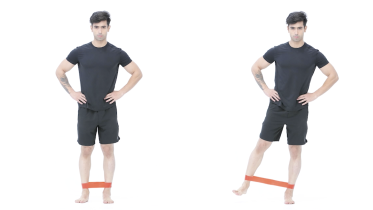 Standing hip abduction with band
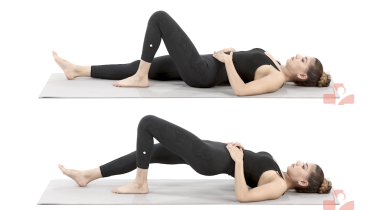 Single leg bridge
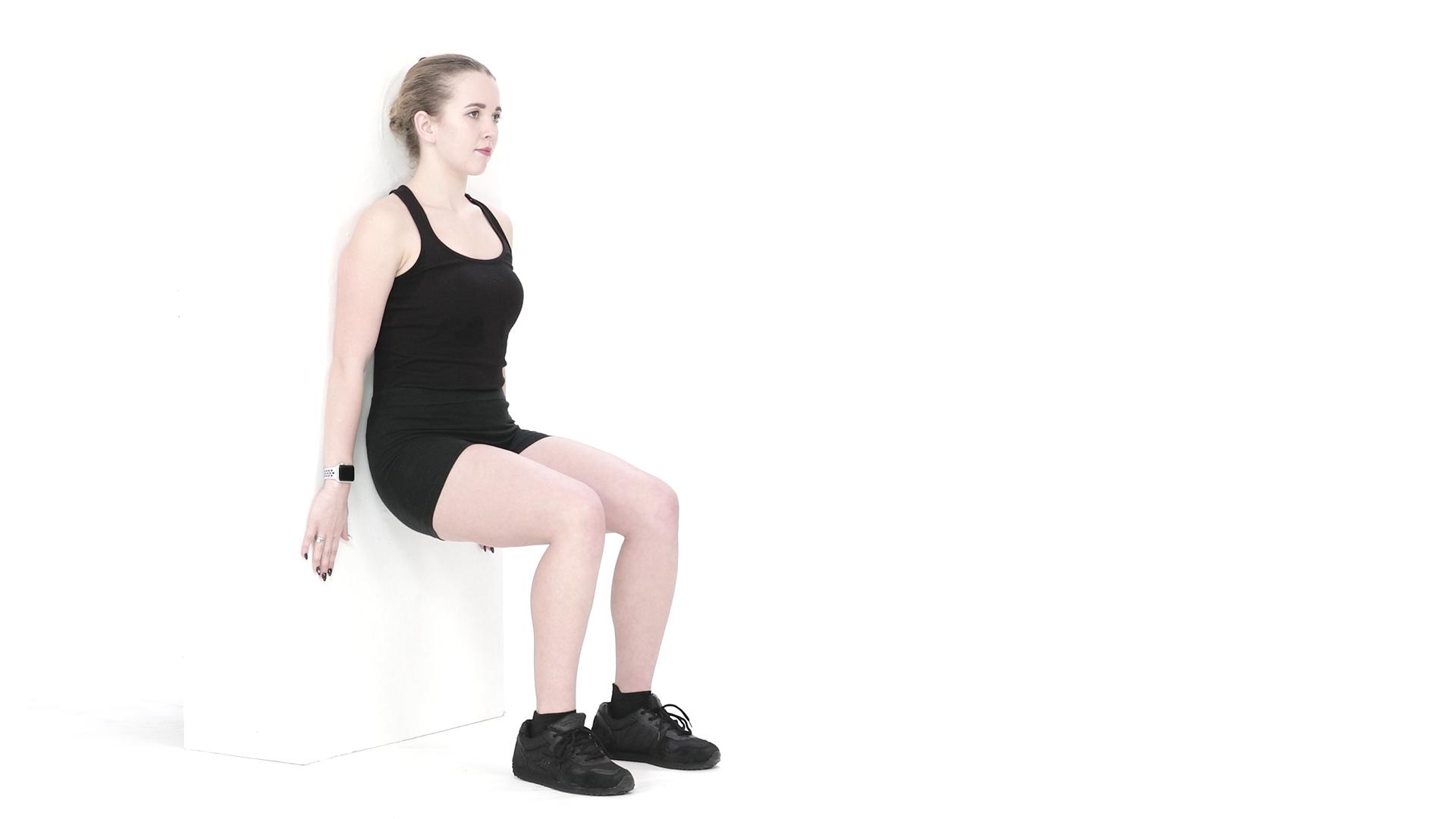 Wall sit
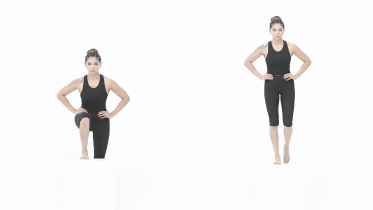 Step up
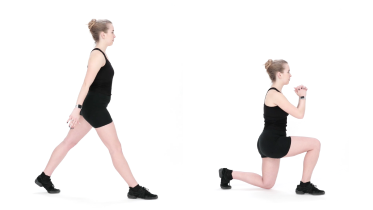 Split squat
Is it runner's knee or something else?
Runners use the name loosely, and the spot that hurts matters. Pain you could cover with a fingertip at the bottom edge of the kneecap points more toward the tendon, which is covered on the patellar tendinopathy page. A sharp spot on the outside of the knee that arrives partway into a run fits IT band syndrome better. The knee pain after running page sorts these by location.
If you have already stopped and want a structured way back, the return to running plan covers the walk and run stages. The running injuries hub lists the other common problems by body area.
When to see a physio (physical therapist)
Book an assessment if the knee is no better after a few weeks of changing your running, if it hurts from the first few minutes of every run, or if you are limping. A physio will check the knee and the hip, watch you squat and step down, and often watch you run, then set both the strength dose and the running dose with you.
Swelling, locking, the knee giving way or pain at one spot on a bone are not part of runner's knee. The warning signs below say how fast to act on each.
Related exercise programs
Warning signs
Get emergency help now
- Emergency: you felt a sudden pop or tearing feeling below your kneecap, the kneecap seems to have moved up toward the thigh, or you suddenly cannot straighten your knee or lift your leg out straight. Stop exercising and go to an emergency department straight away, even if you can still walk, as this can be a torn patellar tendon. Do not drive yourself. A repair usually does better if it is done soon after the injury.
- Emergency: the knee has moved out of place, looks misshapen or is pointing at an odd angle, or you have tingling or no feeling in the knee, leg or toes, or your foot turns cold, pale or blue. Go to an emergency department straight away. Do not drive yourself: ask someone to drive you or call an ambulance.
- Emergency: the whole knee, not just the kneecap, felt as though it slid or shifted right out of place at the moment of injury, even if it went back straight away, or the knee now feels loose or wobbly in more than one direction. Go to an emergency department straight away. Do not drive yourself: ask someone to drive you or call an ambulance. A knee that comes out of place and goes back can tear several ligaments at the same time and can damage the artery or the nerve behind the knee. That damage is not always obvious at first, and the knee can look almost normal, so it is checked in hospital on the day rather than worked out at home.
- Emergency: the knee became very swollen very quickly, within a few hours of a twist, fall or blow, or you felt a pop or snap. Go to an emergency department straight away. Do not drive yourself: ask someone to drive you or call an ambulance.
- Emergency: the kneecap has slipped out of place, even if it went back by itself. If it is still out of place, go to an emergency department straight away, and do not drive yourself. If it went back by itself, get medical advice the same day.
- Emergency: you are still growing and have pain that wakes you at night, pain at rest that keeps getting worse, or a lump or swelling around the knee or thigh that keeps growing. If you also have a rash that does not fade when you press it, call emergency services or go to an emergency department.
Get help today
- Same day: the pain started with a fall, a twist or a blow to the knee, or you cannot put weight on the leg. Get medical advice the same day.
- Same day: the knee locks and you cannot straighten it, keeps giving way under you, or clicks painfully. Get medical advice the same day, and stop running until it has been checked. Painless clicking on its own is common.
- Same day: the knee swells up with no clear reason, including swelling that appears after a run when you have not injured it. Get medical advice the same day, and stop running until it has been checked.
- Same day: the knee is hot, red and swollen, or you have knee pain with a high temperature or feel hot, cold or shivery. Get medical advice the same day, and go to an emergency department if you feel very unwell. This can be a sign of infection in the joint, which needs treatment quickly.
- Same day: you are a teenager who is still growing and you have a limp, or pain in the hip, groin or thigh as well as the knee. Get an urgent appointment with a doctor the same day, and stay off sport and these exercises until you have been checked. If you cannot put weight on the leg, have a high temperature or feel very unwell, go to an emergency department. Some hip problems in growing teenagers, such as a slipped growth plate at the top of the thigh bone (slipped capital femoral epiphysis), are felt in the knee and need checking quickly.
- Same day: pain at night or at rest that keeps getting worse. If you are being treated for cancer now, contact your cancer team the same day.
Book an appointment
- Within a day or two: you are still growing and have pain that wakes you at night, pain at rest that keeps getting worse, or a lump or swelling around the knee or thigh that keeps growing. See a doctor within a day or two. Ask for an urgent appointment rather than the next routine one, and say what the pain does at night and whether a lump is getting bigger. Do the same if the pain comes with looking pale, unusual tiredness, fevers with no clear cause, bruising or bleeding easily, or weight loss. Bone pain that is worse at night, or a new lump, needs checking to rule out rarer causes such as a bone tumor or a blood cancer (leukemia).
- Within a few days: the pain sits at one small spot on a bone that you can point to with a finger, such as the kneecap or the top of the shinbone, the bone aches at rest or at night, or hopping on that leg hurts at that one spot. Stop running, jumping and any exercise that hurts at that spot, and see a doctor within a few days, as this can be a stress fracture. This matters even more if the spot is on the kneecap, because doctors treat stress fractures there as high risk. If walking hurts or makes you limp, get it checked the same day. An X-ray can look normal for the first 2 to 3 weeks, so a normal early X-ray does not rule it out.
- Within a day or two: pain at night or at rest that keeps getting worse. If you have had cancer, now or in the past, see your doctor sooner, within a day or two, and mention it, even if the pain is not getting worse. Do the same if you have knee pain and are losing weight without trying, even if it does not hurt at night.
- Within a few days: pain at night or at rest that keeps getting worse. See your doctor within a few days.
Common questions
Should I stop running with runner's knee?
Not completely, in most cases. Stop for now if running makes you limp, if the knee swells afterward, or if the pain is sharp from the first few minutes. Otherwise cut the distance and the pace until the run stays at a mild ache of about 2 out of 10 that settles within an hour, as the runners in the Esculier trial did, and judge each run by how the knee feels the next morning. Your physio will adjust this to your knee.
How long does runner's knee take to heal?
There is no fixed timetable. In a trial of 69 runners, all three treatment groups had improved by the end of the 8 week program and improved further by 20 weeks (Esculier and colleagues, 2018), while the 2016 international consensus notes that kneecap pain lingers for years in some people (Crossley and colleagues, 2016). If the knee is no better after a few weeks of changing your running, get it assessed instead of waiting.
Does a knee strap or brace help runner's knee?
The US physical therapy guideline advises against prescribing knee braces, sleeves or straps for kneecap pain, while taping the kneecap alongside exercise eased pain in the short term (Marra, 2020). Some runners still like a strap for a long run. Treat tape or a strap as a short-term help, never as a reason to drop the strength work or the changes to your running.
Can I run downhill with runner's knee?
Leave the steep descents until the knee has settled. In a treadmill study of 20 recreational runners, a gentle downhill slope put more stress on the joint behind the kneecap than flat or uphill running did (Ho and colleagues, 2018). Walk the downhill stretches of your usual routes for now and bring them back last, a short section at a time.
References
- Esculier JF, Bouyer LJ, Dubois B, et al. Is combining gait retraining or an exercise programme with education better than education alone in treating runners with patellofemoral pain? A randomised clinical trial. British Journal of Sports Medicine. 2018;52(10):659-666. https://doi.org/10.1136/bjsports-2016-096988
- Crossley KM, Stefanik JJ, Selfe J, et al. 2016 Patellofemoral pain consensus statement from the 4th International Patellofemoral Pain Research Retreat, Manchester. Part 1: Terminology, definitions, clinical examination, natural history, patellofemoral osteoarthritis and patient-reported outcome measures. British Journal of Sports Medicine. 2016;50(14):839-843. https://doi.org/10.1136/bjsports-2016-096384
- Willy RW, Hoglund LT, Barton CJ, et al. Patellofemoral Pain: Clinical Practice Guidelines Linked to the International Classification of Functioning, Disability and Health From the Academy of Orthopaedic Physical Therapy of the American Physical Therapy Association. Journal of Orthopaedic and Sports Physical Therapy. 2019;49(9):CPG1-CPG95. https://doi.org/10.2519/jospt.2019.0302
- Marra J. Patellofemoral Pain: Guidelines from the American Physical Therapy Association. American Family Physician. 2020;102(7):442-443. https://www.aafp.org/pubs/afp/issues/2020/1001/p442.html
- Ho KY, French T, Klein B, Lee Y. Patellofemoral joint stress during incline and decline running. Physical Therapy in Sport. 2018;34:136-140. https://doi.org/10.1016/j.ptsp.2018.09.010
- Lenhart RL, Thelen DG, Wille CM, Chumanov ES, Heiderscheit BC. Increasing running step rate reduces patellofemoral joint forces. Medicine and Science in Sports and Exercise. 2014;46(3):557-564. https://doi.org/10.1249/MSS.0b013e3182a78c3a
- Bramah C, Preece SJ, Gill N, Herrington L. A 10% Increase in Step Rate Improves Running Kinematics and Clinical Outcomes in Runners With Patellofemoral Pain at 4 Weeks and 3 Months. American Journal of Sports Medicine. 2019;47(14):3406-3413. https://doi.org/10.1177/0363546519879693
- Frandsen JSB, Hulme A, Parner ET, et al. How much running is too much? Identifying high-risk running sessions in a 5200-person cohort study. British Journal of Sports Medicine. 2025;59(17):1203-1210. https://doi.org/10.1136/bjsports-2024-109380
- American Academy of Orthopaedic Surgeons. Patellofemoral Pain Syndrome. OrthoInfo. https://www.orthoinfo.org/en/diseases--conditions/patellofemoral-pain-syndrome/
- NHS. Knee pain. Page last reviewed 21 December 2023. https://www.nhs.uk/symptoms/knee-pain/
Written and checked by the PocketPhysio editorial team. Last updated 2026-10-21.
This page is general education, not a diagnosis or a personal treatment plan. See a physiotherapist or doctor for advice about your own situation.