
Part of Running injuries: where they happen and what to do
Strength training for runners: a physio plan for calves, hips and thighs
Warning signs, and when to get help
Why one leg at a time
Running is a series of single leg landings. Every stride puts the whole body on one foot, and the calf, the thigh and the hip muscles on that side have to absorb the landing and push you on again. A framework for running injuries describes each of those structures as having its own capacity for load, which is exceeded when an injury happens (Bertelsen and colleagues, 2017). Building that capacity is the point of this session.
That is why every exercise here works one leg at a time, apart from the side plank. One-leg work also shows up the side that is lagging, which two-legged squats and calf raises tend to hide. If you have had a running injury on one side, expect that side to be the slower one to progress.
How often should runners do strength training?
Two sessions a week, every week, is the plan here. The figure is borrowed from public health guidance rather than running research: the UK Chief Medical Officers ask adults to do muscle strengthening activities on at least 2 days a week. A third session is fine in a lighter running block, for example in the off season or the weeks after a race.
Where you put the sessions matters more than people expect. Many runners do strength work on the same day as an easy run, ideally a few hours after it, or on a rest day, so that hard runs and long runs happen on fresh legs. Avoid heavy leg work the day before a race or your longest run. In race week, keep a short, lighter session rather than dropping it altogether.
What strength work does for your running
The performance evidence is reasonably consistent. A 2018 systematic review of strength training in middle and long distance runners found that running economy, meaning how much oxygen you use at a given pace, improved in most of the studies that measured it, often by around 2 to 8% compared with runners who did not add strength work (Blagrove and colleagues, 2018). Time trials from 1.5 to 10 km also tended to improve. Body composition did not get worse, which answers the common worry that lifting will make you heavier and slower.
Most of those studies were in trained runners, and many used heavier gym lifting than a home plan can offer. So a home session is a starting point, and a gym is the natural next step once body weight and dumbbells stop being a challenge.
Does strength training prevent running injuries?
This is where honesty matters, because a lot of advice oversells it. Across many sports, strength training programs cut injuries to less than a third of the rate in control groups in a 2014 meta-analysis, while stretching programs made no significant difference (Lauersen and colleagues, 2014). A later meta-analysis by the same lead author found the benefit grew with the amount of strength training done (Lauersen and colleagues, 2018). Both reviews pooled trials from many sports, not running alone.
When a 2024 review looked only at endurance runners, pooling all the exercise programs showed no clear drop in injury risk or injury rate (Wu and colleagues, 2024). Programs that were supervised did seem to lower risk, which may simply mean people did more of the work when someone was watching. So train for the strength and the running benefit, and think of fewer injuries as a probable extra. If you are working through a current problem, such as runner's knee or Achilles pain when running, its own program comes before this general plan.
The six exercises and what each one is for
The split squat trains the front of the thigh and the buttock through a long, staggered stance. It loads the knee in a controlled way, which is why it turns up in programs for patellofemoral pain.
The single leg deadlift works the back of the thigh and the buttock while you balance, and it trains the hip hinge that controls your pelvis on landing. The single leg bridge loads the same muscles lying down, without the balance demand, so it suits days when your legs are tired.
The calf takes a large share of each push off, and it has two parts. The single leg heel raise, with the knee straight, works the upper calf (gastrocnemius). The bent-knee calf raise shifts more of the work onto the deeper muscle underneath (soleus), so doing both covers the whole calf. Both are part of the Achilles tendinopathy and shin splints programs.
The side plank works the trunk and the muscles at the side of the hip together. Those hip muscles help keep the pelvis level when you land on one leg, and they are a regular part of programs for outer hip pain, which is covered on our hip pain when running page.
Adding load without losing form
Start with body weight for the first two to three weeks, and spend that time on position rather than effort. When you reach the top of the range on every set for two sessions in a row, make one thing harder. More repetitions come first, then a harder version, then weight.
For weight, a light dumbbell or kettlebell in each hand, or a backpack with books in it, is enough to start, for example 2 to 5 kg (4.4 to 11 lb). Heel raises can later go onto the edge of a step, and the split squat can go to a rear-foot-elevated version once your physio is happy with your control. Our guide to exercise progression works through the same order with other examples, and the FITT principle guide explains how physios adjust frequency, intensity, time and type. Your physio will adjust this.
Muscle soreness for a day or two after a new exercise is normal. Sharp pain during a repetition, or a joint that is more swollen or painful the next morning, means the step was too big, so drop back.
Exercises that can help
Six exercises in one session, done in this order, 2 or 3 days a week. Split squats often use 2 to 3 sets of 8 to 12 on each leg, starting with a shorter range, single leg deadlifts 2 to 3 sets of 6 to 10 on each leg, and single leg bridges 2 to 3 sets of 8 to 12 on each side with a 2 to 5 second hold. Single leg heel raises and bent-knee calf raises both often start at 2 to 3 sets of 8 to 15 on each leg, and the side plank at holds of 10 to 30 seconds, 2 to 5 times on each side. If an exercise page gives different numbers, go with the page. Your physio will adjust this.
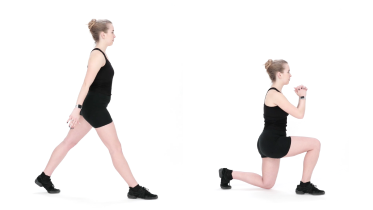 Split squat
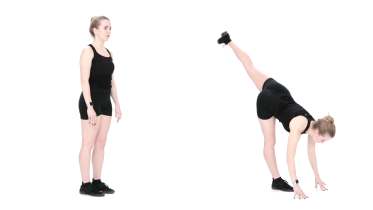 Single leg deadlift
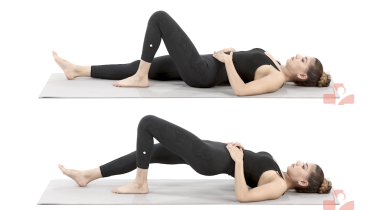 Single leg bridge
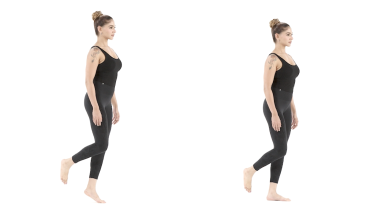 Single leg heel raise
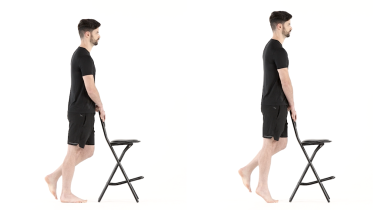 Bent-knee calf raise
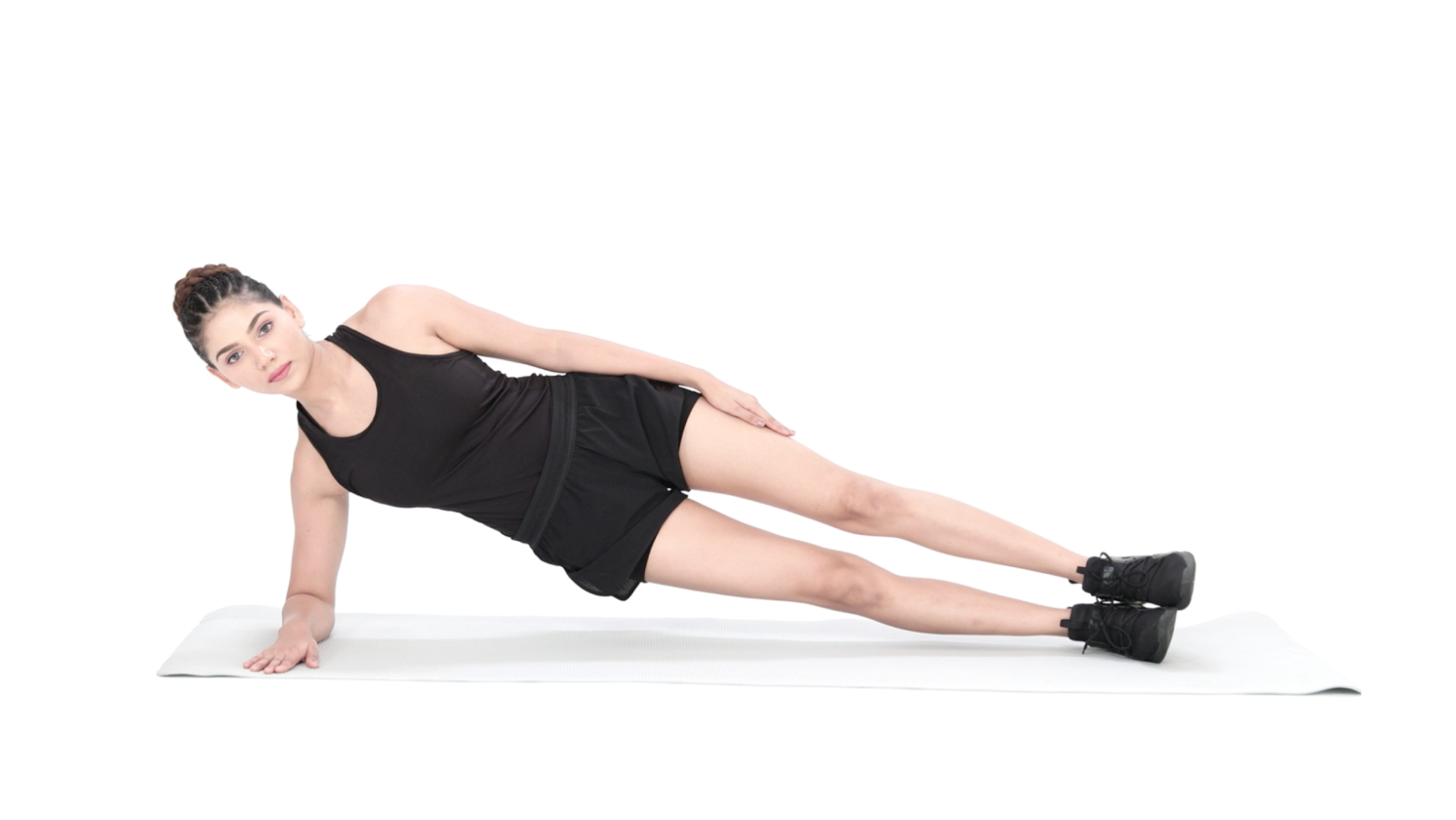 Side plank
Read the precautions on each exercise page before you start, because they outrank this list. Keep a wall, counter or sturdy chair beside you for the split squat, single leg deadlift and heel raises, and hold it throughout if your balance is poor or you have had falls. Wear flat shoes that fit well and grip the floor, not socks, tights or bare feet. After an Achilles tendon repair or ankle surgery, single leg heel raises come later in rehab, so wait until your surgeon's protocol and your physio both say you are ready.
If you have had a hip replacement or other hip surgery, get the go-ahead from your surgeon or physio before you try split squats, single leg deadlifts or the side plank. Some operations limit this kind of work for the first months, so the timing depends on your surgery. After hip, knee or back surgery, single leg work starts when your surgeon's protocol allows it. If you are pregnant and past the first three months, check with your physio before exercising flat on your back. That includes the single leg bridge.
If you have osteoporosis, keep your back straight and the range small on the single leg deadlift, and check with your physio first, because rounding the spine forward is a position many osteoporosis programs limit. With a painful shoulder, or after shoulder surgery or a dislocation, check with your physio before putting your full weight through one arm in the side plank.
If you have high blood pressure, breathe steadily through every repetition and never hold your breath. With a heart condition or high blood pressure, check with your doctor before you start. If chest pain, pressure or tightness does not ease quickly when you rest, spreads to your arm, neck, jaw, stomach or back, or comes with sweating, feeling sick, feeling light-headed or being short of breath, call emergency services straight away, as this can be a heart attack. If it eases quickly and none of these happen, get medical advice the same day, and do not exercise again until you have been checked.
When to see a physio (physical therapist)
Book a session before you start if weights are new to you, if an old knee, hip, ankle or back injury flares every time you add load, or if you have had surgery in the past year. One visit is usually enough to set the starting version of each exercise and check your form.
Come back if a pain lasts more than two sessions, if one side stays clearly weaker after a couple of months, or if you want the plan built around a race. A physio can also swap any of the six for an exercise that asks the same muscles for the same job. Where a surgical team is involved, their plan comes first. The warning signs below come first too, at the speed each one sets.
Related exercise programs
- Patellofemoral pain
- Achilles tendinopathy
- Shin splints
- Hamstring strain
- Greater trochanteric pain syndrome
Warning signs
Get emergency help now
- Emergency: if chest pain, pressure or tightness does not ease quickly when you rest, spreads to your arm, neck, jaw, stomach or back, or comes with sweating, feeling sick, feeling light-headed or being short of breath, call emergency services straight away, as this can be a heart attack. If it eases quickly and none of these happen, get medical advice the same day, and do not exercise again until you have been checked.
- Emergency: any sign of a stroke, even if it goes away. That means a face that droops on one side, an arm you cannot lift or keep up, slurred or muddled speech, weakness or numbness on one side of your body or face, sudden blurred vision, double vision or loss of sight, trouble swallowing, sudden dizziness with unsteadiness or falling over, a sudden severe headache, or a sudden fall where your legs give way but you do not black out (a drop attack). Call emergency services straight away.
- Emergency: pain, tingling, numbness or weakness in both legs, numbness or altered feeling around your genitals or bottom, or new trouble peeing or controlling your bladder or bowels. The same applies if you lose feeling in one leg. Call emergency services or go to an emergency department straight away. These can be signs of pressure on the nerves at the base of the spine (cauda equina syndrome).
- Emergency: sudden, severe pain in your lower back or tummy that is not like your usual back pain, if you have been told you have a swelling of the main blood vessel in your tummy (abdominal aortic aneurysm), you are over 60, you smoke or used to smoke, or you have high blood pressure. The same applies if sudden, severe back or tummy pain comes with feeling faint or passing out, pale, sweaty or clammy skin, a racing heartbeat or being short of breath. Call emergency services straight away. This can be a sign of an aneurysm bursting, which needs treatment in hospital at once.
Get help today
- Same day: a sudden pop or snap at the back of your ankle or heel, a feeling that someone kicked you there, or sudden pain there after which you cannot push off or rise onto your toes on that leg. Stop, take the weight off that leg carefully and go to an urgent care center or emergency department the same day, even if you can still walk, as this can be a torn Achilles tendon.
- Same day: a sudden sharp pain, pop or snap at the back of your thigh. Stop straight away. If you then get large bruising spreading down the back of the thigh, a gap or dip you can feel, a stiff-legged walk, or clear weakness when you bend the knee, get assessed the same day at urgent care or an emergency department, as the tendon may have pulled away from the bone near the buttock.
- Same day: dizziness or feeling faint during or after exercise, without any of the emergency signs above. Stop the exercises and get medical advice the same day. If you faint, it does not settle within a few minutes of sitting still, or you cannot stand or walk steadily, call emergency services.
- Same day: a calf or thigh that is newly swollen or getting more swollen, warm, tender, red or darker than usual, has swollen veins that are sore to touch, or has a throbbing or cramping pain that does not fit your injury or condition, or that feels different from normal muscle soreness after exercise. This can be a sign of a blood clot (deep vein thrombosis), especially after surgery, an injury, time in a cast or boot, a long trip or a spell of being much less mobile than usual. Get medical advice the same day. If you are also short of breath or have chest pain, call emergency services.
- Same day: back pain that comes on suddenly after lifting, bending, a cough or a sneeze, even without a fall, if you have low bone density (osteoporosis). Get medical advice the same day. This can be a sign of a broken bone in the spine (vertebral fracture). Stop the exercises until you have been checked.
- Same day: the pain is there at night or at rest and keeps getting worse. If you are being treated for cancer now, contact your cancer team the same day.
Book an appointment
- Within a few days: sharp pain during an exercise, a joint that gives way, new swelling, or pain that is still worse a few days after you drop back a step. Stop that exercise and check with your physio before you do it again.
- Within a day or two: the pain is there at night or at rest and keeps getting worse. If you have had cancer, now or in the past, or are losing weight without trying, see your doctor sooner, within a day or two, and mention it. This applies even if the pain is not getting worse.
- Within a few days: the pain is there at night or at rest and keeps getting worse. See your doctor within a few days.
Common questions
How often should runners do strength training?
Two sessions a week is a sensible floor for most runners, and a third is fine in a lighter running block. The UK Chief Medical Officers ask all adults to do muscle strengthening activities on at least 2 days a week, which is a general health figure rather than one tested in runners. Leave at least a day between two strength sessions, and count them as part of your training week rather than something extra. Your physio will adjust this.
Should I lift on running days?
Yes, as long as you pair the strength work with an easy run rather than a hard one. A common approach is to run first and lift later the same day, or to lift on a rest day, so that your interval session or long run is done on fresh legs. Avoid heavy leg work the day before a race or your longest run of the week.
Can I do strength training for running at home without weights?
Yes. All six exercises on this page start with body weight, and one-leg versions are hard enough for most runners for the first several weeks. When the top of the range feels easy for two sessions in a row, add a light dumbbell, a kettlebell or a backpack with books in it, for example 2 to 5 kg (4.4 to 11 lb) to begin with. A step and a wall to hold are the only other kit you need.
Does strength training prevent running injuries?
It probably helps, but the running evidence is weaker than many training plans suggest. Across sports in general, a 2014 meta-analysis found that strength training cut injuries to less than a third of the rate in control groups (Lauersen and colleagues, 2014). A 2024 review that looked only at endurance runners found no clear drop in injuries when all exercise programs were pooled, although supervised programs did seem to lower injury risk (Wu and colleagues, 2024). Do it because it makes the legs stronger and may improve your running, and treat any injury benefit as a likely bonus rather than a promise.
References
- Blagrove RC, Howatson G, Hayes PR. Effects of strength training on the physiological determinants of middle- and long-distance running performance: a systematic review. Sports Medicine. 2018;48(5):1117-1149. https://doi.org/10.1007/s40279-017-0835-7
- Wu H, Brooke-Wavell K, Fong DTP, Paquette MR, Blagrove RC. Do exercise-based prevention programs reduce injury in endurance runners? A systematic review and meta-analysis. Sports Medicine. 2024;54(5):1249-1267. https://doi.org/10.1007/s40279-024-01993-7
- Lauersen JB, Bertelsen DM, Andersen LB. The effectiveness of exercise interventions to prevent sports injuries: a systematic review and meta-analysis of randomised controlled trials. British Journal of Sports Medicine. 2014;48(11):871-877. https://doi.org/10.1136/bjsports-2013-092538
- Lauersen JB, Andersen TE, Andersen LB. Strength training as superior, dose-dependent and safe prevention of acute and overuse sports injuries: a systematic review, qualitative analysis and meta-analysis. British Journal of Sports Medicine. 2018;52(24):1557-1563. https://doi.org/10.1136/bjsports-2018-099078
- Department of Health and Social Care. UK Chief Medical Officers' physical activity guidelines. Updated 10 July 2026. https://www.gov.uk/government/publications/physical-activity-guidelines-uk-chief-medical-officers-report/uk-chief-medical-officers-physical-activity-guidelines
- Bertelsen ML, Hulme A, Petersen J, Brund RK, Sørensen H, Finch CF, Parner ET, Nielsen RO. A framework for the etiology of running-related injuries. Scandinavian Journal of Medicine and Science in Sports. 2017;27(11):1170-1180. https://doi.org/10.1111/sms.12883
- NHS. Chest pain. Page last reviewed 8 August 2023. https://www.nhs.uk/symptoms/chest-pain/
- NHS. Symptoms of a stroke. Page last reviewed 12 September 2024. https://www.nhs.uk/conditions/stroke/symptoms/
- NHS. DVT (deep vein thrombosis). Page last reviewed 30 April 2026. https://www.nhs.uk/conditions/deep-vein-thrombosis-dvt/
- NHS. Osteoporosis. Page last reviewed 13 October 2022. https://www.nhs.uk/conditions/osteoporosis/
- NHS. Abdominal aortic aneurysm. https://www.nhs.uk/conditions/abdominal-aortic-aneurysm/
- National Institute for Health and Care Excellence. Abdominal aortic aneurysm: diagnosis and management (NG156). 2020. https://www.nice.org.uk/guidance/ng156
Written and checked by the PocketPhysio editorial team. Last updated 2026-10-16.
This page is general education, not a diagnosis or a personal treatment plan. See a physiotherapist or doctor for advice about your own situation.