
Muscle soreness after exercise or injury: how to tell the difference
Sore muscles or a pulled muscle?
The quickest way to sort this out is to ask when it started. Ordinary soreness has no starting moment. It creeps in over the hours after a session that was new, longer or harder than your body is used to, and you wake up the next day stiff.
A strain is a moment. People can usually say what they were doing, and many describe a sudden catch, a pull or a snap in one spot. That difference matters more than how much it hurts, because a mild strain can ache less than a first leg day.
Sports medicine draws the same line. The Munich consensus statement splits muscle problems into functional disorders, which include delayed soreness and have no tearing of fibers that shows up on a scan, and structural injuries, where fibers really do tear (Mueller-Wohlfahrt and colleagues, 2013). What follows is a guide to which pattern your symptoms fit, not a diagnosis. The two can also sit together, for example when a hard session leaves you generally sore and one calf then gives way on the way home.
What ordinary muscle soreness looks like
Delayed onset muscle soreness, or DOMS, builds over the hours after hard or unfamiliar exercise, is felt one to three days later and usually settles within a few days. The movements that bring it on are the lowering ones: walking downhill, running downstairs, and the way down of a squat or a curl. Cleveland Clinic gives the same picture and adds that soreness lasting a week or more may be an injury. A narrative review of the research puts the worst of it at 48 to 72 hours after the session (Hotfiel and colleagues, 2018).
Four things point toward plain soreness rather than damage:
- Nothing much hurt during the session or straight afterward, and the ache arrived the next morning.
- Both thighs, both calves or both arms ache, in the meaty part of the muscle rather than at one point, and the whole group is tender to press.
- It is stiffest after sitting still, and a gentle walk or a warm shower loosens it. Pain that builds the longer you move fits this pattern less well.
- Day three is better than day two, and by the end of the week it is a memory.
None of this tells you the session worked. When 110 men did eccentric elbow exercise, soreness matched the objective markers of muscle damage poorly, and soreness on pressing the muscle did not match them at all (Nosaka and colleagues, 2002).
What points to a strain or tear instead
A strain is an injury to a muscle or its tendon, and the NHS lists pain, tenderness or weakness, swelling or bruising, trouble taking weight or using the part normally, and muscle spasms or cramping. OrthoInfo describes thigh strains starting with a popping or snapping feeling as fibers tear, followed by sudden pain, tenderness and bruising that can spread down the limb and sometimes appears a day or two later.
In the clinic, these are the things that tip it toward a strain:
- One moment you can name, such as a sprint, a kick, a slip or a sudden reach.
- One spot you can find with a fingertip, usually the same spot each time you press.
- Pain when you tighten that muscle against resistance, and pain when you stretch it, rather than a general ache everywhere.
- Swelling, bruising, or a dip or gap you can feel in the muscle.
- Weakness or a limp that is clearly worse than the other side.
- Symptoms on one side only, when both sides did the same work.
Bruising is useful evidence, but it is slow. It can take a day or two to surface, and it usually tracks downhill under gravity (OrthoInfo). No bruise does not mean no strain.
One pattern needs faster action than the rest. A pop or a feeling of being kicked at the back of the ankle or heel, after which you cannot push off or rise onto your toes, can be a torn Achilles tendon rather than a calf strain, and that needs checking the same day even if you can still walk (Cambridge University Hospitals).
Our programs for a hamstring strain, a groin strain and a hip flexor strain set out what rehab looks like once a physio has confirmed which muscle is involved.
Other reasons a muscle hurts after exercise
Not everything that aches after training is soreness or a strain. A direct knock can bruise the muscle itself, which is why a dead leg feels tight and painful to stretch without any sprint to explain it. Cramp is different again: it grips hard, lasts seconds to minutes, and leaves the muscle tender afterward. Widespread aching in muscles you did not train, especially with a temperature or a new medicine, is not a training problem at all and belongs with your doctor. Muscle pain and tightness that arrives every time you exercise and goes when you rest is another pattern, and the NHS advises seeing a GP for pain, numbness, swelling or trouble moving part of your body that keeps happening when you exercise.
A few problems copy muscle pain closely enough to be missed. A blood clot in a leg vein causes throbbing pain, swelling, warmth or skin that is red, blue or darker than usual, and the NHS says to get help urgently rather than wait it out. Pressure building inside a limb after an injury or under a tight cast causes severe pain that is worse when the muscle is stretched, with numbness or weakness, and that is an emergency (NHS).
Muscle breakdown after very hard exercise, called rhabdomyolysis, shows up as badly swollen, painful or weak muscles and dark pee (Cleveland Clinic). Skin over the muscle that is hot, red and spreading points to infection instead (NHS). All four are in the warning signs below, with what to do and how fast.
What helps ordinary soreness
Time does most of the work. The useful question is what makes the next few days easier without slowing you down.
Keep moving gently. In a meta-analysis of 99 studies, massage came out as the most effective method for reducing soreness and perceived fatigue, with active recovery, compression garments and cold water immersion also helping (Dupuy and colleagues, 2018). Foam rolling after exercise cut muscle pain by about 6 percent in a meta-analysis of 21 foam rolling studies, 7 of which tested rolling after exercise, and the authors called the overall effects on performance and recovery minor (Wiewelhove and colleagues, 2019).
Stretching is the one to let go of. A Cochrane review of 12 trials found that stretching before, after, or both before and after exercise does not produce clinically important reductions in soreness, with effects of about half a point to one point on a 100 point scale the day after exercise (Herbert and colleagues, 2011). Stretch because you want the range or because it feels pleasant, not as soreness insurance.
Cold has modest support. A Cochrane review found cold water immersion reduced soreness compared with passive rest, though the trials were small and the authors asked for better reporting of harms (Bleakley and colleagues, 2012), while whole-body cryotherapy chambers had too little evidence behind them to judge (Costello and colleagues, 2015). A warm shower or a heat pack is fine for comfort when there is no fresh injury.
Next time, build up instead of jumping ahead. The American College of Sports Medicine position stand says gradual progression of exercise intensity and volume may lower the risks of exercise (Garber and colleagues, 2011), and muscle adapts fast: the same session repeated produces markedly less soreness the second time (Hyldahl and colleagues, 2017).
What helps if you think you pulled a muscle
For the first 2 to 3 days the NHS advises protecting and resting the injury, with an ice pack wrapped in a towel on it for up to 20 minutes every 2 to 3 hours. It also advises a bandage for support during the day, and keeping the part raised on a pillow when you can. Heat, alcohol and massage are the things to leave alone in those days.
After that, gentle movement inside a comfortable range beats complete rest, and the strain programs above build the load back in stages. Let the muscle tell you the size of each step: soreness that settles by the next morning is acceptable, and pain that is sharp during the exercise is not. Our guide to the pain monitoring model explains how physios use that next-morning check.
Ask for help early rather than late if the leg will not take your weight, if the pain is severe, or if you felt a pop with immediate weakness. The same goes for a strain in the same muscle that keeps coming back, which usually means the rehab stopped before the muscle was ready.
Exercises that can help
These are easy options for a body that is already sore, not a training session. Brisk walking often starts at 10 to 20 minutes on most days, marching on the spot at 30 seconds to 1 minute repeated 2 to 3 times, foam rolling at 30 to 60 seconds per leg, the standing quad stretch at holds of 20 to 30 seconds and the calf stretch at holds of about 30 seconds, both 2 to 3 times on each side. Check each page for its own dose, precautions and stop signs. Your physio will adjust this for you.
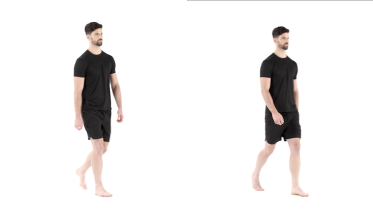 Brisk walking
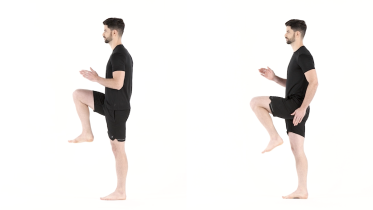 Marching on the spot
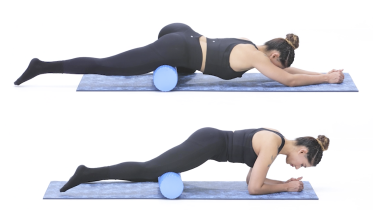 Quad foam rolling
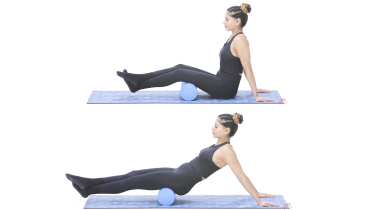 Hamstring foam rolling
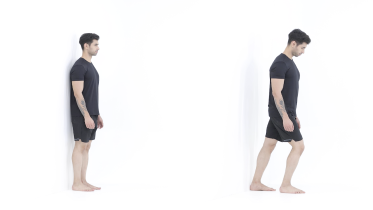 Calf stretch
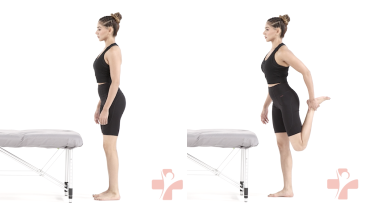 Standing quad stretch
Walking and marching keep you moving without loading the sore muscles. That is the active recovery the meta-analysis above supports. The two rollers and the two stretches are comfort measures, and the rolling is the one with pain relief behind it.
Do not roll or massage a calf or thigh that is newly swollen, warm, tender or throbbing until a doctor has checked it, and go around any area that is bruised (see the warning signs for what that could be). Hold a counter during the standing quad stretch if you feel unsteady.
If you have a clotting or bleeding disorder, take blood-thinning medicine, have varicose veins, or have ever had a blood clot in the leg, check with your doctor or physio before you use a roller on it. If you have had a hip replacement, get the go-ahead from your surgeon or physio before you try marching on the spot. A high knee lift can bend the hip past a right angle, and many surgeons ask you to avoid that for the first months after some operations.
Stop any of them for chest pain or pressure, dizziness or feeling faint, a racing or irregular heartbeat, or being far more out of breath than the effort should cause. If chest pain, pressure or tightness does not ease quickly when you rest, spreads to your arm, neck, jaw, stomach or back, or comes with sweating, feeling sick, feeling light-headed or being short of breath, call emergency services straight away, as this can be a heart attack. If it eases quickly and none of these happen, get medical advice the same day, and do not exercise again until you have been checked.
When to see a physio (physical therapist)
Book an appointment if soreness has not settled within a week, if one muscle stays painful or weak while the rest of you recovers, or if the same muscle has now been strained more than once. A physio can test the muscle against resistance and on stretch, work out how much of it is involved, and plan the return to running, lifting or sport with a loading schedule rather than a guess.
Come sooner if you cannot take weight on the leg, if the muscle looks or feels different in shape, or if any of the warning signs below apply. If you have had surgery on the area, follow the plan from your surgeon and physio first, and ask them before adding anything from this page. If the soreness after training sits around the knee itself rather than in the thigh muscle, the page on knee pain when squatting is the better read.
Related exercise programs
See a doctor promptly if
- Emergency: dark pee (brown, red or tea-colored) after exercise, or muscles that become badly swollen, extremely painful or too weak to use, are not normal soreness. Go to an emergency department straight away, as these can be signs of serious muscle damage (rhabdomyolysis).
- Emergency: sudden, severe pain in a muscle that is much worse than you would expect or keeps getting worse, especially after an injury or with a plaster cast or tight bandage on the arm or leg. It may come with a tight, swollen limb, pain that gets worse when the muscle is stretched, numbness, pins and needles or weakness. Call emergency services or go to an emergency department straight away, and do not drive yourself. This can be acute compartment syndrome, which needs urgent surgery.
- Emergency: you heard a crack as you were injured, the injured part has changed shape or points at an odd angle, the skin around it turns blue or gray or feels cold, or you have numbness, tingling or pins and needles. Go to an emergency department straight away, and do not drive yourself.
- Same day: a calf or thigh that is newly swollen, warm, tender, red or darker than usual, has swollen veins that are sore to touch, or has a throbbing or cramping pain that does not fit your injury or condition, or that feels different from normal muscle soreness after exercise. This can be a sign of a blood clot (deep vein thrombosis), especially after surgery, an injury, time in a cast or boot, a long trip or a spell of being much less mobile than usual. Get medical advice the same day. If you are also short of breath or have chest pain, call emergency services.
- Same day: the skin over a sore muscle is hot, red and swollen, or the redness is spreading, or you have muscle pain with a high temperature or feel hot, cold or shivery. Get medical advice the same day, and go to an emergency department if you feel very unwell. This can be a sign of infection, which needs treatment quickly. If hot, red or swollen skin comes together with a high temperature or feeling hot, cold or shivery, a fast heartbeat or fast breathing, purple patches on the skin (less obvious on brown or black skin), dizziness or feeling faint, or confusion, call emergency services or go to an emergency department straight away. If you have a very high or very low temperature, shivering you cannot control, you are breathing very fast or finding it hard to breathe, you are confused or your speech is slurred, your skin, lips or tongue look blue, gray, pale or blotchy (on brown or black skin this can be easier to see on the palms of the hands or soles of the feet), or you have a rash that does not fade when you press it, call emergency services, as this can be sepsis.
- Same day: the pain is very bad or getting worse, the swelling or bruising is large or growing, you find it very hard to stand or walk on the leg, or the limb is very stiff and hard to move. Get medical advice the same day.
- Same day: a sudden pop or snap at the back of your ankle or heel, a feeling that someone kicked you there, or sudden pain there after which you cannot push off or rise onto your toes on that leg. Stop, take the weight off that leg carefully and go to an urgent care center or emergency department the same day, even if you can still walk, as this can be a torn Achilles tendon.
- Within a few days: soreness that is still there a week after the session that caused it, pain that stays sharp rather than settling into an ache, or a muscle that stays weak. See a doctor or physio within a few days, because that pattern fits an injury rather than ordinary soreness.
- Within a few days: aching in several muscles with no hard or new exercise to explain it, or muscle aching that started after a new medicine. See your doctor within a few days, and ask the prescriber or pharmacist about the medicine. Do not stop a prescribed medicine on your own.
- Within a week or two: the same muscles get tight, cramping or painful every time you exercise and settle when you stop and rest, especially with numbness, tingling or weakness, or a foot that slaps down as you run. This is not an emergency, but stop that activity and see a doctor in the next week or two, as it can be chronic exertional compartment syndrome. If the numbness or weakness is still there after you have rested, get it checked the same day.
Common questions
How do I know if it is DOMS or an injury?
Ask yourself three things. Was there a moment when it happened, can you put one fingertip on the sore spot, and does it hurt when you tighten or stretch that one muscle? Ordinary delayed soreness answers no to all three: it creeps in over hours, covers a whole muscle group, and usually sits on both sides if you trained both. A strain answers yes, and often adds swelling, bruising or weakness within a day or two. If you are still unsure after a few days, or the muscle feels weak, have a physio look at it.
How long does DOMS last after a workout?
Most of it clears within a few days. Cleveland Clinic describes soreness that starts one to three days after the session and rarely lasts more than five days, and a review by Hotfiel and colleagues (2018) puts the peak at 48 to 72 hours. The first session of a new program is normally the sorest one, and the same session repeated a few weeks later produces far less soreness, an adaptation known as the repeated bout effect (Hyldahl and colleagues, 2017). Soreness still present a week later is a reason to get checked rather than to push on.
Should I work out with sore muscles?
Usually yes, with the load changed rather than the week written off. Train a different muscle group, or repeat the same movement lighter and slower, and keep heavy or fast work until the soreness has faded. A meta-analysis by Dupuy and colleagues (2018) found that active recovery lowers soreness, so easy movement beats lying still. Soreness that is sharp, on one side only, or paired with weakness is a different matter, and that one gets checked before you train again.
Is muscle soreness a sign of muscle growth?
No. Soreness tracks how unfamiliar the work was, not how much you gained from it. In a study of 110 men doing eccentric elbow exercise, soreness was a poor reflection of the objective signs of muscle damage, and tenderness to pressure did not match them at all (Nosaka and colleagues, 2002). Regular trainers often stop getting sore while still adding strength, because the muscle adapts to the session (Hyldahl and colleagues, 2017). Judge progress by what you can lift and how you move, not by how much you ache the next day.
Heat or ice for sore muscles after a workout?
For plain soreness, use whichever feels better, because neither changes much. A Cochrane review found that cold water immersion reduced soreness compared with doing nothing, although the trials were small (Bleakley and colleagues, 2012), while a second Cochrane review found too little evidence to judge whole-body cryotherapy chambers (Costello and colleagues, 2015). A fresh injury is handled differently. The NHS advises an ice pack wrapped in a towel for up to 20 minutes every 2 to 3 hours in the first 2 to 3 days, and avoiding heat, massage and alcohol during those days, so heat is the thing to skip if you suspect a strain.
Is muscle soreness a side effect of Mounjaro, Wegovy or Zepbound?
That question belongs with the prescriber or the pharmacist, and this page gives no advice about any medicine. They hold your dose, your other medicines and your history, and they are the people who can say whether a symptom is linked to one of them. Never stop or change a prescribed medicine on your own. What applies to everyone is the warning signs on this page: dark pee after exercise, or a muscle that is badly swollen, extremely painful or too weak to use, needs an emergency department straight away, and a calf that is newly swollen, warm or throbbing needs medical advice the same day.
References
- NHS. Sprains and strains. Page last reviewed 23 April 2024. https://www.nhs.uk/conditions/sprains-and-strains/
- NHS. Deep vein thrombosis (DVT). Page last reviewed 30 April 2026. https://www.nhs.uk/conditions/deep-vein-thrombosis-dvt/
- NHS. Compartment syndrome. Page last reviewed 4 September 2026. https://www.nhs.uk/conditions/compartment-syndrome/
- NHS. Cellulitis. Page last reviewed 18 April 2024. https://www.nhs.uk/conditions/cellulitis/
- Cambridge University Hospitals NHS Foundation Trust. Achilles tendon rupture. Patient information. Approved 14 January 2025. https://www.cuh.nhs.uk/patient-information/achilles-tendon-rupture/
- American Academy of Orthopaedic Surgeons. Sprains, Strains and Other Soft-Tissue Injuries. OrthoInfo. https://www.orthoinfo.org/en/diseases--conditions/sprains-strains-and-other-soft-tissue-injuries/
- American Academy of Orthopaedic Surgeons. Muscle Strains in the Thigh. OrthoInfo. https://www.orthoinfo.org/en/diseases--conditions/muscle-strains-in-the-thigh/
- Cleveland Clinic. Delayed Onset Muscle Soreness (DOMS). Last reviewed 19 December 2025. https://my.clevelandclinic.org/health/diseases/delayed-onset-muscle-soreness
- Cleveland Clinic. Rhabdomyolysis. Last updated 24 February 2023. https://my.clevelandclinic.org/health/diseases/21184-rhabdomyolysis
- Mueller-Wohlfahrt HW, Haensel L, Mithoefer K, et al. Terminology and classification of muscle injuries in sport: the Munich consensus statement. British Journal of Sports Medicine. 2013;47(6):342-350. https://doi.org/10.1136/bjsports-2012-091448
- Hotfiel T, Freiwald J, Hoppe MW, et al. Advances in Delayed-Onset Muscle Soreness (DOMS): Part I: Pathogenesis and Diagnostics. Sportverletzung Sportschaden. 2018;32(4):243-250. https://doi.org/10.1055/a-0753-1884
- Heiss R, Lutter C, Freiwald J, et al. Advances in Delayed-Onset Muscle Soreness (DOMS) Part II: Treatment and Prevention. Sportverletzung Sportschaden. 2019;33(1):21-29. https://doi.org/10.1055/a-0810-3516
- Nosaka K, Newton M, Sacco P. Delayed-onset muscle soreness does not reflect the magnitude of eccentric exercise-induced muscle damage. Scandinavian Journal of Medicine and Science in Sports. 2002;12(6):337-346. https://doi.org/10.1034/j.1600-0838.2002.10178.x
- Hyldahl RD, Chen TC, Nosaka K. Mechanisms and mediators of the skeletal muscle repeated bout effect. Exercise and Sport Sciences Reviews. 2017;45(1):24-33. https://doi.org/10.1249/JES.0000000000000095
- Herbert RD, de Noronha M, Kamper SJ. Stretching to prevent or reduce muscle soreness after exercise. Cochrane Database of Systematic Reviews. 2011;(7):CD004577. https://doi.org/10.1002/14651858.CD004577.pub3
- Bleakley C, McDonough S, Gardner E, Baxter GD, Hopkins JT, Davison GW. Cold-water immersion (cryotherapy) for preventing and treating muscle soreness after exercise. Cochrane Database of Systematic Reviews. 2012;(2):CD008262. https://doi.org/10.1002/14651858.CD008262.pub2
- Costello JT, Baker PR, Minett GM, Bieuzen F, Stewart IB, Bleakley C. Whole-body cryotherapy (extreme cold air exposure) for preventing and treating muscle soreness after exercise in adults. Cochrane Database of Systematic Reviews. 2015;(9):CD010789. https://doi.org/10.1002/14651858.CD010789.pub2
- Dupuy O, Douzi W, Theurot D, Bosquet L, Dugue B. An evidence-based approach for choosing post-exercise recovery techniques to reduce markers of muscle damage, soreness, fatigue, and inflammation: a systematic review with meta-analysis. Frontiers in Physiology. 2018;9:403. https://doi.org/10.3389/fphys.2018.00403
- Wiewelhove T, Doweling A, Schneider C, et al. A meta-analysis of the effects of foam rolling on performance and recovery. Frontiers in Physiology. 2019;10:376. https://doi.org/10.3389/fphys.2019.00376
- Garber CE, Blissmer B, Deschenes MR, et al. American College of Sports Medicine position stand. Quantity and quality of exercise for developing and maintaining cardiorespiratory, musculoskeletal, and neuromotor fitness in apparently healthy adults: guidance for prescribing exercise. Medicine and Science in Sports and Exercise. 2011;43(7):1334-1359. https://doi.org/10.1249/MSS.0b013e318213fefb
Written and checked by the PocketPhysio editorial team. Last updated 2026-09-30.
This page is general education, not a diagnosis or a personal treatment plan. See a physiotherapist or doctor for advice about your own situation.