
Part of Pickleball and your body
Getting back on the pickleball court after an injury
The four steps, in order
Most players come back in two steps: wait until it stops hurting, then play. That works often enough to feel like a method and fails often enough to fill clinics.
The version that holds up has four steps.
- Settle the injured part so it is calm enough to work with.
- Rebuild its strength until the injured side is close to the other one.
- Rebuild the movements the sport asks for, which is where most people stop too early.
- Return to play in stages, adding one thing at a time.
Each step earns the next. That is the principle behind criterion-based progression, where you move on when a task can be done well and not when a number of weeks has passed, and where each new challenge is added only after the last one is handled cleanly (Porter and Hoch, 2023). It also gives you something to do while you wait, which matters when the calendar answer is vague.
Step 1: settle it
The aim here is a limb you can work with, not a limb that never complains. Relative rest usually beats complete rest: take out the part of the game that provokes it, keep the parts that do not, and keep moving generally.
Two things tend to help more than people expect. Keep using the rest of the body, because general fitness drops off quickly when everything stops, and faster with age than most people plan for. And give it a realistic window, since most soft tissue problems need weeks, not days, and a shoulder or a tendon usually takes longer than an ankle.
Two things do less than people hope. Waiting for pain to reach zero before starting anything usually delays the whole process. Hands-on treatment, needles, machines and the rest can be part of a plan, but none of them loads a muscle or a tendon, so something has to be added that does. This is also the step where an assessment pays for itself, because getting the problem named changes what the next three steps look like.
Step 2: rebuild strength
Strength is the step with the clearest measure: compare the injured side with the other one and keep working until the gap has closed.
A physio will usually test that gap directly, for example with a hand-held dynamometer, a single leg test, or a timed set of repetitions on each side. At home you can use simpler versions. Count how many single leg heel raises each calf manages before the height drops, or how many times you can stand from a chair on one leg. Write the numbers down, because memory flatters the injured side.
Older players have a second reason to take this step seriously. A leg that has spent six weeks off court is usually weaker than it was, and muscle is easier to lose than to rebuild, more so past 50. Playing again is not the same as strength training, so do not expect court time on its own to close the gap. The strength work carries on after you return; it does not stop at the door.
Step 3: rebuild the movements
Here is where most returns come unstuck. A leg strong enough for the gym can still be unprepared for the court, because pickleball does not ask for straight lines.
Think about what the game actually demands of you. Short bursts forward and back between the kitchen and the baseline, sideways scrambles with a change of direction at the end, split steps and sudden stops, reaching low for a dink with your weight on one leg, and turning to chase a ball behind you.
Add those back in a sensible order: controlled and slow first, then faster, then reacting to something outside your control such as a partner's call or a ball fed at you. The last of those three is the part people skip, and it is the one the court will test in your first game.
Balance belongs in this step too, and it matters more in this sport than in most. In weighted national estimates from the NEISS sample of United States emergency department visits, falls lay behind 51.3% of pickleball injuries, and most of those injuries were in the 60 to 79 age band (McMillan and colleagues, 2025). A record of injuries treated at one large health system, with a median patient age of 60, put 60% of injuries in the lower limb and 44% of those at the knee (Siow and colleagues, 2026). Neither figure tells you your own risk, since both count people who already needed care and neither measures hours played, but both point at the same thing: footing and change of direction deserve practice before you play, not after.
Balance work itself has better evidence behind it than anything else on this page, though it comes from a different population. A Cochrane review of 108 trials in people over 60 living at home, average age 76, found that programs built mainly on balance and functional exercises reduce the rate of falls by 24%, rated high-certainty evidence (Sherrington and colleagues, 2019). Those trials were not about returning to a sport, so take them as a reason to keep balance work in your week, not as a pickleball result.
Step 4: return in steps
A return is a series of decisions, not a single one. That is the point of the 2016 Bern consensus statement on return to sport, which treats the return as a continuum running alongside recovery and rehabilitation rather than a decision taken at the end of it (Ardern and colleagues, 2016). A 2023 clinical commentary sets the continuum out in three parts: returning to participation, where you are training or playing at a level below your goal; returning to sport, where you are competing again but not at your old standard; and returning to performance, where you are back to or beyond where you were (Porter and Hoch, 2023).
For a recreational player that translates into something like this.
- Drills alone or with a cooperative partner, no score, a fixed short time.
- Dinking games and controlled rallies, still with the harder shots left out.
- Friendly doubles, one session, with a partner who knows you are coming back.
- Your usual games, one session a week at first, then two.
- Longer sessions, back-to-back days, and finally tournaments or ladder play.
Change one thing at a time. If you add a second session this week, do not also add an hour and the drives, because when something flares you want to know what caused it. Give each level at least a couple of outings before you move up, and be willing to drop back a level instead of abandoning the whole plan when a session goes badly.
What to judge readiness on
Four questions, asked honestly, cover most of it.
- Symmetry. Is the injured side close to the other one for strength, movement and endurance, measured rather than guessed?
- Control. Can you do the sport's movements at speed, in both directions, without watching your own leg or arm do it?
- Confidence. Would you go for a ball you are not sure of, or do you hold back? Hesitation changes how you move, so take it seriously instead of talking yourself out of it.
- The morning after. Does a harder session leave you where an easier one does, or does it leave you stiff and sore into the next day?
A yes to all four points at the next level. A no to one of them usually means stay where you are for another week or two, which is a normal part of the process, not a setback.
Using the pain monitoring model
You need a rule for how much discomfort is acceptable, otherwise every twinge becomes a decision. The pain monitoring model gives you one.
Three checks decide whether the last session was the right size. How bad it got while you played and just after, where the pain sits when you wake the next day, and which direction it has moved across the last couple of weeks. A ceiling of about 5 out of 10 is the figure most often quoted, though physios often set a lower one for a joint, and our pain monitoring model guide sets out where the number comes from and how narrow the evidence behind it is.
Pick one morning test and use the same one every time, for example the first steps out of bed, a single chair stand, or lifting a kettle. The value is in comparing like with like week after week. The model covers the familiar pain of the problem you are treating, and nothing else: a new pain, a pain in a new place, or anything on the warning signs list below means stop and get advice instead of reaching for a number.
General exercises for the third step
These four are a base for getting back to court movement, not rehabilitation for any one injury. If your problem is at the calf or Achilles, the knee, the shoulder or the elbow, use the page for that part and the matching program, because the specific work matters more than this general set.
Set the balance work up properly before the first attempt. Work beside a counter or a heavy chair you can grab without stepping, and clear rugs, cables and pets out of the space first. Wear flat shoes that fit well and grip the floor, not socks, tights or bare feet. Anyone who has fallen in the past year, feels unsteady, or takes medicines that bring on dizziness should keep a hand on the support throughout, practice while somebody else is in the house, and ask their doctor or physio for a falls check.
A sudden loss of balance is different. Call emergency services straight away for any sign of a stroke, even if it goes away: sudden dizziness with unsteadiness or falling over, a face that droops on one side, an arm you cannot lift or keep up, slurred or muddled speech, weakness or numbness on one side of your body or face, sudden blurred vision, double vision or loss of sight, or a sudden severe headache.
If chest pain, pressure or tightness does not ease quickly when you rest, spreads to your arm, neck, jaw, stomach or back, or comes with sweating, feeling sick, feeling light-headed or being short of breath, call emergency services straight away, as this can be a heart attack. If it eases quickly and none of these happen, get medical advice the same day, and do not exercise again until you have been checked.
If you have had a hip or knee replacement, get the go-ahead from your surgeon or physio before you try single leg stance or side stepping. Some operations limit this kind of work for the first months, so the timing depends on your surgery. On the side lunge, start with a short step and a shallow bend, especially if your groin has been sore, and go wider only once that feels steady. For the step ups, pick a height you can control and do them beside a wall or a rail.
Exercises that can help
These belong to the third step, when you are rebuilding the movements the court asks for: standing on one leg, moving sideways, lunging out to the side, and stepping up and down under control. Usual starting points are 5 to 10 single leg lifts on each side held for a few seconds, 2 to 3 lengths of about 10 to 15 side steps each way once or twice a day, 2 to 3 sets of 8 to 12 lateral lunges on each side, and 2 to 3 sets of 8 to 12 step ups on each leg. These are a general base, not rehab for one injury. The numbers on each exercise page come first, and your physio will adjust this.
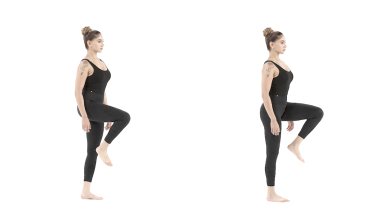 Single leg stance
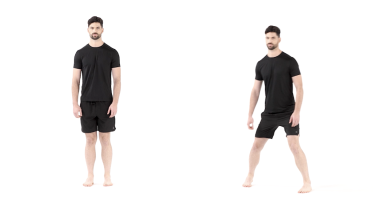 Side stepping
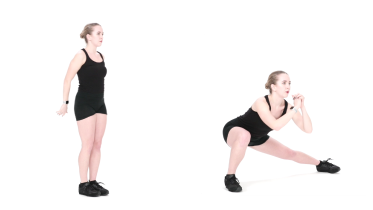 Lateral lunge
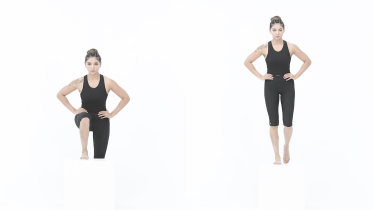 Step up
When to see a physio (physical therapist)
Go before the return, not after the relapse. The most useful appointment is the one where somebody measures the gap between your two sides and writes the staged plan, because that is the part players cannot do for themselves.
Book sooner if the injury has not moved in two or three weeks, if the limb gives way or locks, if you have come back twice and been stopped twice, or if you are not sure what the injury was in the first place. A physio will test each side, watch you move rather than take your word for it, set the criteria for each stage, and give you the version of the game you can keep playing meanwhile. Where surgery or a fracture is part of the story, your surgeon or hospital team's plan comes first and this page does not replace it. Prevention research in this sport is still thin, and a 2024 review of injuries in aging pickleball players describes the evidence base for preventing them as limited (Touhey and colleagues, 2024), so treat any promise of a guaranteed safe return with caution.
Related exercise programs
See a doctor promptly if
- Emergency: chest pain or pressure, dizziness or feeling faint, a racing or irregular heartbeat, or being far more out of breath than the effort should cause. If chest pain, pressure or tightness does not ease quickly when you rest, spreads to your arm, neck, jaw, stomach or back, or comes with sweating, feeling sick, feeling light-headed or being short of breath, call emergency services straight away, as this can be a heart attack. If it eases quickly and none of these happen, get medical advice the same day, and do not exercise again until you have been checked.
- Emergency: any sign of a stroke, even if it goes away. That means a face that droops on one side, an arm you cannot lift or keep up, slurred or muddled speech, weakness or numbness on one side of your body or face, sudden blurred vision, double vision or loss of sight, trouble swallowing, sudden dizziness with unsteadiness or falling over, a sudden severe headache, or a sudden fall where your legs give way but you do not black out (a drop attack). Call emergency services straight away.
- Emergency: after a knock to the head, you were knocked out, even for a moment, you cannot remember what happened just before or after, you have had a headache ever since, or you are being sick (vomiting). The same applies, even if you feel fine, if you take medicine that thins your blood, other than aspirin on its own, have a bleeding or clotting condition, have had brain surgery in the past, or had been drinking alcohol or taking drugs when it happened. Go to an emergency department straight away, and do not drive yourself.
- Emergency: you fell and cannot remember the fall or how it happened. Go to an emergency department straight away, and do not drive yourself. You may have blacked out or hit your head without knowing it.
- Emergency: you have had a fall or an injury and now have severe hip pain, or you cannot walk or put weight on the leg. Call emergency services or go to an emergency department. This can be a sign of a broken hip (hip fracture).
- Same day: a sudden pop or snap at the back of your ankle or heel, a feeling that someone kicked you there, or sudden pain there after which you cannot push off or rise onto your toes on that leg. Stop, take the weight off that leg carefully and go to an urgent care center or emergency department the same day, even if you can still walk, as this can be a torn Achilles tendon.
- Same day: a calf or thigh that is newly swollen, warm, tender, red or darker than usual, has swollen veins that are sore to touch, or has a throbbing or cramping pain that does not fit your injury or condition, or that feels different from normal muscle soreness after exercise. This can be a sign of a blood clot (deep vein thrombosis), especially after surgery, an injury, time in a cast or boot, a long trip or a spell of being much less mobile than usual. Get medical advice the same day. If you are also short of breath or have chest pain, call emergency services.
- Same day: new hip or groin pain after a fall, even a small one, if you are older, have low bone density (osteoporosis) or have taken steroid tablets for a long time, even if you can still walk. Get medical advice the same day. A broken hip is not always obvious at first.
- Same day: a leg or foot that is getting weaker, for example your foot drags, catches on the ground or slaps down when you walk (foot drop). Get medical advice the same day. If the weakness is getting worse by the hour, go to an emergency department.
- Same day: pins and needles, numbness or weakness in an arm or leg that does not go away after you stop. Get medical advice the same day. If one side of your face or body suddenly goes numb or weak, or your speech becomes slurred or muddled, call emergency services, even if it goes away.
- Within a few days: sharp pain during an exercise, a joint that gives way, new swelling, or pain that is still worse a few days after you drop back a step. Stop that exercise and check with your physio before you do it again.
- Within a few days: the pain is there at night or at rest and keeps getting worse. See your doctor within a few days. If you have had cancer, now or in the past, or are losing weight without trying, see your doctor sooner, within a day or two, and mention it. This applies even if the pain is not getting worse. If you are being treated for cancer now, contact your cancer team the same day.
Common questions
How long before I can play pickleball again after an injury?
There is no single number, and a clinician who gives you one without examining you is guessing. Tissue healing sets a floor, so a torn muscle or a broken bone has a minimum that no amount of enthusiasm shortens. Above that floor the date comes from what you can do, so set the next test instead of the next date: when you can move sideways at speed on that leg without thinking about it, you have earned the next step. A 2023 clinical commentary on the return to sport continuum treats progress as criterion-based, where you move on once a task is completed with few errors and not once a set number of weeks has passed (Porter and Hoch, 2023), and that is expert reasoning rather than trial evidence: the Bern statement says plainly that research to support return to sport decisions is scarce. After surgery or a fracture, your surgeon or hospital team sets the timeline and it comes before anything on this page.
How do I know I am ready to go back on court?
Look for four things together. The injured side should be close to the other one for strength and movement, you should be able to do the sport's movements at speed without watching yourself do them, you should trust the limb enough to react without hesitating, and the morning after a hard practice should look like the morning after an easy one. Confidence is not a soft extra here, because a player who is guarding a leg moves differently from one who is not. If any of the four is missing, you are usually ready to practice, not ready to compete, and that is a real stage rather than a consolation prize.
Should I play through the pain?
Some familiar pain is usually acceptable, and new or sharp pain is not. The pain monitoring model gives you a ceiling of about 5 out of 10 during and just after activity, with two checks on top of it: the next morning it should be back to your usual level, and it should not be climbing from week to week. Our pain monitoring model guide explains where those numbers come from and how thin the evidence is behind the exact figure. What the model never covers is pain in a new place, a joint that gives way, new swelling, or anything on the warning signs list on this page, and none of those is a number to be tolerated.
Why does my pickleball injury keep coming back?
Two things come up again and again: the return went from nothing to a full morning of games in one jump, or the third step got skipped. Most pickleball injuries in the player surveys are overuse problems: in a 2024 tournament survey in South Korea, 62 of the 79 players who reported an injury over the previous year, 78% of them, called it an overuse problem rather than a single traumatic moment (Jeong and colleagues, 2025). Overuse problems come back when the load returns faster than the tissue rebuilt, which is why a staged return matters more than a perfect exercise choice. The other common reason is that the first injury was never fully rehabilitated, so the limb went back on court weaker than its partner and stayed that way.
Should I wear a brace or taping when I go back?
It depends what it is for, and it should have an end date instead of becoming part of your kit forever. A brace or strapping can give a joint some mechanical support, and many people find it reassuring during the first weeks back. How much either is worth depends on the joint and the injury, and it is not a substitute for the strength and control work. Nothing you strap on makes an unready joint ready. Ask the clinician who assessed you whether yours is for support, for confidence or for a specific instability, because the answer changes how long you keep it on.
Do I have to stop playing completely while I recover?
Usually not, and complete rest is rarely the best plan. Most players can keep some version of the game going, for example by dinking only, by playing shorter sessions, by leaving out the shots that provoke it, or by playing doubles and letting a partner cover the running. Keeping a modified version going protects your fitness, your balance and your social life, all of which make the full return easier. What decides it is the injury, so ask your physio which part of the game you can keep, instead of assuming the answer is none of it.
References
- Porter KH, Hoch MC. A model for applying situational awareness theory to the return to sport continuum. International Journal of Sports Physical Therapy. 2023;18(4):1009-1015. https://doi.org/10.26603/001c.83946
- Ardern CL, Glasgow P, Schneiders A, et al. 2016 consensus statement on return to sport from the First World Congress in Sports Physical Therapy, Bern. British Journal of Sports Medicine. 2016;50(14):853-864. https://doi.org/10.1136/bjsports-2016-096278
- McMillan P, Lake LP, Burkhart A, Reddy E, Hale IC, Grawe BM. The epidemiology of pickleball injuries presenting to US emergency departments. Sports Health. 2026;18(4):749-755, first published online 13 July 2025. https://doi.org/10.1177/19417381251350671
- Jeong B, Lee KJ, Nam SH, et al. Injury risk and epidemiology of pickleball players in South Korea: a cross-sectional study. Frontiers in Public Health. 2025;13:1617291. https://doi.org/10.3389/fpubh.2025.1617291
- Siow MY, Zafar-Khan A, Limpisvasti O. Pickleball-related orthopaedic injury presentations to a large urban healthcare system from 2015 to 2024. JAAOS Global Research and Reviews. 2026;10(3):e25.00477. https://doi.org/10.5435/JAAOSGlobal-D-25-00477
- Touhey DC, Bozorgmehr CK, Tartibi DS, Smith MV, Knapik DM. Pickleball injuries in the aging athlete: a critical analysis review. Cureus. 2024;16(9):e69950. https://doi.org/10.7759/cureus.69950
- Sherrington C, Fairhall NJ, Wallbank GK, et al. Exercise for preventing falls in older people living in the community. Cochrane Database of Systematic Reviews. 2019;(1):CD012424. https://doi.org/10.1002/14651858.CD012424.pub2
- NHS. Heart attack. Page last reviewed 31 March 2026. https://www.nhs.uk/conditions/heart-attack/
- NHS. Symptoms of a stroke. Page last reviewed 12 September 2024. https://www.nhs.uk/conditions/stroke/symptoms/
Written and checked by the PocketPhysio editorial team. Last updated 2026-10-01.
This page is general education, not a diagnosis or a personal treatment plan. See a physiotherapist or doctor for advice about your own situation.