
Part of Pickleball and your body
Warming up for pickleball
What a warm-up can and cannot promise
Two different claims travel together and they deserve separating. The first is that warming up changes how you move in the opening minutes, which is easy to accept and easy to feel. The second is that it stops you getting hurt, and that one has never been settled.
A systematic review of the randomized evidence found five high quality trials. Three reported lower injury risk after a warm-up, two found no difference, and the authors concluded there was not enough evidence to endorse or to discontinue the routine, while saying the overall picture leaned slightly toward benefit (Fradkin 2006). Nobody has since run a trial in pickleball players, so nothing on this page is specific to the sport.
That is a thinner foundation than most coaching advice admits, and it does not change what to do. Ten minutes costs you nothing, and the demand this game makes is concentrated in the first two steps of the first rally, which is exactly where a cold body is least ready.
How do you warm up for pickleball?
Get warm, 2 to 4 minutes
Walk a lap of the courts, march on the spot, or do both while you wait for a partner. You are after mild warmth and slightly quicker breathing, not effort. If you are still cold when you pick up a paddle, the rest of this will not do much.
Move the joints you are about to use, 2 to 4 minutes
Now take each joint through the range the game will ask of it, one unhurried movement at a time, with no load on it. Shoulders go overhead. Ankles rock up and down. Hips swing across and step sideways, and knees bend under you in a wide lunge.
Keep everything smooth and inside a range that does not hurt. Hold a fence, a bench or a partner for anything done on one leg.
Rehearse the game, 1 to 2 minutes
Finish with the sport itself, starting slow. Dinks first, then some easy drives, then a few overhead reaches without a real swing, then build to normal pace over the last minute. This part also earns its place if you have stretched: in that review, the studies that put dynamic activity in after the stretching showed no clear drop in performance (Behm 2016).
Where stretching belongs
The evidence is more specific than the argument in the parking lot suggests. Averaged across studies, static stretching came out at about minus 3.7% on performance measures, dynamic stretching at plus 1.3% and proprioceptive neuromuscular facilitation stretching at minus 4.4%, with the deficits larger when static stretches ran to 60 seconds or more (Behm 2016). The same review found no clear effect of static or proprioceptive neuromuscular facilitation stretching on all-cause or overuse injuries, and no data at all for dynamic stretching. As an injury measure on its own, stretching produced a pooled risk ratio of 0.963 across randomized trials, which is no effect worth naming (Lauersen 2014).
Read together, that gives a simple rule. Keep anything you hold before play short, well under a minute, and always move again afterward. Save the long calf, hamstring and hip flexor holds for when the last game is finished, when a drop in power costs you nothing.
Cold courts and stiff mornings
Morning leagues and outdoor courts in Michigan or Manitoba are a different proposition from an indoor afternoon, and the answer is more time, not more effort. Add a few minutes at the front, keep a layer on until you are properly warm, and start the rehearsal slower than you think you need to.
If a knee or a shoulder is stiff for the first half hour of every day, that stiffness is information, not an obstacle. Take it to an assessment rather than warming through it for a season, because morning stiffness that lasts belongs to a diagnosis, and the right program is quicker than the wrong routine.
After the last game
This is where the held stretches go, and where your calves will thank you. It is also when to notice what the session cost you. Muscle soreness that peaks a day or two later and fades is ordinary; pain that is sharper the next morning than it was at the time, or that sits in one spot rather than through a muscle, is the kind to act on. Muscle soreness after exercise or injury works through the difference in detail.
Exercises that can help
Two to get you warm, three to take the joints through the range the game uses, and one to rehearse the step out to a wide ball, in that order. Marching on the spot often starts at 30 seconds to 1 minute, or 10 to 20 lifts on each leg, repeated 2 to 3 times. Arm circles run at 1 to 2 sets of 10 to 15 in each direction, side to side leg swings at 1 to 2 sets of 10 to 15 on each leg, heel and toe raises at 10 to 15 slow rises per set for 2 or 3 sets with a few toe lifts added, side stepping at 2 to 3 lengths of about 10 to 15 steps each way, and the lateral lunge at 2 to 3 sets of 8 to 12 on each side at a depth you can control. Courtside you will do fewer of each and move on sooner. Your physio will adjust this.
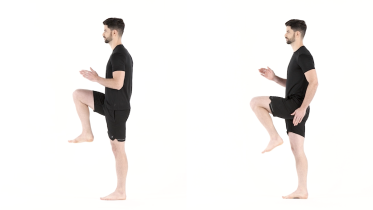 Marching on the spot
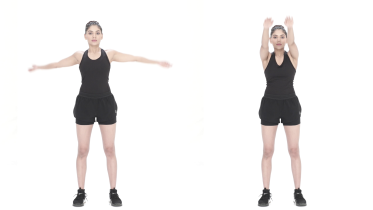 Arm circles
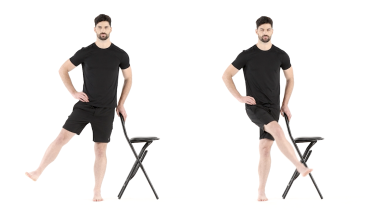 Side to side leg swings
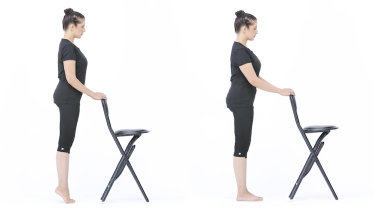 Heel and toe raises
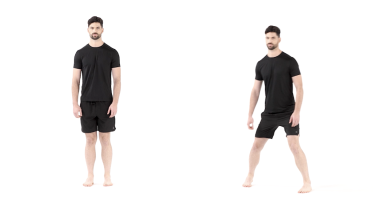 Side stepping
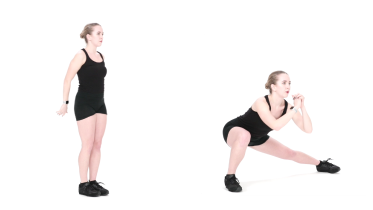 Lateral lunge
A few precautions before you start any of them. Wear flat shoes that fit well and grip the floor, not socks, tights or bare feet, and keep a fence, a sturdy chair or a counter within reach for the leg swings, the heel and toe raises and the side stepping. If you have fallen in the past year or often feel unsteady, keep one hand on the support for every repetition, ask your physio before you let go, and practice indoors with someone else at home before you try any of it courtside.
If you have had a hip replacement or other hip surgery, get the go-ahead from your surgeon or physio before you try side stepping, side to side leg swings and marching on the spot. A high knee lift bends the hip past a right angle and a swing across the standing leg takes it past the middle of your body, and many surgeons ask you to avoid both for the first months after some operations. Side stepping loads the muscles at the side of the hip, which are often held back for around the first 6 weeks after an operation through the side of the hip. After a shoulder dislocation, shoulder surgery or a recent shoulder injury, ask your physio before you add big overhead arm circles. Shorten the lateral lunge to a short step and a shallow bend if your groin or inner thigh has been sore, and go wider only when that feels steady.
If you have high blood pressure, breathe steadily through every repetition and never hold your breath. With a heart condition or high blood pressure, check with your doctor before you start. If chest pain, pressure or tightness does not ease quickly when you rest, spreads to your arm, neck, jaw, stomach or back, or comes with sweating, feeling sick, feeling light-headed or being short of breath, call emergency services straight away, as this can be a heart attack. If it eases quickly and none of these happen, get medical advice the same day, and do not exercise again until you have been checked.
When to see a physio (physical therapist)
Book an appointment if a warm-up stops feeling like a formality. A joint that needs fifteen minutes before it behaves, a calf that tightens in the first rally every time, or a shoulder that will not reach overhead without a wince are all telling you something a routine cannot fix.
Go sooner if you have gone down on a court, even once, or if you have started avoiding a shot because of how the last one felt. The pickleball hub has the rest of the picture, including what the injury research does and does not show. A physio can watch you lunge and reach, find which link is short or weak, and give you a warm-up built for that, not a general one copied from a video. Read the warning list below before any of that, and act on the timing each line gives.
Related exercise programs
See a doctor promptly if
- Emergency: if chest pain, pressure or tightness does not ease quickly when you rest, spreads to your arm, neck, jaw, stomach or back, or comes with sweating, feeling sick, feeling light-headed or being short of breath, call emergency services straight away, as this can be a heart attack. If it eases quickly and none of these happen, get medical advice the same day, and do not exercise again until you have been checked.
- Emergency: call emergency services straight away for any sign of a stroke, even if it goes away: sudden dizziness with unsteadiness or falling over, a face that droops on one side, an arm you cannot lift or keep up, slurred or muddled speech, weakness or numbness on one side of your body or face, sudden blurred vision, double vision or loss of sight, or a sudden severe headache.
- Emergency: you fell and cannot remember the fall or how it happened. Go to an emergency department straight away, and do not drive yourself. You may have blacked out or hit your head without knowing it.
- Emergency: after a ball, a paddle or a fall to the face, any change to your sight, severe pain in the eye, a headache or finding light hard to bear, feeling sick or being sick, an eye you cannot move or keep open, or blood or pus coming from the eye. The same applies if something has pierced the eye or hit it at high speed, or if a strong chemical has gone into it. Go to an emergency department or call emergency services straight away, and do not drive yourself.
- Emergency: after a knock to the head, being very drowsy or finding it hard to keep your eyes open, confusion, a fit (seizure), new weakness or numbness anywhere in your body, new trouble understanding, speaking, walking or keeping your balance, new problems seeing or hearing, clear fluid coming from your ears or nose, bleeding from your ears or bruising behind them, a black eye when your eye was not hit, a dent in your head or a wound with something stuck in it, or a change in behavior. Call emergency services straight away. These can be signs of an injury to the brain.
- Emergency: after a knock to the head, you were knocked out, even for a moment, you cannot remember what happened just before or after, you have had a headache ever since, or you are being sick (vomiting). The same applies, even if you feel fine, if you take medicine that thins your blood, other than aspirin on its own, have a bleeding or clotting condition, have had brain surgery in the past, or had been drinking alcohol or taking drugs when it happened. Go to an emergency department straight away, and do not drive yourself.
- Emergency: you have had a fall or an injury and now have severe hip pain, or you cannot walk or put weight on the leg. Call emergency services or go to an emergency department. This can be a sign of a broken hip (hip fracture).
- Emergency: the shoulder feels as if it has slipped out of place, looks a different shape or suddenly locks so you cannot move the arm, or the pain is severe after a fall or an injury. Go to an emergency department straight away, without driving yourself, and do not try to put the shoulder back in yourself.
- Same day: a sudden pop or snap at the back of your ankle or heel, a feeling that someone kicked you there, or sudden pain there after which you cannot push off or rise onto your toes on that leg. Stop, take the weight off that leg carefully and go to an urgent care center or emergency department the same day, even if you can still walk, as this can be a torn Achilles tendon.
- Same day: sudden new dizziness, or feeling faint or unsteady, without any of the stroke signs above. Stop, sit down and get medical advice the same day. If you faint, it does not settle within a few minutes of sitting still, or you cannot stand or walk steadily, call emergency services.
- Same day: you blacked out or fainted, even for a moment. Get medical advice the same day. Call emergency services instead if the person cannot be woken within 1 minute, has not fully recovered or has trouble speaking or moving, has chest pain or a pounding, fluttering or irregular heartbeat, fainted while exercising or lying down, is shaking or jerking, or was badly hurt.
- Same day: new hip or groin pain after a fall, even a small one, if you are older, have low bone density (osteoporosis) or have taken steroid tablets for a long time, even if you can still walk. Get medical advice the same day. A broken hip is not always obvious at first.
- Same day: a calf or thigh that is newly swollen, warm, tender, red or darker than usual, has swollen veins that are sore to touch, or has a throbbing or cramping pain that does not fit your injury or condition, or that feels different from normal muscle soreness after exercise. This can be a sign of a blood clot (deep vein thrombosis), especially after surgery, an injury, time in a cast or boot, a long trip or a spell of being much less mobile than usual. Get medical advice the same day. If you are also short of breath or have chest pain, call emergency services.
Common questions
How long should you warm up for pickleball?
Five to ten minutes covers it for most people, split between getting warm, moving the joints and rehearsing the shots. Longer is not better in any measurable way, and the useful part is the order rather than the clock: temperature first, range second, speed last. Give yourself a few extra minutes on a cold morning or an early court, and a few more again if a joint is stiff first thing. The one thing that does not work is letting the first game be the warm-up, which is how a body that was sitting in a car ten minutes ago ends up sprinting for a drop shot.
Should you stretch before pickleball?
Short stretches inside a warm-up are fine. Long ones on their own are the version to skip. A systematic review of the immediate effects found average performance changes of about minus 3.7% after static stretching, plus 1.3% after dynamic stretching and minus 4.4% after proprioceptive neuromuscular facilitation stretching, with the bigger drops when a static stretch was held for 60 seconds or more, and no clear performance effect left in the studies that put dynamic activity in after the stretching (Behm 2016). So keep any held stretch well under a minute, do it after you are warm, and always move again before you play. The long calf and hamstring holds are better after the last game.
Does warming up actually prevent injuries?
Nobody can say for certain, and anyone who tells you otherwise has not read the trials. A systematic review found five high quality randomized controlled trials: three reported that warming up lowered injury risk and two found no effect, and the authors concluded there was insufficient evidence to endorse or discontinue routine warm-up before physical activity, while noting the overall picture leaned slightly toward benefit (Fradkin 2006). Stretching as a standalone measure has fared worse, with a pooled risk ratio of 0.963 across randomized trials of injury prevention, which is another way of saying nothing measurable (Lauersen 2014). The case for warming up is not a strong prevention claim; it is that it costs ten minutes and this sport asks a lot of your first two steps.
What is the best warm-up for pickleball players over 50?
The same three parts, with more time given to the first one and a hand on something solid during the balance work. Over 50 the two things worth protecting are your calf and Achilles, which take the push-off, and your balance, which decides whether a stumble becomes a fall. That means a few minutes of marching or walking before anything asks for speed. Then heel and toe raises and leg swings while you hold a fence or a bench, and side steps and a lateral lunge before you rally. If you have had a hip or knee replacement, a shoulder repair or an Achilles injury, your surgeon's or physio's plan sets which of these you do and when.
Do I need to warm up if it is just social doubles?
Social doubles still starts with someone hitting a ball you did not expect. The effort in this sport is not spread evenly: you stand, then you accelerate, and the acceleration does not care what the scoreboard means. Clinic records of pickleball foot and ankle injuries put running or lunging forward as the commonest mechanism, in 30.9% of 198 cases (Kingston 2024), and that movement happens in friendly games as readily as in tournaments. Five minutes is enough for a social morning. Skipping it altogether is what catches people out.
References
- Fradkin AJ, Gabbe BJ, Cameron PA. Does warming up prevent injury in sport? The evidence from randomised controlled trials. Journal of Science and Medicine in Sport. 2006;9(3):214-220. https://doi.org/10.1016/j.jsams.2006.03.026
- Behm DG, Blazevich AJ, Kay AD, McHugh M. Acute effects of muscle stretching on physical performance, range of motion, and injury incidence in healthy active individuals: a systematic review. Applied Physiology, Nutrition, and Metabolism. 2016;41(1):1-11. https://doi.org/10.1139/apnm-2015-0235
- Lauersen JB, Bertelsen DM, Andersen LB. The effectiveness of exercise interventions to prevent sports injuries: a systematic review and meta-analysis of randomised controlled trials. British Journal of Sports Medicine. 2014;48(11):871-877. https://doi.org/10.1136/bjsports-2013-092538
- Kingston K, Parker EB, Higgins A, Smith JT. Emerging patterns of foot and ankle injuries in pickleball players: a short report. Foot and Ankle International. 2024;45(11):1266-1269. https://doi.org/10.1177/10711007241271215
- NHS. Chest pain. Page last reviewed 8 August 2023. https://www.nhs.uk/symptoms/chest-pain/
- NHS. Symptoms of a stroke. https://www.nhs.uk/conditions/stroke/symptoms/
- NHS. Eye injuries. Page last reviewed 12 March 2026. https://www.nhs.uk/conditions/eye-injuries/
- NHS. Head injury and concussion. Page last reviewed 29 May 2025. https://www.nhs.uk/conditions/head-injury-and-concussion/
- NHS. Falls. https://www.nhs.uk/conditions/falls/
- NHS. Fainting. https://www.nhs.uk/symptoms/fainting/
- NHS. Tendonitis. Page last reviewed 9 June 2023. https://www.nhs.uk/conditions/tendonitis/
- NHS. DVT (deep vein thrombosis). Page last reviewed 30 April 2026. https://www.nhs.uk/conditions/deep-vein-thrombosis-dvt/
Written and checked by the PocketPhysio editorial team. Last updated 2026-10-01.
This page is general education, not a diagnosis or a personal treatment plan. See a physiotherapist or doctor for advice about your own situation.