
Part of Pickleball and your body
Pickleball and the shoulder: smashes, the cuff and life after 50
Where the overhead load really comes from
Start with a rule most players know and few connect to their shoulder. The official rules summary says the server's arm must be moving in an upward arc when the ball is struck, that contact must be below waist level, and that the head of the paddle must not be above the highest part of the wrist at contact (USA Pickleball). The rules also allow a drop serve, where you drop the ball, let it bounce and hit it, and those three conditions do not apply to it. Either version is a low, underhand action, nothing like the overhead serve that makes tennis and volleyball shoulders sore.
So when a player says serving is the shot that hurts, the next question is which other shots they hit. The overhead smash is the one true above-the-head action in the sport. High volleys taken at head height come next, then the scramble backward for a lob, where the arm goes up and behind the body while your feet are still moving.
The rest of the game is a different picture. Dinks, drops and drives are played low, with the paddle head below the wrist for much of the exchange, which is why players who spend most of an hour at the kitchen line rarely blame their shoulder afterward. Change the mix of shots and you change the shoulder's workload without changing how long you play.
What an overhead asks of the cuff
The rotator cuff is four muscles wrapping the top of the arm bone, and their job is less about power than about keeping the ball of the joint centered in its shallow socket while the big muscles swing the arm.
What follows is the picture from throwing and tennis research, since nobody has measured cuff load in a pickleball smash. In an overhead the cuff does two separate jobs in under a second. On the way up and back it holds the joint together while the arm is turned out and cocked, which is the position furthest from where the shoulder is strongest. Then, after contact, it slows the arm down while it is being lengthened. That second job is what leaves people sore the next day, and it is the first thing to fade when a cuff is out of condition.
The shoulder blade is part of the same movement. For the arm to travel overhead, the blade has to rotate upward and tilt back on the ribcage, and the muscles that do that fatigue over a long session like any others. What that fatigue does to a sore shoulder is less settled than it sounds: the old picture of the tendon being pinched in a narrowing space is no longer how guidelines explain this pain, and our shoulder impingement program goes through why the name changed to subacromial pain. Treat blade fatigue as one more reason a long morning asks more of the shoulder than a short one, not as a diagnosis.
What changes in a shoulder after 50
Tissue changes with age, and it does so quietly. OrthoInfo lists people over 40 as being at greater risk of a rotator cuff tear, names repeating the same shoulder motions as a stress on the cuff, and notes that the blood supply in the cuff tendons decreases as we get older. It also says some cuff tears are not painful, though those tears can still leave the arm weak.
A 2015 evidence review of rotator cuff tears puts some numbers on that. It reports a systematic review of 30 studies covering 6112 shoulders, in which cuff abnormalities appeared in 9.7% of people aged 20 or under and in 62% of those aged 80 and over, whether or not the shoulder hurt. The same review cites an ultrasound study of 683 Japanese villagers with an average age of 57.9 years, in which tears were found in 20.7% overall, 36% of people with symptoms and 16.9% of people without (Sambandam and colleagues, 2015). Finding a change on a scan does not explain the pain on its own, and plenty of people play well with one.
Two practical points follow. A shoulder in its sixties needs a longer build-up to a heavy season than the same shoulder needed at 35, because the tissue adapts more slowly, not because it is fragile. And weakness that appeared suddenly, after a fall or a hard pull on the arm, is a different matter from a shoulder that got sore over a month, which is why the warning signs on this page treat it more urgently.
What the pickleball injury numbers do and do not show
Shoulders turn up often in the published work, and none of it tells you your odds.
In a chart review of 545 people who attended one large United States health system with a pickleball injury between 2015 and 2024, with a median age of 60, 35% of injuries were in the upper limb and the shoulder was the most common site within that group at 34% (Siow and colleagues, 2026). In a survey of 232 players at a 2024 tournament in South Korea, average age 50.5 years, 34.2% reported an injury over the previous year and the shoulder or upper arm accounted for 17.2% of the injuries reported (Jeong and colleagues, 2025). Weighted national estimates from the NEISS sample of United States emergency department visits put most pickleball injuries in the 60 to 79 age band, with falls behind 51.3% of them (McMillan and colleagues, 2025).
Read those as maps, not forecasts. Every one of them counts people who were already injured or who came forward for care, and none divides injuries by the hours played, so a database count cannot be turned into a risk. A 2024 review of pickleball injuries in aging players makes the same point about the state of the literature and calls the evidence base for prevention limited (Touhey and colleagues, 2024).
Can you play pickleball with a sore shoulder?
Small changes to shot selection buy a lot of shoulder comfort. Nobody has trialed any of them in pickleball, so read the list as sensible load management, not proven prevention.
- Share the overheads. In doubles, agree that the partner with the healthier shoulder takes the balls above head height for a few weeks.
- Let a lob bounce when you can. Backing up and reaching up together is the most demanding combination the sport offers a shoulder.
- Take high balls in front of you, not behind your head, which keeps the arm out of its most stretched position.
- Warm the shoulder up before the first smash rather than after it. A few minutes of easy dinking and some arm circles cost nothing.
- Build the season, not just the session. Adding a third or fourth playing day is the change that most often precedes a sore shoulder.
- Keep some shoulder strength work going while you are playing well, instead of starting it once the shoulder hurts.
If the pain is mostly about lifting the arm, shoulder pain when lifting your arm goes through what the arc of pain and the direction tell you. If it is the nights that are the problem, shoulder pain at night covers positions and the gentler starting exercises.
Exercises for a pickleball shoulder
Work the cuff without lifting the arm first, then add the band, then the shoulder blade muscles that let the arm travel overhead. The stretch is for the back of the shoulder, which often tightens in people who play a lot of racket or paddle sport. Keep everything below the height that pinches for now, and raise that ceiling over weeks, not inside one session.
Use the night as your meter. Discomfort during the set is acceptable while the shoulder settles within a few hours and does not cost you extra sleep that night. Stop an exercise if it produces a sharp catch, or if the ache grows steadily from the first repetition to the last. If you have high blood pressure, breathe steadily through every hold and never hold your breath.
After shoulder surgery, including a rotator cuff repair, or after a shoulder fracture or dislocation, follow your surgeon's or physio's plan, and do only the movements and range they have cleared. Many plans allow only passive movement at first, where the arm is moved for you and its muscles stay relaxed. Pushing and pulling against resistance, which covers the hold, the band rotation and the row here, is not an early part of a cuff repair plan, so ask your surgical team when each one can start.
Two of these are done lying face down. If that is uncomfortable in pregnancy, which is common from the middle months on, ask your physio for a version done leaning forward or sitting. Go gently with the stretch, since the top hand can press far harder than the shoulder wants, and speak to your physio before you try it if the shoulder has slipped out before or feels loose.
Check the band for nicks and small tears before each session and tug the anchor hard, because a band that lets go can hit you. If you have had a hip replacement, get the go-ahead from your surgeon or physio before you try the sleeper stretch. Lying on your side lets the top leg slide forward or drop across the lower one, and many surgeons ask you to avoid that for the first months after some operations.
If chest pain, pressure or tightness does not ease quickly when you rest, spreads to your arm, neck, jaw, stomach or back, or comes with sweating, feeling sick, feeling light-headed or being short of breath, call emergency services straight away, as this can be a heart attack. If it eases quickly and none of these happen, get medical advice the same day, and do not exercise again until you have been checked.
Exercises that can help
For a shoulder complaining about overheads: a hold to load the cuff with nothing moving, the same movement against a band, two for the muscles that hold the shoulder blade back, and a stretch for the back of the shoulder. Usual starting points are 5 to 10 holds of 5 to 10 seconds once or twice a day, 2 to 3 sets of 10 to 15 slow band repetitions once a day, 2 to 3 sets of 8 to 12 lifts held for 3 to 5 seconds once a day, 2 to 3 sets of 10 to 15 rows once a day or every other day, and stretch holds of 20 to 30 seconds repeated 3 to 5 times. The numbers on each exercise page come first, and your physio will adjust this.
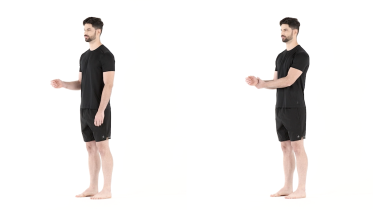 Isometric shoulder external rotation
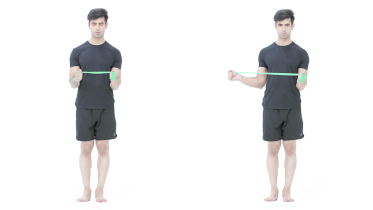 Shoulder external rotation with band
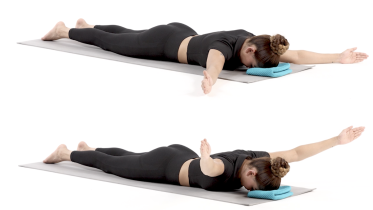 Prone Y raise
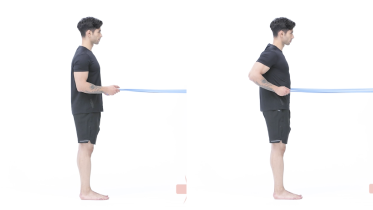 Resistance band row
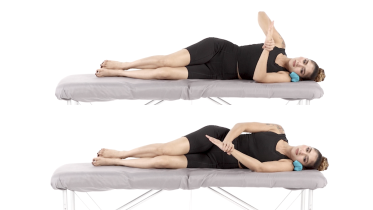 Sleeper stretch
The rotator cuff tendinopathy program and the shoulder impingement program cover the same ground in stages under different names. If your shoulder has gone stiff in every direction instead of painful in one, the frozen shoulder program is the better fit.
When to see a physio (physical therapist)
The NHS suggests seeing a GP if shoulder pain is getting worse or has not improved after 2 weeks, or if moving the arm is very difficult. Go sooner if the arm has been weak since an injury, because that changes the urgency.
An assessment settles two questions a home program cannot. Is the arm limited by pain, by stiffness or by weakness, and does the neck reproduce any of it? A physio will compare how far the arm goes when you lift it against how far it goes when they lift it, test turning in and out against resistance, and then set a load the shoulder can handle now. Tell them how often you play, which shot hurts and what the shoulder does at night, because that usually decides the plan faster than any test does.
A physical therapy clinical practice guideline for rotator cuff tendinopathy covers assessment, nonsurgical care, rehabilitation and return to sport for recreational athletes (Desmeules and colleagues, 2025), so this is well-trodden ground for whoever sees you. If you have had shoulder surgery, your surgical team decides when any new exercise starts.
Related exercise programs
See a doctor promptly if
- Emergency: chest pain or tightness, which may spread to your arm, neck or jaw, or shoulder or arm pain that comes with shortness of breath, sweating or feeling sick. This can be a heart attack. Call emergency services straight away.
- Emergency: after a fall or a blow to the shoulder or collarbone, bone is sticking out through the skin, the shoulder swells up very quickly, you are bleeding heavily, or you find it hard to breathe, have chest pain or cough up blood. Call emergency services straight away.
- Emergency: the shoulder feels as if it has slipped out of place, looks a different shape or suddenly locks so you cannot move the arm, or the pain is severe after a fall or an injury. Go to an emergency department straight away, without driving yourself, and do not try to put the shoulder back in yourself.
- Emergency: your arm, hand or fingers turn cold, pale, blue or gray compared with the other side. Call emergency services or go to an emergency department straight away, and do not drive yourself. The blood supply to the arm may be blocked.
- Same day: after a fall or a blow to the shoulder, the shoulder is very swollen or bruised, or you cannot use your arm normally. Get it checked the same day, as the collarbone or the top of the arm may be broken.
- Same day: the shoulder is hot, red and swollen, or you have a fever or feel unwell. This can be a joint infection. Go to an emergency department the same day.
- Same day: sudden, very bad shoulder pain, or you suddenly cannot lift or move your arm at all. Get medical help the same day.
- Same day: pins and needles or numbness in the arm that does not go away, no feeling in part of the arm, or weakness that is getting worse. Get medical advice the same day. For pain spreading down the arm from your neck, ask for an urgent appointment with your doctor. If one side of your face or body suddenly goes numb or weak, or your speech becomes slurred or muddled, call emergency services, even if it goes away.
- Within a day or two: severe pain in both shoulders that has come on recently. Ask for an urgent appointment with your doctor.
- Within a day or two: new shoulder pain and you have had cancer, now or in the past, or you are losing weight without trying. See your doctor within a day or two and mention it. If you are being treated for cancer now, contact your cancer team the same day.
- Within a few days: the pain started after a fall, a pull or another injury, especially if the arm has been weak since, for example you cannot lift it out to the side or hold it up. This can be a broken bone or a torn tendon. Ask for an urgent appointment with your doctor, within days rather than weeks, because UK shoulder surgeons advise urgent referral for a rotator cuff tear caused by an injury.
- Within a few days: you are over 50 and have aching and stiffness in both shoulders, often in the neck or hips too, that is worst in the morning and lasts more than 45 minutes after you get up. See your doctor within a few days, as this can be an inflammatory condition (polymyalgia rheumatica) rather than a local shoulder problem. If you also get a new headache, pain or tenderness at your temples or on your scalp, or jaw pain when you eat or talk, get medical advice the same day, and if your vision changes, call emergency services.
- Within a few days: night pain is common with shoulder problems, but get checked within a few days if the pain is constant, no rest or change of position eases it at all, and it keeps getting worse. If you have had cancer, now or in the past, or are losing weight without trying, see your doctor sooner, within a day or two, and mention it. If you are being treated for cancer now, contact your cancer team the same day.
Common questions
Why does my shoulder hurt after playing pickleball?
Most often because the overheads and high volleys asked more of the rotator cuff than it had been doing lately, and the soreness arrives the next day rather than on court. The cuff works hardest with the arm above shoulder height and while it slows the arm down after contact, so a session with a lot of smashes loads it differently from an hour of dinking. Reaching backward for a lob adds another demand, because the arm goes behind the body under load and the shoulder blade has to travel to keep up. A shoulder that aches for a day and settles is usually reporting an unfamiliar workload. One that is worse each session, or that wakes you in the night, has stopped adapting and is worth an assessment.
Is the pickleball serve bad for your shoulder?
The serve is not an overhead action, which surprises a lot of players. The rules require the server's arm to be moving in an upward arc, contact with the ball below waist level, and the head of the paddle no higher than the highest part of the wrist. The drop serve, the other legal option, drops the ball and lets it bounce before you hit it, which keeps contact low as well. Both rule out the tennis-style serve that loads the shoulder most, so repeated serving is a question of repetition, not of overhead load, and if serving is the shot that hurts you, it is worth having someone watch how far you reach across your body and how much trunk rotation you add.
Can I play pickleball with a rotator cuff tear?
That is a decision for the clinician who knows your scan and your shoulder, not one this page can make. What helps is knowing that cuff changes on a scan are common with age and are not the same as a shoulder that cannot work: a 2015 evidence review reports a systematic review of 30 studies with rotator cuff abnormalities rising from 9.7% in people aged 20 or under to 62% at 80 and over, in people with and without symptoms (Sambandam and colleagues, 2015). A tear that came on gradually, with a shoulder that still lifts and holds, is usually managed with a loading program and a modified shot selection. A tear that followed a fall or a sudden pull, with an arm that has been weak since, is the one that needs assessing within days rather than weeks, and that sits in the warning signs on this page.
Should I stop hitting overheads if my shoulder hurts?
Reduce them before you remove them. The NHS advice for shoulder pain is to stay active and gently move the shoulder, not to stop using it, while avoiding what obviously makes it worse. In practice that often means keeping the soft game and the drives, letting the overhead go for a few weeks, and calling your partner across for the balls above your head. Bring them back one session at a time once the shoulder is quiet at night and a light band rotation no longer catches. If you have gone three or four weeks with no change at all, get it looked at instead of waiting out another month.
Is pickleball bad for your shoulders after 50?
Nothing in the research says it is, and the age pattern in the injury studies mostly reflects who plays the sport. The published counts come from emergency departments, clinic records and player surveys, all of which describe injured people rather than measuring risk per hour on court. What does change after 50 is the tissue: OrthoInfo notes that people over 40 are at greater risk of cuff tears, that repeating the same shoulder motions stresses the cuff, and that the blood supply to those tendons decreases as we get older. The practical reading is to build up gradually, keep some shoulder strength work going through the season, and treat a shoulder that wakes you at night as a reason to get advice, not a reason to rest and hope.
How long does pickleball shoulder pain take to settle?
Give it weeks, and set a review date instead of watching it daily. NHS advice suggests trying shoulder exercises for 6 to 8 weeks to stop the pain returning, and to see a GP if the pain is getting worse or has not improved after 2 weeks. The same page says recovery from shoulder pain can take 6 months or longer, so a slow answer is the usual one, not a sign something is wrong. Tendon problems in particular change slowly, so you usually notice it as doing more before the shoulder grumbles; there is rarely a day the pain just stops. If the shoulder has gone stiff as well as sore, so that helping the arm up with your other hand gets it no further, that is a different pattern with a different program and it is worth checking early.
References
- USA Pickleball. Essential pickleball rules summary for beginners. https://usapickleball.org/rules/summary/
- USA Pickleball. Pickleball serve rules, tips and techniques. https://usapickleball.org/blog/pickleball-serve-tips/
- Siow MY, Zafar-Khan A, Limpisvasti O. Pickleball-related orthopaedic injury presentations to a large urban healthcare system from 2015 to 2024. JAAOS Global Research and Reviews. 2026;10(3):e25.00477. https://doi.org/10.5435/JAAOSGlobal-D-25-00477
- Jeong B, Lee KJ, Nam SH, et al. Injury risk and epidemiology of pickleball players in South Korea: a cross-sectional study. Frontiers in Public Health. 2025;13:1617291. https://doi.org/10.3389/fpubh.2025.1617291
- McMillan P, Lake LP, Burkhart A, Reddy E, Hale IC, Grawe BM. The epidemiology of pickleball injuries presenting to US emergency departments. Sports Health. 2026;18(4):749-755, first published online 13 July 2025. https://doi.org/10.1177/19417381251350671
- Touhey DC, Bozorgmehr CK, Tartibi DS, Smith MV, Knapik DM. Pickleball injuries in the aging athlete: a critical analysis review. Cureus. 2024;16(9):e69950. https://doi.org/10.7759/cureus.69950
- Sambandam SN, Khanna V, Gul A, Mounasamy V. Rotator cuff tears: an evidence based approach. World Journal of Orthopedics. 2015;6(11):902-918. https://doi.org/10.5312/wjo.v6.i11.902
- Desmeules F, Roy JS, Lafrance S, et al. Rotator cuff tendinopathy diagnosis, nonsurgical medical care, and rehabilitation: a clinical practice guideline. Journal of Orthopaedic and Sports Physical Therapy. 2025;55(4):235-274. https://doi.org/10.2519/jospt.2025.13182
- American Academy of Orthopaedic Surgeons. Rotator cuff tears. OrthoInfo. https://www.orthoinfo.org/en/diseases--conditions/rotator-cuff-tears/
- Kulkarni R, Gibson J, Brownson P, Thomas M, Rangan A, Carr AJ, Rees JL. Subacromial shoulder pain. BESS/BOA Patient Care Pathways. Shoulder and Elbow. 2015;7(2):135-143. https://doi.org/10.1177/1758573215576456
- NHS. Shoulder pain. Page last reviewed 22 May 2023. https://www.nhs.uk/symptoms/shoulder-pain/
- NHS. Polymyalgia rheumatica. Page last reviewed 23 April 2023. https://www.nhs.uk/conditions/polymyalgia-rheumatica/
- NHS. Temporal arteritis. Page last reviewed 14 August 2023. https://www.nhs.uk/conditions/temporal-arteritis/
- NHS. Heart attack. Page last reviewed 31 March 2026. https://www.nhs.uk/conditions/heart-attack/
- NHS. Septic arthritis. Page last reviewed 3 September 2026. https://www.nhs.uk/conditions/septic-arthritis/
- NHS. Symptoms of a stroke. Page last reviewed 12 September 2024. https://www.nhs.uk/conditions/stroke/symptoms/
Written and checked by the PocketPhysio editorial team. Last updated 2026-10-01.
This page is general education, not a diagnosis or a personal treatment plan. See a physiotherapist or doctor for advice about your own situation.