
Part of Pickleball and your body
Pickleball and your knees
What the kitchen line asks of a knee
Watch a doubles point and count the knee bends. There is the split step before the return, the drop into a low dink, the push back off a deep knee to reset, and then the awkward half lunge sideways when the ball goes to the middle. None of it looks dramatic. Done four days a week by somebody who took the sport up 18 months ago at 62, it adds up to more deep knee loading than that knee has seen since their thirties.
That is why the pattern in clinic is so consistent. The pain rarely starts with an incident. It starts as a niggle going down to the kitchen, then shows up on stairs and getting out of the car, and by the time someone books an appointment they have usually been playing through it for a couple of months.
The falls data points the same way. In a cross-sectional study of 92 recreational players, 42% reported falling while playing, and lunging was the reason given in 57% of those falls, with moving backward next at 24% (Myers and Hanks, 2024). Hip abduction strength and single leg squat quality did not separate the fallers from the non-fallers in that sample, though the authors flagged their limited numbers. The players who fell were older and slower on a change of direction test.
Kneecap pain, the one most players have
Pain at the front of the knee, around or under the kneecap, brought on by bent knee loading and quiet when you walk on the flat, is the most common presentation. It gets worse going down rather than up, hates sitting still in a car, and is usually tender if you press around the edges of the kneecap rather than at a single point.
The treatment is well settled. The US physical therapy clinical practice guideline puts exercise therapy first. Hip strengthening added to knee strengthening beats knee exercise alone for pain and function (Willy and colleagues, 2019). An international consensus panel of 41 experts had landed in the same place a year earlier. It backed hip-focused and knee-focused exercise together and advised against knee or lower back mobilizations used on their own (Collins and colleagues, 2018).
For a pickleball player that translates into two jobs: build the thigh and hip so the knee can take a bend, and take some depth and volume out of the sessions while you do. The patellofemoral pain program stages the exercises, and knee pain when bending covers the same complaint from the symptom side.
Can you play pickleball with knee osteoarthritis?
Plenty of players arrive already carrying an osteoarthritis diagnosis, and the question is always whether the sport is making it worse. Guidelines answer the treatment half of that clearly. NICE names therapeutic exercise and weight management as the core treatments, and the OARSI panel put structured land-based exercise and arthritis education in the same place, with dietary weight management alongside them for the knee. The Cochrane evidence behind that is real but modest: exercise probably helps in the short term, at a size that may or may not be big enough to notice (Lawford and colleagues, 2024). A separate review of randomized trials looking at the joint surface itself found no evidence that exercise that loads the knee harms cartilage, on low quality evidence (Bricca and colleagues, 2019).
What nobody can tell you is whether pickleball specifically is good, neutral or bad for an arthritic knee over ten years, because that study does not exist. Until it does, the working approach is the one used for any loaded activity with osteoarthritis: keep doing it, keep the dose within what the knee tolerates overnight, and build strength around it.
An X-ray does not settle the question either way. NICE says osteoarthritis can be diagnosed without imaging in people aged 45 and over who have activity-related joint pain and either no morning stiffness or morning stiffness that clears within half an hour. Scans are less decisive than they look in this age group, since plenty of knees with a meniscal tear on the film have had no pain at all in the previous month (Englund and colleagues, 2008). The knee osteoarthritis program is the structured version of the strength work.
The twist that tears a meniscus
A meniscus tear in a player over 50 usually comes from something unimpressive: a pivot on a planted foot, or standing up out of a low reach. The ESSKA consensus describes the degenerative type as a tear that develops slowly in someone over 35, without a significant injury (Beaufils and colleagues, 2017). Pain along the joint line, swelling that builds over a day or two, and a knee that catches are the usual features.
The important part is what happens next. A BMJ guideline panel made a strong recommendation against arthroscopic surgery for almost all patients with degenerative knee disease, including those with mechanical symptoms and those whose pain started suddenly, and named a knee that genuinely cannot be straightened as the one possible exception (Siemieniuk and colleagues, 2017). A randomized trial of 140 middle aged people with a degenerative tear found no clinically relevant difference at two years between supervised exercise and arthroscopic partial meniscectomy (Kise and colleagues, 2016). So a tear on a report is not a surgical referral by default. It is a reason to start a program and give it time: the exercise arm of that trial ran for 12 weeks, and the ESSKA consensus sets 3 months from the start of symptoms as the earliest reasonable point to weigh up surgery, with 3 to 6 months before an operation is offered for a knee that is not locked and not arthritic (Beaufils and colleagues, 2017).
Traumatic tears are the exception that needs speed. If the tear came from a real injury in a younger knee, or if the knee locks, get it assessed early rather than waiting, because some of those tears are repairable and the window matters. The meniscus tear program sets out both routes.
Swelling, locking and giving way
These three change the plan, and they are the reason this page has a long warning list. A knee that fills up within a few hours of a twist or a fall is not a training error, and it goes to an emergency department straight away. A knee stuck bent that you cannot fully straighten is a locked knee, and it goes the same day too.
Giving way deserves a note of its own, because players tend to normalize it. If the knee buckles under you repeatedly, buckled after a recent injury, or buckles and is also painful or swollen, that is a same day problem. If it happens occasionally with no injury and no swelling, it is not urgent, but it still earns an appointment rather than another month of hoping.
A knee that clicks without pain or catching is different again and rarely means anything on its own. It is the painful catch, the block and the buckle that carry information. A hot, red, swollen knee with fever is in a category by itself and is on the list below.
What helps
The work that shifts a sore knee is strength, and it takes months rather than a couple of weeks. Most of what goes wrong here is a knee asked to control a deep bend by muscles that are not up to it yet, so the job is to build them while you ask less of the knee on court for a while.
Volume comes down before technique changes. Two or three games instead of six, a day off between court days, a shorter session, and lunges shallower than your ego would like will settle most irritable knees inside a few weeks. Add height to the reach rather than depth to the knee: bending at the hips and getting the paddle low with a longer arm costs the knee much less than dropping into a deep squat every dink.
Judge every change by the next morning. Discomfort during a session that has gone by the following day is workable. A knee that is stiffer, more swollen or more painful when you get out of bed means the previous day was too much, and the answer is a smaller dose, not a stop.
Exercises that can help
The list works through what the sport asks of a knee: standing up, bending under control, splitting the stance forward and sideways, holding the pelvis level, and staying steady on one leg. Sit to stand often begins at 2 to 3 sets of 5 to 10, the mini squat at 2 to 3 sets of 10 to 15, the split squat and the lateral lunge at 2 to 3 sets of 8 to 12 each side, side lying hip abduction at 2 to 3 sets of 10 to 15 each side, and single leg stance at 5 to 10 lifts per leg held for a few seconds. Each exercise page carries its own numbers, so use those. Your physio will adjust this.
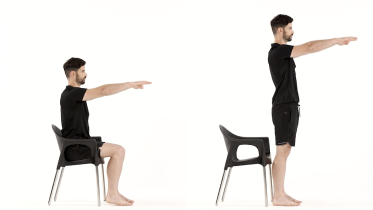 Sit to stand
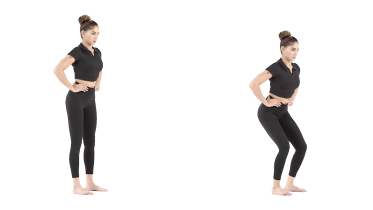 Mini squat
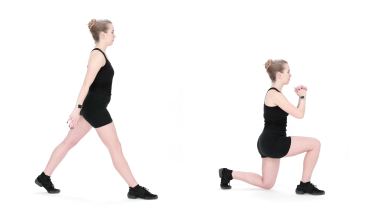 Split squat
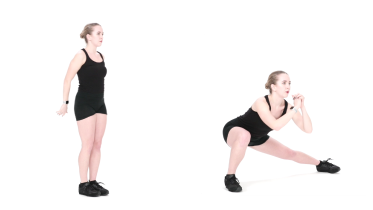 Lateral lunge
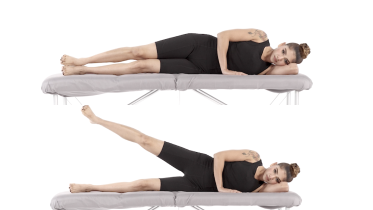 Side lying hip abduction
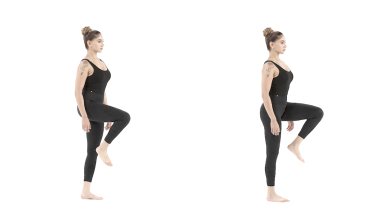 Single leg stance
Precautions before you start. If you have had a hip replacement, get the go-ahead from your surgeon or physio before you try sit to stand and side lying hip abduction. Standing up from a low seat bends the hip past a right angle, and many surgeons ask you to avoid that for the first months after some operations. Some operations also limit side leg work for the first months, so the timing depends on your surgery.
After any knee or hip surgery, your surgeon's and physio's plan comes first for the squats, the lunges and single leg stance, since standing on the operated leg alone comes at a set stage of rehab. If you are pregnant, check with your midwife or physio before you start.
Set the balance work up properly. Stand within arm's reach of a kitchen counter or a sturdy chair for single leg stance, clear rugs and clutter, and wear flat shoes that fit well and grip the floor, not socks, tights or bare feet. If you have fallen in the past year, feel unsteady, or take medicines that make you dizzy, keep one hand on the support for every lift, practice only when someone else is at home, and ask your doctor or physio about a falls check.
A sudden loss of balance is different. Call emergency services straight away for any sign of a stroke, even if it goes away: sudden dizziness with unsteadiness or falling over, a face that droops on one side, an arm you cannot lift or keep up, slurred or muddled speech, weakness or numbness on one side of your body or face, sudden blurred vision, double vision or loss of sight, or a sudden severe headache.
Start the split squat and the lateral lunge with a short step and a shallow bend, and go wider and lower only once that feels steady. If you have high blood pressure, breathe steadily through every repetition and never hold your breath. With a heart condition or high blood pressure, check with your doctor before you start.
Stop the exercises for any of these: chest pain or pressure, dizziness or feeling faint, a racing or irregular heartbeat, or being far more out of breath than the effort should cause. If chest pain, pressure or tightness does not ease quickly when you rest, spreads to your arm, neck, jaw, stomach or back, or comes with sweating, feeling sick, feeling light-headed or being short of breath, call emergency services straight away, as this can be a heart attack. If it eases quickly and none of these happen, get medical advice the same day, and do not exercise again until you have been checked.
When to see a physio (physical therapist)
Six weeks of knee pain that has not shifted, or any knee you have started protecting on court, is worth an assessment. So is a knee that has begun to change how you move: shortening the lunge on one side, or planting differently to spare it. Those adaptations tend to move the problem somewhere else rather than solve it.
A physical therapist can work out whether the front of the knee, the joint line or the hip is driving it, set a starting dose that does not flare you, and tell you which parts of your game to trim while the strength catches up. Go to a doctor first, not a physio, if the picture matches the warning signs below, particularly a knee that locked, swelled quickly, gave way, or came with fever. Those need a diagnosis before they need a program.
Related exercise programs
See a doctor promptly if
- Emergency: the knee has moved out of place, looks misshapen or is pointing at an odd angle, or you have tingling or no feeling in the knee, leg or toes, or your foot turns cold, pale or blue. Go to an emergency department straight away. Do not drive yourself: ask someone to drive you or call an ambulance.
- Emergency: the knee became very swollen very quickly, within a few hours of a twist, fall or blow, or you felt a pop or snap. Go to an emergency department straight away. Do not drive yourself: ask someone to drive you or call an ambulance. Swelling from a meniscus tear often builds up more slowly, over a few hours to 2 or 3 days, and a meniscus tear from sport often comes with other damage inside the knee, such as a torn ligament (the ACL), so fast swelling needs checking.
- Emergency: the kneecap has slipped out of place, even if it went back by itself. If it is still out of place, go to an emergency department straight away, and do not drive yourself. If it went back by itself, get medical advice the same day.
- Same day: the knee is locked, which means it is stuck bent and you cannot fully straighten it, even after gently trying to move it, or you cannot bend or straighten the leg at all. Get assessed the same day by a doctor, at urgent care or at an emergency department. A torn piece of meniscus can get caught in the joint and block it, and when a tear like this can be repaired, it should be done as early as possible. A knee that catches for a moment and then frees itself can happen with a meniscus tear. That is not the same as a locked knee, but tell your physio or doctor about it.
- Same day: the knee keeps giving way under you, or it gave way after a recent injury, or it gives way and is also very painful or swollen. Get medical advice the same day. If it only happens now and then, with no recent injury and no swelling, it is not an emergency, but book an assessment with a physio or doctor in the next few days.
- Same day: the knee swells up quickly and a lot with no clear reason, especially if you take medicine to thin your blood. Get medical advice the same day.
- Same day: you cannot walk or put weight on the leg, or you have very bad knee pain after a fall or injury. Get medical advice the same day.
- Same day: the knee is hot, red and swollen, or you have knee pain with a high temperature or feel hot, cold or shivery. Get medical advice the same day, and go to an emergency department if you feel very unwell. This can be a sign of infection in the joint, which needs treatment quickly.
- Same day: a calf or thigh that is newly swollen, warm, tender, red or darker than usual, has swollen veins that are sore to touch, or has a throbbing or cramping pain that does not fit your injury or condition, or that feels different from normal muscle soreness after exercise. This can be a sign of a blood clot (deep vein thrombosis), especially after surgery, an injury, time in a cast or boot, a long trip or a spell of being much less mobile than usual. Get medical advice the same day. If you are also short of breath or have chest pain, call emergency services.
- Within a few days: pain at night or at rest that keeps getting worse. See your doctor within a few days. If you have had cancer, now or in the past, see your doctor sooner, within a day or two, and mention it, even if the pain is not getting worse. Do the same if you have knee pain and are losing weight without trying, even if it does not hurt at night. If you are being treated for cancer now, contact your cancer team the same day.
Common questions
Is pickleball bad for your knees?
There is no study that answers that, and the honest position is that nobody has measured knee outcomes in players over time. What exists is emergency department data, where the knee was the injured part in 5.9% of a weighted estimate of 33,817 pickleball injury visits of all ages, drawn from a national US sample of emergency departments between 2010 and 2019, in which more than 85% of the injured players were 60 or over (Weiss and colleagues, 2021), and a clinic series of 166 pickleball and paddleball lower limb injuries in which a sudden change of direction was the commonest recorded mechanism (Opara and colleagues, 2024). Both are counts of people who turned up at a hospital or a clinic, and neither followed anybody, so neither can tell you whether the sport wears a knee out. Set against that, the research on loading a knee is reassuring as far as it goes: a review of 9 randomized trials found no sign that knee-loading exercise harms the joint cartilage, while grading the quality of that evidence as low (Bricca and colleagues, 2019).
Can I play pickleball with knee arthritis?
Usually yes, and moving the knee is part of the treatment rather than a risk to it. NICE and OARSI both list structured exercise as a core treatment for knee osteoarthritis, and the 2024 Cochrane review of 139 trials found low to moderate certainty evidence that exercise probably improves pain, function and quality of life in the short term, while judging those benefits to be of uncertain clinical importance against the usual thresholds for a difference people notice (Lawford and colleagues, 2024). The practical limits are volume and depth: fewer games in a row, a rest day between court days, and a shallower lunge rather than a deep one. NICE also notes that losing weight improves pain and function if you carry extra, and that any amount of loss is likely to help. Judge each session by how the knee is the next morning.
Why does my knee only hurt going down to the kitchen line and not on the flat?
Because the load on the joint behind the kneecap climbs steeply as the knee bends, and walking on level ground barely bends it. That pattern, pain with bent knee loading and comparative comfort walking, is the classic kneecap picture. It is also why the fix is usually strength rather than rest, since a thigh and hip that can control the bend take the pressure off the joint. Stairs do the same thing in slow motion, which is covered on knee pain on stairs, and the deep version is on knee pain when squatting.
Do I need an MRI if my knee hurts after pickleball?
Not as a first step for most players over 50. Meniscus tears show up on scans in people with no knee pain at all: in a study that scanned 991 knees in people aged 50 to 90, 61% of those with a tear had no knee pain, aching or stiffness in the previous month (Englund and colleagues, 2008). A scan that finds something incidental can send you down a path you did not need. Imaging earns its place when the knee locks, when it gave way after a clear injury, or when a surgeon is weighing up an operation.
Should I wear a knee brace or tape for pickleball?
As an add-on at most, not instead of the exercises. The US physical therapy guideline for kneecap pain recommends against prescribing patellofemoral knee orthoses, meaning braces, sleeves and straps, and says tailored patellar taping used alongside exercise may ease pain immediately and over about 4 weeks, with no promise beyond that (Willy and colleagues, 2019). The international consensus panel was less sure again and listed taping and bracing as uncertain (Collins and colleagues, 2018). So if a sleeve makes the knee feel more secure on court, that is your call rather than a recommendation, and it is not a reason to skip the strength work.
How long should I rest a knee that swelled up after playing?
Swelling that comes on within a few hours of a twist, fall or blow is not something to sit out at home; that goes to an emergency department straight away. A knee that puffs up mildly the evening after a heavy session, with no injury moment, is usually telling you the dose was too big. Drop the volume for a week or two rather than stopping completely, keep the strength work going at a level that does not swell it, and rebuild from there. If the swelling keeps returning, or arrives with no clear reason at all, get it assessed rather than managing it round and round.
References
- Weiss H, Dougherty J, DiMaggio C. Non-fatal senior pickleball and tennis-related injuries treated in United States emergency departments, 2010-2019. Injury Epidemiology. 2021;8:34. https://doi.org/10.1186/s40621-021-00327-9
- Myers B, Hanks J. Hip Strength, Change of Direction, and Falls in Recreational Pickleball Players. International Journal of Sports Physical Therapy. 2024;19(9):1116-1125. https://doi.org/10.26603/001c.122490
- Opara OA, Brush PL, Pohl N, et al. Pickleball- and Paddleball-Related Injuries in the Lower Extremity: Description, Treatment Options, and Return to Play. Cureus. 2024;16(2):e53954. https://doi.org/10.7759/cureus.53954
- National Institute for Health and Care Excellence. Osteoarthritis in over 16s: diagnosis and management (NG226). 2022. https://www.nice.org.uk/guidance/ng226
- Bannuru RR, Osani MC, Vaysbrot EE, et al. OARSI guidelines for the non-surgical management of knee, hip, and polyarticular osteoarthritis. Osteoarthritis and Cartilage. 2019;27(11):1578-1589. https://doi.org/10.1016/j.joca.2019.06.011
- Lawford BJ, Hall M, Hinman RS, et al. Exercise for osteoarthritis of the knee. Cochrane Database of Systematic Reviews. 2024;(12):CD004376. https://doi.org/10.1002/14651858.CD004376.pub4
- Bricca A, Juhl CB, Steultjens M, Wirth W, Roos EM. Impact of exercise on articular cartilage in people at risk of, or with established, knee osteoarthritis: a systematic review of randomised controlled trials. British Journal of Sports Medicine. 2019;53(15):940-947. https://doi.org/10.1136/bjsports-2017-098661
- Willy RW, Hoglund LT, Barton CJ, et al. Patellofemoral Pain: Clinical Practice Guidelines Linked to the International Classification of Functioning, Disability and Health From the Academy of Orthopaedic Physical Therapy of the American Physical Therapy Association. Journal of Orthopaedic and Sports Physical Therapy. 2019;49(9):CPG1-CPG95. https://doi.org/10.2519/jospt.2019.0302
- Collins NJ, Barton CJ, van Middelkoop M, et al. 2018 Consensus statement on exercise therapy and physical interventions (orthoses, taping and manual therapy) to treat patellofemoral pain: recommendations from the 5th International Patellofemoral Pain Research Retreat, Gold Coast, Australia, 2017. British Journal of Sports Medicine. 2018;52(18):1170-1178. https://doi.org/10.1136/bjsports-2018-099397
- Siemieniuk RAC, Harris IA, Agoritsas T, et al. Arthroscopic surgery for degenerative knee arthritis and meniscal tears: a clinical practice guideline. BMJ. 2017;357:j1982. https://doi.org/10.1136/bmj.j1982
- Beaufils P, Becker R, Kopf S, et al. Surgical management of degenerative meniscus lesions: the 2016 ESSKA meniscus consensus. Knee Surgery, Sports Traumatology, Arthroscopy. 2017;25(2):335-346. https://doi.org/10.1007/s00167-016-4407-4
- Kise NJ, Risberg MA, Stensrud S, Ranstam J, Engebretsen L, Roos EM. Exercise therapy versus arthroscopic partial meniscectomy for degenerative meniscal tear in middle aged patients: randomised controlled trial with two year follow-up. BMJ. 2016;354:i3740. https://doi.org/10.1136/bmj.i3740
- Englund M, Guermazi A, Gale D, et al. Incidental meniscal findings on knee MRI in middle-aged and elderly persons. New England Journal of Medicine. 2008;359(11):1108-1115. https://doi.org/10.1056/NEJMoa0800777
- NHS. Knee pain. Page last reviewed 21 December 2023. https://www.nhs.uk/symptoms/knee-pain/
- NHS. Deep vein thrombosis (DVT). Page last reviewed 30 April 2026. https://www.nhs.uk/conditions/deep-vein-thrombosis-dvt/
Written and checked by the PocketPhysio editorial team. Last updated 2026-10-01.
This page is general education, not a diagnosis or a personal treatment plan. See a physiotherapist or doctor for advice about your own situation.