
Part of Pickleball and your body
A strength plan for pickleball players over 50
The session, and where it sits in your week
The same six movements every time, on 2 or 3 days of the week. They run biggest to smallest: a squat, a hinge on one leg, a lunge backward, a loaded calf raise, a standing pull for the upper back, then a press overhead while sitting. Between them they cover what the game keeps asking of you, which is pushing off, reaching up and getting back to the middle without falling over.
Keep at least a day between two sessions. Beyond that the days do not matter much, so fit them where the courts and the rest of your life leave a gap.
Once the movements are familiar the whole thing runs 25 to 35 minutes. Your first two weeks will be much shorter than that, since the sets are short and light and most of the time goes on learning where your feet belong. Between sets, wait until your breathing has settled, which is about a minute, and take longer after a hard one.
Why 2 or 3 days a week
Nobody studied paddle sports to arrive at 2 or 3 days a week. The WHO guidelines, developed from systematic reviews, tell adults to do muscle-strengthening activities at moderate or greater intensity involving all major muscle groups on 2 or more days a week, and from age 65 they add varied multicomponent physical activity emphasizing functional balance and strength training at moderate or greater intensity on 3 or more days a week, to improve everyday function and prevent falls (Bull 2020).
National guidance in the US and Canada lands in the same place. The CDC summary of the US guidelines for adults 65 and over asks for at least 2 days of activities that strengthen muscles, working all major muscle groups, alongside activities that improve balance. The Canadian 24-Hour Movement Guidelines for adults aged 65 and over, published by the Canadian Society for Exercise Physiology, ask for muscle strengthening activities using major muscle groups at least twice a week, plus physical activities that challenge balance.
Between 50 and 64 the guideline floor is 2 days and nothing in it asks for a third, so treat a third session as a bonus, not a target you keep missing. From 65 the extra day in the guideline is not a third round of this session either. It is varied activity that emphasizes balance as much as strength, so balance practice counts toward it. Two is not a compromise, and two sessions kept up all year beat three that stop in February.
What this plan can and cannot claim
First, what nobody has tested. No randomized trial has given pickleball players a strength program and counted what happened to their injuries, and the 2024 critical analysis review of injuries in aging pickleball players states plainly that the evidence-based, sport-specific guidance on lowering injury risk is limited (Touhey 2024). Anything you read that promises this sport's injuries away is guessing.
The one pickleball study that measured strength against falls found less than you would expect. It was a cross-sectional study, meaning everything was measured at one moment and nothing was followed over time, and it tested and surveyed 92 recreational players, 42% of whom reported having fallen while playing. Hip abduction strength showed no significant difference between the fallers and the non-fallers, and neither did how far the ankle bends (dorsiflexion) or the quality of a single leg squat. What did differ was age and speed on a change of direction test, and hip strength did correlate with faster change of direction times (Myers and Hanks 2024). Two thirds of that sample were under 55, so it is not a study of the over-50 player as such.
Outside this sport the evidence is much stronger. The Cochrane review of progressive resistance training pooled 121 randomized trials and 6,700 older people, and found a large positive effect on muscle strength across 73 trials and 3,059 participants, a moderate to large effect on getting out of a chair, and a modest gain in walking speed of 0.08 m/s. Serious adverse events were rare and none was reported as caused directly by the exercise programs (Liu and Latham 2009). The reviewers put a limit on that reassurance: adverse events were poorly recorded across the trials, so they advised caution in carrying these exercises over to people with medical conditions.
Falls are the other reason people take up strength work, and the common pickleball injuries page sets out how large a share of the hospital records they account for. Here the evidence is picky about which kind of exercise has actually been tested.
The Cochrane review of exercise for preventing falls covered 108 trials and 23,407 community-dwelling older people whose average age was 76. Exercise programs of multiple types, usually balance and functional work combined with resistance training, probably reduced the rate of falls by 34% across 11 studies and 1,374 people, on moderate-certainty evidence. Balance and functional training on its own also reduced the rate of falls, on high-certainty evidence and a much larger pool of trials. For programs that are mainly resistance training, the reviewers said they were uncertain of the effect on the rate of falls (Sherrington 2019). That is a general older-adult finding, not a pickleball one, and it is why the last section of this page sends you to balance work as well.
Your first two weeks
Not one of the six needs a gym membership or a previous life as a lifter. Every one of them has an easier starting version on its own page, and these two weeks belong to the shape of the movement, not the load on it.
Almost everybody starts too heavy. The goblet squat can begin with empty hands at whatever depth keeps your heels flat, and a 1 liter bottle of water, about 1 kg (2.2 lb), is plenty in each hand for the first shoulder presses. Keep fingertips on a counter for the single leg deadlift, which is as much a balance test as a strength one, and pick a band light enough that the row moves your arms and shoulder blades and nothing else.
Give one movement your full attention each session, and let the other five tick along. Two weeks of that is dull. It is also the difference between a player still training next season and one who spent week three nursing a shoulder.
How hard a set should feel
Stop each set with about 2 repetitions still in you. That means two more were available without your technique changing. Coaches call it repetitions in reserve, and it is a common way to set how hard a set should be without testing a maximum (Helms 2016). The same article is blunt about the catch: the judgment takes practice, and people new to lifting read it badly at first, which is a second reason the early weeks stay light.
You do not have to push to the point where another repetition is impossible: pooling 15 trials, a meta-analysis found no significant difference in strength gains between training to that point and stopping short of it, although every one of those trials was in young adults (Grgic 2022). Where exactly to stop is practice guidance, not a figure any trial has set for people over 50, so treat 2 in reserve as a starting rule your physio can move.
A day or two of muscle soreness after something new is ordinary, and it fades as your body learns the movement. Sharp pain inside a repetition is a different thing: stop that exercise for the day instead of grinding out one more. A joint that is more swollen or more painful the next morning means the last session was too big, so go down a rung and build up again without dropping the movement. Our pain monitoring model guide goes through that judgment, and through how narrow the evidence behind the usual numbers is.
What the next morning tells you beats anything you noticed during the session. Keep one fixed check and run it every week: the first three steps out of bed, say, or getting out of the dining chair without using your hands.
Making it harder without wrecking it
One change at a time, and keep each one small. Repetitions go up first, to the top of the range, with everything else left alone. Add a set next. After that comes a harder version of the exercise, and more weight in your hands last of all.
The six do not climb the same ladder. For the goblet squat, depth comes before the dumbbell. The single leg deadlift steps up when your fingertips leave the counter, and again when you hold a weight, which is a step for your physio to time and not one to take on a whim. Calf raises go up in small weight steps, the band row moves to a firmer band or one step further back from the anchor, and the reverse lunge deepens before it gets loaded.
Some programs later swap the upright row for the bent-over band row, which adds a forward lean. That lean puts extra load through the spine, so it is a change to make with your physio, and not one to make at all while your back is sore or if you have been told your bones are thin.
Two comfortable sessions in a row earn the next step. If the step costs you your technique, you have your answer: back down, sit there a couple of weeks, then try again. Our guide to exercise progression works through the same order on other programs.
Keeping it going through a playing season
The usual failure is not the plan. It is the week the league starts, when the strength work quietly disappears because there is suddenly no room for it.
Shrink the session instead of skipping it. Two sets of four movements on a busy week keeps the habit alive, and a habit that survives the season counts for more than any one week where you hit the full total. Pin the session to a fixed time attached to something you already do, because anything that depends on finding a spare 30 minutes will not survive two weeks of good weather and full courts.
If you play four or five times a week, treat the strength work as part of the same total, not as an extra. A leg that has done three mornings of games and two heavy lunge sessions has had five hard days, whatever the labels say.
The half of the job this plan does not do
Strength is one ingredient. The falls evidence in older adults supports balance and functional training, with or without resistance work alongside it, and is uncertain about resistance training taken on its own (Sherrington 2019), so this session is meant to sit beside balance practice, not to replace it. The balance and falls prevention program is the staged version of that half.
Speed is the other gap. The pickleball falls study found that the players who had gone down were slower on a change of direction test, not weaker at the hip (Myers and Hanks 2024), and no amount of goblet squatting teaches a body to stop and turn. Court movement practice belongs on a separate day at low intensity, and the getting back on court after an injury page covers how to rebuild it in stages.
If six movements is more than your current level will carry, start on the strength training for older adults program, which begins seated and with support, and come back here when stage 2 feels easy.
Exercises that can help
Six movements, one session, in this order. A goblet squat often starts with a light weight or with none at all, 2 to 3 sets of 8 to 12 a few days a week, and the single leg deadlift and the reverse lunge both commonly begin at 2 to 3 sets of 6 to 10 on each leg. Weighted calf raises are usually 3 sets of 8 to 12 with a weight that makes the last few repetitions hard but still smooth, 2 or 3 times a week, the standing band row 2 to 3 sets of 10 to 15 with a band light enough that only your arms and shoulder blades move, and the seated shoulder press 2 to 3 sets of 8 to 12 slow presses with each arm using a light weight. Read the technique notes, precautions and stop signs on each exercise page before your first session. Your physio will adjust this.
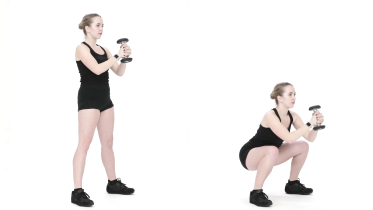 Goblet squat
.png) Single leg deadlift
Single leg deadlift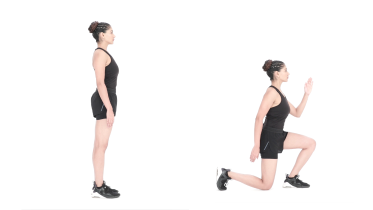 Reverse lunge
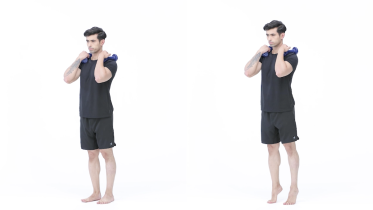 Weighted calf raise
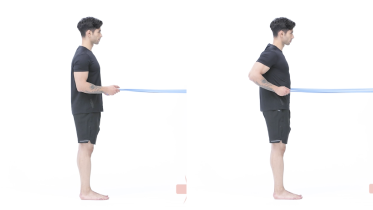 Resistance band row
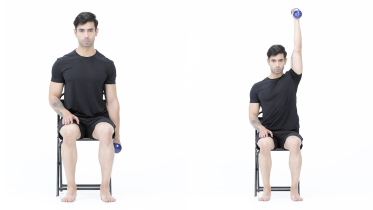 Seated dumbbell shoulder press
Sort the space out before the first session. Use a heavy chair or a counter that will not slide, clear the floor around you, and wear flat shoes that fit well and grip the floor, not socks, tights or bare feet. If you have fallen in the past year, feel unsteady, or take medicines that make you dizzy, keep one hand on the support for every repetition of the single leg deadlift and the calf raise, and ask your doctor or physio about a falls check. The single leg deadlift takes your head down and brings it back up again, so if bending forward tends to leave you light-headed, take your time on the way up and keep breathing through it.
A sudden loss of balance is different. Call emergency services straight away for any sign of a stroke, even if it goes away: sudden dizziness with unsteadiness or falling over, a face that droops on one side, an arm you cannot lift or keep up, slurred or muddled speech, weakness or numbness on one side of your body or face, sudden blurred vision, double vision or loss of sight, or a sudden severe headache.
If you have had a hip replacement, get the go-ahead from your surgeon or physio before you try goblet squats and single leg deadlifts. A deep squat bends the hip well past a right angle and a forward hinge bends the standing hip to a right angle or more, and many surgeons ask you to avoid that for the first months after some operations. After a knee fracture or knee surgery, including a knee replacement, follow your surgeon's or physio's plan, and start these exercises only when they have cleared you.
The weighted calf raise waits its turn after any ankle problem. After an ankle fracture or ankle surgery, follow your surgeon's or physio's weight-bearing plan, and start this exercise only when they have cleared you, and after an Achilles repair your surgeon's protocol decides when extra weight goes on. Add weight in small steps if the tendon has a history, and treat a tendon that is clearly worse the next morning as a sign the jump was too big.
After shoulder surgery, including a rotator cuff repair, or after a shoulder fracture or dislocation, follow your surgeon's or physio's plan, and do only the movements and range they have cleared. Many plans allow only passive movement at first, where the arm is moved for you and its muscles stay relaxed. A banded row is rarely one of the first things allowed after shoulder surgery, so ask when it can go in.
Check with your physio before you start the press if lifting your arm overhead is painful, or if you have a rotator cuff problem, a frozen shoulder or a shoulder that has dislocated in the past. The row bends the elbow against the band as well. After a broken or dislocated elbow, or elbow surgery such as a tendon repair, follow your surgeon's or physio's plan, and start this exercise only when they have cleared you.
Low bone density changes one of these. If you have osteoporosis, keep the back straight and the range small on the single leg deadlift, and check with your physio first, because rounding the spine forward is a position many osteoporosis programs limit. That is also why the row on this page is the upright one rather than a version done leaning forward. Work from the osteoporosis program and your own clinician rather than from this page alone, and if you have had a fracture in your spine, check with your physio before you begin.
Go over the band and its fixing before every row. A nick or a thin spot is where a band snaps, and an anchor that slips sends the handles straight back at you. If you have high blood pressure, breathe steadily through every repetition and never hold your breath. With a heart condition or high blood pressure, check with your doctor before you start.
Stop and sit down for chest pain or pressure, dizziness or feeling faint, a racing or irregular heartbeat, or being far more out of breath than the effort should cause. If chest pain, pressure or tightness does not ease quickly when you rest, spreads to your arm, neck, jaw, stomach or back, or comes with sweating, feeling sick, feeling light-headed or being short of breath, call emergency services straight away, as this can be a heart attack. If it eases quickly and none of these happen, get medical advice the same day, and do not exercise again until you have been checked.
When to see a physio (physical therapist)
A visit before session one earns its keep if you have never trained with weights, if an old knee, hip, back or shoulder is likely to have something to say once you add load, if you have been told your bones are thin, or if you have had surgery in the past year. One appointment is usually enough to set all six starting loads, and it saves months of guessing. When one of the six does not work for your body, a physical therapist can put something else in its place that trains the same muscles.
Come back for a review if something is still sore after two sessions, if nothing has moved in the numbers for a month, or if you want the gap between your two legs measured instead of guessed at. If you have had surgery, the plan from your surgical team comes first and nothing here replaces it. Read the warning list below before any of this, because each line sets its own timing.
Related exercise programs
See a doctor promptly if
- Emergency: if chest pain, pressure or tightness does not ease quickly when you rest, spreads to your arm, neck, jaw, stomach or back, or comes with sweating, feeling sick, feeling light-headed or being short of breath, call emergency services straight away, as this can be a heart attack. If it eases quickly and none of these happen, get medical advice the same day, and do not exercise again until you have been checked.
- Emergency: any sign of a stroke, even if it goes away. That means a face that droops on one side, an arm you cannot lift or keep up, slurred or muddled speech, weakness or numbness on one side of your body or face, sudden blurred vision, double vision or loss of sight, trouble swallowing, sudden dizziness with unsteadiness or falling over, a sudden severe headache, or a sudden fall where your legs give way but you do not black out (a drop attack). Call emergency services straight away.
- Emergency: you have just fallen and cannot get up, or you think you may have hurt your head, neck, back or hip. Stay where you are, keep warm and call emergency services, or get someone to call for you. If you got up and walked without trouble and only notice pain later, use the lines below.
- Emergency: you have had a fall or an injury and now have severe hip pain, or you cannot walk or put weight on the leg. Call emergency services or go to an emergency department. This can be a sign of a broken hip (hip fracture).
- Emergency: the shoulder feels as if it has slipped out of place, looks a different shape or suddenly locks so you cannot move the arm, or the pain is severe after a fall or an injury. Go to an emergency department straight away, without driving yourself, and do not try to put the shoulder back in yourself.
- Emergency: your arm, hand or fingers turn cold, pale, blue or gray compared with the other side. Call emergency services or go to an emergency department straight away, and do not drive yourself. The blood supply to the arm may be blocked.
- Same day: a sudden pop or snap at the back of your ankle or heel, a feeling that someone kicked you there, or sudden pain there after which you cannot push off or rise onto your toes on that leg. Stop, take the weight off that leg carefully and go to an urgent care center or emergency department the same day, even if you can still walk, as this can be a torn Achilles tendon.
- Same day: a sudden sharp pain, pop or snap at the back of your thigh. Stop straight away. If you then get large bruising spreading down the back of the thigh, a gap or dip you can feel, a stiff-legged walk, or clear weakness when you bend the knee, get assessed the same day at urgent care or an emergency department, as the tendon may have pulled away from the bone near the buttock.
- Same day: a sudden pop or tearing feeling in the shoulder that brings sharp pain, new weakness or trouble lifting the arm. Stop and contact your surgical team the same day, or get medical advice the same day if you have not had surgery.
- Same day: a sudden pop or snap at the front of your elbow, sudden sharp pain there, or the muscle at the front of your upper arm bunches up or changes shape. Stop and go to an urgent care center or emergency department the same day, even if you can still bend the elbow, as this can be a torn biceps tendon.
- Same day: pins and needles in your arm or hand that do not go away after you stop, or part of your arm or hand goes numb. Get medical advice the same day. If one side of your face or body suddenly goes numb or weak, or your speech becomes slurred or muddled, call emergency services, even if it goes away.
- Same day: dizziness or feeling faint during or after exercise, without any of the emergency signs above. Stop the exercises and get medical advice the same day. If you faint, it does not settle within a few minutes of sitting still, or you cannot stand or walk steadily, call emergency services.
- Same day: you blacked out or fainted, even for a moment. Get medical advice the same day. Call emergency services instead if the person cannot be woken within 1 minute, has not fully recovered or has trouble speaking or moving, has chest pain or a pounding, fluttering or irregular heartbeat, fainted while exercising or lying down, is shaking or jerking, or was badly hurt.
- Same day: after a fall, you are in pain, have hurt yourself or feel unwell, or you were on the floor for an hour or more, without any of the emergency signs above. Get medical advice the same day, even if you managed to get up.
- Same day: new hip or groin pain after a fall, even a small one, if you are older, have low bone density (osteoporosis) or have taken steroid tablets for a long time, even if you can still walk. Get medical advice the same day. A broken hip is not always obvious at first.
- Same day: a calf or thigh that is newly swollen, warm, tender, red or darker than usual, has swollen veins that are sore to touch, or has a throbbing or cramping pain that does not fit your injury or condition, or that feels different from normal muscle soreness after exercise. This can be a sign of a blood clot (deep vein thrombosis), especially after surgery, an injury, time in a cast or boot, a long trip or a spell of being much less mobile than usual. Get medical advice the same day. If you are also short of breath or have chest pain, call emergency services.
- Same day: back pain that comes on suddenly after lifting, bending, a cough or a sneeze, even without a fall, if you have low bone density (osteoporosis). Get medical advice the same day. This can be a sign of a broken bone in the spine (vertebral fracture). Stop the exercises until you have been checked.
- Same day: back pain after a minor fall or strain if you are older, have low bone density (osteoporosis) or have taken steroid tablets for a long time. Get medical advice the same day.
- Within a few days: sharp pain during an exercise, a joint that gives way, new swelling, or pain that is still worse a few days after you drop back a step. Stop that exercise and check with your physio before you do it again.
- Within a few days: the pain is there at night or at rest and keeps getting worse. See your doctor within a few days. If you have had cancer, now or in the past, or are losing weight without trying, see your doctor sooner, within a day or two, and mention it. This applies even if the pain is not getting worse. If you are being treated for cancer now, contact your cancer team the same day.
Common questions
How often should pickleball players over 50 do strength training?
On 2 days a week at the least, and 3 if the week allows it. The WHO guidelines ask adults for muscle-strengthening activity at moderate or greater intensity across all the major muscle groups on 2 or more days a week, and from age 65 they ask for varied multicomponent activity emphasizing functional balance and strength training on 3 or more days a week, to improve everyday function and prevent falls (Bull 2020). The US guidance summarized by the CDC for adults 65 and over says the same 2 days for muscle work, adding activities that challenge balance, and the Canadian 24-Hour Movement Guidelines for adults 65 and over ask for muscle strengthening using major muscle groups at least twice a week plus activities that challenge balance. Those are guidelines drawn from systematic reviews, not from any study of paddle sport players, and under 65 none of them asks for a third day. Leave a day between sessions, and your physio will adjust this.
Will strength training stop me getting injured playing pickleball?
Nobody can tell you that, because the study has not been done. No randomized trial has put pickleball players on a strength program and counted their injuries, and the 2024 critical analysis review of injuries in aging pickleball players describes the sport-specific guidance on reducing injury risk as limited (Touhey 2024). There is one pickleball study that looked directly at strength and falls, and its result is worth knowing before you build hopes on this page. Across 92 recreational players in a cross-sectional study, hip abduction strength did not separate the players who had fallen from the players who had not, and neither did ankle bend or single leg squat quality; what did separate them was age and speed on a change of direction test (Myers and Hanks 2024). So lift for strength and function, which is well supported in older adults, and treat anything about injury rates in this sport as unmeasured.
Should I lift on the same day I play pickleball?
You can, and the order usually matters more than the calendar. If both land on one day, play first and lift afterward, so you are not asking for sharp changes of direction on legs that have just done three sets of lunges. Most recreational players find it easier to put the session on a non-playing day, keep a day between two sessions, and leave the heavier leg work at least 48 hours clear of a tournament or a ladder night. If your week is already four mornings of games, start with two short sessions rather than three, because the total is what your body answers to.
What weight should I start with if I have never lifted?
Light enough that the weight is the least interesting thing about the first two or three weeks. A 1 liter bottle of water weighs about 1 kg (2.2 lb) and is enough in each hand for early shoulder presses, and the goblet squat can start with nothing at all held in front of your chest. Go up only when the last repetition of a set has stopped feeling hard, and go up in the smallest step you own rather than the next dumbbell but one. If you would rather not guess, book one session with a physio or physical therapist and have all six starting loads set for you.
Can I do this at home without a gym?
Yes. The list needs one dumbbell or a weight you can hold at your chest, a pair of light dumbbells or bottles, a resistance band with somewhere at about waist height to anchor it, such as a door anchor or a solid stair rail, and something sturdy to stand next to. A 2 kg (4.4 lb) bag of sugar held against the chest works for early goblet squats, and a filled bottle in each hand works for the press. What a gym adds is the option to keep going up in small steps once the household objects run out of weight, which is usually a question for month four rather than week one.
How long before I notice a difference on court?
Give it 8 to 12 weeks before you judge it, and watch the right things. Strength shows up first in the numbers you are writing down and in ordinary jobs, such as getting out of a low car seat or climbing the stairs to the club balcony without thinking about it. On court, players usually notice the reset after a wide ball before they notice anything else, because that is the movement most dependent on one leg holding a load. The pooled trial evidence in older adults is about strength, chair rises and walking speed, not about pickleball performance, so set your expectations there rather than on your scoreline.
References
- Bull FC, Al-Ansari SS, Biddle S, et al. World Health Organization 2020 guidelines on physical activity and sedentary behaviour. British Journal of Sports Medicine. 2020;54(24):1451-1462. https://doi.org/10.1136/bjsports-2020-102955
- Liu CJ, Latham NK. Progressive resistance strength training for improving physical function in older adults. Cochrane Database of Systematic Reviews. 2009;(3):CD002759. https://doi.org/10.1002/14651858.CD002759.pub2
- Sherrington C, Fairhall NJ, Wallbank GK, Tiedemann A, Michaleff ZA, Howard K, Clemson L, Hopewell S, Lamb SE. Exercise for preventing falls in older people living in the community. Cochrane Database of Systematic Reviews. 2019;1:CD012424. https://doi.org/10.1002/14651858.CD012424.pub2
- Myers B, Hanks J. Hip strength, change of direction, and falls in recreational pickleball players. International Journal of Sports Physical Therapy. 2024;19(9):1116-1125. https://doi.org/10.26603/001c.122490
- Touhey DC, Bozorgmehr CK, Tartibi DS, Smith MV, Knapik DM. Pickleball injuries in the aging athlete: a critical analysis review. Cureus. 2024;16(9):e69950. https://doi.org/10.7759/cureus.69950
- Helms ER, Cronin J, Storey A, Zourdos MC. Application of the repetitions in reserve-based rating of perceived exertion scale for resistance training. Strength and Conditioning Journal. 2016;38(4):42-49. https://doi.org/10.1519/SSC.0000000000000218
- Grgic J, Schoenfeld BJ, Orazem J, Sabol F. Effects of resistance training performed to repetition failure or non-failure on muscular strength and hypertrophy: a systematic review and meta-analysis. Journal of Sport and Health Science. 2022;11(2):202-211. https://doi.org/10.1016/j.jshs.2021.01.007
- Centers for Disease Control and Prevention. Older adult activity: an overview. Page last updated 4 December 2025. https://www.cdc.gov/physical-activity-basics/guidelines/older-adults.html
- Canadian Society for Exercise Physiology. Canadian 24-Hour Movement Guidelines for adults aged 65 years and older. https://csepguidelines.ca/guidelines/adults-65/
- NHS. Chest pain. Page last reviewed 8 August 2023. https://www.nhs.uk/symptoms/chest-pain/
- NHS. Symptoms of a stroke. Page last reviewed 12 September 2024. https://www.nhs.uk/conditions/stroke/symptoms/
- NHS. DVT (deep vein thrombosis). Page last reviewed 30 April 2026. https://www.nhs.uk/conditions/deep-vein-thrombosis-dvt/
- NHS. Tendonitis. Page last reviewed 9 June 2023. https://www.nhs.uk/conditions/tendonitis/
- NHS. Falls. Page last reviewed 6 March 2025. https://www.nhs.uk/conditions/falls/
- NHS. Fainting. Page last reviewed 17 August 2026. https://www.nhs.uk/symptoms/fainting/
- NHS. Osteoporosis. Page last reviewed 13 October 2022. https://www.nhs.uk/conditions/osteoporosis/
Written and checked by the PocketPhysio editorial team. Last updated 2026-10-01.
This page is general education, not a diagnosis or a personal treatment plan. See a physiotherapist or doctor for advice about your own situation.