
Pickleball and your body
What the sport asks of your body
A pickleball rally is short, and that is most of the problem. You stand nearly still, move hard for a second or two, then stand nearly still again. Most of the court is covered in two or three steps, so the first one takes a load that a longer run would spread out. Now put that on a hard surface, with a ball dropping at your feet at the kitchen line and an overhead you did not see coming. The sport keeps asking a body that was standing still a second ago to move fast.
The clinic records match that description. At one hospital foot and ankle service, the mechanisms players gave for 198 injuries were running or lunging forward in 30.9% of cases, planting the foot in 16.5% and rolling the ankle inward in 15.5% (Kingston 2024). A chart review of 164 pickleball injuries at an academic orthopedic and rehabilitation clinic recorded overhead hitting as the mechanism mentioned most often for rotator cuff tears, and a fall while running for the ball for most of the broken wrists. For pain on the outside of the elbow the same authors point to backhand shots and a tight grip, which is their suggestion and not something they counted (Meng 2026).
Both are single-center series. They tell you what walked through those particular doors, not what happens to players in general.
Who gets hurt, and where
Start with what kind of evidence this is, because the numbers are easy to misread. Most of what is known comes from the National Electronic Injury Surveillance System, a sample of around 100 US emergency departments whose cases are weighted up to a national estimate. It counts visits. It has no idea how many people played, for how long, or how many hurt themselves and went to a clinic, a physical therapist or nobody at all. It can show you a pattern and a direction, but never a risk.
The pattern is consistent all the same. In the sample covering 2014 to 2023, 1,722 pickleball cases were weighted to an estimated 100,704 injuries nationally, with the annual estimate rising from 1,313 in 2014 to 24,461 in 2023. Of those patients, 73.8% were aged 60 to 79. Fractures made up 26.4% of diagnoses and strains or sprains 24.0%, falls were the mechanism in 51.3% and overexertion in 42.3%, and 18.6% ended in a hospital admission or transfer. Cardiac arrest was recorded in 11 people, 5 of whom died, in a group aged 64 to 77, and those were the only deaths in the sample (McMillan 2025).
The older players were looked at separately in an earlier analysis of the same database. Among people aged 60 and over between 2010 and 2019, 429 pickleball cases were weighted to an estimated 28,984 injuries. Strains and sprains accounted for 31.0% and fractures 30.4%, the upper limb took 35.0% of the injuries and the lower limb 27.6%, and 66.9% followed a slip, trip or fall (Weiss 2021). The same paper's all-age pickleball group, which is the one the body part figures come from, named the wrist most often at 13.2%, then the lower leg at 12.9% and the head at 11.9%. Falls, wrists and heads are what you would expect from a group that is mostly over 60 and moving sideways in a hurry.
Growth explains part of the rise and cannot be separated from the rest. The Sports and Fitness Industry Association puts US participation at 24.3 million in 2025 against roughly 4.2 million in 2020, and a January 2025 survey commissioned by Pickleball Canada estimated 1.54 million Canadians playing. More players produce more injuries even if the sport has not changed at all, and no database can tell those two things apart.
The two that cannot wait
A pop at the back of the ankle is the first. Players describe it as being kicked or hit from behind, they turn round to apologize to somebody who is not there, and then they find they cannot push off. Achilles rupture was the commonest single foot and ankle diagnosis at that hospital service, 39.4% of the 198 cases (Kingston 2024), and in a review of 2,684 Achilles ruptures at one center over ten years, the 43 sustained at pickleball were in people averaging 64.5 years against 48.6 for everyone else, and 67.4% of them went to surgery against 45.4% (McCahon 2026).
Walking is still possible with a ruptured tendon, which is exactly why people wait. Do not wait. The warning list below gives the wording to use and where to go.
Chest pain is the second. The only deaths in the national emergency department sample were cardiac arrests: 11 people arrested on court or just after playing, 5 of them died, and the group ranged from 64 to 77 years old (McMillan 2025). A game of doubles is short bursts of hard effort in people who are often past 60, sometimes in heat, often with a competitive streak that overrides how they feel. Treat chest pain, pressure or tightness during play as a reason to stop immediately, sit down and follow the first line in the warning list.
Playing with less risk
Nobody has run an injury prevention trial in pickleball players, so the sensible steps are borrowed and should be read that way. Falls are the place to put the effort, given how much of the hospital data they account for. The Cochrane review of exercise for preventing falls, covering 59 studies and 12,981 community-dwelling older adults, found a 23% reduction in the rate of falls, with balance and functional training on its own producing 24% across 39 studies and 7,920 people (Sherrington 2019). The staged version is the balance and falls prevention program.
Strength is the second borrowed step. Pooling 25 randomized trials, 26,610 participants and 3,464 injuries across various sports, strength training was associated with sports injuries falling to less than a third, and the exercise programs taken together with overuse injuries falling to roughly half, while stretching by itself showed no effect (Lauersen 2014). None of those trials involved pickleball, so do not expect the same size of effect on a court, but the direction has held up across sports for a decade.
Then there are the habits that cost nothing, although no trial has tested any of them in this sport. Warm up before the first point rather than during the first game, which the pickleball warm-up page sets out step by step, along with what the warm-up evidence does and does not show. Add playing days in steps, not in a jump from twice a week to daily because a new court opened. Get a niggle looked at in its first week, while it is still a small problem with a short program.
If something already hurts
Each of the usual sore spots has a staged program on this site. The Achilles tendinopathy program is for a tendon that grumbles, not one that has torn, and the Achilles tendon rupture program follows a repair or a boot. A rolled ankle goes to the ankle sprain program. For the arm, there is tennis elbow for pain on the outside of the elbow and rotator cuff tendinopathy for a shoulder that complains on the serve or the overhead.
If you would rather start from where it hurts than from a diagnosis, heel pain in the morning, elbow pain when lifting, shoulder pain when lifting your arm and knee pain on stairs all cover complaints that turn up in this age group. Muscle soreness after exercise or injury is the one to read after a heavy weekend of play, because it sorts ordinary stiffness from the kind that needs attention.
Exercises that can help
One for each part of you this sport leans on hardest: the calf and Achilles, the lunging leg, your balance on one foot, and the back of the shoulder. Calf raises often start at 2 to 3 sets of 10 to 15 on both legs, the split squat at 2 to 3 sets of 8 to 12 on each leg, single leg stance at 5 to 10 lifts on each leg holding each for a few seconds, and the band external rotation at 2 to 3 sets of 10 to 15 slow repetitions with a light band. The numbers, precautions and stop signs on each exercise page come first. Your physio will adjust this.
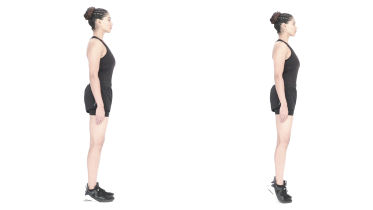 Calf raises
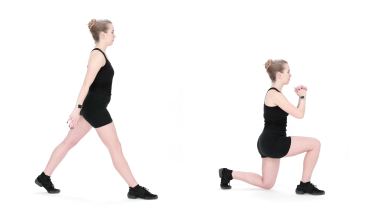 Split squat
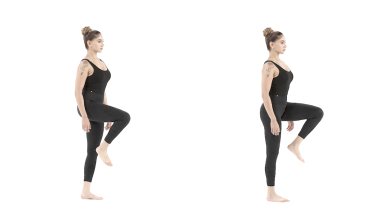 Single leg stance
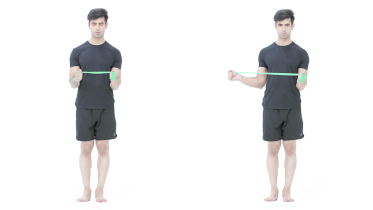 Shoulder external rotation with band
Read the precautions on each page before the first set. Wear flat shoes that fit well and grip the floor, not socks, tights or bare feet, and keep a counter or a sturdy chair within reach for single leg stance and the split squat. If you have fallen in the past year or feel unsteady on your feet, keep one hand on the support for every repetition, practice only when someone else is at home, and ask your physio before you let go. If you have had a hip or knee replacement, get the go-ahead from your surgeon or physio before you try single leg stance. Standing on the operated leg alone comes at a set stage of rehab, and some hip operations limit how high the knee can lift in the first months after surgery.
Calf raises come in at the stage your surgeon's protocol sets after an Achilles repair or any ankle operation. After shoulder surgery, a fracture or a dislocation, follow your surgeon's or physio's plan and do only the range they have cleared before you add a band. If you have high blood pressure, breathe steadily through every repetition and never hold your breath. With a heart condition or high blood pressure, check with your doctor before you start.
If chest pain, pressure or tightness does not ease quickly when you rest, spreads to your arm, neck, jaw, stomach or back, or comes with sweating, feeling sick, feeling light-headed or being short of breath, call emergency services straight away, as this can be a heart attack. If it eases quickly and none of these happen, get medical advice the same day, and do not exercise again until you have been checked.
When to see a physio (physical therapist)
Book an appointment if something has been sore for more than about two weeks, if it is changing how you move on court, or if it comes back every time you play twice in a row. Come sooner if an ankle has given way more than once, if a shoulder has started waking you at night, or if you have noticed yourself reaching for a fence or a partner to steady yourself between points.
An assessment is mostly watching. Expect someone to check how far your ankle bends, how long you can hold one leg, how your knee behaves when you lunge, and what your shoulder does at the top of a serve, then to build a program around whichever of those is furthest behind. That is a better use of six weeks than reading about it. Start with the warning list below, and follow the timing on whichever line fits.
In this topic
- Pickleball Achilles and calf injuries
A pop or kicked feeling at the back of the ankle during a push off can be a torn Achilles. What to do, plus calf strain and tendon pain that builds.
- Common pickleball injuries
Where pickleball players actually get hurt, from Achilles and knee to wrist and shoulder, what kind of study each figure comes from, and the red flags.
- Pickleball and your knees
Lunging to the kitchen line is hard on an older knee. Kneecap pain, arthritis, meniscus tears and the swelling or giving way that needs checking.
- Pickleball elbow: the same tendon, a newer name
Pickleball elbow is tennis elbow under a sportier name. What the paddle weight, the grip and your playing week change, and the program that treats it.
- Getting back on the pickleball court after an injury
How to get back on the pickleball court after an injury: settle it, rebuild strength, rebuild the movements, then return in stages.
- Pickleball and the shoulder: smashes, the cuff and life after 50
The pickleball serve is underhand by rule, so the overhead load comes from smashes and high volleys. What that asks of a rotator cuff over 50.
- A strength plan for pickleball players over 50
A twice weekly home strength session for pickleball players over 50: six movements, how to build them up, and what the evidence does and does not say.
- Warming up for pickleball
A 5 to 10 minute pickleball warm-up for players over 50, what the evidence for warming up really says, where stretching fits, and when to stop.
Related exercise programs
- Achilles tendon rupture
- Achilles tendinopathy
- Ankle sprain
- Knee osteoarthritis
- Rotator cuff tendinopathy
- Tennis elbow
See a doctor promptly if
- Emergency: if chest pain, pressure or tightness does not ease quickly when you rest, spreads to your arm, neck, jaw, stomach or back, or comes with sweating, feeling sick, feeling light-headed or being short of breath, call emergency services straight away, as this can be a heart attack. If it eases quickly and none of these happen, get medical advice the same day, and do not exercise again until you have been checked.
- Emergency: call emergency services straight away for any sign of a stroke, even if it goes away: sudden dizziness with unsteadiness or falling over, a face that droops on one side, an arm you cannot lift or keep up, slurred or muddled speech, weakness or numbness on one side of your body or face, sudden blurred vision, double vision or loss of sight, or a sudden severe headache.
- Emergency: you have just fallen and cannot get up, or you think you may have hurt your head, neck, back or hip. Stay where you are, keep warm and call emergency services, or get someone to call for you. If you got up and walked without trouble and only notice pain later, use the lines below.
- Emergency: you fell and cannot remember the fall or how it happened. Go to an emergency department straight away, and do not drive yourself. You may have blacked out or hit your head without knowing it.
- Emergency: after a ball, a paddle or a fall to the face, any change to your sight, severe pain in the eye, a headache or finding light hard to bear, feeling sick or being sick, an eye you cannot move or keep open, or blood or pus coming from the eye. The same applies if something has pierced the eye or hit it at high speed, or if a strong chemical has gone into it. Go to an emergency department or call emergency services straight away, and do not drive yourself.
- Emergency: after a knock to the head, being very drowsy or finding it hard to keep your eyes open, confusion, a fit (seizure), new weakness or numbness anywhere in your body, new trouble understanding, speaking, walking or keeping your balance, new problems seeing or hearing, clear fluid coming from your ears or nose, bleeding from your ears or bruising behind them, a black eye when your eye was not hit, a dent in your head or a wound with something stuck in it, or a change in behavior. Call emergency services straight away. These can be signs of an injury to the brain.
- Emergency: after a knock to the head, you were knocked out, even for a moment, you cannot remember what happened just before or after, you have had a headache ever since, or you are being sick (vomiting). The same applies, even if you feel fine, if you take medicine that thins your blood, other than aspirin on its own, have a bleeding or clotting condition, have had brain surgery in the past, or had been drinking alcohol or taking drugs when it happened. Go to an emergency department straight away, and do not drive yourself.
- Emergency: you have had a fall or an injury and now have severe hip pain, or you cannot walk or put weight on the leg. Call emergency services or go to an emergency department. This can be a sign of a broken hip (hip fracture).
- Emergency: the knee became very swollen very quickly, within a few hours of a twist, fall or blow, or you felt a pop or snap. Go to an emergency department straight away. Do not drive yourself: ask someone to drive you or call an ambulance. A knee that fills up that fast has usually bled inside the joint, which can come from a torn ligament, a kneecap that slipped out or a break, so it needs checking before you play again.
- Emergency: the shoulder feels as if it has slipped out of place, looks a different shape or suddenly locks so you cannot move the arm, or the pain is severe after a fall or an injury. Go to an emergency department straight away, without driving yourself, and do not try to put the shoulder back in yourself.
- Same day: a sudden pop or snap at the back of your ankle or heel, a feeling that someone kicked you there, or sudden pain there after which you cannot push off or rise onto your toes on that leg. Stop, take the weight off that leg carefully and go to an urgent care center or emergency department the same day, even if you can still walk, as this can be a torn Achilles tendon.
- Same day: you felt the kneecap slip out of place and it went back by itself. Get assessed the same day.
- Same day: after a fall, you are in pain, have hurt yourself or feel unwell, or you were on the floor for an hour or more, without any of the emergency signs above. Get medical advice the same day, even if you managed to get up.
- Same day: you blacked out or fainted, even for a moment. Get medical advice the same day. Call emergency services instead if the person cannot be woken within 1 minute, has not fully recovered or has trouble speaking or moving, has chest pain or a pounding, fluttering or irregular heartbeat, fainted while exercising or lying down, is shaking or jerking, or was badly hurt.
- Same day: new hip or groin pain after a fall, even a small one, if you are older, have low bone density (osteoporosis) or have taken steroid tablets for a long time, even if you can still walk. Get medical advice the same day. A broken hip is not always obvious at first.
- Same day: a calf or thigh that is newly swollen, warm, tender, red or darker than usual, has swollen veins that are sore to touch, or has a throbbing or cramping pain that does not fit your injury or condition, or that feels different from normal muscle soreness after exercise. This can be a sign of a blood clot (deep vein thrombosis), especially after surgery, an injury, time in a cast or boot, a long trip or a spell of being much less mobile than usual. Get medical advice the same day. If you are also short of breath or have chest pain, call emergency services.
- Within a few days: you have fallen two or more times in the past year, or you keep tripping, stumbling or feeling that your legs might give way. Book an appointment with your GP within a few days and ask about a falls assessment. Tell them about every fall, even the ones where you were not hurt.
Common questions
Is pickleball bad for your knees?
No study has followed pickleball players and non-players over time to answer that, so anyone who tells you it wrecks knees or protects them is going beyond the evidence. What exists is a picture of who turns up sore. In a five-year chart review at one academic clinic, the knee was the largest single group of pickleball injuries, 52 of 164, and a torn medial meniscus was the commonest knee diagnosis at 48% (Meng 2026). That is a count of people who sought specialist care, not a rate. If your knees already ache, the graded knee osteoarthritis program linked from this page is a better starting point than giving the sport up, because NICE lists tailored exercise as a core treatment for osteoarthritis rather than an optional extra (NICE NG226).
Why do so many pickleball players tear their Achilles?
The move that does it is the one the sport is built on: a sudden push off a still leg, usually forward. At one hospital foot and ankle service, running or lunging forward was the mechanism in 30.9% of 198 pickleball foot and ankle injuries, and Achilles rupture was the single commonest diagnosis at 39.4% (Kingston 2024). Age is the other half of the story. In a review of 2,684 Achilles ruptures at one center, the 43 that happened at pickleball were in people who averaged 64.5 years old, against 48.6 for all the rest (McCahon 2026). Both are single-center series and neither can tell you how likely a rupture is per hour of play.
Is pickleball safe after 60?
For most people it is exercise, and exercise at that age is worth having. The caution is not the sport, it is the two things that go wrong fast. Of the pickleball injuries in the national emergency department sample, 73.8% were in people aged 60 to 79, 26.4% were fractures and 18.6% of cases ended in a hospital admission or transfer, and the only deaths were cardiac arrests, 5 of the 11 people who arrested, in a group aged 64 to 77 (McMillan 2025). If you have a heart condition, high blood pressure, or symptoms you have not had looked at, see your doctor before you start, not after. Then count balance and leg strength as part of playing.
Does pickleball cause more injuries than tennis?
In older players the two look more alike than the arguments suggest. Among US emergency department visits by people aged 60 and over from 2010 to 2019, there were an estimated 28,984 pickleball injuries and 58,836 tennis injuries, and the authors described the injury patterns as mostly similar, with annual pickleball numbers reaching parity with tennis by 2018 (Weiss 2021). Falls made up 66.9% of the pickleball injuries and 59.0% of the tennis ones. None of that is a comparison of risk per hour played, because the data has no idea how many people played either sport or for how long.
What is the best way to avoid getting hurt playing pickleball?
Nobody has tested an injury prevention program in pickleball players, so the honest answer borrows from other sports and from falls research. A meta-analysis of 25 randomized trials covering 26,610 people found that strength training reduced sports injuries to less than a third, while stretching on its own made no difference (Lauersen 2014). For falls, the Cochrane review of 59 studies and 12,981 older adults found exercise cut the rate of falls by 23%, and balance and functional training by 24%, both rated high certainty (Sherrington 2019). Warm up before the first point, build your playing time up in steps rather than jumps, and deal with a niggle in week one instead of week ten.
References
- McMillan P, Lake LP, Burkhart A, Reddy E, Hale IC, Grawe BM. The epidemiology of pickleball injuries presenting to US emergency departments. Sports Health. Published online 13 July 2025; in print 2026;18(4):749-755. https://doi.org/10.1177/19417381251350671
- Weiss H, Dougherty J, DiMaggio C. Non-fatal senior pickleball and tennis-related injuries treated in United States emergency departments, 2010-2019. Injury Epidemiology. 2021;8:34. https://doi.org/10.1186/s40621-021-00327-9
- Kingston K, Parker EB, Higgins A, Smith JT. Emerging patterns of foot and ankle injuries in pickleball players: a short report. Foot and Ankle International. 2024;45(11):1266-1269. https://doi.org/10.1177/10711007241271215
- McCahon JAS, Miller M, Riebesell S, Pedowitz DI, Parekh SG, Daniel JN. Pickleball and the rising incidence of Achilles tendon injuries in the elderly. Foot and Ankle Specialist. 2026;19(2):206-210. https://doi.org/10.1177/19386400241286591
- Meng Y, Chen A, Nguyen C, Kaufman M, Li D, Pham N, Chou R, Roh E. Pickleball-related injuries treated at a tertiary academic center over five years: a cross-sectional study. Injury Epidemiology. 2026;13:39. https://doi.org/10.1186/s40621-026-00673-6
- Lauersen JB, Bertelsen DM, Andersen LB. The effectiveness of exercise interventions to prevent sports injuries: a systematic review and meta-analysis of randomised controlled trials. British Journal of Sports Medicine. 2014;48(11):871-877. https://doi.org/10.1136/bjsports-2013-092538
- Sherrington C, Fairhall NJ, Wallbank GK, Tiedemann A, Michaleff ZA, Howard K, Clemson L, Hopewell S, Lamb SE. Exercise for preventing falls in older people living in the community. Cochrane Database of Systematic Reviews. 2019;1:CD012424. https://doi.org/10.1002/14651858.CD012424.pub2
- Sports and Fitness Industry Association. US pickleball participation. Accessed 30 September 2026. https://sfia.org/research/u-s-pickleball-participation/
- Pickleball Canada. Pickleball in Canada, January 2025 survey. Accessed 30 September 2026. https://pickleballcanada.org/pickleball-in-canada-january-2025-survey/
- National Institute for Health and Care Excellence. Osteoarthritis in over 16s: diagnosis and management. NICE guideline NG226, last reviewed 19 October 2022. https://www.nice.org.uk/guidance/ng226
- NHS. Tendonitis. Page last reviewed 9 June 2023. https://www.nhs.uk/conditions/tendonitis/
- NHS. Symptoms of a stroke. https://www.nhs.uk/conditions/stroke/symptoms/
- NHS. Falls. https://www.nhs.uk/conditions/falls/
- NHS. Fainting. https://www.nhs.uk/symptoms/fainting/
- NHS. Dislocated kneecap. Page last reviewed 10 March 2026. https://www.nhs.uk/conditions/dislocated-kneecap/
- NHS. Eye injuries. Page last reviewed 12 March 2026. https://www.nhs.uk/conditions/eye-injuries/
- NHS. Head injury and concussion. Page last reviewed 29 May 2025. https://www.nhs.uk/conditions/head-injury-and-concussion/
- NHS. Chest pain. Page last reviewed 8 August 2023. https://www.nhs.uk/symptoms/chest-pain/
- NHS. DVT (deep vein thrombosis). Page last reviewed 30 April 2026. https://www.nhs.uk/conditions/deep-vein-thrombosis-dvt/
Written and checked by the PocketPhysio editorial team. Last updated 2026-10-01.
This page is general education, not a diagnosis or a personal treatment plan. See a physiotherapist or doctor for advice about your own situation.