
Heel pain in the morning: what it means and what helps
Why the first step is the worst one
Overnight your foot rests with the toes pointed, which lets the calf and the tissue under the sole settle short. Then you stand on it. One stride asks that tissue to lengthen and carry your body weight at the same time, and a heel that has been irritated protests loudly for a few paces before it gives in.
Two details help a clinician more than anything else you can describe. How long the pain takes to ease, and whether it comes back later in the day. A heel that loosens in a few strides and then aches again after two hours on your feet is behaving differently from one that stays sore from the moment you stand.
Where on the heel it hurts
Nothing here is a diagnosis. These are the options a clinician works through, and the spot on the heel narrows them down faster than any other clue you can give.
Under the heel, toward the inside
This is plantar fasciitis territory: pain where the thick band under your foot attaches to the heel bone, worst on the first steps of the morning, worse again when you stand up after sitting, and often worse after a long day on hard floors. No other problem accounts for as many sore heels, and the physical therapy guideline supports diagnosing it from that pattern together with tenderness at the attachment (Koc and colleagues, 2023). The plantar fasciitis program sets out the staged exercises, the shoe advice and how long it usually takes.
Right at the back of the heel
Pain at the very back, where the Achilles tendon meets the bone, usually points to insertional Achilles tendinopathy rather than a fascia problem. Morning stiffness in the tendon is one of its marks. It often eases as you move and returns after a run or a long walk, and it is handled a little differently, because bending the ankle up a long way presses the tendon against the heel bone. A clinical guide to Achilles tendinopathy suggests limiting that squeeze for insertional pain, for instance with a small heel lift during heel raises (Silbernagel and colleagues, 2020). So deep calf stretching and letting the heel drop below a step are usually kept off the list at first.
The Achilles tendinopathy program covers both types and explains why the insertional kind needs that adjustment.
Deep in the middle of the heel pad
Under your heel bone sits a pad of fat that works as a shock absorber. When it thins or gets irritated, the ache sits deeper and more central, closer to a bruise, and walking barefoot on a hard floor is unbearable in a way that plantar fasciitis often is not. A scoping review of heel fat pad syndrome found that pain worsening during long spells of standing, pain at night and pain in both heels all raised the likelihood of a fat pad problem rather than plantar fasciitis, while morning first-step pain and tenderness at the inner heel bone lowered it (Chang and colleagues, 2022). That comparison is between two ordinary causes of heel pain, so it is no reason to put pain at night down to the fat pad and leave it there: heel pain at night or at rest that keeps getting worse has its own entry, and its own time frame, in the warning signs below. The same review reported that the condition may be the second most common source of plantar heel pain, based on only two studies, and that no trial has tested the usual treatments for it.
The whole heel, sore when you squeeze the sides
A stress fracture in the heel bone behaves differently again. The pain builds with walking instead of easing, the heel hurts when you press it from both sides at once, and it usually follows a jump in training, a new job on your feet or a long-distance hike. Stress fractures come from repeated load rather than a single injury, and they often need several weeks of reduced loading (OrthoInfo). Pushing on through one makes it worse, so it is in the warning signs below with how soon to get it checked.
Burning, tingling or numbness in the sole
Nerve-related heel pain feels different from mechanical pain. People describe burning, pins and needles, an electric quality, or a patch of sole that feels dead, and it often carries on at rest and at night rather than settling with movement. The nerve can be squeezed at the inner ankle, which is tarsal tunnel syndrome, although the evidence base for diagnosing and treating it is weak and much of the literature is opinion (Doneddu and colleagues, 2017). Damage to the nerves themselves usually affects both feet fairly evenly, and the peripheral neuropathy program covers that picture, including the daily foot checks it calls for.
Both heels at once, with other joints
Two sore heels with no training explanation deserve a wider look, particularly alongside back stiffness that is worse in the morning, swollen joints elsewhere, psoriasis or a bowel condition. Painful inflammation where a bone joins a tendon or ligament (enthesitis) is part of ankylosing spondylitis, and the NHS lists behind the heel at the Achilles tendon, and under the heel, among the common sites for it. The list below gives that combination a week or two. Not an emergency, then, but not something to sit on for a year either.
If it is a child or teenager
Heel pain in a growing child is usually a different problem entirely, centered on the growth plate at the back of the heel bone rather than the fascia. The typical age group is 8 to 15, it is the most common cause of heel pain in children (Kothari and colleagues, 2023), and it stops for good once a child is fully grown and the growth plate has turned to solid bone (OrthoInfo). Other causes do occur at that age, including infection and, rarely, a tumor, which is why a child's sore heel is worth examining rather than assuming (Kothari and colleagues, 2023). The Sever's disease page is written for parents, covers what to change about sport and carries the warning signs in a parent's words. Have a doctor or physio check a child's heel before they start any exercises, and read the entry for children in the warning signs below for the symptoms that cannot wait.
Gout, diabetes and what they change
Gout is worth knowing about because it looks nothing like a mechanical heel. It arrives suddenly with severe pain and hot, red, swollen skin over the joint, and redness can be harder to see on brown or black skin. It is most often the big toe, and the NHS lists other joints in the feet, ankles, hands, wrists, elbows or knees rather than naming the heel. Any joint that flares up like that needs same-day advice, because an infected joint presents in much the same way and cannot wait.
Diabetes changes the stakes rather than the diagnosis. Reduced feeling means a blister or a cut goes unnoticed, and the foot can be damaged before there is any pain to warn you. Aging, diabetes, rheumatological conditions and higher body weight are all named as things that may thin the heel fat pad, although the review that gathered them says this comes from expert opinion rather than good evidence (Chang and colleagues, 2022). The specific signs to act on are listed below, among them a foot that becomes hot, swollen or changes shape, which needs your weight off it and advice that day.
What to change in the first week
Cut the load before you add exercises. The NHS advice for heel pain is to rest the foot and raise it where you can, and to put an ice pack wrapped in a towel on it for up to 20 minutes every 2 to 3 hours. For shoes it says wide and comfortable, with a low heel and a cushioned sole, plus a soft insole or heel pad. It also warns against long periods of walking or standing, above all with nothing on your feet, and against high heels or tight pointed shoes.
Hard floors do most of the damage at home. Slippers with a cushioned sole, kept by the bed, spare the heel the first barefoot steps onto tile or wood, and that one change often does more in a week than any stretch. Best practice guidance for plantar heel pain puts education matched to the person at the center of first-line care (Morrissey and colleagues, 2021). Stretching and taping sit alongside it, with other options added if progress stalls.
Give it two weeks before you judge. The NHS suggests seeing a doctor if heel pain has not improved after 2 weeks of looking after it yourself, and sooner if it is severe, stopping you doing normal things, or coming with tingling or numbness.
Exercises for the first steps of the day
The five below are gentle, early-stage movements, not a rehabilitation program. Two are done sitting on the edge of the bed before you stand, which is the point: the heel that has been still all night gets some movement through it before it takes your body weight.
Breathe normally rather than holding your breath, and keep a hand on a wall or counter for the standing stretches if your balance is unsteady. If your pain is at the back of the heel, go carefully with both calf stretches and stop well short of any pull in the tendon itself, since bending the ankle up hard presses the tendon against the bone. Skip the ball release if the skin of your sole is broken or marked, and leave it out if you have reduced feeling in your feet until your foot team says otherwise. If you are wearing a cast or a boot, or you have had surgery on your foot, ankle or Achilles tendon, your surgeon's or physio's plan comes first, so check which movements are allowed before you start any of these.
Exercises that can help
These five are for the first few minutes of the day, two of them done sitting on the edge of the bed before you stand up. Typical starting doses are 10 to 20 ankle pumps at a time, 1 to 2 rounds of the ankle alphabet, holds of about 30 seconds repeated 2 to 3 times on each leg for the two calf stretches, and 1 to 2 minutes of slow rolling for the ball release. Each exercise page carries its own numbers, and your physio will adjust this.
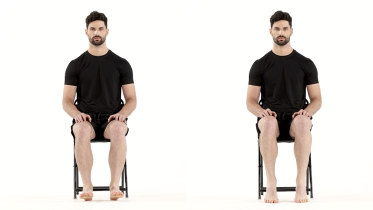 Ankle pumps
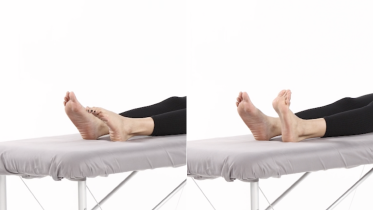 Ankle alphabet
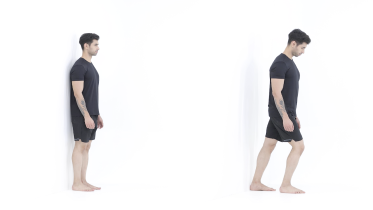 Calf stretch
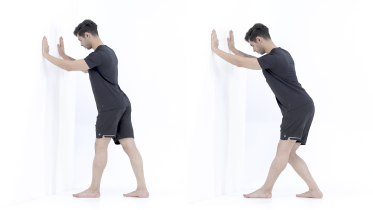 Soleus stretch
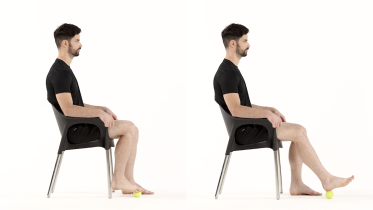 Plantar fascia ball release
Use the next morning as the judge. Some soreness while you do them is normal, as long as it has gone again within a day. If tomorrow's first steps are noticeably worse than today's, you did too much, so cut the numbers back instead of giving up on them.
When to see a physio (physical therapist)
Book an appointment if the heel has not improved after 2 weeks of sensible self-care, if it is severe or stopping you doing normal things, or if it keeps coming back every time you increase your walking or running. Go sooner if you have diabetes, if you have tingling or loss of feeling in the foot, or if the pain does not fit the morning pattern described here.
An assessment is quick and it settles the question of location, which is what everything else depends on. Expect the clinician to press specific spots on the heel, squeeze the heel from both sides, check how far your ankle bends up, watch you walk, and ask what changed in the weeks before it started. That produces a plan aimed at the right tissue, which beats months of stretching something that was never the problem. The warning signs that follow run to their own timings, from emergency care down to an appointment in the next week or two, and those come first, ahead of any routine booking.
Related exercise programs
See a doctor promptly if
- Part of your foot or a toe turns cold, pale, blue or black. Call emergency services or go to an emergency department straight away, and do not drive yourself, as the blood supply to the foot may be blocked.
- You felt a sudden pop or snap at the back of your ankle, it felt as if someone hit or kicked you in the calf, or walking or rising onto your toes on that leg suddenly became weak or difficult. Stop exercising and go to an urgent care center or emergency department the same day, even if you can still walk, as this can be a torn (ruptured) Achilles tendon. This page does not cover a rupture.
- A calf or thigh that is newly swollen, warm, tender, red or darker than usual, has swollen veins that are sore to touch, or has a throbbing or cramping pain that does not fit your injury or condition, or that feels different from normal muscle soreness after exercise. This can be a sign of a blood clot (deep vein thrombosis), especially after surgery, an injury, time in a cast or boot, a long trip or a spell of being much less mobile than usual. Get medical advice the same day. If you are also short of breath or have chest pain, call emergency services.
- You felt a sudden pop or tearing under the foot, followed by bruising and difficulty walking. Get it checked the same day.
- The heel pain started with a fall or a landing from height, or you cannot put weight on the foot. Get it checked the same day.
- The heel or foot is hot, red and swollen, or you have a fever or feel unwell. Get medical help the same day, and go to an emergency department if you feel very unwell. If you have a very high or very low temperature, shivering you cannot control, you are breathing very fast or finding it hard to breathe, you are confused or your speech is slurred, your skin, lips or tongue look blue, gray, pale or blotchy (on brown or black skin this can be easier to see on the palms of the hands or soles of the feet), or you have a rash that does not fade when you press it, call emergency services, as this can be sepsis.
- You have diabetes or numb feet, and one foot becomes hot, swollen or red, or changes color or shape, with or without pain. Take your weight off that foot straight away and get advice the same day from your doctor or your diabetes foot team. This can be Charcot foot, where the bones and joints of the foot are damaged and the foot can collapse. Do not exercise that foot until it has been checked. If you also have a fever or feel very unwell, or redness is spreading up your foot or leg, go to an emergency department.
- You have diabetes or numb feet and find a new blister, cut or sore on your foot, especially one you did not feel, a wound that smells or is leaking, or new pain in your foot that you cannot explain. Get it seen by your doctor or foot team the same day. If you also have a fever or feel very unwell, redness is spreading up your foot or leg, or part of your foot or a toe turns black, go to an emergency department.
- Your tendon pain or swelling started while you were taking a fluoroquinolone antibiotic, such as ciprofloxacin or levofloxacin, or in the months after a course. Contact your doctor straight away. The UK medicines regulator (MHRA) advises stopping the antibiotic at the first sign of tendon pain or swelling and talking to your doctor. Hold off the calf exercises until you have been checked.
- The whole heel hurts when you squeeze it from both sides, especially after a sudden increase in running or walking, or if you have thin bones (osteoporosis). Stop running and jumping, cut down on walking and standing, and see a doctor within a few days, as this can be a stress fracture of the heel bone rather than plantar fasciitis. An X-ray can look normal for the first 2 to 3 weeks, so a normal early X-ray does not rule it out.
- The pain is there at night or at rest as well as when you stand and walk, and it is getting worse. See your doctor within a few days. If you have had cancer, now or in the past, or are losing weight without trying, see your doctor sooner, within a day or two, and mention it. This applies even if the pain is not getting worse. If you are being treated for cancer now, contact your cancer team the same day.
- You have numbness, tingling, burning or loss of feeling in the foot. Book an assessment with a doctor or physio in the next week or two.
- Your heel or Achilles pain comes with back pain and stiffness that is worse in the morning and at night, or with painful, swollen joints elsewhere, or both heels became painful without an obvious reason. The same applies if you also have psoriasis, Crohn's disease or ulcerative colitis, or have had a red, painful, inflamed eye (iritis). This is not an emergency, but see your doctor in the next week or two, as it can be a sign of an inflammatory arthritis such as ankylosing spondylitis.
- Heel pain in a child or teenager needs a doctor or physio to look at it before they start any exercises. Get an urgent appointment with a doctor the same day if your child is limping when they have not been playing sport, has pain in the hip, groin, thigh or knee as well as the heel, or has heel pain with a fever or seems unwell. If they cannot put weight on the leg, have a high temperature or seem very unwell, go to an emergency department. See a doctor within a day or two if pain wakes your child at night, pain at rest keeps getting worse, or there is a lump or swelling on the heel or ankle that keeps growing.
- With diabetes, get any new foot pain checked by your doctor before you start these exercises.
Common questions
Why does my heel hurt in the morning when I get out of bed?
Because the tissues under and behind the heel have spent the night in a shortened position and then take your whole body weight in one step. The foot rests with the toes pointed while you sleep, so the plantar fascia and the calf sit short, and the first stride pulls them long again under load. This first-step pattern is the one physical therapy guidelines describe for plantar fasciitis, alongside pain that returns after sitting and after a long day standing (Koc and colleagues, 2023). It is the single most useful thing to tell a clinician, along with where on the heel it hurts and how many minutes it takes to settle.
Why does morning heel pain go away after walking?
Moving warms and lengthens the tissue and spreads the load over many steps rather than one. That easing is typical of plantar fasciitis and of Achilles pain at the back of the heel, and it is part of why both often get ignored for months. What matters is what happens later in the day. Pain that comes back after a long spell of standing, or that is worse by evening than it was first thing, says the tissue is being loaded more than it currently tolerates. Pain that never eases at all, or that is worse at rest and at night and keeps building, belongs on the warning list on this page instead.
Is heel pain in the morning always plantar fasciitis?
No, though it is the most likely single cause of pain under the heel. Pain right at the back of the heel is usually the Achilles tendon where it attaches, not the fascia. A scoping review of heel fat pad syndrome found that morning first-step pain and tenderness at the inner heel bone both made fat pad problems less likely, while pain that worsens the longer you stand, pain at night and pain in both heels made them more likely (Chang and colleagues, 2022). Burning or tingling in the sole suggests a nerve, and a heel that is sore to squeeze from both sides after a jump in training can be a stress fracture. An examination sorts these out in a few minutes, which is why guessing is a poor use of your time.
Why does the back of my heel hurt in the morning?
That location, right where the tendon meets the heel bone, is called insertional Achilles tendinopathy, and stiffness first thing in the morning is typical of Achilles tendon pain of any kind. It behaves a little differently from pain in the cord of the tendon higher up. Positions that bend the ankle up a long way press the tendon against the bone, so deep calf stretches and letting the heel drop below a step are usually left out at first. If the back of your heel is the sore spot, the Achilles program is the better fit than anything aimed at the fascia, and a physio can confirm which one you have.
Can heel pain be a sign of gout, diabetes or cancer?
Each is possible and each has its own signature. Gout brings sudden, severe pain with hot, swollen, red skin over the joint, most often the big toe, and the NHS lists other joints in the feet and ankles rather than the heel; a joint that flares like that needs checking the same day, because a joint infection looks similar. Diabetes matters for different reasons: nerve damage causes burning or numbness in both feet, often worse at night, and diabetes is one of the conditions named as a possible cause of thinning of the heel fat pad, on expert opinion rather than firm evidence (Chang and colleagues, 2022). Diabetes also brings its own dangers, so any new foot pain, a wound, or a foot that becomes hot, swollen or changes shape appears in the warning signs on this page with how fast to act. Cancer is a rare cause of heel pain, and the pattern that prompts checking is pain at night or at rest that keeps getting worse, especially alongside a cancer history or weight loss you did not intend.
What stretches and exercises help morning heel pain?
Calf stretches and loading work for the foot and ankle are the two that guidelines support for plantar heel pain, with stretching of the plantar fascia itself added (Koc and colleagues, 2023). The five on this page are the early, gentle end of that: ankle pumps and the alphabet done sitting on the bed before your first steps, a calf stretch with the knee straight and again with it bent, and a slow roll of the sole over a ball. They are a starting point rather than a full program, and the condition pages carry the staged versions with heavier heel raises. Judge any of them by how the next morning feels, not by how they feel while you do them.
References
- Koc TA Jr, Bise CG, Neville C, et al. Heel Pain - Plantar Fasciitis: Revision 2023. Journal of Orthopaedic and Sports Physical Therapy. 2023;53(12):CPG1-CPG39. https://doi.org/10.2519/jospt.2023.0303
- Morrissey D, Cotchett M, Said J'Bari A, et al. Management of plantar heel pain: a best practice guide informed by a systematic review, expert clinical reasoning and patient values. British Journal of Sports Medicine. 2021;55(19):1106-1118. https://doi.org/10.1136/bjsports-2019-101970
- Silbernagel KG, Hanlon S, Sprague A. Current Clinical Concepts: Conservative Management of Achilles Tendinopathy. Journal of Athletic Training. 2020;55(5):438-447. https://doi.org/10.4085/1062-6050-356-19
- Chang AH, Rasmussen SZ, Jensen AE, Sorensen T, Rathleff MS. What do we actually know about a common cause of plantar heel pain? A scoping review of heel fat pad syndrome. Journal of Foot and Ankle Research. 2022;15:60. https://doi.org/10.1186/s13047-022-00568-x
- Kothari EA, Padgett AM, Young SM, Ray J, Shah A, Conklin MJ. A Review of Pediatric Heel Pain. Cureus. 2023;15(1):e34228. https://doi.org/10.7759/cureus.34228
- Doneddu PE, Coraci D, Loreti C, Piccinini G, Padua L. Tarsal tunnel syndrome: still more opinions than evidence. Status of the art. Neurological Sciences. 2017;38(10):1735-1739. https://doi.org/10.1007/s10072-017-3039-x
- American Academy of Orthopaedic Surgeons. Stress fractures. OrthoInfo. https://www.orthoinfo.org/en/diseases--conditions/stress-fractures/
- American Academy of Orthopaedic Surgeons. Sever's Disease (Heel Pain). OrthoInfo. https://www.orthoinfo.org/diseases--conditions/severs-disease/
- NHS. Heel pain. Page last reviewed 24 October 2025. https://www.nhs.uk/symptoms/foot-pain/heel-pain/
- NHS. Plantar fasciitis. Page last reviewed 14 February 2025. https://www.nhs.uk/conditions/plantar-fasciitis/
- NHS. Gout. Page last reviewed 24 August 2023. https://www.nhs.uk/conditions/gout/
- NHS. Deep vein thrombosis (DVT). Page last reviewed 30 April 2026. https://www.nhs.uk/conditions/deep-vein-thrombosis-dvt/
- NHS. Symptoms: Ankylosing spondylitis. Page last reviewed 5 January 2023. https://www.nhs.uk/conditions/ankylosing-spondylitis/symptoms/
- National Institute for Health and Care Excellence. Diabetic foot problems: prevention and management. NICE guideline NG19. Published 26 August 2015, last updated 11 October 2019. https://www.nice.org.uk/guidance/ng19
- National Institute for Health and Care Excellence. Suspected cancer: recognition and referral (NG12). Published 23 June 2015, last updated 15 April 2026. https://www.nice.org.uk/guidance/ng12
- Diabetes UK. Charcot foot and diabetes. Last reviewed 8 November 2024. https://www.diabetes.org.uk/about-diabetes/looking-after-diabetes/complications/feet/charcot-foot
- Medicines and Healthcare products Regulatory Agency. Fluoroquinolone antibiotics: must now only be prescribed when other commonly recommended antibiotics are inappropriate. Drug Safety Update. 22 January 2024. https://www.gov.uk/drug-safety-update/fluoroquinolone-antibiotics-must-now-only-be-prescribed-when-other-commonly-recommended-antibiotics-are-inappropriate
Written and checked by the PocketPhysio editorial team. Last updated 2026-09-30.
This page is general education, not a diagnosis or a personal treatment plan. See a physiotherapist or doctor for advice about your own situation.