
Part of Pickleball and your body
Pickleball Achilles and calf injuries
The moment that cannot wait until Monday
The sound comes first. A bang or a snap at the back of the lower leg, loud enough that partners on the next court sometimes hear it, followed by a leg that will not push off properly. The Cambridge University Hospitals leaflet on Achilles rupture describes the sensation as being hit or kicked in the calf, and the NHS tendonitis page treats a popping or snapping sound as a reason to get urgent advice rather than to sleep on it.
The trap is that plenty of people finish the game. Other muscles in the lower leg can still point the foot down, so the limp may look unimpressive and the pain may ease within the hour. The American Academy of Orthopaedic Surgeons lists being unable to walk on the injured leg among the possible signs, and notes that the diagnosis is made by squeezing the calf to see whether the foot moves and by asking you to rise onto your toes. Go the same day, and get a lift rather than driving.
What the clinic numbers actually show
Pickleball research is young, and almost all of it counts people who turned up somewhere rather than measuring risk. Keep that in mind while reading any figure on this page.
The tendon at the back of the ankle dominates the picture. A retrospective chart review of 198 pickleball foot and ankle injuries found Achilles tendon rupture to be the commonest single diagnosis at 39.4%, with 77.8% of the injuries recorded as traumatic rather than gradual and 62.8% of the ruptures treated surgically, in a group whose mean age was 58.3 years and 58.6% male (Kingston and colleagues, 2024). A separate chart review of 166 lower limb pickleball and paddleball injuries put Achilles rupture at 12.1% of patients and Achilles tendinitis at 8.4% (Opara and colleagues, 2024). A third series pulled 2,684 Achilles ruptures from one orthopedic group's records: the 43 that happened at pickleball came at a mean age of 64.5 years against 48.6 for the rest, and were operated on more often, 67.4% against 45.4% (McCahon and colleagues, 2026).
None of them tells you your odds. All are chart reviews at particular clinics, and none has a denominator of how many people played or for how long. What they establish is that when a pickleball player reaches a foot and ankle clinic, the tendon at the back of the ankle is the structure most often involved, and that these players are mostly in their fifties and sixties.
Why the push off is the moment
The lunge forward is the signature movement of this sport and it is also the one that catches people out. In a cross-sectional study of 92 recreational players, 42% reported a fall while playing and 30% had fallen more than once. Among those falls, lunging was the stated reason in 57% and moving backward in 24% (Myers and Hanks, 2024). The same study found no relationship between fall history and ankle dorsiflexion, single leg squat form or hip abduction strength. The usual physio measures did not pick out who had fallen.
The clinic records point at the same movements, with the usual caveat that they only describe who turned up. Running or lunging forward was the noted mechanism for 30.9% of the 198 foot and ankle injuries in the Kingston review, ahead of planting the foot at 16.5% and rolling the ankle inward at 15.5%. Opara's series coded most of its cases more broadly, as a sudden change of direction, at 54.2%, and kept push off, jump or lunge as a smaller separate category at 6.0%, which shows how much these labels depend on who wrote the notes. A 2026 systematic review of 15 pickleball studies ranked the mechanisms as falls first, then running or lunging forward, then rolling the ankle inward, and reported age 50 or over as a consistent risk factor across nearly all of them (Okhovat and colleagues, 2026).
The Achilles is loaded hardest when the ankle is bending up while the calf is contracting, which is what happens the instant your front foot lands on a stretched lunge and you have to get back again. Backpedaling for a lob does something similar with less control, because you cannot see the ground behind you.
The authors of the falls study suggested that prevention work for this sport should include multi-directional lunging, lower limb strength and power, and change of direction training that includes moving backward. That is a reasonable suggestion from a cross-sectional survey. The 2026 systematic review also calls for structured prevention programs. Neither is a tested program, and no trial has shown that any warm-up or strength routine lowers Achilles rupture rates in pickleball.
Calf strain, and the mistake it invites
A calf strain is the other injury that starts suddenly at the back of the lower leg. The University Hospitals Plymouth leaflet describes a sudden tearing or stabbing pain, with minor strains letting you carry on and severe ones stopping you standing, and swelling and bruising that can track down as far as the ankle. It puts recovery from a nasty tear at up to 3 months.
Early on, the leaflet asks for protection, relative rest, ice wrapped in a towel, compression and elevation above heart level for the first 2 weeks, and no heat, alcohol, running or massage in the first 72 hours. Pain free movement comes back gradually rather than all at once. Once the leg tolerates it, the calf work in the exercise list below is the route back to a push off you trust.
Here is the mistake that matters. A swollen, warm, tender calf is also how a blood clot presents, and the Plymouth leaflet lists deep vein thrombosis as a rare complication of a calf tear itself. Do not let a plausible story about a lunge on Tuesday stop you getting the leg looked at. Massage and rolling are exactly the wrong response if it turns out to be a clot, which is why the warning sign below sits high on the list. If your pain sits higher still, at the crease behind the knee rather than in the lower leg, pain behind the knee covers the other structures that live there.
Achilles tendinopathy, the slow version
This one arrives without a story. The tendon aches after play, then starts being stiff and sore for the first few minutes out of bed, then begins complaining during games rather than after them. It may feel thickened, and it is usually tender to pinch. Midportion pain sits in the cord a few centimeters above the heel bone; insertional pain sits right where the tendon meets the heel, and that version dislikes positions that bend the ankle up a long way.
It was recorded as Achilles tendinitis in 8.4% of the 166 patients in the Opara pickleball and paddleball case series. Of the three problems on this page, it is also the one you can do the most about yourself, because the treatment is loading exercise at home. The Achilles tendinopathy program stages it from holds through to hopping and covers the differences between the two types.
What helps
Load, applied in a way you can repeat. The 2024 US physical therapy clinical practice guideline makes tendon loading exercise, at loads as high as the tendon tolerates, its lead recommendation for midportion Achilles tendinopathy, done at least 3 times a week, and it advises against complete rest (Chimenti and colleagues, 2024). Several loading styles have worked in trials, from slow lowering to heavy slow resistance, so the style matters less than doing it consistently for months.
Judge the dose by tomorrow morning, not by how it feels during the set. The Swedish pain-monitoring model allowed pain up to 5 out of 10 both during and after activity, required it to have settled by the next morning, and did not allow symptoms to build from week to week (Silbernagel and colleagues, 2007). Silbernagel's later clinical review puts the emphasis on avoiding moderate or severe pain and on symptoms that worsen over time rather than on any single number (Silbernagel and colleagues, 2020).
Cut the load without cutting the activity. Fewer games in a row and a rest day between court days will do more for the tendon than stopping altogether, and a bike keeps your fitness while it catches up. None of this applies to a rupture, which follows the plan your surgical or fracture team gives you.
Exercises that can help
These load the calf and the Achilles in the order most programs use them: a hold first, then raises on two feet, then one, then the slow lowering, with a soleus stretch for a stiff ankle. Wall presses usually start at holds of 10 to 30 seconds repeated 3 to 5 times, calf raises on two feet at 2 to 3 sets of 10 to 15, bent knee and single leg raises at 2 to 3 sets of 8 to 15 on each leg, eccentric raises at 2 to 3 sets of 10 to 15 slow lowerings, and the stretch at about 30 seconds held 2 to 3 times each side. Read the numbers off each exercise page rather than this paragraph. Your physio will adjust this.
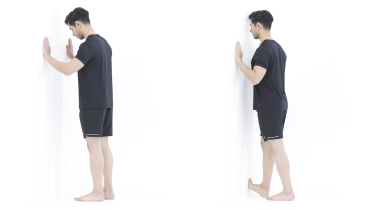 Isometric calf press against a wall
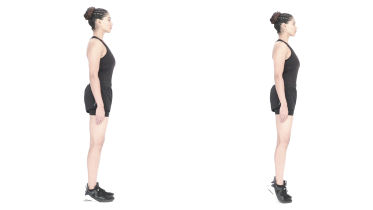 Calf raises
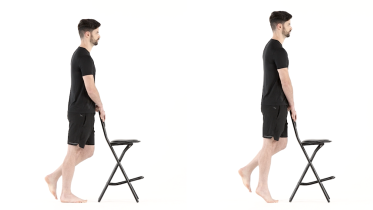 Bent-knee calf raise
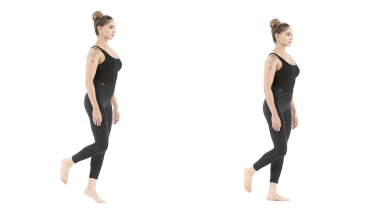 Single leg heel raise
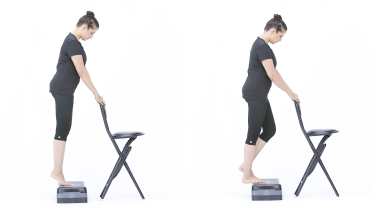 Eccentric calf raise
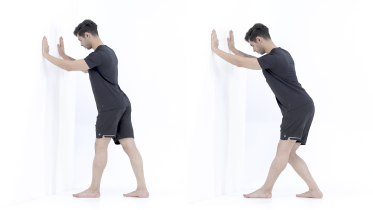 Soleus stretch
Precautions before you start. If you have had an Achilles repair or ankle surgery, your surgeon's protocol sets when each of these comes in, so check with your physio rather than starting on your own. The guideline's advice to load as high as the tendon tolerates is written for tendons that are not already fragile, so a tendon that has been ruptured, injected with steroid or upset by a fluoroquinolone antibiotic needs a starting point set by a clinician who has examined it.
If your pain is where the tendon joins the heel bone, keep your heels at floor level or step level and ask your physio before you let a heel drop below a step. Keep fingertips on a wall or counter for the standing raises if your balance is at all unsteady, and hold on throughout if you have had falls. If you have high blood pressure, breathe steadily through every hold and never hold your breath. With a heart condition or high blood pressure, check with your doctor before you start.
Stop the exercises for any of these: chest pain or pressure, dizziness or feeling faint, a racing or irregular heartbeat, or being far more out of breath than the effort should cause. If chest pain, pressure or tightness does not ease quickly when you rest, spreads to your arm, neck, jaw, stomach or back, or comes with sweating, feeling sick, feeling light-headed or being short of breath, call emergency services straight away, as this can be a heart attack. If it eases quickly and none of these happen, get medical advice the same day, and do not exercise again until you have been checked.
Playing on while the tendon settles
Most people with tendinopathy do not need to give up the sport, and the guideline is on their side about that. What usually needs to change is the volume rather than the activity: two games instead of five, plus an honest look at how many days a week you have been playing since you took the sport up. A tendon that went from nothing to four sessions a week in two months is telling you something about the ramp, not about your age.
Shoes are worth a thought too. Court shoes with some heel height are usually more comfortable than flat ones for an irritated Achilles. The US guideline lists a heel lift as an option for temporarily reducing how far the ankle bends up during activity in midportion tendon pain, on weaker evidence than the loading exercise itself (Chimenti and colleagues, 2024). Use one in both shoes so your legs stay the same length, and treat it as a short-term help rather than the plan. Sudden sprints for a drop shot are the last thing to come back, not the first.
When to see a physio (physical therapist)
Any sudden pop, snap or kicked feeling goes to urgent care the same day, not to a physio. For everything else, a few weeks of steadily worsening tendon pain, an ankle you no longer trust to push off, a calf strain that has not moved in a month, or a heel that is stiff every single morning all justify an assessment. A physio can tell a midportion problem from an insertional one, work out whether the calf or the hip is the limiting factor, and set a starting dose that does not flare you.
Book sooner if you are over 50 and new to the sport, if you have had a previous Achilles problem on either side, or if you are taking or have recently taken a fluoroquinolone antibiotic. First season players are well represented among the pickleball ruptures that have been followed up. Book sooner too if the calf keeps cramping or feeling tight in a way that is new for you. That is worth assessing on its own, though no study shows it warns of a tear to come, and a calf that feels fine is no guarantee either. The warning signs below set out what needs a doctor instead.
Related exercise programs
See a doctor promptly if
- Same day: a sudden pop or snap at the back of your ankle or heel, a feeling that someone kicked you there, or sudden pain there after which you cannot push off or rise onto your toes on that leg. Stop, take the weight off that leg carefully and go to an urgent care center or emergency department the same day, even if you can still walk, as this can be a torn Achilles tendon.
- Same day: a calf or thigh that is newly swollen, warm, tender, red or darker than usual, has swollen veins that are sore to touch, or has a throbbing or cramping pain that does not fit your injury or condition, or that feels different from normal muscle soreness after exercise. This can be a sign of a blood clot (deep vein thrombosis), especially after surgery, an injury, time in a cast or boot, a long trip or a spell of being much less mobile than usual. Get medical advice the same day. If you are also short of breath or have chest pain, call emergency services.
- Same day: the pain started with a fall or a blow to the back of the ankle, and there is bruising or you cannot put weight on the foot. Get it checked the same day.
- Same day: the tendon or heel is hot, red and swollen, or you have a fever or feel unwell. Get medical help the same day, and go to an emergency department if you feel very unwell. If you have a very high or very low temperature, shivering you cannot control, you are breathing very fast or finding it hard to breathe, you are confused or your speech is slurred, your skin, lips or tongue look blue, gray, pale or blotchy (on brown or black skin this can be easier to see on the palms of the hands or soles of the feet), or you have a rash that does not fade when you press it, call emergency services, as this can be sepsis.
- Same day: your tendon pain or swelling started while you were taking a fluoroquinolone antibiotic, such as ciprofloxacin or levofloxacin, or in the months after a course. Contact your doctor straight away. The UK medicines regulator (MHRA) advises stopping the antibiotic at the first sign of tendon pain or swelling and talking to your doctor. Hold off the calf exercises until you have been checked.
- Within a few days: the pain is there at night or at rest as well as with activity and keeps getting worse. See your doctor within a few days. If you have had cancer, now or in the past, or are losing weight without trying, see your doctor sooner, within a day or two, and mention it. This applies even if the pain is not getting worse. If you are being treated for cancer now, contact your cancer team the same day.
- Within a week or two: your heel or Achilles pain comes with back pain and stiffness that is worse in the morning and at night, or with painful, swollen joints elsewhere, or both heels became painful without an obvious reason. The same applies if you also have psoriasis, Crohn's disease or ulcerative colitis, or have had a red, painful, inflamed eye (iritis). This is not an emergency, but see your doctor in the next week or two, as it can be a sign of an inflammatory arthritis such as ankylosing spondylitis.
- Within a week or two: you have numbness, tingling, burning or loss of feeling in the foot, often along the outer edge. Book an assessment with a doctor or physio in the next week or two.
Common questions
Is a pop in the back of my ankle always a torn Achilles?
No, but it is treated as one until somebody has examined the leg. A calf muscle tear can also start with a sudden tearing or stabbing pain at the back of the lower leg, and the University Hospitals Plymouth leaflet describes swelling and bruising that can spread down to the ankle. The two are told apart by where the tenderness sits, by squeezing the calf to see whether the foot moves, and by asking you to rise onto your toes. Since a missed rupture is the expensive mistake and a strain loses nothing by being checked, the same day rule applies to both. Take the weight off the leg and get someone to drive you.
Why do so many pickleball players tear an Achilles?
The honest answer is that the research describes the pattern and has not yet explained it. Clinic series keep finding the same picture: Achilles rupture was the commonest foot and ankle diagnosis in a review of 198 pickleball patients whose average age was 58 (Kingston and colleagues, 2024), and pickleball ruptures arrived at a mean age of 64.5 in a series of 2,684 Achilles ruptures seen at one orthopedic group (McCahon and colleagues, 2026). One finding is worth knowing before your first season: of 28 players reached by phone after a pickleball Achilles rupture, 68% were hurt within their first month of playing and 32% were playing for the first time (Lencer and colleagues, 2025). Those are all counts of people who reached a clinic, not a risk per hour of play. The court is small, the ball comes back fast, and plenty of people take the sport up in the decade when tendons are least forgiving, but no study has separated those out.
How do I know if it is my calf or my Achilles?
Point to it. Calf muscle tears are felt higher, in the belly of the muscle in the upper third of the lower leg, and they are usually sore when you squeeze that muscle. Achilles problems sit lower, in the cord you can pinch above the heel or right at the back of the heel bone itself. A tendinopathy builds over weeks and is stiffest for the first few minutes after you get out of bed. A tear of either kind announces itself in one moment, and that moment belongs to a clinician, not a search result.
Can I keep playing pickleball with Achilles tendinopathy?
Often some of it, with a rule attached. The US physical therapy guideline advises against complete rest and says to keep going within your pain tolerance while you load the tendon at least 3 times a week (Chimenti and colleagues, 2024). The pain-monitoring rule from the Swedish trial allows pain up to 5 out of 10 during and after activity, as long as it has settled by the next morning and is not creeping up week to week (Silbernagel and colleagues, 2007). In practice that often means shorter sessions, fewer games in a row and a break between days on court. If the tendon is clearly worse the morning after, the session was too long.
Will calf raises stop me tearing my Achilles?
Nobody can promise that, and no trial has tested a prevention program in pickleball players. What calf strengthening has behind it is treatment evidence for tendinopathy, where loading exercise is the first-line recommendation (Chimenti and colleagues, 2024), plus the general case that a stronger calf handles a push off it is used to. Treat it as sensible conditioning rather than insurance. What the descriptive research does keep showing is age: a 2026 systematic review found age 50 or over to be a consistent risk factor for lower limb injury across nearly all of the 15 studies it reviewed (Okhovat and colleagues, 2026), and the recreational players who reported falls in a courtside survey of 92 people were significantly older than those who did not (Myers and Hanks, 2024). Balance, leg strength and practice at changing direction are worth training on their own merits.
How long after an Achilles tear before I can play pickleball again?
Plan in seasons, not weeks, and let your surgical or fracture team set the dates. The American Academy of Orthopaedic Surgeons puts full recovery at about 12 months, with some people saying it took nearer 2 years to reach all their goals. In a follow-up of pickleball players specifically, 28 people were reached by phone an average of 4.7 years after a pickleball Achilles rupture: 47% had gone back to the sport, at an average of 1.6 years, with no difference in scores or return rates between those repaired surgically and those treated in a boot, and almost everyone who had not gone back gave fear of tearing it again as the reason (Lencer and colleagues, 2025). Returning to a sport with sudden push offs usually comes at the end of that, after a physio has compared the calf strength and heel rise height of the two legs. The Achilles tendon rupture program sets out the stages between the boot and the court.
References
- Kingston K, Parker EB, Higgins A, Smith JT. Emerging patterns of foot and ankle injuries in pickleball players: a short report. Foot and Ankle International. 2024;45(11):1266-1269. https://doi.org/10.1177/10711007241271215
- Opara OA, Brush PL, Pohl N, et al. Pickleball- and Paddleball-Related Injuries in the Lower Extremity: Description, Treatment Options, and Return to Play. Cureus. 2024;16(2):e53954. https://doi.org/10.7759/cureus.53954
- McCahon JAS, Miller M, Riebesell S, Pedowitz DI, Parekh SG, Daniel JN. Pickleball and the Rising Incidence of Achilles Tendon Injuries in the Elderly. Foot and Ankle Specialist. 2026;19(2):206-210. https://doi.org/10.1177/19386400241286591
- Lencer AJ, McCahon JAS, Kohring AS, Amponsah N, Pedowitz DI, Parekh SG, Daniel JN. Pickleball and the Return to Sport After Achilles Tendon Rupture. Journal of the American Academy of Orthopaedic Surgeons. Published online 2025. https://doi.org/10.5435/JAAOS-D-25-00809
- Okhovat A, Ferkel E, Richards SA. Lower Extremity Injuries in Adult Pickleball Players: A Systematic Review of Injury Types, Mechanisms, and Risk Factors. Cureus. 2026;18(5):e108841. https://doi.org/10.7759/cureus.108841
- Myers B, Hanks J. Hip Strength, Change of Direction, and Falls in Recreational Pickleball Players. International Journal of Sports Physical Therapy. 2024;19(9):1116-1125. https://doi.org/10.26603/001c.122490
- Chimenti RL, Neville C, Houck J, Cuddeford T, Carreira D, Martin RL. Achilles Pain, Stiffness, and Muscle Power Deficits: Midportion Achilles Tendinopathy Revision - 2024. Journal of Orthopaedic and Sports Physical Therapy. 2024;54(12):CPG1-CPG32. https://doi.org/10.2519/jospt.2024.0302
- Silbernagel KG, Thomee R, Eriksson BI, Karlsson J. Continued sports activity, using a pain-monitoring model, during rehabilitation in patients with Achilles tendinopathy: a randomized controlled study. American Journal of Sports Medicine. 2007;35(6):897-906. https://doi.org/10.1177/0363546506298279
- Silbernagel KG, Hanlon S, Sprague A. Current Clinical Concepts: Conservative Management of Achilles Tendinopathy. Journal of Athletic Training. 2020;55(5):438-447. https://doi.org/10.4085/1062-6050-356-19
- American Academy of Orthopaedic Surgeons. Achilles tendon rupture (tear). OrthoInfo. https://www.orthoinfo.org/en/diseases--conditions/achilles-tendon-rupture-tear/
- Cambridge University Hospitals NHS Foundation Trust. Achilles tendon rupture. Patient information. Approved 14 January 2025. https://www.cuh.nhs.uk/patient-information/achilles-tendon-rupture/
- University Hospitals Plymouth NHS Trust. Calf muscle tears and strains. Patient information A-538 v2. Issued February 2025. https://www.plymouthhospitals.nhs.uk/display-pil/pil-calf-muscle-tears-and-strains-6064/
- NHS. Tendonitis. Page last reviewed 9 June 2023. https://www.nhs.uk/conditions/tendonitis/
- NHS. Deep vein thrombosis (DVT). Page last reviewed 30 April 2026. https://www.nhs.uk/conditions/deep-vein-thrombosis-dvt/
- NHS. Sepsis. Page last reviewed 14 May 2026. https://www.nhs.uk/conditions/sepsis/
- Medicines and Healthcare products Regulatory Agency. Fluoroquinolone antibiotics: must now only be prescribed when other commonly recommended antibiotics are inappropriate. Drug Safety Update. 22 January 2024. https://www.gov.uk/drug-safety-update/fluoroquinolone-antibiotics-must-now-only-be-prescribed-when-other-commonly-recommended-antibiotics-are-inappropriate
Written and checked by the PocketPhysio editorial team. Last updated 2026-10-01.
This page is general education, not a diagnosis or a personal treatment plan. See a physiotherapist or doctor for advice about your own situation.