
Rotator cuff tendinopathy exercises and physiotherapy
What is rotator cuff tendinopathy?
Four small muscles wrap around the ball of your shoulder joint and blend into a sheet of tendon called the rotator cuff. They turn the arm in and out, and they keep the ball centered in its socket while the bigger muscles lift the arm. Rotator cuff tendinopathy means that tendon has become painful and copes less well with load. You may also hear it called rotator cuff tendonitis, shoulder impingement, subacromial pain syndrome or rotator cuff related shoulder pain.
The typical picture, as UK shoulder surgeons describe it, is pain at the top and outer side of the shoulder that gets worse with overhead activity and can come with pain at night. Many people notice it most when they reach up to a shelf, put on a jacket or lie on that side. A doctor or physio usually diagnoses it from your story and an examination, and a scan is rarely needed at the start.
This page is for adults whose shoulder pain came on gradually. It is not a program for rehab after shoulder surgery, or for a tear caused by a fall, a pull or another injury. If either applies to you, follow the plan your surgeon or physio gives you.
Does exercise help rotator cuff tendinopathy?
Yes, and it is usually the first treatment to try. An overview of systematic reviews by Pieters and colleagues (2020) made a strong recommendation for exercise as the first-line treatment to improve pain, movement and function. It also supported adding hands-on treatment to exercise, and found moderate evidence that passive treatments such as laser and therapeutic ultrasound had no effect for this kind of shoulder pain. A 2025 physical therapy guideline, endorsed by the American Physical Therapy Association, gives its strongest grade (A) to an active exercise program as a first treatment to reduce pain and disability (Desmeules and colleagues, 2025).
Exercise also holds up well against surgery. Lewis (2016) concludes that a graduated, well-built exercise approach gives at least the same benefit as surgery. In the CSAW trial, the common operation for this problem did no better than a placebo operation (Beard and colleagues, 2018).
You do not always need many physio visits to do well. In the GRASP trial, one session with a physio, with an advice booklet, a resistance band and a simple set of home exercises with videos, did as well over 12 months as up to 6 sessions of progressive exercise with a physio (Hopewell and colleagues, 2021). A review of exercise programs for this condition also found that whether you exercise at home or in a clinic did not seem to matter (Littlewood and colleagues, 2015).
The research still has gaps. A Cochrane review found only one trial that compared a typical program of exercise and hands-on treatment with a placebo, and that trial found little difference between them (Page and colleagues, 2016). Nobody has pinned down the best exercises or dose either. What the evidence does back is a gradual program you can keep up for several months.
How to use this program
Pick the stage that matches your shoulder this week. If you are not sure, start at stage 1. Move up when the current stage feels easy and your shoulder is no worse the next morning.
Many programs use 2 to 3 sets of 8 to 15 slow repetitions for the band exercises, once a day or every other day. The review by Littlewood and colleagues found that 3 sets tended to do better than 1 or 2, that some resistance seemed to matter, and that most programs should show a clear change by 12 weeks. So once 2 sets feel comfortable, build toward 3 before you reach for a stronger band. Stretches are often held for 20 to 30 seconds, 2 to 3 times. Your physio will adjust the exercises and the numbers to your shoulder and to what you need to get back to.
Some discomfort during the exercises is common. The same review found that whether exercise produced some pain or avoided it did not seem to change results. A review of painful and pain-free exercise for long-lasting muscle and joint pain, which included three shoulder trials, reached a similar view: pain during exercise need not stop you (Smith and colleagues, 2017).
In practice, many programs accept mild discomfort that eases soon after you finish, with a shoulder no worse the next morning. Sharp or catching pain, or pain that builds with each repetition, means stop that exercise. If the shoulder is clearly worse the next morning, or the night pain comes back, the load was too much. Drop back a step rather than stopping altogether.
The exercise program
Stage 1: Settle the shoulder and keep it moving
For a shoulder that hurts with small reaches, aches at night or catches as you lift the arm. The three static holds work the muscles that turn the arm out, turn it in and lift it to the side while the arm stays still, and many people can do them even when lifting the arm hurts. Push gently into your hand or the wall, well short of your hardest, and keep breathing. Many programs use 5 to 10 holds of 5 to 10 seconds, once or twice a day; if the shoulder is sorer the next morning, push more gently or hold for less time. The pendulum and the stick exercise, done in a comfortable range rather than stretching into pain, keep the joint moving while the shoulder muscles stay relaxed.
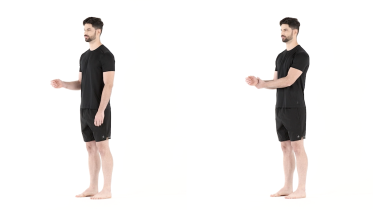 Isometric shoulder external rotation
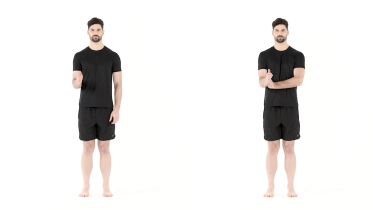 Isometric shoulder internal rotation
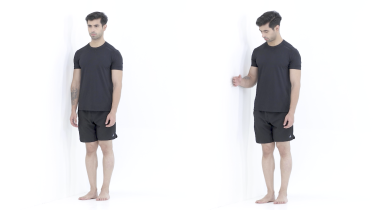 Isometric shoulder abduction
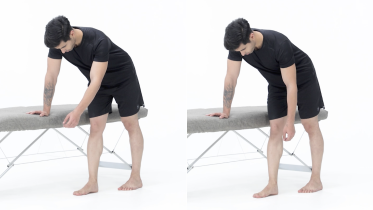 Pendulum exercise for the shoulder
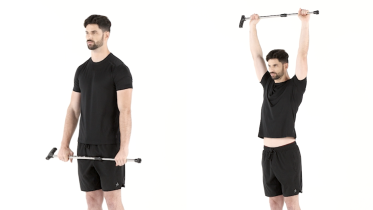 Shoulder flexion with a stick
Stage 2: Strengthen the rotator cuff with a band
When the static holds feel easy and reaching to chest height hurts less. Start with the side-lying turn, no weight in the hand, as a gentle step from the holds to a moving arm, then move on to the lightest band. Turning the arm out and in with the elbow tucked at your side works the rotator cuff without lifting the arm, which is usually the part that hurts most, and the band row works the muscles that control the shoulder blade. Wall slides rebuild reaching overhead while the wall takes some of the arm's weight; if there is a painful spot partway up, stop just below it for now. The cross body stretch is optional, for people whose physio finds the back of the shoulder is tight.
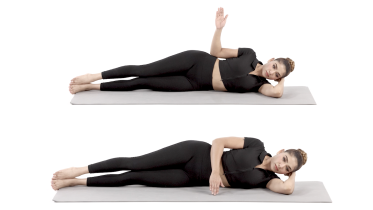 Side-lying external rotation
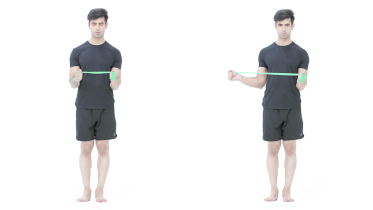 Shoulder external rotation with band
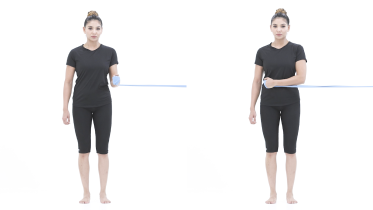 Shoulder internal rotation with band
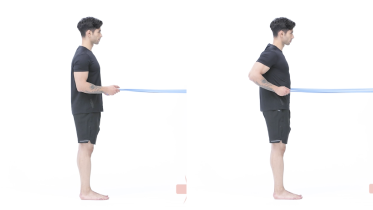 Resistance band row
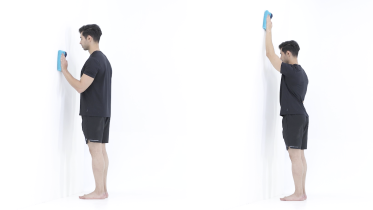 Wall slides with a towel
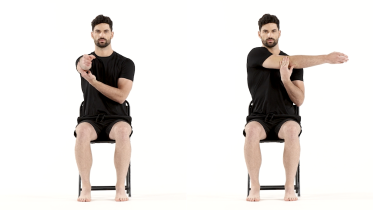 Cross body shoulder stretch
Stage 3: Build strength with the arm raised
When 3 sets of the stage 2 band exercises feel easy and the shoulder settles well by the next day, keep those going and add these. Lifting the arm out to the side against a band loads the tendon over the top of the shoulder (supraspinatus), so stop at shoulder height at first and go higher only if it stays comfortable. The 90/90 band turn works the same outward turn as stage 2, now with the arm held out at shoulder height, which is closer to reaching overhead or throwing. The serratus punch and the prone Y and T raises train the muscles that hold the shoulder blade steady as the arm lifts, and wall push-ups add a light pushing load. This is also the stage to practice what you need to get back to, such as reaching to a high shelf, working overhead or throwing, at a lighter load and for less time than usual.
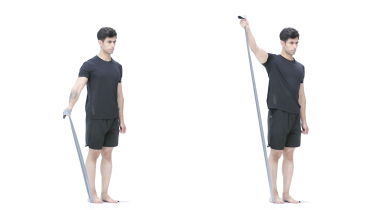 Shoulder abduction with band
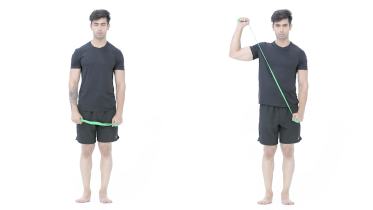 90/90 external rotation with band
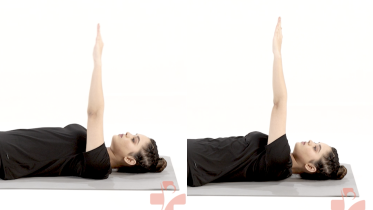 Serratus punch
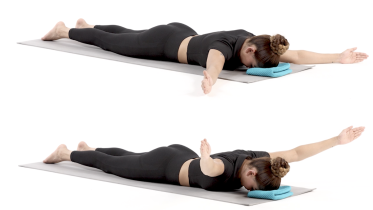 Prone Y raise
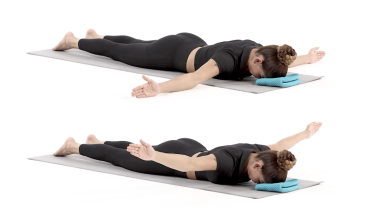 Prone T raise
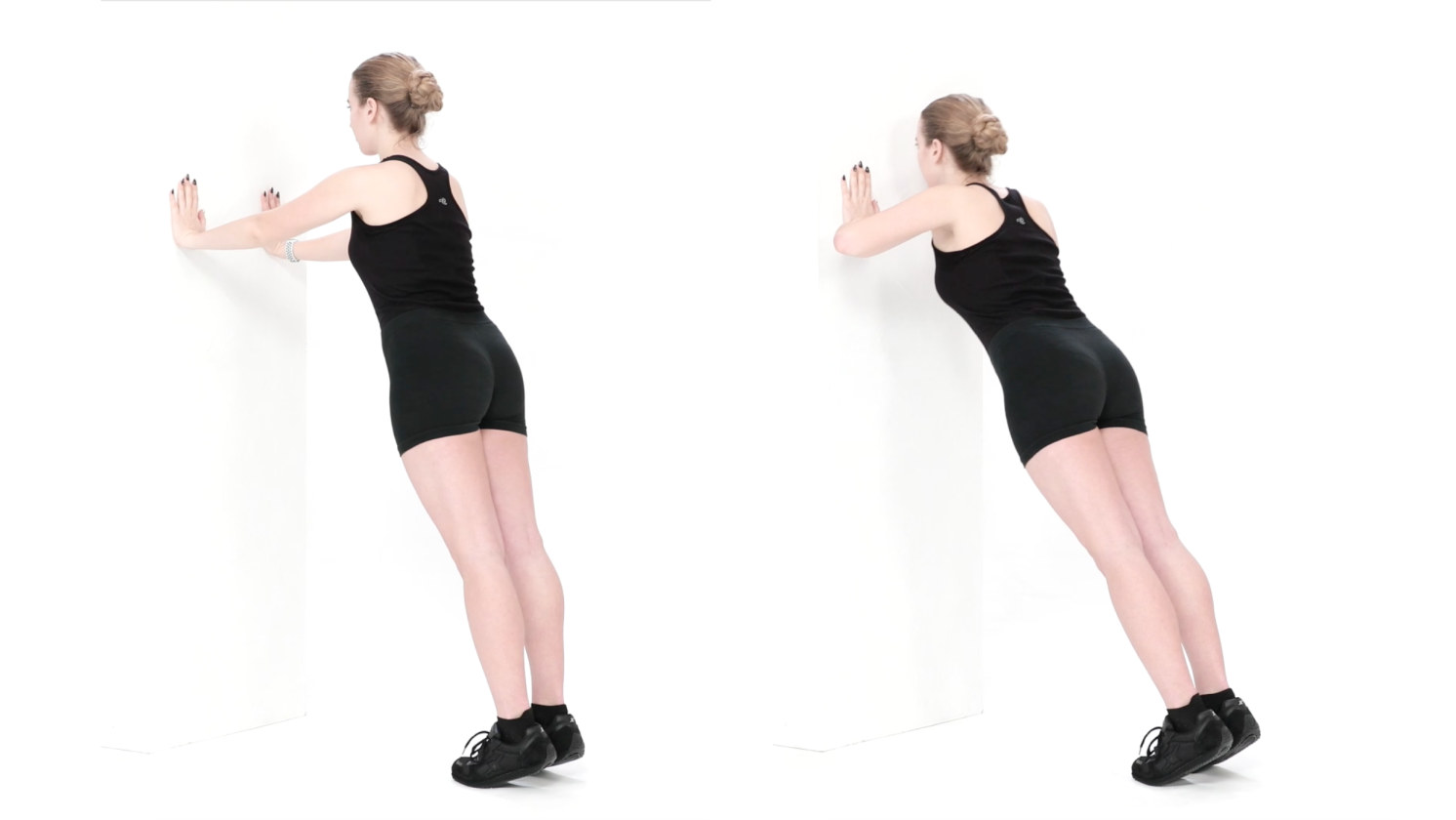 Wall push-ups
What to change at work and at home
The NHS advice is to stay active and keep gently moving the shoulder, and not to stop using it completely, because that can slow recovery. At the same time, avoid the things that clearly make it worse, and do not make up your own strenuous exercises or use heavy gym equipment for now. Paracetamol or ibuprofen, and heat or cold packs, can help you keep moving. Ask a pharmacist if you are not sure a medicine is safe for you.
Physios often suggest small changes like these, although they have not been tested on their own. Move things you use every day from high shelves to waist or chest height. Carry bags close to your body with the elbow bent, and split heavy loads between both hands. If your work involves long spells with your arms overhead, break them up with short rests at waist height. The 2025 guideline notes that changes to how you work may help reduce shoulder pain at work.
Sleep is often the hardest part. Many people find it easier to lie on the good side hugging a pillow, or on their back with a pillow under the sore arm so it rests slightly forward. There is no single right position, so use whatever lets you sleep.
If you play a sport that loads the shoulder, such as swimming, tennis or cricket, physios often suggest cutting the amount back rather than stopping, then building it up again as the shoulder settles. A physio can plan that return with you, based on how your shoulder copes with the load rather than a fixed date.
When to see a physio or doctor
See a physio or doctor if your shoulder pain is getting worse or has not improved after 2 weeks, as the NHS advises, or if it is very hard to move your arm. It is also worth an assessment if you are not sure the pain comes from the rotator cuff. Pain from the neck, frozen shoulder, arthritis and a torn tendon can all feel similar, and each needs a different plan. If the pain spreads from your neck, the neck pain program may be a better place to start once a professional has checked it.
If you have a program and it is not helping, a physio can check the diagnosis and change the load. The UK shoulder surgeons' care pathway suggests about 6 weeks of physiotherapy, with a further 6 weeks if it is helping, before thinking about a specialist referral. The warning signs below need medical attention, and some of them need it straight away.
For physiotherapists
This page gives patients a starting framework for rotator cuff related shoulder pain of gradual onset, in the sense used by Lewis (2016). The 2025 JOSPT guideline covers rotator cuff tendinopathy with or without calcification and partial-thickness tears, and addresses assessment, nonsurgical medical care, rehabilitation and return to sport. It grades an active exercise program with motor control and/or resistance training as an initial treatment at A, advises against imaging to confirm the diagnosis in initial management, and suggests imaging or specialist referral when symptoms persist despite up to 12 weeks of appropriate nonsurgical care (grade F, expert opinion). Acute traumatic tears need urgent referral under the BESS/BOA pathway, and post-surgical rehab is out of scope here.
Littlewood and colleagues (2015) give practical, preliminary dosing guidance: some resistance, 3 sets in preference to fewer, possibly higher repetitions, and a 12-week window to judge response. Whether pain was produced or avoided did not appear to matter. Base progression on the 24-hour response rather than a fixed timeline. In GRASP, a single best practice advice session with a self-guided home program matched up to 6 sessions of supervised progressive exercise on the SPADI at 12 months, and subacromial corticosteroid injection gave a small benefit at 8 weeks only. The Dutch update suggests considering an injection to enable exercise in patients whose pain stops them taking part.
See a doctor promptly if
- Chest pain or tightness, which may spread to your arm, neck or jaw, or shoulder or arm pain that comes with shortness of breath, sweating or feeling sick. This can be a heart attack. Call emergency services straight away.
- The shoulder is hot, red and swollen, or you have a fever or feel unwell. This can be a joint infection. Go to an emergency department the same day.
- The shoulder feels as if it has slipped out of place, looks a different shape or suddenly locks so you cannot move the arm, or the pain is severe after a fall or an injury. Go to an emergency department straight away, without driving yourself, and do not try to put the shoulder back in yourself.
- Your arm, hand or fingers turn cold, pale, blue or gray compared with the other side. Call emergency services or go to an emergency department straight away, and do not drive yourself. The blood supply to the arm may be blocked.
- Sudden, very bad shoulder pain, or you suddenly cannot lift or move your arm at all. Get medical help the same day.
- The pain started after a fall, a pull or another injury, especially if the arm has been weak since, for example you cannot lift it out to the side or hold it up. This can be a broken bone or a torn tendon. Ask for an urgent appointment with your doctor, within days rather than weeks, because UK shoulder surgeons advise urgent referral for a rotator cuff tear caused by an injury.
- Pins and needles or numbness in the arm that does not go away, no feeling in part of the arm, or weakness that is getting worse. Get medical advice the same day. For pain spreading down the arm from your neck, ask for an urgent appointment with your doctor. If one side of your face or body suddenly goes numb or weak, or your speech becomes slurred or muddled, call emergency services, even if it goes away.
- Severe pain in both shoulders that has come on recently. Ask for an urgent appointment with your doctor.
- You are over 50 and have aching and stiffness in both shoulders, often in the neck or hips too, that is worst in the morning and lasts more than 45 minutes after you get up. See your doctor within a few days, as this can be an inflammatory condition (polymyalgia rheumatica) rather than a rotator cuff problem. If you also get a new headache, pain or tenderness at your temples or on your scalp, or jaw pain when you eat or talk, get medical advice the same day, and if your vision changes, call emergency services.
- New shoulder pain and you have had cancer, now or in the past, or you are losing weight without trying. See your doctor within a day or two and mention it. If you are being treated for cancer now, contact your cancer team the same day.
- Night pain is common with this condition, but get checked within a few days if the pain is constant, no rest or change of position eases it at all, and it keeps getting worse. If you have had cancer, now or in the past, or are losing weight without trying, see your doctor sooner, within a day or two, and mention it. If you are being treated for cancer now, contact your cancer team the same day.
Common questions
How long does rotator cuff tendinopathy take to heal?
It varies a lot. The NHS says it can take 6 months or longer to recover from shoulder pain. A review of exercise programs for rotator cuff tendinopathy found that most programs should show a clear, worthwhile change by 12 weeks. Some people do not recover fully, or find the pain comes back (Lewis 2016). The NHS suggests keeping up shoulder exercises for 6 to 8 weeks to help stop the pain returning.
Should I rest rotator cuff tendinopathy or exercise it?
Mostly exercise, with some changes to your day. NHS advice is not to stop using the shoulder completely, because that can stop it getting better, and also not to keep doing the things that make it worse. Cut back on long spells of overhead reaching and heavy lifting for a while, and build up a strengthening program. Your physio will adjust the load to your shoulder.
Is rotator cuff tendinopathy the same as shoulder impingement?
Largely, yes. Shoulder impingement is an older name for the same kind of shoulder pain, and the 2025 physical therapy guideline counts subacromial impingement as part of rotator cuff tendinopathy. The 2014 Dutch guideline replaced the term impingement with subacromial pain syndrome, because pinching of the tendon under the bone does not explain the problem well. Lewis (2016) groups subacromial pain syndrome, rotator cuff tendinopathy and partial and full-thickness cuff tears under one name, rotator cuff related shoulder pain. Whatever name you are given, the exercise approach is much the same.
Do I need a scan for rotator cuff tendinopathy?
Usually not at first. UK shoulder surgeons advise that an ultrasound or MRI scan of the rotator cuff is rarely needed before specialist referral, and that a normal ultrasound does not rule out other serious shoulder problems. A doctor or physio usually diagnoses it from your story and an examination. The 2025 physical therapy guideline advises against a scan to confirm it at the start, and says one can be considered if it has not improved after up to 12 weeks of good nonsurgical care. The 2026 update of the Dutch guideline advises an ultrasound when a tear of the tendon is suspected.
Will a steroid injection help rotator cuff tendinopathy?
It may ease pain for a short time. In the GRASP trial of over 700 adults in the UK, people given an injection had slightly better pain and function at 8 weeks, but there was no difference by 12 months. The 2026 update of the Dutch guideline suggests considering an injection when pain is bad enough to stop you doing your exercises, and UK shoulder surgeons advise no more than two injections as part of nonsurgical care. Whether it suits you is a decision to make with your doctor.
Do I need surgery for rotator cuff tendinopathy?
Exercise comes first for most people. In the UK CSAW trial, an operation to remove bone and soft tissue from under the top of the shoulder (arthroscopic subacromial decompression) gave no extra benefit over a placebo operation in which the surgeon only looked inside the shoulder. Lewis (2016) concludes that a graduated, carefully built exercise program gives at least the same benefit as surgery. A tear caused by an injury is a different problem, and a surgeon may advise repair.
References
- Desmeules F, Roy JS, Lafrance S, et al. Rotator cuff tendinopathy diagnosis, nonsurgical medical care, and rehabilitation: a clinical practice guideline. Journal of Orthopaedic and Sports Physical Therapy. 2025;55(4):235-274. https://doi.org/10.2519/jospt.2025.13182
- Lewis J. Rotator cuff related shoulder pain: assessment, management and uncertainties. Manual Therapy. 2016;23:57-68. https://doi.org/10.1016/j.math.2016.03.009
- Pieters L, Lewis J, Kuppens K, Jochems J, Bruijstens T, Joossens L, Struyf F. An update of systematic reviews examining the effectiveness of conservative physical therapy interventions for subacromial shoulder pain. Journal of Orthopaedic and Sports Physical Therapy. 2020;50(3):131-141. https://doi.org/10.2519/jospt.2020.8498
- Littlewood C, Malliaras P, Chance-Larsen K. Therapeutic exercise for rotator cuff tendinopathy: a systematic review of contextual factors and prescription parameters. International Journal of Rehabilitation Research. 2015;38(2):95-106. https://doi.org/10.1097/MRR.0000000000000113
- Smith BE, Hendrick P, Smith TO, et al. Should exercises be painful in the management of chronic musculoskeletal pain? A systematic review and meta-analysis. British Journal of Sports Medicine. 2017;51(23):1679-1687. https://doi.org/10.1136/bjsports-2016-097383
- Hopewell S, Keene DJ, Marian IR, et al. Progressive exercise compared with best practice advice, with or without corticosteroid injection, for the treatment of patients with rotator cuff disorders (GRASP): a multicentre, pragmatic, 2 x 2 factorial, randomised controlled trial. The Lancet. 2021;398(10298):416-428. https://doi.org/10.1016/S0140-6736(21)00846-1
- Page MJ, Green S, McBain B, et al. Manual therapy and exercise for rotator cuff disease. Cochrane Database of Systematic Reviews. 2016;(6):CD012224. https://doi.org/10.1002/14651858.CD012224
- Beard DJ, Rees JL, Cook JA, et al. Arthroscopic subacromial decompression for subacromial shoulder pain (CSAW): a multicentre, pragmatic, parallel group, placebo-controlled, three-group, randomised surgical trial. The Lancet. 2018;391(10118):329-338. https://doi.org/10.1016/S0140-6736(17)32457-1
- Diercks R, Bron C, Dorrestijn O, et al. Guideline for diagnosis and treatment of subacromial pain syndrome: a multidisciplinary review by the Dutch Orthopaedic Association. Acta Orthopaedica. 2014;85(3):314-322. https://doi.org/10.3109/17453674.2014.920991
- Lambers Heerspink FO, Veen EJD, Dorrestijn O, et al. Update of guideline for diagnosis and treatment of subacromial pain syndrome: a multidisciplinary review by the Dutch Orthopedic Association. Part 1: preventive measures, diagnostics, and non-surgical treatment of subacromial pain syndrome. Acta Orthopaedica. 2026;97:91-98. https://doi.org/10.2340/17453674.2026.45365
- Kulkarni R, Gibson J, Brownson P, Thomas M, Rangan A, Carr AJ, Rees JL. Subacromial shoulder pain. BESS/BOA Patient Care Pathways. Shoulder and Elbow. 2015;7(2):135-143. https://doi.org/10.1177/1758573215576456
- NHS. Shoulder pain. Page last reviewed 22 May 2023. https://www.nhs.uk/symptoms/shoulder-pain/
- NHS. Heart attack. Page last reviewed 31 March 2026. https://www.nhs.uk/conditions/heart-attack/
Written and checked by the PocketPhysio editorial team. Last updated 2026-09-28.
This page is general education, not a diagnosis or a personal treatment plan. See a physiotherapist or doctor for advice about your own situation.