
Frozen shoulder exercises and physiotherapy
What is frozen shoulder?
In frozen shoulder, the lining of the shoulder joint (the capsule) becomes inflamed. Over time it thickens and tightens, so the shoulder gets painful and steadily stiffer. The stiffness is there whether you lift the arm yourself or someone else moves it for you, and that is one of the things a physio checks to tell it apart from a rotator cuff problem.
It is most common between about 40 and 65, more common in women, and more likely if you have diabetes or thyroid disease. Often there is no obvious cause. A doctor or physio usually diagnoses it from your story and an examination. Turning the arm outward with the elbow at your side (external rotation) is typically the most limited movement, and an X-ray is sometimes used to rule out arthritis, which can look similar.
How long does frozen shoulder last?
You may have read that frozen shoulder moves through three stages (freezing, then frozen, then thawing) and then clears up by itself. Real shoulders are rarely that tidy. A systematic review by Wong and colleagues found no good evidence that people move through set stages to a full recovery without treatment. People who had no treatment did improve, but often not all the way.
The JOSPT clinical practice guideline puts it this way: some pain and stiffness can still be there 12 to 18 months on, though many people by then have little or no trouble with daily life. So this program is organized by how irritable your shoulder is today, not by a calendar.
Do frozen shoulder exercises help?
Exercise is a standard part of care. The JOSPT guideline recommends stretching exercises, with the intensity set by how irritable the shoulder is, along with education about what to expect.
The research has limits. Stretching seems to help pain and movement, but not clearly more than other treatments, and no study has worked out the best number of repeats or hold time. Nor will exercise loosen a tight capsule overnight. What it can do is hold on to the range you have and win some back gradually, so the arm stays useful while the shoulder settles.
How hard you push matters. Diercks and Stevens followed 77 people in a Dutch study and compared intensive physiotherapy (passive stretching and manual mobilization) against supportive care with exercises kept within pain limits. At two years the gentler group had the better results. The study was not randomized, so it cannot prove the point on its own, but the guideline also warns that stretching beyond painful limits may lead to poorer results.
Injections have a place too. The guideline gives its strongest grade to a steroid injection into the joint combined with mobility and stretching exercises, which gave better pain relief and function over the first 4 to 6 weeks than exercises alone. A Cochrane review found that manual therapy and exercise may not work as well as a steroid injection in the short term, though that finding rests mostly on one trial. By 6 and 12 months the differences between treatments were small.
For a shoulder that stays very stiff after months of good care, a specialist may talk about manipulation under anesthesia or keyhole surgery to release the capsule (arthroscopic capsular release). The UK FROST trial compared these two with early structured physiotherapy plus a steroid injection in over 500 adults. None of the three came out clearly better at 12 months, and the keyhole release carried more risk.
How to use this program
Pick the stage that fits your shoulder this week, not the one you hope it is at. If pain wakes you at night and even small movements ache, start at stage 1. If you sleep reasonably and the main problem is reaching up or behind you, start at stage 2.
This program is not meant for the weeks after a manipulation under anesthesia or a capsular release, or for a shoulder that stiffened after a fracture or an operation. In those cases, follow the plan your surgeon and physio give you.
There is no research-backed best dose, so these numbers come from common practice. In the painful stage, many programs use gentle movements for a few minutes, 3 to 5 times a day, with short holds or none at all. Later, stretches are often held for 20 to 30 seconds and repeated 3 to 5 times, once or twice a day. Your physio will adjust this to your shoulder.
A simple rule many physios give: stretch to a pull you can breathe through, not a pain that makes you hold your breath. Mild aching that settles within an hour or two is common and fine. If the shoulder is sorer the next morning, or the night pain comes back, you went too hard, so drop back a step for a few days.
The exercise program
Stage 1: Keep it moving while it is painful
For a shoulder that aches at rest, wakes you at night or hurts with small movements. The aim is to keep the joint moving without stirring it up. Use the stick to move the arm gently back and forth within the range that feels comfortable, rather than as a strong stretch, and keep any holds short.
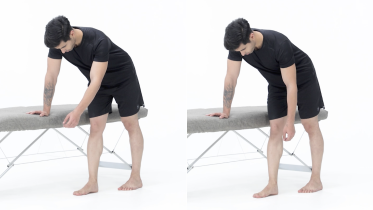 Pendulum exercise for the shoulder
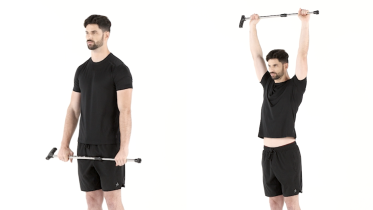 Shoulder flexion with a stick
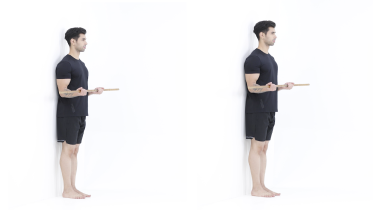 Shoulder external rotation with a stick
Stage 2: Win back range when stiffness is the main problem
When night pain has eased and the real trouble is how far the arm will go. Keep the stick exercises from stage 1 going, hold stretches a little longer, and take them to a firmer pull that you can still breathe through.
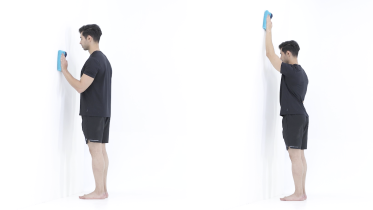 Wall slides with a towel
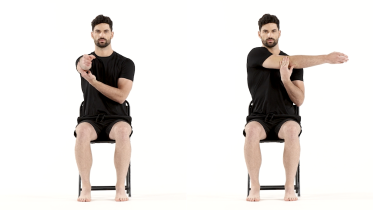 Cross body shoulder stretch
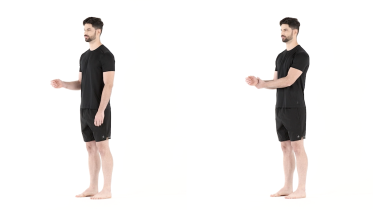 Isometric shoulder external rotation
Stage 3: Get strength and everyday use back
As movement returns, the muscles that have been underused for months need work. Start with a light band and keep your stretches going alongside. The sleeper stretch comes in here because you lie on the sore shoulder to do it. Leave it out if lying on that side still hurts.
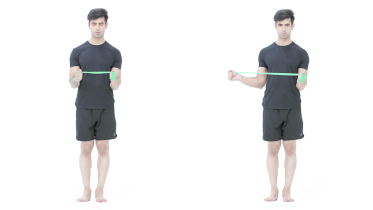 Shoulder external rotation with band
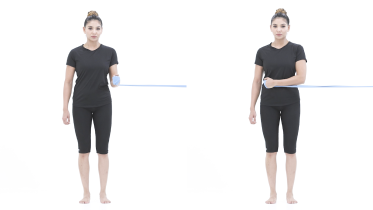 Shoulder internal rotation with band
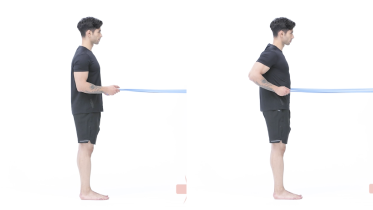 Resistance band row
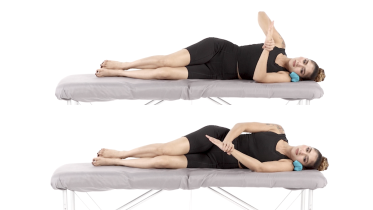 Sleeper stretch
Everyday tips while the shoulder is stiff
The guideline's advice is to change what you do so you keep using the arm in ways that do not hurt. Eating, washing your face and reaching to a shelf at chest height all count. Save the awkward reaches, like fastening a bra or getting a wallet from a back pocket, for when range improves, or use the other hand for now.
Sleep is often the hardest part. Many people find it easier lying on the good side hugging a pillow, or on their back with a pillow under the sore elbow so the arm rests slightly forward.
When to see a physio or doctor
See a physio or doctor if shoulder pain and stiffness have not improved after a few weeks, if pain is stopping you sleeping, or if you are not sure it is frozen shoulder. A rotator cuff tear or arthritis can look much the same, and so can pain coming from the neck. The right plan depends on the cause. Get help straight away for any of the warning signs below.
For physiotherapists
This page gives patients a starting framework based on tissue irritability, in line with the 2013 JOSPT guideline. Stretch intensity and dosage, and the point at which someone moves between stages, are best set after assessment. Tracking passive external rotation at the side, along with a patient-reported score such as the SPADI or the Oxford Shoulder Score, helps show change over the months this takes.
See a doctor promptly if
- Chest pain or tightness, which may spread to your arm, neck or jaw, or shoulder or arm pain that comes with shortness of breath, sweating or feeling sick. This can be a heart attack. Call emergency services straight away.
- The pain started after a fall or injury, or you suddenly cannot lift the arm at all.
- The shoulder feels as if it has slipped out of place, looks a different shape or suddenly locks so you cannot move the arm, or the pain is severe after a fall or an injury. Go to an emergency department straight away, without driving yourself, and do not try to put the shoulder back in yourself.
- You have a fever or feel unwell, or the shoulder is hot, red and swollen. This can be a joint infection. Go to an emergency department straight away.
- You are over 50 and have aching and stiffness in both shoulders, often in the neck or hips too, that is worst in the morning and lasts more than 45 minutes after you get up. This can be an inflammatory condition (polymyalgia rheumatica) rather than frozen shoulder. If you also get a new headache, pain or tenderness at your temples or on your scalp, or jaw pain when you eat or talk, get medical advice the same day, and if your vision changes, call emergency services.
- Your arm feels weak, numb or tingly, or the weakness is getting worse. If one side of your face or body suddenly goes numb or weak, or your speech becomes slurred or muddled, call emergency services, even if it goes away.
- Night pain is common with frozen shoulder, but get checked if the pain is constant, is not eased at all by rest or changing position, and keeps getting worse. If you have had cancer, now or in the past, or are losing weight without trying, mention it. If you are being treated for cancer now, contact your cancer team the same day.
- You have new shoulder pain and you have had cancer, now or in the past, or you are losing weight without trying. Mention it when you get checked. If you are being treated for cancer now, contact your cancer team the same day.
Common questions
How long does frozen shoulder last?
It is slow. The JOSPT guideline notes that some pain and stiffness can still be there 12 to 18 months after it starts, although many people by then have little or no trouble with daily life. Some people are left with a bit of lasting stiffness. Your physio can help you keep the arm working in the meantime.
Does frozen shoulder go away on its own?
It usually improves, but not always completely. A systematic review found that people who had no treatment got some movement back over 1 to 4 years, though often not all of it, and the evidence was low quality. The JOSPT guideline recommends stretching, with how hard you stretch matched to how irritable the shoulder is.
Should I push through the pain when stretching a frozen shoulder?
No. How hard you stretch should match how irritable the shoulder is. While it is very painful, gentle movement is enough, and pushing hard can flare it and cost you sleep. Later on, a firm stretch you can breathe through is fine. Your physio will help you find that level.
Can a steroid injection help frozen shoulder?
It can help with pain in the short term. The JOSPT guideline found that an injection into the joint combined with mobility and stretching exercises gave better pain relief and function over the first 4 to 6 weeks than the exercises alone. If you have diabetes, tell your doctor first: a systematic review found that a steroid injection into a joint can push blood sugar up for several days, and advised checking your levels for up to a week afterward. Whether it suits you is a decision to make with your doctor.
Can frozen shoulder happen in the other shoulder?
Yes. Having had it in one shoulder is listed as a risk factor for getting it in the other. Diabetes and thyroid disease also raise the risk.
References
- Kelley MJ, Shaffer MA, Kuhn JE, et al. Shoulder pain and mobility deficits: adhesive capsulitis. Clinical practice guidelines linked to the International Classification of Functioning, Disability, and Health from the Orthopaedic Section of the American Physical Therapy Association. Journal of Orthopaedic and Sports Physical Therapy. 2013;43(5):A1-A31. https://doi.org/10.2519/jospt.2013.0302
- Page MJ, Green S, Kramer S, et al. Manual therapy and exercise for adhesive capsulitis (frozen shoulder). Cochrane Database of Systematic Reviews. 2014;(8):CD011275. https://doi.org/10.1002/14651858.CD011275
- Wong CK, Levine WN, Deo K, et al. Natural history of frozen shoulder: fact or fiction? A systematic review. Physiotherapy. 2017;103(1):40-47. https://doi.org/10.1016/j.physio.2016.05.009
- Diercks RL, Stevens M. Gentle thawing of the frozen shoulder: a prospective study of supervised neglect versus intensive physical therapy in seventy-seven patients with frozen shoulder syndrome followed up for two years. Journal of Shoulder and Elbow Surgery. 2004;13(5):499-502. https://doi.org/10.1016/j.jse.2004.03.002
- Rangan A, Brealey SD, Keding A, et al. Management of adults with primary frozen shoulder in secondary care (UK FROST): a multicentre, pragmatic, three-arm, superiority randomised clinical trial. The Lancet. 2020;396(10256):977-989. https://doi.org/10.1016/S0140-6736(20)31965-6
- Choudhry MN, Malik RA, Charalambous CP. Blood glucose levels following intra-articular steroid injections in patients with diabetes: a systematic review. JBJS Reviews. 2016;4(3):e5. https://doi.org/10.2106/JBJS.RVW.O.00029
Written and checked by the PocketPhysio editorial team. Last updated 2026-09-28.
This page is general education, not a diagnosis or a personal treatment plan. See a physiotherapist or doctor for advice about your own situation.