Shoulder external rotation with a stick
In shoulder external rotation with a stick, your other arm pushes the stick so the forearm on the stiff side swings outward while that elbow stays tucked at your side. It is often used to help a stiff shoulder get back its outward turn (external rotation), for example with a frozen shoulder.
How to do the shoulder external rotation with a stick
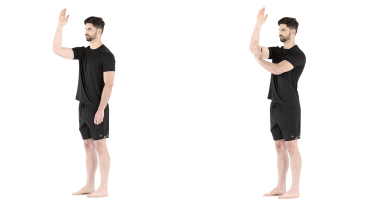
- Stand upright with your feet hip width apart and your shoulders relaxed. In the video he stands with his back against a wall, which helps stop the body turning.
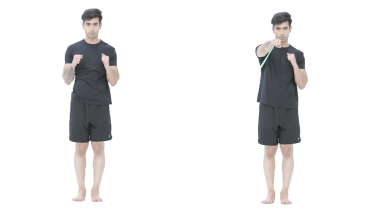
- Bend both elbows to a right angle and tuck them into your sides. Hold the stick across the front of your body with both hands.
- Start in the middle, with both forearms pointing straight ahead and the stick level.
- Use your other arm to push the stick slowly across, so the hand on the stiff side moves outward, away from your stomach. Keep that elbow against your ribs.
- Stop when you feel a stretch in the shoulder and hold it there. Then bring the stick back to the middle.
What you should feel
A stretch at the front of the shoulder on the side that is turning out.
Common mistakes
- Letting the elbow drift away from your side. Once it leaves your ribs, the arm is lifting rather than turning.
- Twisting your body so the stick travels further.
- Hunching up through the shoulders as you push.
How often
Many programs use 3 to 5 holds of 15 to 30 seconds each, once or twice a day. Your physio may change the hold time or the number of repeats.
Stop and check with your physio if
- The shoulder catches, or the stretch turns into sharp pain.
- Pain or tingling runs down the arm.
- Pins and needles in your arm or hand that do not go away after you stop, or part of your arm or hand goes numb. Get medical advice the same day. If one side of your face or body suddenly goes numb or weak, or your speech becomes slurred or muddled, call emergency services, even if it goes away.
- A sudden pop or tearing feeling in the shoulder that brings sharp pain, new weakness or trouble lifting the arm. Stop and contact your surgical team the same day, or get medical advice the same day if you have not had surgery.
- The shoulder feels as if it has slipped out of place, looks a different shape or suddenly locks so you cannot move the arm, or your hand turns cold, pale or blue. Go to an emergency department straight away, without driving yourself, and do not try to put the shoulder back in yourself.
From the clinic
A small rolled towel squeezed between your elbow and your side is a simple way to stop the elbow wandering. If the towel drops, the elbow has moved.
After shoulder surgery, including a rotator cuff repair, or after a shoulder fracture or dislocation, follow your surgeon's or physio's plan, and do only the movements and range they have cleared. Many plans allow only passive movement at first, where the arm is moved for you and its muscles stay relaxed. After some operations, especially repairs at the front of the shoulder, outward turning is kept limited for a period, so ask how far you may turn before you start. Strengthening the same movement against a band is covered in shoulder external rotation with a band.
Reviewed by the PocketPhysio by VirtueLife expert physiotherapy team. Last reviewed 2026-09-25.
This page is general education, not a diagnosis or a personal treatment plan. If you have pain, an injury or a health condition, see a physiotherapist or doctor before starting new exercises.