
Arm exercises after breast cancer surgery
Warning signs, and when to get help
When can you start arm exercises after breast cancer surgery?
Your own surgical team sets the start date. There is no national day number to give you: NICE NG101, the UK guideline, asks the breast unit to explain when the exercises should be started and leaves the detail to local protocols, which means the day is a property of your hospital and not of the operation. If nobody has told you, ring and ask. That is also a fair question to ask before the operation, when there is time to answer it.
Two numbers circulate and neither is a recommendation. A Cochrane review of ways to prevent arm swelling counted a start seven days after surgery as the delayed one, and compared it with starting earlier (Stuiver 2015). The PROSPER trial brought its exercise program in at 7 to 10 days after surgery, with further appointments at one and three months (Bruce 2021). Those are descriptions of what the research did, which is a different thing from advice about what you should do, and a leaflet from another hospital is not your protocol either.
What the Cochrane review found is worth knowing while you wait for that answer. Across three studies of an early versus a delayed start, 378 women between them, the pooled relative risk of lymphedema after an early start was 1.69, with a confidence interval running from 0.94 to 3.01, and the authors concluded that the evidence does not indicate a higher risk of lymphedema from starting shoulder exercises early. Both halves of that are true at once, because an interval that wide includes no difference and also includes a threefold increase, so the number settles nothing in either direction. It is a reason to keep to the start date your unit sets rather than bring it forward on your own, and it is not a reason to put off a start your unit has already cleared.
The movement side of the same comparison went the other way. Forward flexion, which is lifting the arm in front of you, was better at one and six months in the early starters, although the studies were too different to pool. At 12 months the one study that measured it found no difference in shoulder movement or in what people reported about their own arm. The evidence overall was judged low quality and the search ran in 2013, so this is a careful signal and not a settled answer.
There is a reason to defer to your unit beyond politeness. One of the two studies in that review that measured fluid from the surgical drains reported more of it in the people who started early. Your team knows what your wound, your drains and your operation were, and nobody writing a web page does. If your drains are still in, ask what the arm may do while they are there instead of taking a number off a page, and use the warning list if the drain site or the fluid in it changes.
NG101 is the only national guideline we found that deals with the arm and shoulder after breast cancer surgery, and it is British. Australia's main consumer health site carries a breast cancer page that does not mention the shoulder once. That is not a reason to treat NG101 as irrelevant outside the UK: it is a reason to take its risk list to your own team and ask where you sit on it.
What makes a shoulder problem more likely after breast cancer surgery
NG101 names the things that put someone at higher risk of an arm and shoulder problem, and it is the most useful list on this page, because it is how you find out whether you are the person the supervised physiotherapy recommendation was written for.
- A shoulder that was already a problem: previous surgery on it, a fracture or dislocation, a frozen shoulder, osteoarthritis or rheumatoid arthritis in that shoulder, or shoulder pain with no clear cause, stiffness or loss of function.
- A body mass index over 30 kg/m2.
- A planned clearance of the lymph nodes in the armpit (axillary node clearance).
- Planned radiotherapy to the armpit, or to the nodes above the collarbone (supraclavicular nodes).
NG101 then adds the group everyone forgets. If a node clearance, or radiotherapy to the armpit or those nodes, was not planned but was decided on after your operation, you move into the same higher risk group. Your risk level can therefore change weeks after the plan you were discharged with was written, and the plan does not update itself.
For people at higher risk, NG101 says to offer supervised support for arm and shoulder mobility, and for everyone else to consider it. It also sets out what that support should look like, which is useful to know before you are told what is available: individual, group or virtual, depending on your circumstances, needs and preferences; tailored to you, with the exercises modified where your needs are more complex; including a check that you are doing the movement correctly; and delivered by physiotherapy staff or other appropriately trained allied health professionals. A further recommendation asks for a referral to the physiotherapy department for assessment and treatment where arm and shoulder mobility stays reduced after breast cancer surgery or radiotherapy. In practice the list above is what you quote when you ask for that referral.
Which operation you had, and what it leaves the shoulder
What is written on your operation note matters more here than anything else on this page, because four different operations send people to the same set of exercises.
A wide local excision, often called a lumpectomy, takes the lump out with a margin of tissue around it and leaves the chest wall and the armpit largely alone. A mastectomy removes the whole breast and lifts the skin off a wide area of chest wall, so the closure is under more tension and lifting the arm pulls on more of it in the early weeks. A sentinel node biopsy takes the first node or two that the breast drains to, through a small cut in the armpit. An axillary node clearance opens the armpit and takes the nodes out of it, and that is the operation that changes the arm. A risk-reducing (prophylactic) mastectomy is the same mastectomy done for a different reason, and it has its own note below.
The ALMANAC trial put numbers on the difference between those last two. It randomized 1031 women with early breast cancer to a sentinel node biopsy or to standard axillary treatment, which in that trial meant a clearance, or axillary radiotherapy at the centers that worked that way. At 12 months, 5 percent of the sentinel node group had any lymphedema against 13 percent, and 11 percent had loss of feeling against 31 percent. Arm function and quality of life were better in the sentinel node group throughout, drains were needed less often and women got back to their usual activities sooner (Mansel 2006).
That gap is why advice written for a clearance is heavier than a sentinel node biopsy needs, and why advice written around a sentinel node biopsy is too thin for a clearance. PROSPER, the trial most of this page leans on, recruited at the clearance end: 83 percent of those women had one.
What none of that gives you is a day or a weight, and the reason is worth knowing. Early restrictions are set by the wound and the armpit rather than by the shoulder joint. A fresh surgical wound is held by its stitches at first and by its own new tissue later, so it is at its weakest in the first couple of weeks, which is where most of the restrictions sit. The armpit is also where fluid collects after node surgery, and how much the arm moves is one of the things that affects how much collects, which is the drainage signal in the Cochrane review above. Those limits come off on your unit timetable and not when the arm feels ready.
If you had a risk-reducing mastectomy and have never had cancer
This page is for you as well, and it says so here because nothing else on it does. NICE CG164, the UK guideline on familial breast cancer, has a section on risk-reducing mastectomy for women with no personal history of breast cancer: it asks for bilateral mastectomy to be raised as an option with everyone at high risk, for genetic counseling before the decision, and for reconstruction, immediate or delayed, to be discussed with the surgical team that would do it. It names BRCA1, BRCA2 and TP53 among the mutations it is written for. What was done to your chest wall is the mastectomy described above, the reconstruction section below is yours, and so is every stage of the program.
Two things read differently for you. The nodes in your armpit are usually left alone, so the node surgery numbers above describe a bigger operation than yours, and every trial quoted on this page recruited women treated for breast cancer, so none of their results is about you. And a few of the warning signs at the foot of this page open with "if you have had cancer, now or in the past". Those few are not yours, and they are the only ones that are not. The rest are: the wound, the drains, the reconstruction, an arm that is swelling, a blood clot, and a new lump or a change in the skin, the scar or the chest wall, which goes the same day to the surgical team that operated on you, exactly as that line says.
If you have had a reconstruction
The main evidence on this page was not collected in women who had one. PROSPER recruited after non-reconstructive breast cancer surgery, so none of its numbers describe a rebuilt breast, and the stages below assume somebody has cleared the range and the load. In each of these four situations the limits belong to the team that did the reconstruction, and this page cannot stand in for them.
- A tissue expander or an implant under the chest muscle. The pectoral muscle has been lifted off the chest wall to make the pocket, and arm movement pulls on it while it heals. A systematic review of 29 studies found that women with implants under the muscle reported worse arm symptoms and function than before their surgery, and worse than women whose implants sat in front of the muscle (Carr 2025). Which side of the muscle yours is on is a fair thing to ask.
- A latissimus dorsi flap. One of the muscles that works the shoulder has been moved: the latissimus pulls the arm down, back and inward, which is a large part of what a resistance band row asks of it. A meta-analysis of 26 studies and 1045 women found flexion and abduction measurably reduced at three months or earlier, and concluded that the flap does affect shoulder function, usually by a small amount, with the published evidence too weak to settle it (Steffenssen 2019). In the patient-reported review above, latissimus reconstruction carried the highest reported arm impairment of the reconstruction types (Carr 2025). No published protocol says what a transferred latissimus may pull against in your eighth week, so ask your plastic surgery team for your own limits on pulling and lifting with that arm, and ask about the band row and the prone Y raise by name.
- An abdominal flap (DIEP or TRAM). The breast has been rebuilt from tissue taken from the tummy, and the limits that matter are the abdominal ones. They come from your team.
- Any flap or implant, in the early weeks. Lying face down presses on the rebuilt breast, so prone work is something to clear rather than something to judge by comfort.
Reconstruction also adds its own problems to watch for, and they are on the warning list: skin or flap tissue that changes color or goes hard, a wound opening over an implant, a rebuilt breast that swells quickly or turns hard and more painful, and a collection of fluid at the back or the tummy where the tissue was taken. None of those is a rehabilitation problem.
What arm exercises do you do, and how often?
Three stages, in the order the arm usually gets them back: supported movement, then movement under its own power, then strength. The program below follows that order, and every exercise page gives a starting dose with the detail of the technique.
Early on, the movement exercises are often done more than once a day in short spells, which suits a shoulder that stiffens between sessions. As a rough guide, the assisted range exercises here use around 10 to 15 slow repetitions, 1 to 3 times a day. Stage 3's loaded work goes the other way, and this is the part people get wrong at home: the two band exercises and the prone Y raise are 2 to 3 sets of 8 to 15 repetitions, two or three sessions a week with a day off in between, not one every day. That is the frequency the international roundtable on exercise for cancer survivors sets for resistance training in women with or at risk of lymphedema after breast cancer (Campbell 2019), the trial in women who already had lymphedema lifted twice a week (Schmitz 2009), and a rest day is the only thing that lets the next-day rule below tell you anything.
The isometric hold is not loaded the same way and keeps the numbers on its own page. Where an exercise page sets its own repetitions, use those and keep this frequency. Your physio will adjust all of it, and the numbers on your unit's own sheet come first. If you have neither a sheet nor a physio yet, ring your breast care nurse and ask for both, and for the three numbers that decide the stages: when to start, how far the arm may go, and when you may load it.
How to use this program
Start with the stage your team has cleared, not the stage the arm feels ready for. If you have been given a limit on how far the arm may lift or how far it may go out to the side, that limit decides the stage, and the way round it is to ask for it to be reviewed, not to go past it quietly.
One thing to settle before you start at all. If your arm or hand is swollen now and nobody has looked at it yet, get that assessed first rather than starting the program to see whether it settles. The section on lymphedema below says how quickly, and which swelling needs emergency help.
Some discomfort as a stiff shoulder moves is normal. The level to work at is discomfort that settles soon after you stop and leaves the arm no worse the next morning. Pain that is still there the next day, or an arm that looks puffier or feels heavier or tighter afterward, means the session was too much, and the warning signs on this page say which of those needs checking rather than adjusting.
Breathe normally through every repetition rather than holding your breath. Four of these exercises use a stick, and the precautions on those pages about operations at the shoulder or the elbow still apply: if you have had one, that team's limits come before anything here.
Exercise after cancer treatment is safe for most people and inactivity is the thing to avoid, which is the conclusion of an international roundtable on exercise for cancer survivors, with enough evidence to say that the right doses improve fatigue, physical functioning, anxiety, depressive symptoms and quality of life (Campbell 2019). Arm rehabilitation sits inside that wider picture. Check with your doctor first if you have a heart or lung condition, or blood pressure that is not under control.
Two groups the same roundtable deals with separately, because the usual advice is not written for them. If you have been told there is cancer in your bones, you are in the group it says needs a medical assessment and a doctor's clearance before exercising, with the program then set around where the lesions are by a rehabilitation specialist or a trained exercise professional. The ribs, the spine and the upper arm bone are among the common sites, so that applies to arm exercises and loading as much as it does to running or lifting from the floor. And if you already have lymphedema, or have been told your bones are thinner than they should be (osteopenia or osteoporosis), it asks for a medical check first and the exercises adjusted to what that finds. The roundtable also says bone pain can be the first sign of a lesion in bone, and it tells exercise professionals to send anyone who reports new pain back to their medical team before carrying on, so pain the exercises do not explain, pain that is there at rest or at night, or pain that keeps getting worse is a reason to stop the program and be checked rather than to work around.
The clearance comes first because a bone with a lesion in it can break under a load that would not normally break it, and the upper arm bone is the bone these exercises load. A row and an overhead lift both send a bending and twisting force through it. This is the one situation on this page where the limit on load, and not only the limit on range, has to come from the people who know where your lesions are, and they may want the bone itself looked at or treated before you load it at all.
The exercise program
The exercises below carry their own stop signs and precautions. Open the line under an exercise and read them before you try it.
Stage 1: Movement first, with help
This is where most units start, and your own protocol decides when and how far the arm goes. The arm is supported, or moved by your other hand, so the muscles around the shoulder do very little work. Keep inside the range your team has cleared even if the arm feels able to go further. While movement is coming back, these are often done more than once a day.
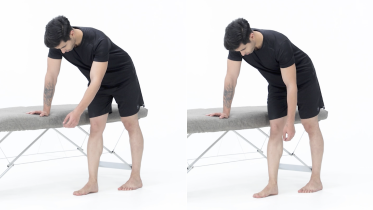 Pendulum exercise for the shoulder
Stop signs and precautions for the pendulum exercise for the shoulder
Before you start
- The pendulum is common for frozen shoulder and in the first weeks after some shoulder operations. Do it only if your own team has said it is right for you.
- After shoulder surgery, including a rotator cuff repair, or after a shoulder fracture or dislocation, follow your surgeon's or physio's plan, and do only the movements and range they have cleared. Many plans allow only passive movement at first, where the arm is moved for you and its muscles stay relaxed.
- After a repair of the biceps tendon at the elbow, or another repair, break or operation at the elbow or forearm, leave this one out until your surgeon or physio has cleared the elbow to straighten fully. There is no smaller version of it. The arm hangs fully straight and relaxed, so the elbow goes to its full straight position under the weight of the arm and the hand, which puts a tendon repaired at the elbow in its longest position with nothing of yours holding it back. If your team has set a limit on how far the elbow may straighten, or you are wearing a sling, brace, cast or splint after an operation or a break at the elbow or forearm, this exercise is not yet for you, and taking the arm out of it, or changing a brace setting to let the arm hang, is not the way round that limit. Teams differ on when full straightening is allowed after these operations, so the go-ahead comes from yours.
When to stop and get help
- Shoulder pain gets sharper or keeps building while you swing.
- You feel dizzy when leaning forward. Stand up slowly and sit down. If you faint while exercising, call emergency services, even if you feel fine again quickly.
- Your arm or hand goes numb, tingles or gets pins and needles.
- Pins and needles in your arm or hand that do not go away after you stop, or part of your arm or hand goes numb. Get medical advice the same day. If one side of your face or body suddenly goes numb or weak, or your speech becomes slurred or muddled, call emergency services, even if it goes away.
- A sudden pop or tearing feeling in the shoulder that brings sharp pain, new weakness or trouble lifting the arm. Stop and contact your surgical team the same day, or get medical advice the same day if you have not had surgery.
- The shoulder feels as if it has slipped out of place, looks a different shape or suddenly locks so you cannot move the arm, or your hand turns cold, pale or blue. Go to an emergency department straight away, without driving yourself, and do not try to put the shoulder back in yourself.
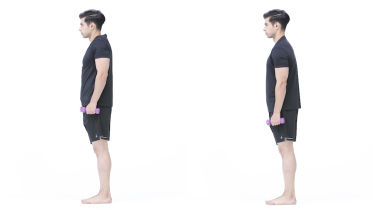 Shoulder shrugs
Stop signs and precautions for the shoulder shrugs
Before you start
- If you have had shoulder or neck surgery, ask your surgeon or physio before you pick up weights.
- After surgery or a tendon repair at the elbow or in the upper arm, such as a biceps tendon repair, do not hold weights for these until your surgeon or physio says you may lift. Holding a dumbbell with the arm hanging pulls on a healing repair. Shrug with nothing in your hands instead.
When to stop and get help
- The shoulder catches or gives a sharp pain during the lift.
- Pain or tingling spreads into the arm.
- Pins and needles in your arm or hand that do not go away after you stop, or part of your arm or hand goes numb. Get medical advice the same day. If one side of your face or body suddenly goes numb or weak, or your speech becomes slurred or muddled, call emergency services, even if it goes away.
- A headache or dizziness comes on while you are doing them. If you faint while exercising, call emergency services, even if you feel fine again quickly.
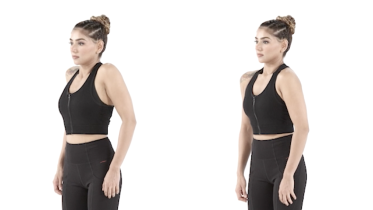 Forward shoulder rolls
Stop signs and precautions for the forward shoulder rolls
Before you start
- After shoulder surgery, including a rotator cuff repair, or after a shoulder fracture or dislocation, follow your surgeon's or physio's plan, and do only the movements and range they have cleared. Many plans allow only passive movement at first, where the arm is moved for you and its muscles stay relaxed. The same care applies after a broken collarbone or an operation on your neck, so ask your surgeon or physio first.
When to stop and get help
- Sharp or grinding pain in the shoulder, or a catch that hurts.
- Pins and needles or numbness spreading into your arm or hand.
- Pins and needles in your arm or hand that do not go away after you stop, or part of your arm or hand goes numb. Get medical advice the same day. If one side of your face or body suddenly goes numb or weak, or your speech becomes slurred or muddled, call emergency services, even if it goes away.
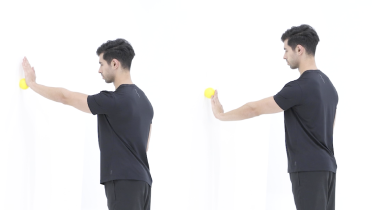 Wall ball shoulder flexion
Stop signs and precautions for the wall ball shoulder flexion
Before you start
- After shoulder surgery, including a rotator cuff repair, or after a shoulder fracture or dislocation, follow your surgeon's or physio's plan, and do only the movements and range they have cleared. Many plans allow only passive movement at first, where the arm is moved for you and its muscles stay relaxed. Your own muscles lift the arm here, even with the wall helping, so ask whether you are at that stage yet.
When to stop and get help
- A sharp pain or pinch at the front or top of the shoulder as the ball rises.
- Pain, pins and needles or numbness spreading down your arm or into your hand.
- Pins and needles in your arm or hand that do not go away after you stop, or part of your arm or hand goes numb. Get medical advice the same day. If one side of your face or body suddenly goes numb or weak, or your speech becomes slurred or muddled, call emergency services, even if it goes away.
- A sudden pop or tearing feeling in the shoulder that brings sharp pain, new weakness or trouble lifting the arm. Stop and contact your surgical team the same day, or get medical advice the same day if you have not had surgery.
- The shoulder feels as if it has slipped out of place, looks a different shape or suddenly locks so you cannot move the arm, or your hand turns cold, pale or blue. Go to an emergency department straight away, without driving yourself, and do not try to put the shoulder back in yourself.
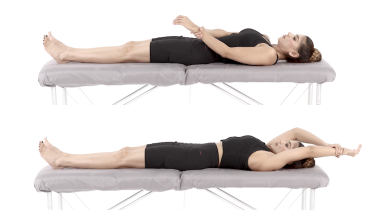 Lying assisted shoulder flexion
Stop signs and precautions for the lying assisted shoulder flexion
Before you start
- After shoulder surgery, including a rotator cuff repair, or after a shoulder fracture or dislocation, follow your surgeon's or physio's plan, and do only the movements and range they have cleared. Many plans allow only passive movement at first, where the arm is moved for you and its muscles stay relaxed.
- If you have had a repair, check that this stage has been cleared.
- If you are pregnant and past the first three months, check with your physio before exercising flat on your back.
When to stop and get help
- Sharp pain or a pinch in the shoulder as the arms go over your head.
- Pain, pins and needles or numbness spreading down your arm or into your hand.
- Pins and needles in your arm or hand that do not go away after you stop, or part of your arm or hand goes numb. Get medical advice the same day. If one side of your face or body suddenly goes numb or weak, or your speech becomes slurred or muddled, call emergency services, even if it goes away.
- A sudden pop or tearing feeling in the shoulder that brings sharp pain, new weakness or trouble lifting the arm. Stop and contact your surgical team the same day, or get medical advice the same day if you have not had surgery.
- The shoulder feels as if it has slipped out of place, looks a different shape or suddenly locks so you cannot move the arm, or your hand turns cold, pale or blue. Go to an emergency department straight away, without driving yourself, and do not try to put the shoulder back in yourself.
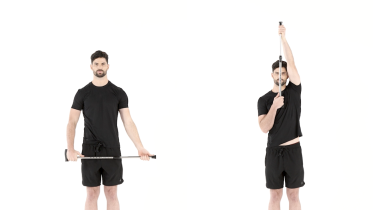 Shoulder abduction with a stick
Stop signs and precautions for the shoulder abduction with a stick
Before you start
- After shoulder surgery, including a rotator cuff repair, or after a shoulder fracture or dislocation, follow your surgeon's or physio's plan, and do only the movements and range they have cleared. Many plans allow only passive movement at first, where the arm is moved for you and its muscles stay relaxed. How far you may lift the arm is often limited for a while.
- After a repair of the biceps tendon at the elbow, or another repair, break or operation at the elbow or forearm, leave this one out until your surgeon or physio has cleared the elbow to straighten fully, and cleared you to hold it straight with a stick in your hand while your other arm pushes it. There is no smaller version of it. The lifting arm holds one end of the stick with the elbow straight, and the push that raises it comes from your other arm, so the repaired side is gripping, held straight and taken out to the side and overhead by a force that is not its own. The palm faces forward here rather than turned down, so the forearm is not turned as far as in the two-handed lifts, but a straight elbow, a grip and a push supplied from outside are three things early plans after a biceps repair keep apart. If your team has set a limit on how far the elbow may straighten or how far the forearm may turn, or you are wearing a sling, brace, cast or splint after an operation or a break at the elbow or forearm, this exercise is not yet for you, and taking the arm out of it, or changing a brace setting, is not the way round that limit. Teams differ on when these movements can be put together, so the go-ahead comes from yours.
When to stop and get help
- You get a sharp pain or a catch in the shoulder as the arm lifts.
- Pain or pins and needles spread down the arm.
- Pins and needles in your arm or hand that do not go away after you stop, or part of your arm or hand goes numb. Get medical advice the same day. If one side of your face or body suddenly goes numb or weak, or your speech becomes slurred or muddled, call emergency services, even if it goes away.
- The shoulder stays more painful for hours afterward.
- A sudden pop or tearing feeling in the shoulder that brings sharp pain, new weakness or trouble lifting the arm. Stop and contact your surgical team the same day, or get medical advice the same day if you have not had surgery.
- The shoulder feels as if it has slipped out of place, looks a different shape or suddenly locks so you cannot move the arm, or your hand turns cold, pale or blue. Go to an emergency department straight away, without driving yourself, and do not try to put the shoulder back in yourself.
Stage 2: Range without help, and the shoulder blade
When the cleared range feels comfortable and your team is happy for the arm to work on its own. The stick exercises are still assisted, so use them for the last part of the range the arm cannot yet reach by itself. Squeezing the shoulder blades back trains the muscles that go quiet while an arm is being guarded, which is most of why a shoulder on the operated side starts to sit forward. If you have also had an operation on that shoulder or elbow, the precautions on those exercise pages come first.
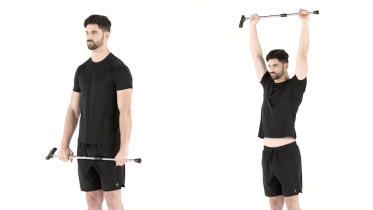 Shoulder flexion with a stick
Stop signs and precautions for the shoulder flexion with a stick
Before you start
- After shoulder surgery, including a rotator cuff repair, or after a shoulder fracture or dislocation, follow your surgeon's or physio's plan, and do only the movements and range they have cleared. Many plans allow only passive movement at first, where the arm is moved for you and its muscles stay relaxed. How high you may lift is often limited for a while.
- After a repair of the biceps tendon at the elbow, or another repair, break or operation at the elbow or forearm, leave this one out until your surgeon or physio has cleared the elbow to straighten fully, and cleared you to hold it straight with the palm turned down and a stick in your hand. There is no smaller version of it. Both elbows stay straight and both palms turn down, and the easier arm supplies the push, so the repaired side is held straight and palm down by a stick it is also gripping and carrying overhead. The biceps turns the palm up as well as bending the elbow, so a straight elbow with the palm turned down is the position that pulls hardest on a tendon repaired there, and the force holding the arm in it comes from your other arm through the stick. Early plans after this repair usually allow gentle bending and straightening, and turning the palm up and down with the elbow bent in at your side, and they keep those two movements apart from each other and from anything held in the hand, which is what this exercise puts together. If your team has set a limit on how far the elbow may straighten or how far the forearm may turn, or you are wearing a sling, brace, cast or splint after an operation or a break at the elbow or forearm, this exercise is not yet for you, and taking the arm out of it, or changing a brace setting, is not the way round that limit. A cast or clinic limit on the wrist or hand does not change that, and leaving the stick out is not a way round it either, because the arm still has to travel overhead. Teams differ on when these movements can be put together, so the go-ahead comes from yours.
- After a broken wrist, hand or forearm, or surgery on any of them, keep the shoulder moving, and do this one only as far as your cast, splint or fracture clinic allows. Both elbows stay straight and both palms turn down, so the injured side has to grip the stick, hold the forearm palm down and carry the stick overhead. Where your fracture clinic, surgeon or hand therapist has limited turning the palm, gripping or taking load through the wrist, that limit comes first. Hold the stick lightly with your fingers. If the cast, or a thumb held still inside it, stops you holding the stick securely, leave the stick out and lift that arm forward and overhead on its own.
- While your hand is in a cast or splint, do not lift it above your head if the hand is painful, tight, more swollen or numb. Rest it at about the level of your heart instead and contact your fracture clinic, as the stop signs for a tight cast describe.
- If you have rheumatoid arthritis or another inflammatory arthritis in your hands or wrists, keep the shoulder moving, and let the state of your wrists decide whether the stick goes in your hands that day. Both elbows stay straight and both palms turn down, so each hand has to grip the stick, hold the forearm palm down and carry the stick overhead. On any day when your wrist or hand joints are hot, swollen or more painful than usual, or you are in a flare, leave the stick out and lift that arm forward and overhead on its own. If you have been told the joints in your wrist are badly damaged or unstable, leave the stick out and lift that arm forward and overhead on its own, on your better days as well, and do not put a stick in that hand unless your physio, hand therapist or rheumatology team has checked that wrist and set the exercise up with you. Hold the stick lightly with your fingers rather than gripping hard, and stop at the height you reach without forcing.
When to stop and get help
- Emergency: while you are in a cast or splint, your fingers turn blue, white or pale, or feel cold. Do not wait to see if raising your hand helps. Go to an emergency department straight away, and do not drive yourself. The cast or splint may be cutting off the blood supply, or pressure may be building up inside the forearm (compartment syndrome), and both need checking quickly.
- In a cast or splint, the pain gets worse, your fingers feel numb or tingle or look more swollen, or the cast feels too tight. Stop, rest your hand at about the level of your heart, keep moving your fingers and contact your fracture clinic or get medical advice straight away. Do not lift the hand higher than your heart and do not put ice on it, because if pressure is building up inside the forearm both of those cut down the blood reaching it. If you cannot move your fingers, the pain is severe even after painkillers, or the numbness, tingling or swelling has not settled within 30 minutes, go to your fracture clinic or an emergency department straight away, and do not drive yourself.
- You get a sharp pain or a catch in the shoulder as the stick goes up.
- Pain or pins and needles spread down the arm.
- Pins and needles in your arm or hand that do not go away after you stop, or part of your arm or hand goes numb. Get medical advice the same day. If one side of your face or body suddenly goes numb or weak, or your speech becomes slurred or muddled, call emergency services, even if it goes away.
- The shoulder stays more painful for hours afterward.
- A sudden pop or tearing feeling in the shoulder that brings sharp pain, new weakness or trouble lifting the arm. Stop and contact your surgical team the same day, or get medical advice the same day if you have not had surgery.
- The shoulder feels as if it has slipped out of place, looks a different shape or suddenly locks so you cannot move the arm, or your hand turns cold, pale or blue. Go to an emergency department straight away, without driving yourself, and do not try to put the shoulder back in yourself.
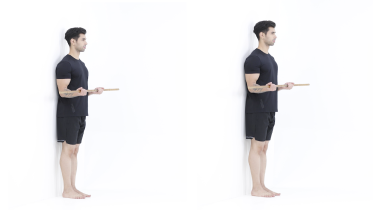 Shoulder external rotation with a stick
Stop signs and precautions for the shoulder external rotation with a stick
Before you start
- After shoulder surgery, including a rotator cuff repair, or after a shoulder fracture or dislocation, follow your surgeon's or physio's plan, and do only the movements and range they have cleared. Many plans allow only passive movement at first, where the arm is moved for you and its muscles stay relaxed. After some operations, especially repairs at the front of the shoulder, outward turning is kept limited for a period, so ask how far you may turn before you start.
- A broom handle, a walking stick or a length of dowel all work as the stick.
When to stop and get help
- The shoulder catches, or the stretch turns into sharp pain.
- Pain or tingling runs down the arm.
- Pins and needles in your arm or hand that do not go away after you stop, or part of your arm or hand goes numb. Get medical advice the same day. If one side of your face or body suddenly goes numb or weak, or your speech becomes slurred or muddled, call emergency services, even if it goes away.
- A sudden pop or tearing feeling in the shoulder that brings sharp pain, new weakness or trouble lifting the arm. Stop and contact your surgical team the same day, or get medical advice the same day if you have not had surgery.
- The shoulder feels as if it has slipped out of place, looks a different shape or suddenly locks so you cannot move the arm, or your hand turns cold, pale or blue. Go to an emergency department straight away, without driving yourself, and do not try to put the shoulder back in yourself.
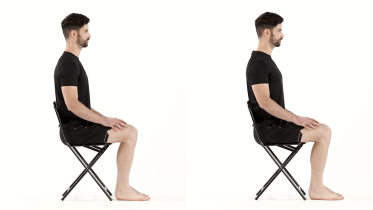 Scapular squeeze
Stop signs and precautions for the scapular squeeze
When to stop and get help
- Pain, numbness or tingling spreads into the arm or hand.
- Pins and needles in your arm or hand that do not go away after you stop, or part of your arm or hand goes numb. Get medical advice the same day. If one side of your face or body suddenly goes numb or weak, or your speech becomes slurred or muddled, call emergency services, even if it goes away.
- Neck or shoulder pain gets sharper during the squeeze instead of settling.
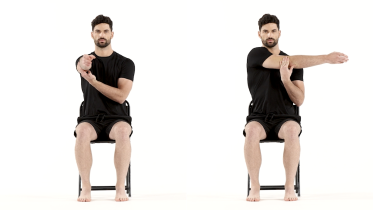 Cross body shoulder stretch
Stop signs and precautions for the cross body shoulder stretch
Before you start
- After shoulder surgery, including a rotator cuff repair, or after a shoulder fracture or dislocation, follow your surgeon's or physio's plan, and do only the movements and range they have cleared. Many plans allow only passive movement at first, where the arm is moved for you and its muscles stay relaxed.
When to stop and get help
- The shoulder pinches, catches or gives a sharp pain, most often at the front or top.
- You get pain or tingling running down the arm.
- Pins and needles in your arm or hand that do not go away after you stop, or part of your arm or hand goes numb. Get medical advice the same day. If one side of your face or body suddenly goes numb or weak, or your speech becomes slurred or muddled, call emergency services, even if it goes away.
- A sudden pop or tearing feeling in the shoulder that brings sharp pain, new weakness or trouble lifting the arm. Stop and contact your surgical team the same day, or get medical advice the same day if you have not had surgery.
- The shoulder feels as if it has slipped out of place, looks a different shape or suddenly locks so you cannot move the arm, or your hand turns cold, pale or blue. Go to an emergency department straight away, without driving yourself, and do not try to put the shoulder back in yourself.
Stage 3: Strength
Once your team has cleared you to load the arm and stage 2 range is comfortable. A band starts lighter than any dumbbell and goes up in smaller steps, which is why all four of these use one or no weight at all. Build up slowly and judge it by how the arm is the next day rather than by how the set felt, which means two or three sessions a week with a day off between them rather than one every day. The evidence does not settle whether starting resistance work without supervised instruction is safe in this group (Campbell 2019), so go up by the smallest step your equipment allows and get someone to watch the first sessions if there is anyone who can. Lying face down is uncomfortable for a long while after some breast operations and after reconstruction, so the prone exercise can wait until it is not. After a reconstruction it is more than a comfort question, because lying face down presses on the rebuilt breast, so clear it with that team first. If your reconstruction used muscle from your back (a latissimus dorsi flap), one of the muscles that works the shoulder has been moved, so the limits on pulling and lifting with that arm come from the team that did that operation. Ask them about the resistance band row and the prone Y raise by name. Ask the same way if you have an expander or an implant under the chest muscle, because that muscle was lifted off the chest wall to make the pocket.
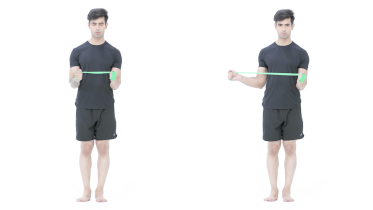 Shoulder external rotation with band
Stop signs and precautions for the shoulder external rotation with band
Before you start
- After shoulder surgery, including a rotator cuff repair, or after a shoulder fracture or dislocation, follow your surgeon's or physio's plan, and do only the movements and range they have cleared. Many plans allow only passive movement at first, where the arm is moved for you and its muscles stay relaxed. Resisted rotation usually starts later, and the range may be limited at first, so check with your physio before adding a band.
When to stop and get help
- You feel a sharp pain or a catch in the shoulder as the forearm turns out.
- Pain or tingling spreads down the arm.
- Pins and needles in your arm or hand that do not go away after you stop, or part of your arm or hand goes numb. Get medical advice the same day. If one side of your face or body suddenly goes numb or weak, or your speech becomes slurred or muddled, call emergency services, even if it goes away.
- A sudden pop or tearing feeling in the shoulder that brings sharp pain, new weakness or trouble lifting the arm. Stop and contact your surgical team the same day, or get medical advice the same day if you have not had surgery.
- The shoulder feels as if it has slipped out of place, looks a different shape or suddenly locks so you cannot move the arm, or your hand turns cold, pale or blue. Go to an emergency department straight away, without driving yourself, and do not try to put the shoulder back in yourself.
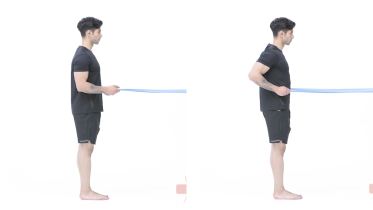 Resistance band row
Stop signs and precautions for the resistance band row
Before you start
- After a broken or dislocated elbow, or elbow surgery such as a tendon repair, follow your surgeon's or physio's plan, and start this exercise only when they have cleared you. If you have just hurt your arm and have severe pain or cannot move the elbow, do not exercise it. Go to an urgent care center or emergency department the same day. If you heard a snap or a crack at the moment of the injury, the arm looks a different shape or sits at an odd angle, a bone is showing, or your arm or hand tingles, feels numb or turns cold, pale or blue, go to an emergency department straight away or call emergency services, and do not drive yourself.
- After shoulder surgery, including a rotator cuff repair, or after a shoulder fracture or dislocation, follow your surgeon's or physio's plan, and do only the movements and range they have cleared. Many plans allow only passive movement at first, where the arm is moved for you and its muscles stay relaxed. Banded rows are not usually an early exercise after shoulder surgery, so ask when you can add them.
- After recent heart or chest surgery, get your surgeon's or surgical team's okay first, because pulling a band back and squeezing the shoulder blades together pulls across the healing breastbone. If the breastbone clicks, grinds, shifts or feels as if it is moving while you do it, stop, and contact your surgical team the same day.
When to stop and get help
- Pulling gives you a sharp pain or a catching feeling in the shoulder.
- You notice tingling or pain spreading down an arm.
- Pins and needles in your arm or hand that do not go away after you stop, or part of your arm or hand goes numb. Get medical advice the same day. If one side of your face or body suddenly goes numb or weak, or your speech becomes slurred or muddled, call emergency services, even if it goes away.
- A sudden pop or tearing feeling in the shoulder that brings sharp pain, new weakness or trouble lifting the arm. Stop and contact your surgical team the same day, or get medical advice the same day if you have not had surgery.
- The shoulder feels as if it has slipped out of place, looks a different shape or suddenly locks so you cannot move the arm, or your hand turns cold, pale or blue. Go to an emergency department straight away, without driving yourself, and do not try to put the shoulder back in yourself.
- Chest pain or pressure, dizziness or feeling faint, a racing or irregular heartbeat, or being far more out of breath than the effort should cause.
- A sudden pop or snap at the front of your elbow, sudden sharp pain there, or the muscle at the front of your upper arm bunches up or changes shape. Stop and go to an urgent care center or emergency department the same day, even if you can still bend the elbow, as this can be a torn biceps tendon.
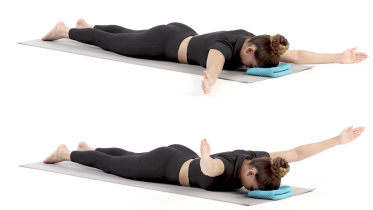 Prone Y raise
Stop signs and precautions for the prone y raise
Before you start
- After shoulder surgery, including a rotator cuff repair, or after a shoulder fracture or dislocation, follow your surgeon's or physio's plan, and do only the movements and range they have cleared. Many plans allow only passive movement at first, where the arm is moved for you and its muscles stay relaxed. An overhead lift against gravity like this is usually kept for later in rehab.
- After recent heart or chest surgery, get your surgeon's or surgical team's okay first, because lifting both straight arms overhead off the mat pulls across the healing breastbone. If the breastbone clicks, grinds, shifts or feels as if it is moving while you do it, stop, and contact your surgical team the same day.
When to stop and get help
- Lifting brings on a sharp pain or a catch in the shoulder.
- You get tingling or pain down an arm.
- Pins and needles in your arm or hand that do not go away after you stop, or part of your arm or hand goes numb. Get medical advice the same day. If one side of your face or body suddenly goes numb or weak, or your speech becomes slurred or muddled, call emergency services, even if it goes away.
- Lying face down brings on neck or lower back pain that does not ease when you rest.
- A sudden pop or tearing feeling in the shoulder that brings sharp pain, new weakness or trouble lifting the arm. Stop and contact your surgical team the same day, or get medical advice the same day if you have not had surgery.
- The shoulder feels as if it has slipped out of place, looks a different shape or suddenly locks so you cannot move the arm, or your hand turns cold, pale or blue. Go to an emergency department straight away, without driving yourself, and do not try to put the shoulder back in yourself.
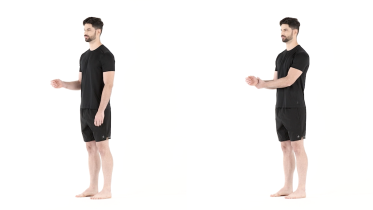 Isometric shoulder external rotation
Stop signs and precautions for the isometric shoulder external rotation
Before you start
- After shoulder surgery, including a rotator cuff repair, or after a shoulder fracture or dislocation, follow your surgeon's or physio's plan, and do only the movements and range they have cleared. Many plans allow only passive movement at first, where the arm is moved for you and its muscles stay relaxed. After a rotator cuff repair, pushing against resistance is usually held off for several weeks.
- Do not hold your breath while you push, especially if you have high blood pressure.
When to stop and get help
- Pushing gives you a sharp pain or a catch in the shoulder.
- You feel pain or tingling spread down the arm.
- Pins and needles in your arm or hand that do not go away after you stop, or part of your arm or hand goes numb. Get medical advice the same day. If one side of your face or body suddenly goes numb or weak, or your speech becomes slurred or muddled, call emergency services, even if it goes away.
- The shoulder aches more after the holds and is still sore a few minutes later.
- A sudden pop or tearing feeling in the shoulder that brings sharp pain, new weakness or trouble lifting the arm. Stop and contact your surgical team the same day, or get medical advice the same day if you have not had surgery.
- The shoulder feels as if it has slipped out of place, looks a different shape or suddenly locks so you cannot move the arm, or your hand turns cold, pale or blue. Go to an emergency department straight away, without driving yourself, and do not try to put the shoulder back in yourself.
Will arm exercises cause lymphedema?
This is the question underneath all the others, and the guideline answer is more reassuring than most of the advice still in circulation. NG101 states that physical activity may improve quality of life and that there is no indication that physical activity causes, or worsens, lymphedema.
The same section of NG101 goes further and lists things people are routinely warned off, with the evidence not supporting the warning. There is no consistent evidence of increased risk from air travel, travel to hot countries, manicures, hot tub use or sports injuries. Nor is there consistent evidence of risk from medical procedures on the treated side, which includes blood tests, injections, drips and having your blood pressure taken. NG101 still asks for the use of that arm to be a shared decision with the clinician in front of you rather than an automatic yes or no. These are 2025 amendments, so if you were told something different a few years ago, you were told what was then being said.
NG101 also says not to offer compression therapy as a way of reducing the risk. Read that narrowly. It is about preventing lymphedema in someone who does not have it, and it says nothing about a garment you have been given to treat swelling you already have. If you have lymphedema, your lymphedema team's instructions about your sleeve stand, and the trial that tested weight lifting in women with established lymphedema required a well-fitted compression garment while lifting (Schmitz 2009).
The trial evidence on loading the arm points the same way as the guideline. In the Cochrane review, two studies compared progressive resistance training with restricted activity and found a relative risk of developing lymphedema of 0.58, with a confidence interval from 0.30 to 1.13 across 358 participants, which is a result that leans toward exercise without excluding no difference. The authors attached a condition to it, that symptoms are closely monitored and adequately treated if they occur. That condition is not decoration. It is the reason this page gives you warning signs to watch and a route for each of them.
Swelling is not the only thing to keep an eye on. One of those two studies also measured pain, and the resistance training group reported pain more often at three months and at six months than the comparison group. An arm that is sore between sessions wants its load dropped rather than its sessions pushed through.
Then there are the two PAL trials, which are the numbers almost nobody quotes. One randomized 154 women who were 1 to 5 years past surgery, had at least two nodes removed and had no signs of lymphedema, and new lymphedema appeared in 11 percent of the weight lifting group (8 of 72) against 17 percent of the controls (13 of 75). Read that gap carefully, because the interval around it runs from 17 percentage points fewer cases to 5 points more: the trial was built to show that lifting did not increase lymphedema rather than that it prevented it, and that is what it showed. In the group who had five or more nodes removed the gap was wider and did not include no difference, 7 percent (3 of 45) against 22 percent (11 of 49), although that is a subgroup and so weaker evidence than the trial as a whole. In the separate trial of 141 women who already had stable arm swelling, an increase of 5 percent or more in limb volume occurred in 11 percent of the lifters and 12 percent of controls, and flare-ups of lymphedema were less common in the lifters, 14 percent against 29 percent.
Those results come with their population attached, and the population is the part that stops them being a permission slip. The at-risk trial recruited women who were 1 to 5 years past their surgery, and its program ran for 13 weeks with supervision before nine months of unsupervised training with a gym membership. In the trial of women who already had swelling, a well-fitted compression garment was worn for the lifting. Neither of them says anything about what to lift in your third week, which is why stage 3 waits for your team.
The roundtable puts the limit more plainly than the trials do. A progressive resistance program on the large muscle groups, two or three times a week, start low and progress slow, is safe in women with or at risk of lymphedema after breast cancer when a fitness professional supervises it, and there is not enough evidence to say whether starting one without supervised instruction is safe (Campbell 2019). Stage 3 at home is an unsupervised start, so that sentence is about you. It is the reason to go up by the smallest step your equipment allows, and to get someone to watch the first sessions if there is anyone who can.
One situation comes before any of that, whether you are at risk or not.
New swelling that nobody has checked yet needs a doctor's assessment before you start, and the same day if it is in one arm or leg and you do not know the cause, or it is severe, painful or came on very suddenly. Call emergency services if swelling comes with shortness of breath, a chest that feels tight, heavy or painful, coughing up blood, a pounding heartbeat, or feeling lightheaded, faint, confused, sick or clammy. Sudden shortness of breath, chest pain or coughing up blood also needs emergency services when the swelling looks no different, as these can be signs of a blood clot in the lungs.
A word about the arm after surgery to the nodes in the armpit. Numbness in the armpit, or along the inner side of the upper arm, is common after that operation, and if your team already knows about yours, it is not a new warning sign. The nerve that supplies the skin there (the intercostobrachial nerve) runs straight through the area the surgeon has to work in, and a meta-analysis of axillary surgery studies found that a change in feeling in that patch is far less common when the nerve is spared than when it is divided, and that it is usually reduced feeling rather than extra sensitivity (Warrier 2014). Numbness that is new or spreading, pins and needles that stay after you stop, and weakness that is getting worse all follow the warning list instead.
Lymphedema treatment itself is a separate subject and is not covered here. Our lymphedema breathing and arm rotation for lymphedema pages carry the technique for the movements those routines use.
Cording after breast surgery, and what to do about it
Cording, or axillary web syndrome, is the tight cord you can sometimes feel or see running under the skin from the armpit, often along the arm toward the elbow crease and sometimes further (Gonzalez-Rubino 2023). It is identified by looking and feeling rather than by a scan (Yeung 2015), and what people usually notice first is that the arm stops short of where it was going, with a band standing out under the skin as the arm lifts. Pain with it is common, and lifting the arm out to the side is usually more restricted than lifting it in front (Yeung 2015). It is one complication among several, so a shoulder that will not lift is not automatically cording.
A systematic review of 37 studies found that most of the studies in it reported cording appearing within eight weeks of the operation, that it can also turn up more than three months later, and that the symptoms usually settle within three months, although in some people they carry on (Yeung 2015). That is the main reason not to go at a cord hard: in most cases you are working alongside something that is on its way out anyway.
How common it is has not been settled. The figures published for the same group of patients vary so widely that they cannot all be describing the same thing, so this page gives none. A number you meet elsewhere may be accurate for the group it was measured in and still tell you nothing about your own odds.
The physiotherapy evidence is thin and worth describing honestly. A systematic review and meta-analysis screened 188 articles and included 9 studies (Gonzalez-Rubino 2023). Exercise and stretching came out as the most effective of the approaches tested for restoring movement, reducing pain and improving quality of life, with manual therapy, scar massage and myofascial release described as possibly helpful but with worse results. The only outcome with a reduction the authors called significant was pain, at a standardized effect of 0.82 in favor of treatment, with an interval running from 1.67 in favor to 0.03 the other way, drawn from the only three studies that measured it, all of them small. An interval that crosses zero does not support a confident claim, so treat this as a small and uncertain benefit from the most studied approach, not a proven treatment.
What that means in practice is unglamorous. Gentle stretching inside comfort is the approach with the most behind it, and pulling hard on a cord that hurts is not a stronger version of the same thing. If a cord is painful, is stopping the arm moving, or you are not sure that is what you are feeling, show it to your breast care team or a physiotherapist instead of working on it alone.
How much can you lift, and when
Nobody can give you a weight from a guideline, because there is not one. The restrictions people are sent home with vary between units and are not in NG101 at all, so the weight limit a friend was given is her hospital's rule and may not be yours. Ask for yours in writing if you can.
Where there is evidence, it is about method rather than a number. The PAL trials progressed load slowly from a low start, with supervision at the beginning, and watched for symptoms between sessions. That shape is reproducible even without a gym. Start with a load you can control for the whole set with no change in the arm by the next day, go up by the smallest step your equipment allows, and change one thing at a time so that if something flares you know what did it. A full one liter bottle of water weighs about 1 kg, or 2.2 lb, which is a useful scale for how small the first steps should be.
Going back to the gym is a plan, not a date. Your team clears loading, you rebuild rather than resume, and you judge each step by the following day. If you have lymphedema, talk to your lymphedema team about your garment before you start, for the reason in the previous section.
Radiotherapy and why your risk level can change after surgery
Radiotherapy to the armpit or to the nodes above the collarbone is on NG101's list of things that make a shoulder problem more likely. In PROSPER, 317 of the 392 women (81 percent) had radiotherapy and 327 (83 percent) had a clearance of the armpit nodes, which is one way of seeing how often these go together.
The part worth acting on is NG101's point about timing. Where a node clearance or that radiotherapy was not planned before the operation but was decided on afterward, the guideline puts you in the higher risk group from then on. So the discharge advice you were given on the ward may have been written for a lower risk than the one you ended up with. Nobody automatically revisits it, which makes it worth raising at your next appointment.
What progress usually looks like
The useful picture comes from PROSPER, which randomized 392 women at 17 UK NHS cancer centers to an exercise program or usual care after non-reconstructive breast cancer surgery (Bruce 2021). At 12 months the exercise group scored better on the DASH questionnaire, which asks about everyday tasks with the arm, shoulder and hand and where a higher score means more difficulty: 16.3 against 23.7, an adjusted difference of about 7.8 points in favor of exercise, with a confidence interval from 3.17 to 12.44. Pain intensity at 12 months was lower in the exercise group too, by about two thirds of a point on a pain rating scale, with an interval from 0.12 to 1.23 points. No increase in complications, lymphedema or adverse events was seen in the exercise group.
Two limits travel with those numbers. PROSPER recruited women at higher risk, with most having had a node clearance and most having had radiotherapy, so it does not show that every woman needs a physiotherapy program. And the benefit at 12 months, while real, is a difference in questionnaire scores rather than a promise about your own arm.
The last movements to come back are usually overhead reaching and reaching behind your back, and a guarded arm often feels tired before it feels sore. That is practice experience rather than a trial finding, so take it as a rough shape and not a timetable. Progress is uneven and a flat week is not a failure. What is not part of normal progress is an arm that keeps swelling, a wound that turns hot or starts leaking, a new lump, or rest pain that climbs week by week. Those are on the warning list for a reason and are not stages to push through.
When to see a physio or your breast care team
Ask for a physiotherapy referral if your arm and shoulder movement has stopped improving or has gone backward, if stiffness or pain is getting in the way of dressing, driving, sleeping or work, or if you are on NG101's higher risk list and nobody has offered you supervised support. NG101 asks for a referral where arm and shoulder mobility stays reduced, so this is a request with a guideline behind it, not a favor.
A few situations belong somewhere other than this page. Shoulder pain that was there before your cancer may be a load-related problem in its own right, and our pages on rotator cuff tendinopathy and shoulder impingement cover those. A genuinely frozen shoulder has its own staged program. If your joints ache in several places at once while you are on endocrine therapy such as an aromatase inhibitor, that is a different problem from a stiff shoulder on the operated side, and joint pain in menopause is the page for it.
Contact your breast care or cancer team, rather than a physio, for anything on the warning list: swelling, a hot or leaking wound, a fever during treatment, a new lump or change in the scar or chest wall, and rest or night pain that keeps getting worse.
You are meant to have that route already. NG101 asks for everyone treated for breast cancer to be given a written care plan that includes the signs and symptoms to look out for and seek advice on, and contact details for immediate referral to specialist care, which is why a new lump or a skin change does not wait for a routine appointment. If nobody gave you those details, ask your breast care nurse for them. Being wrong about one of those costs you a phone call. Being right about it and waiting costs more.
For physiotherapists
NG101's risk stratification is the practical part of this page. The 1.14.14 list plus 1.14.15's post-operative reclassification decides who gets offered supervised support rather than considered for it, and it is worth checking at the first contact, because the decision that changed a patient's risk was often made after the leaflet went home with her.
PROSPER is the trial behind those recommendations and its population matters when the result is applied: 392 women, 17 UK centers, with most having had axillary node clearance and most radiotherapy, program introduced at 7 to 10 days postoperatively with appointments at one and three months. The DASH difference at 12 months was about 7.8 points in favor of exercise (95% CI 3.17 to 12.44). The accompanying Health Technology Assessment monograph reports a cost of roughly 129 pounds per participant, which is the figure to use in a service case.
For timing, the Cochrane review's early versus delayed comparison is the only pooled evidence and its drainage-volume signal in one study is the reason local protocol wins. For load, the PAL trials support progressive resistance training in survivors at risk and in those with stable lymphedema, with supervised initiation, close symptom monitoring and, in the established lymphedema trial, compression during lifting; the established lymphedema trial lifted twice weekly. Campbell 2019 is the dose the stage 3 prescription on this page follows: large muscle groups, 2 to 3 sessions per week, at least 2 sets of 8 to 15 repetitions, start low and progress slow, judged safe in this population when supervised by a fitness professional, with insufficient evidence on whether an unsupervised start is safe. That last clause is the one to read out at a first appointment, because an unsupervised start is what a home program is.
For the swelling side of the assessment, the American Physical Therapy Association oncology section's clinical practice guideline on diagnosing upper quadrant cancer-related lymphedema grades its recommendations by patient presentation (Levenhagen 2017). Two are worth having at a first appointment, each with the grade the guideline itself prints: self-reported swelling, heaviness and numbness should be investigated for early diagnosis, grade B, moderate; and a calculated volume difference between sides of 200 ml or more, or a volume ratio above 1.04 of the affected arm to the other one, helps rule lymphedema in, while a smaller difference cannot rule it out, also grade B. The full text was read for this page, not the abstract, which is why those grade letters are quoted rather than inferred from the wording.
One gap before you go looking. A search for an APTA or Academy of Oncologic Physical Therapy clinical practice guideline specifically on shoulder dysfunction after breast cancer found none, so if you have been told one exists, it was not findable at the time of writing.
Warning signs
Get emergency help now
- Chest pain or tightness, which may spread to your arm, neck or jaw, or shoulder or arm pain that comes with shortness of breath, sweating or feeling sick. This can be a heart attack. Call emergency services straight away.
- Your arm, hand or fingers turn cold, pale, blue or gray compared with the other side. Call emergency services or go to an emergency department straight away, and do not drive yourself. The blood supply to the arm may be blocked.
- The shoulder is hot, red and swollen, or you have a fever or feel unwell. This can be a joint infection, which needs treatment quickly. Go to an emergency department the same day, and call emergency services if you feel very unwell.
- Emergency: you have had cancer, now or in the past, and your back or neck pain feels like a tight band around your body, or you have new or worsening pain spreading down an arm or leg, weakness, numbness, pins and needles or a loss of feeling in your arms or legs, trouble walking, or trouble controlling your bladder or bowels. Those symptoms count on their own, with or without back or neck pain. Call your cancer team's emergency number straight away, or go to an emergency department if you do not have one or cannot get through, and do not drive yourself. This can be cancer pressing on the spinal cord (metastatic spinal cord compression), which needs treatment straight away.
- Emergency: you have been told there is cancer in your bones and you get sudden severe pain in the arm, shoulder, ribs or back, you hear or feel a crack or a snap, or the arm gives way under a load. Stop using that arm, do not lift with it, and go to an emergency department straight away rather than waiting for a same-day call back. Cancer in a bone can make it break under a load that would not normally break it.
Get help now, day or night
- A temperature, feeling hot, cold or shivery, or suddenly feeling unwell while you are having chemotherapy or any other treatment that lowers your immune system. Contact your cancer team straight away, day or night, on the number they gave you for urgent problems, and if you cannot reach them, go to an emergency department and tell them you are having cancer treatment. Do not wait to see how you are in the morning.
- If you have had a reconstruction: an area of skin on the breast, the scar or the flap changes color compared with the skin next to it, goes dusky or blue, blisters, or feels hard, cold or numb, the wound opens up so that an implant or an expander is showing, or the rebuilt breast swells quickly or becomes hard and more painful. Contact your plastic surgery or breast surgical team straight away, day or night, on the number you were given, and go to an emergency department the same day if you cannot reach them. The tissue or the implant may be in trouble, and that is a surgical problem rather than a rehabilitation one. A change in skin color can be harder to see on brown or black skin, so compare the area with the skin beside it.
Get help today
- Same day: since an operation, the wound is red, hot, swollen, leaking fluid or opening up, you have a fever or feel hot and shivery, or the pain in that area is new or getting worse quickly. Contact your surgical team or the ward you went home from the same day rather than waiting for your physio appointment, and if you cannot reach them, go to an emergency department the same day. This can be an infection in the wound or deeper, around a repair or a new joint. Redness can be harder to see on brown or black skin. If you have a very high or very low temperature, shivering you cannot control, you are breathing very fast or finding it hard to breathe, you are confused or your speech is slurred, your skin, lips or tongue look blue, gray, pale or blotchy (on brown or black skin this can be easier to see on the palms of the hands or soles of the feet), or you have a rash that does not fade when you press it, call emergency services, as this can be sepsis.
- If you still have a drain in: the fluid in it suddenly increases a lot, turns cloudy or smells, or starts looking bloody again, the skin around the drain site becomes red, hot or painful, the drain comes out on its own, or fluid leaks heavily around it. Contact your surgical team or the ward you went home from the same day, and go to an emergency department the same day if you cannot reach them. What the arm may do while a drain is in is a question for that team rather than for this page.
- Watch the swollen area for signs of a skin infection (cellulitis), which the NHS says often affects people with lymphedema. If the skin there becomes painful, hot or swollen, or turns red or darker than usual, get medical advice the same day, as early treatment can stop it becoming more serious. Do the same for a high temperature, or if you feel hot, cold or shivery. If the skin changes come with a very high temperature or feeling hot, cold or shivery, a fast heartbeat or fast breathing, purple patches on the skin, feeling dizzy or faint, confusion, or cold, clammy or pale skin, or you feel very unwell, call emergency services or go to an emergency department straight away, and do not drive yourself.
- Same day: your arm or hand looks puffier, or feels heavier or tighter, during or after the exercises. Stop for the day, and tell your breast care team or lymphedema team if it has not settled by the next day. If the swelling comes on quickly, or the hand or arm becomes painful, warm, red or darker than usual, get medical advice the same day.
- Your forearm, hand or upper arm is swelling up rather than settling, feels heavy or tight, or becomes warm, tender, red or darker than usual, has swollen veins that are sore to touch, or has a throbbing or cramping pain that feels different from normal muscle ache. A blood clot can form in a vein in the arm. Do not massage it. Stop and get medical advice the same day. If you are also short of breath or have chest pain, call emergency services.
- Same day: a new lump, swelling or thickening in the breast, the chest wall, the scar, the armpit or above the collarbone, a change in the skin such as dimpling or an orange-peel look, or skin that turns red or darker than usual, a change in the size or shape of the breast, a nipple that turns inward or gets a rash or crusting on it, or fluid or blood coming from the nipple or the scar. Contact your breast care team or breast care nurse the same day on the number you were given, and your doctor the same day if you cannot reach them, and say which breast operation you had and whether it was for cancer, because this belongs with that team rather than being worked on as a shoulder problem. If you are being treated for cancer now, contact your cancer team the same day.
- Sudden, very bad shoulder pain, or you suddenly cannot lift or move your arm at all. Get medical help the same day.
- Pins and needles or numbness in the arm that does not go away, no feeling in part of the arm, or weakness that is getting worse. Get medical advice the same day. For pain spreading down the arm from your neck, ask for an urgent appointment with your doctor. If you have had cancer, now or in the past, and the pain down your arm is new or getting worse, do not wait for that appointment: go to an emergency department straight away, or use your cancer team's emergency number, and do not drive yourself. If one side of your face or body suddenly goes numb or weak, or your speech becomes slurred or muddled, call emergency services, even if it goes away.
- Pain at night or at rest that is constant, that no rest or change of position eases at all, and that keeps getting worse. If you are being treated for cancer now, contact your cancer team the same day.
Book an appointment
- A soft, fluid-filled swelling under the wound, in the armpit, or at the back or the tummy where tissue was taken for a reconstruction, which can feel like water moving under the skin. A collection of fluid (a seroma) is common after node surgery and is not something to press out or work through at home. Ask your breast care nurse or surgical team to look at it within a few days, and the same day if it is getting bigger quickly, the skin over it is tight and shiny, or it becomes hot, red or painful.
- Pain at night or at rest that is constant, that no rest or change of position eases at all, and that keeps getting worse. If you have had cancer, now or in the past, or are losing weight without trying, see your doctor sooner, within a day or two, and mention it. This applies even if the pain is not getting worse.
- Pain at night or at rest that is constant, that no rest or change of position eases at all, and that keeps getting worse. See your doctor within a few days.
- New shoulder pain and you have had cancer, now or in the past, or you are losing weight without trying. See your doctor within a day or two and mention it.
- Within a few days: your arm and shoulder movement has stopped improving, or has gone backward, and you are not under anyone for it. Ask your breast care team or doctor for a physiotherapy referral within the next few days. NICE NG101 asks for a referral when arm and shoulder mobility stays reduced, so this is something to raise rather than wait out.
Common questions
How long after breast surgery can you lift your arms?
Your unit decides, and the honest answer is that no guideline gives a day. NICE NG101 asks the breast unit to explain when the exercises should start and leaves the detail to local protocols, so a number from a leaflet written for another hospital is not advice for you. The research gives two reference points and no rules: a Cochrane review treated a delayed start as seven days after surgery, and the PROSPER trial brought its program in at 7 to 10 days. If nobody has told you, that is the question to ring and ask, and it is a reasonable thing to ask before the operation too.
What should I do about arm swelling after breast cancer surgery?
Get it looked at rather than watching it. Swelling nobody has assessed yet is not something to work out at home, and the warning signs on this page give the route for an arm that is getting puffier, for swelling that comes on quickly, and for skin that turns painful, hot or darker than usual. Exercise is not the likely cause: NICE NG101 states there is no indication that physical activity causes or worsens lymphedema. That cuts both ways, because it also means a swollen arm is not explained away by yesterday's exercises.
Is this frozen shoulder after breast cancer surgery?
It might not be, and the relationship usually runs the other way. NICE NG101 lists a frozen shoulder you already had as one of the things that make a shoulder problem after breast surgery more likely, which is a risk factor, not a diagnosis. A shoulder that is stiff after an operation on the chest and armpit has plenty of other reasons to be stiff. If you do have a frozen shoulder as well, our frozen shoulder program is written for it, and frozen shoulder in midlife covers the overlap with menopause.
Why is my shoulder still stiff months later?
It happens, and it is worth doing something about rather than accepting. NICE NG101 asks for a referral when arm and shoulder mobility stays reduced, so persistent stiffness is a reason to be seen and not a stage to sit through. Two things change the picture and are worth mentioning: radiotherapy to the armpit or the nodes above the collarbone, and a node clearance or radiotherapy that was decided on after your operation. NG101 counts both as putting you in the higher risk group, which can be a route to supervised physiotherapy you were not offered at discharge.
Is this pain the cancer coming back?
This page cannot answer that, and nothing written here should be used to settle it. What it can do is tell you which pain goes to your team rather than into a program. Pain at night or at rest that is constant, that no rest or change of position eases at all, and that keeps getting worse goes to your doctor within a day or two with your cancer history mentioned, or to your cancer team the same day if you are in treatment now. A new lump or a change in the scar, the chest wall or the skin goes the same way. Asking is the normal thing to do, not an overreaction.
When can I go back to the gym?
Your team clears it, and the evidence on lifting is more encouraging than most advice suggests. In the PAL trial of women at risk of lymphedema, the ones lifting weights were 1 to 5 years past their surgery and started with 13 weeks of supervision, so those results describe a supervised return rather than permission to load the arm in the first weeks. Expect to build back gradually, with a plan rather than your old weights, and keep watching the arm over the day after a session. If you already have lymphedema, the trial that tested lifting required a well-fitted compression garment, so that is a conversation with your lymphedema team before you start.
References
- National Institute for Health and Care Excellence. Early and locally advanced breast cancer: diagnosis and management (NG101). Recommendations on arm and shoulder mobility [2023], on lymphoedema early identification and risk reduction [2018, amended 2025], and on clinical follow-up [2009, amended 2023]. https://www.nice.org.uk/guidance/ng101/chapter/Recommendations
- Bruce J, Mazuquin B, Canaway A, Hossain A, Williamson E, Mistry P, Lall R, Petrou S, Lamb SE, Rees S, Padfield E, Vidya R, Thompson AM. Exercise versus usual care after non-reconstructive breast cancer surgery (UK PROSPER): multicentre randomised controlled trial and economic evaluation. BMJ. 2021;375:e066542. doi:10.1136/bmj-2021-066542
- Bruce J, Mazuquin B, Mistry P, Rees S, Canaway A, Hossain A, Williamson E, Padfield EJ, Lall R, Richmond H, Chowdhury L, Lait C, Petrou S, Booth K, Lamb SE, Vidya R, Thompson AM. Exercise to prevent shoulder problems after breast cancer surgery: the PROSPER RCT. Health Technology Assessment. 2022;26(15):1-124. doi:10.3310/JKNZ2003
- Mansel RE, Fallowfield L, Kissin M, Goyal A, Newcombe RG, Dixon JM, Yiangou C, Horgan K, Bundred N, Monypenny I, England D, Sibbering M, Abdullah TI, Barr L, Chetty U, Sinnett DH, Fleissig A, Clarke D, Ell PJ. Randomized multicenter trial of sentinel node biopsy versus standard axillary treatment in operable breast cancer: the ALMANAC Trial. Journal of the National Cancer Institute. 2006;98(9):599-609. doi:10.1093/jnci/djj158
- Steffenssen MCW, Kristiansen AH, Damsgaard TE. A systematic review and meta-analysis of functional shoulder impairment after latissimus dorsi breast reconstruction. Annals of Plastic Surgery. 2019;82(1):116-127. doi:10.1097/SAP.0000000000001691
- Carr H, Gonzalez M, Shubeck S, Beederman MR, Maassen NH, Hanson SE. Patient-reported upper extremity impairment following mastectomy with breast reconstruction: a systematic review. Journal of Plastic, Reconstructive & Aesthetic Surgery. 2025;103:233-247. doi:10.1016/j.bjps.2025.01.020
- Stuiver MM, ten Tusscher MR, Agasi-Idenburg CS, Lucas C, Aaronson NK, Bossuyt PM. Conservative interventions for preventing clinically detectable upper-limb lymphoedema in patients who are at risk of developing lymphoedema after breast cancer therapy. Cochrane Database of Systematic Reviews. 2015;2015(2):CD009765. doi:10.1002/14651858.CD009765.pub2
- Schmitz KH, Ahmed RL, Troxel AB, Cheville A, Lewis-Grant L, Smith R, Bryan CJ, Williams-Smith CT, Chittams J. Weight lifting for women at risk for breast cancer-related lymphedema: a randomized trial. JAMA. 2010;304(24):2699-2705. doi:10.1001/jama.2010.1837
- Schmitz KH, Ahmed RL, Troxel A, Cheville A, Smith R, Lewis-Grant L, Bryan CJ, Williams-Smith CT, Greene QP. Weight lifting in women with breast-cancer-related lymphedema. New England Journal of Medicine. 2009;361(7):664-673. doi:10.1056/NEJMoa0810118
- Gonzalez-Rubino JB, Vinolo-Gil MJ, Martin-Valero R. Effectiveness of physical therapy in axillary web syndrome after breast cancer: a systematic review and meta-analysis. Supportive Care in Cancer. 2023;31(5):257. doi:10.1007/s00520-023-07666-x
- Yeung WM, McPhail SM, Kuys SS. A systematic review of axillary web syndrome (AWS). Journal of Cancer Survivorship. 2015;9(4):576-598. doi:10.1007/s11764-015-0435-1
- Warrier S, Hwang S, Koh CE, Shepherd H, Mak C, Carmalt H, Solomon M. Preservation or division of the intercostobrachial nerve in axillary dissection for breast cancer: meta-analysis of randomised controlled trials. The Breast. 2014;23(4):310-316. doi:10.1016/j.breast.2014.01.014
- Campbell KL, Winters-Stone KM, Wiskemann J, May AM, Schwartz AL, Courneya KS, Zucker DS, Matthews CE, Ligibel JA, Gerber LH, Morris GS, Patel AV, Hue TF, Perna FM, Schmitz KH. Exercise Guidelines for Cancer Survivors: Consensus Statement from International Multidisciplinary Roundtable. Medicine and Science in Sports and Exercise. 2019;51(11):2375-2390. doi:10.1249/MSS.0000000000002116
- Levenhagen K, Davies C, Perdomo M, Ryans K, Gilchrist L. Diagnosis of Upper Quadrant Lymphedema Secondary to Cancer: Clinical Practice Guideline From the Oncology Section of the American Physical Therapy Association. Physical Therapy. 2017;97(7):729-745. doi:10.1093/ptj/pzx050
- National Institute for Health and Care Excellence. Familial breast cancer: classification, care and managing breast cancer and related risks in people with a family history of breast cancer (CG164). Recommendations on risk-reducing mastectomy for women with no personal history of breast cancer, 1.7.30 to 1.7.40. https://www.nice.org.uk/guidance/cg164/chapter/Recommendations
- National Institute for Health and Care Excellence. Surgical site infections: prevention and treatment (NG125). https://www.nice.org.uk/guidance/ng125/chapter/recommendations
- National Institute for Health and Care Excellence. Neutropenic sepsis: prevention and management in people with cancer (CG151). https://www.nice.org.uk/guidance/cg151/chapter/Recommendations
- NHS. Symptoms of breast cancer in women. Page last reviewed 4 March 2024. https://www.nhs.uk/conditions/breast-cancer/symptoms/
- NHS. Sepsis. Page last reviewed 14 May 2026. https://www.nhs.uk/conditions/sepsis/
- NHS. Lymphoedema. https://www.nhs.uk/conditions/lymphoedema/
- NHS. Cellulitis. https://www.nhs.uk/conditions/cellulitis/
Written and checked by the PocketPhysio editorial team. Last updated 2026-11-03.
This page is general education, not a diagnosis or a personal treatment plan. See a physiotherapist or doctor for advice about your own situation.