
Part of Menopause and joints
Frozen shoulder and the menopause
What the overlap actually shows
Two facts sit next to each other, and the internet has welded them together. Frozen shoulder is commonest between 40 and 60 and turns up in women more than in men, which OrthoInfo states plainly. Many women reach their last period inside that same band of years. Put the two on a graph and the peaks line up.
Lining up is not causing. Nothing about that overlap tells you whether estrogen has anything to do with the joint capsule thickening, because age and sex move together with menopause status in the same population, and no study here has pulled them apart. The risk factors OrthoInfo does name are diabetes, thyroid conditions, Parkinson's disease, heart disease and a spell with the shoulder held still after surgery or an injury, and its account of the causes and risk factors does not mention the menopause or hormone levels at all. The JOSPT guideline adds having had a frozen shoulder on the other side (Kelley 2013).
That matters for how you act. A frozen shoulder in a 52 year old is assessed and treated exactly as it would be in a 38 year old with an underactive thyroid, and the treatment does not change according to where you are in the transition.
The term that gets attached to it
A 2024 review in Climacteric proposed musculoskeletal syndrome of menopause as a name for the group of musculoskeletal signs and symptoms linked with estrogen loss at this stage of life (Wright 2024). It is a proposal for a label, offered by its authors as a way to talk about a cluster of complaints.
It has not been adopted as a diagnosis, no criteria or test sit behind it, and it does not appear in the guidelines used to assess a stiff shoulder. Reading it does not mean your shoulder has been explained.
What the hormone therapy research has found so far
There is one study, and it is a small retrospective one whose authors are honest about its limits. Researchers pulled medical records from a single health maintenance organization covering 1,952 menopausal women aged 40 to 60, of whom 152 were on hormone therapy and 1,800 were not. Frozen shoulder was recorded in 7.65% of the women not taking it and 3.95% of those taking it. The odds ratio was 1.99, the confidence interval ran from 0.86 to 4.58, and the p value was 0.10, so the result did not reach statistical significance (Reinke 2026).
The authors describe the work as a preliminary pilot designed to sort out how a proper study should be built, and they conclude that larger prospective studies are needed. That is the correct reading of it. A difference this size in a group this small, with only 152 women in one arm and no control over who chose hormone therapy in the first place, cannot tell you whether the treatment protects a shoulder or whether the women who take it differ in some other way.
Nothing on this site advises for or against starting, continuing or stopping hormone treatment. That decision needs a prescriber who knows your history.
How frozen shoulder behaves
The lining of the joint (the capsule) becomes inflamed and then thickens, so the shoulder loses room to move. Pain leads in the early months, stiffness leads later, and the two overlap messily in real life.
OrthoInfo describes a painful phase of anywhere from 6 weeks to 9 months, a stiff phase of 4 to 6 months, and a return toward normal strength and movement that takes 6 months to 2 years. The JOSPT guideline notes pain and stiffness that can still be present 12 to 18 months from the start (Kelley 2013). A systematic review found no good evidence that everyone travels neatly through set stages to a full recovery without treatment, and people who had no treatment often regained some movement but not all of it (Wong 2017).
The test that separates it from other shoulder problems is what happens when the arm is moved for you. If someone else lifts it and it still stops at the same place, that points at the capsule. Reaching behind your back and rotating the forearm away from your stomach, elbow kept against your ribs, are usually the two that run out first.
What helps
Movement kept inside what the shoulder will tolerate, done often, over months. The JOSPT guideline recommends stretching with the intensity matched to how irritable the shoulder is, along with education about the timeline, which is half the battle when the timeline is this long (Kelley 2013).
Gentler beats harder. Diercks and Stevens compared intensive passive stretching and mobilization against supportive care that stayed inside pain limits in 77 people, and the gentler group was better off at two years. That study was not randomized, so it is supporting evidence rather than proof, and the guideline separately warns against stretching beyond painful limits. A Cochrane review of 32 trials concluded that manual therapy and exercise together may not be as effective as a steroid injection in the short term, and that high quality trials are still needed to settle what these treatments add (Page 2014).
Injections and hospital treatments have a place, and they are decisions for a doctor. The UK FROST trial compared early structured physiotherapy with a steroid injection against manipulation under anesthesia and against arthroscopic capsular release in 503 adults referred to hospital. At 12 months none of the three was clinically better than the others, 8 serious adverse events followed capsular release against 2 after manipulation, and in the UK health service manipulation came out as the most cost effective option (Rangan 2020). The staged exercise version on this site is the frozen shoulder program, and if the shoulder turns out to be painful rather than stiff, the rotator cuff tendinopathy program is the other route. Night pain at this age is covered from a different angle on shoulder pain at night.
Exercises that can help
Four gentle ones, chosen because none of them asks the shoulder muscles to lift a load. The pendulum swing often runs 30 to 60 seconds in each direction a few times a day, the stick-assisted lift 10 to 15 slow repetitions 1 to 3 times a day, the cross body stretch a 20 to 30 second hold 2 to 3 times each side, and the isometric hold 5 to 10 times for 5 to 10 seconds. How far the arm travels matters more than how many you count. Your physio will adjust this.
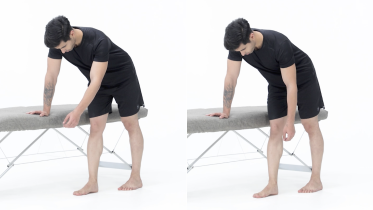 Pendulum exercise for the shoulder
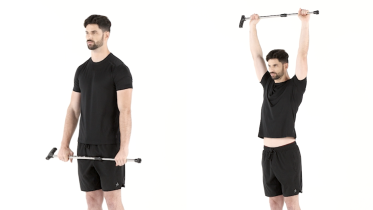 Shoulder flexion with a stick
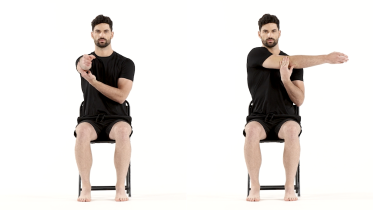 Cross body shoulder stretch
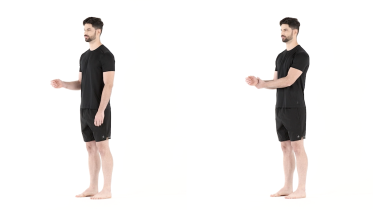 Isometric shoulder external rotation
A few precautions. If you have high blood pressure, breathe steadily through every hold and never hold your breath. Where an operation, a break or a dislocation is part of your history, the plan written by your own surgeon or physio overrides this list, and it may limit you to movements someone else performs for you in the early weeks. The cross body stretch is usually added once the early soreness has come down rather than on day one, and after a rotator cuff repair the isometric hold, which pushes against resistance, usually waits several weeks.
Stop any of these and get it checked if the arm becomes weak, if pins and needles or numbness appear and do not clear when you change position, or if the shoulder becomes hot and swollen. The warning signs below say how fast to act on each.
When to see a physio (physical therapist)
Early, and earlier than most people go. A shoulder that has become stiff as well as sore needs the diagnosis settled before a program is written, because the exercises for a tight capsule and the exercises for a painful tendon are not the same and the wrong set wastes months you cannot get back.
Bring the specifics to the appointment: which direction runs out first, whether help from your other hand gets the arm any higher, how the shoulder behaves at night, and whether you have diabetes or a thyroid condition. Raise your stage of life too, so the clinician has the whole picture, and keep the hormone conversation with your doctor or menopause clinic where it belongs.
Related exercise programs
See a doctor promptly if
- Emergency: chest pain or tightness, which may spread to your arm, neck or jaw, or shoulder or arm pain that comes with shortness of breath, sweating or feeling sick. This can be a heart attack. Call emergency services straight away.
- Emergency: the shoulder feels as if it has slipped out of place, looks a different shape or suddenly locks so you cannot move the arm, or the pain is severe after a fall or an injury. Go to an emergency department straight away, without driving yourself, and do not try to put the shoulder back in yourself.
- Emergency: your arm, hand or fingers turn cold, pale, blue or gray compared with the other side. Call emergency services or go to an emergency department straight away, and do not drive yourself. The blood supply to the arm may be blocked.
- Emergency: you have a fever or feel unwell, or the shoulder is hot, red and swollen. This can be a joint infection. Go to an emergency department straight away.
- Same day: sudden, very bad shoulder pain, or you suddenly cannot lift or move your arm at all. Get medical help the same day.
- Same day: pins and needles or numbness in the arm that does not go away, no feeling in part of the arm, or weakness that is getting worse. Get medical advice the same day. For pain spreading down the arm from your neck, ask for an urgent appointment with your doctor. If one side of your face or body suddenly goes numb or weak, or your speech becomes slurred or muddled, call emergency services, even if it goes away.
- Within a day or two: severe pain in both shoulders that has come on recently. Ask for an urgent appointment with your doctor.
- Within a day or two: new shoulder pain and you have had cancer, now or in the past, or you are losing weight without trying. See your doctor within a day or two and mention it. If you are being treated for cancer now, contact your cancer team the same day.
- Within a few days: the pain started after a fall, a pull or another injury, especially if the arm has been weak since, for example you cannot lift it out to the side or hold it up. This can be a broken bone or a torn tendon. Ask for an urgent appointment with your doctor, within days rather than weeks, because UK shoulder surgeons advise urgent referral for a rotator cuff tear caused by an injury.
- Within a few days: you are over 50 and have aching and stiffness in both shoulders, often in the neck or hips too, that is worst in the morning and lasts more than 45 minutes after you get up. See your doctor within a few days, as this can be an inflammatory condition (polymyalgia rheumatica) rather than a local shoulder problem. If you also get a new headache, pain or tenderness at your temples or on your scalp, or jaw pain when you eat or talk, get medical advice the same day, and if your vision changes, call emergency services.
- Within a few days: night pain is common with shoulder problems, but get checked within a few days if the pain is constant, no rest or change of position eases it at all, and it keeps getting worse. If you have had cancer, now or in the past, or are losing weight without trying, see your doctor sooner, within a day or two, and mention it. If you are being treated for cancer now, contact your cancer team the same day.
Common questions
Does the menopause cause frozen shoulder?
No study has shown that it does. The overlap is in who gets it: OrthoInfo puts the peak age range at 40 to 60 and records more cases in women than in men, and that is the same stretch of years in which many women go through the transition. Two things can share a decade without one producing the other, and age alone explains a good deal of that overlap. The risk factors OrthoInfo does name are diabetes, thyroid conditions, Parkinson's disease, heart disease and a spell with the shoulder held still after surgery or an injury; its account of the causes and risk factors does not mention the menopause or hormone levels at all. The JOSPT guideline adds having had a frozen shoulder on the other side (Kelley 2013).
Can HRT help frozen shoulder?
The evidence does not answer that, and this page will not either. In the closest study to that question, medical records from 1,952 menopausal women aged 40 to 60 were checked for hormone therapy use and a diagnosis of frozen shoulder. Frozen shoulder appeared in 7.65% of the women not on hormone therapy and 3.95% of those on it, an odds ratio of 1.99 with a confidence interval of 0.86 to 4.58 and a p value of 0.10, which means the difference could easily be chance. The authors, who describe their own work as a preliminary pilot, called for larger prospective studies (Reinke 2026). Whether hormone treatment suits you is a prescription decision for your own doctor or menopause clinic.
Is it frozen shoulder or a rotator cuff problem?
Stiffness is the separator. In frozen shoulder the arm stops at the same point whether you lift it yourself, someone else lifts it for you, or you lie down to take gravity out of the movement, and rotating the forearm outward with the elbow pinned to your ribs is the direction that usually runs out soonest. A painful cuff will usually let the arm travel further once the muscles are relaxed. Getting this right changes the program, which is why it is worth an examination rather than a guess.
How long will it take?
Longer than feels reasonable. OrthoInfo describes the painful phase lasting anywhere from 6 weeks to 9 months, a stiff phase of 4 to 6 months, and a return toward normal movement that takes 6 months to 2 years. The JOSPT guideline notes that some pain and stiffness can still be present 12 to 18 months from onset (Kelley 2013), and a systematic review found that people left untreated often regained some movement but not all of it (Wong 2017). Track the direction over months rather than the calendar, and judge progress by what you can reach rather than by how it feels on any one morning.
Should I push through the pain to loosen it?
Hard stretching into pain is the common mistake and it tends to backfire. Diercks and Stevens followed 77 people and compared intensive passive stretching and mobilization against supportive care with movement kept inside pain limits, and at two years the gentler approach came out better. That study was not randomized, so it cannot settle the question alone, though the JOSPT guideline also warns that stretching beyond painful limits can lead to worse results (Kelley 2013). Match the effort to how irritable the shoulder is that week.
References
- American Academy of Orthopaedic Surgeons. Frozen shoulder. OrthoInfo. https://www.orthoinfo.org/en/diseases--conditions/frozen-shoulder/
- Reinke EK, Ford AC, Wahl E, et al. A preliminary pilot study to address design issues related to research on potential association of hormone therapy and adhesive capsulitis. Climacteric. 2026;29(3):478-483. https://doi.org/10.1080/13697137.2026.2615391
- Wright VJ, Schwartzman JD, Itinoche R, Wittstein J. The musculoskeletal syndrome of menopause. Climacteric. 2024;27(5):466-472. https://doi.org/10.1080/13697137.2024.2380363
- Kelley MJ, Shaffer MA, Kuhn JE, et al. Shoulder pain and mobility deficits: adhesive capsulitis. Clinical practice guidelines linked to the International Classification of Functioning, Disability, and Health from the Orthopaedic Section of the American Physical Therapy Association. Journal of Orthopaedic and Sports Physical Therapy. 2013;43(5):A1-A31. https://doi.org/10.2519/jospt.2013.0302
- Page MJ, Green S, Kramer S, et al. Manual therapy and exercise for adhesive capsulitis (frozen shoulder). Cochrane Database of Systematic Reviews. 2014;(8):CD011275. https://doi.org/10.1002/14651858.CD011275
- Wong CK, Levine WN, Deo K, et al. Natural history of frozen shoulder: fact or fiction? A systematic review. Physiotherapy. 2017;103(1):40-47. https://doi.org/10.1016/j.physio.2016.05.009
- Diercks RL, Stevens M. Gentle thawing of the frozen shoulder: a prospective study of supervised neglect versus intensive physical therapy in seventy-seven patients with frozen shoulder syndrome followed up for two years. Journal of Shoulder and Elbow Surgery. 2004;13(5):499-502. https://doi.org/10.1016/j.jse.2004.03.002
- Kulkarni R, Gibson J, Brownson P, Thomas M, Rangan A, Carr AJ, Rees JL. Subacromial shoulder pain. BESS/BOA Patient Care Pathways. Shoulder and Elbow. 2015;7(2):135-143. https://doi.org/10.1177/1758573215576456
- Rangan A, Brealey SD, Keding A, et al. Management of adults with primary frozen shoulder in secondary care (UK FROST): a multicentre, pragmatic, three-arm, superiority randomised clinical trial. The Lancet. 2020;396(10256):977-989. https://doi.org/10.1016/S0140-6736(20)31965-6
Written and checked by the PocketPhysio editorial team. Last updated 2026-09-30.
This page is general education, not a diagnosis or a personal treatment plan. See a physiotherapist or doctor for advice about your own situation.