
Shoulder pain at night: why it wakes you and how to sleep
Why shoulder pain gets louder at night
Standing up, the arm hangs from the shoulder and gravity pulls the joint surfaces slightly apart. Lie down and that reverses: the weight of the trunk, or of the arm falling across you, now presses into the joint and into the soft tissue under the bony roof at the top of the shoulder (the acromion). A review of sleep in rotator cuff problems describes a study of 20 healthy volunteers in which those who preferred to sleep on their back had lower pressure in that space than those who preferred their side or their front (Daher and colleagues, 2024). That was measured in people without shoulder pain, so treat it as a hint rather than a rule. The same review describes higher levels of an inflammatory messenger (tumor necrosis factor alpha) in people whose sleep was disturbed, and raised blood flow in one of the small arteries at the front of the shoulder in people with night pain, so position is probably not the whole story.
Then there is the quiet. A busy day keeps your nervous system occupied, and a shoulder that grumbles in the background rarely reaches the front of the queue. Lying still in the dark removes every one of those distractions. Finan and colleagues (2013) reviewed the research linking sleep and pain and concluded that disturbed sleep is the stronger signal of the two: it predicts pain later on better than pain predicts sleep trouble later on. A broken night therefore leaves the shoulder more tender the next day, which sets up the night after.
Before you read on, work out which of these two your shoulder is doing. If it wakes you when you roll onto it and quietens down once you move off, position and load are driving it, and the rest of this page is written for you. If it aches through the whole night whatever you do, gives you nothing back when you change position, and is worse this month than last, that belongs in the warning signs lower down instead.
What usually lies behind a shoulder that hurts in bed
What follows is background reading, not a way to label your own shoulder. In clinic, what separates them is where the pain sits, how the arm behaves when someone else moves it for you, and how the whole thing started.
Rotator cuff related shoulder pain
This is the common one. Pain at the top and outer side of the shoulder, worse reaching up or out, often with an ache that arrives once you settle rather than the second you lie down. OrthoInfo lists pain at rest and at night, especially when lying on the affected shoulder, among the main symptoms of a rotator cuff tear, and the same pattern turns up without a tear. Lewis (2016) groups the painful cuff, subacromial pain and partial tears under one name, rotator cuff related shoulder pain, because they behave alike and respond to the same kind of program. The rotator cuff tendinopathy program and the shoulder impingement program set that out stage by stage.
Frozen shoulder
Here the lining of the joint itself is inflamed and tightening, so pain comes with stiffness. Night pain is often at its worst in the first months, while pain rather than stiffness is leading. The giveaway is that the arm will not go further even when someone else moves it for you, and turning the arm outward with the elbow at your side is usually the most limited direction. OrthoInfo flags diabetes and thyroid conditions as things that raise the risk, and the JOSPT guideline lists having had it in one shoulder as a risk factor for the other (Kelley and colleagues, 2013). The frozen shoulder program is built around how irritable the shoulder is rather than a calendar.
A calcium deposit in the tendon
Calcium can build up in a cuff tendon and cause pain out of proportion to anything you did. Merolla and colleagues (2016) report that people are most symptomatic while the body is breaking the deposit down, and that the pain may or may not come with loss of movement. The UK shoulder pathway calls an acute episode severely painful, enough to be mistaken for the pain of a tumor (Kulkarni and colleagues, 2015), and people describe a shoulder that becomes unbearable over a day or two, with no sleep at all on that side. Get a first episode like that looked at the same day: an infected joint and a torn tendon can both announce themselves in much the same way, and the warning signs below cover both. The calcific tendinitis program covers what happens after that.
Pain coming from the neck or the wrist
Not everything felt in the shoulder starts there. A nerve root irritated in the neck sends pain into the shoulder blade and down the arm, often with pins and needles, and it can be position sensitive at night. Carpal tunnel syndrome classically wakes people with numb, burning fingers that they shake out. If numbness or tingling is a bigger part of your night than the shoulder ache itself, look at the cervical radiculopathy program and the carpal tunnel syndrome program, and read the warning signs on this page first.
After shoulder surgery
Rehab after an operation runs to a protocol written by your surgical team, and night positions are part of it, including how long you sleep in the sling and whether you may lie flat. The rotator cuff repair rehab program and the shoulder replacement rehab program explain the usual stages so you know what to expect, but your own plan comes first. Both of those pages carry their own warning signs for the weeks after an operation, and those apply on top of the list here. Contact your surgical team the same day if the wound becomes more red, hot, swollen or painful or starts to leak, if the arm is getting more swollen instead of settling down, or if you have a fever, and go to an emergency department instead if you feel very unwell. Call emergency services for sudden shortness of breath or chest pain.
If you are pregnant
Late pregnancy changes the position advice on this page. From about 28 weeks the NHS advises going to sleep on your side rather than on your back, because going to sleep on your back in the last months is linked to a higher risk of stillbirth. So use the side-lying set-up below, with the sore arm resting on a pillow in front of you, and leave the back-lying ones until after the birth. The NHS also says not to worry if you wake up on your back: settle onto your side again and carry on.
Carpal tunnel syndrome is common in pregnancy too and wakes people with numb, burning fingers, which is worth mentioning at your next appointment. Your midwife or maternity physio leads the plan, and anything you want to try goes past them first.
Sleeping positions and pillow set-ups
A set-up has two jobs: support the arm, and keep body weight off the sore shoulder. An arm left hanging unsupported drags on the sore tissue for hours, and a shoulder squashed against the mattress gets compressed for just as long. No trial has compared sleeping positions for shoulder pain, so treat the list below as what physios commonly suggest rather than as tested advice. If you are more than about 28 weeks pregnant, skip positions 1, 2 and 4 and use position 3.
- On your back, with a folded towel or thin pillow under the upper arm, so the arm sits level with your body rather than sagging backward toward the mattress. People who preferred to sleep on their back had the lowest pressure under the bony roof of the shoulder in the small study described by Daher and colleagues (2024).
- On your back with the forearm resting on a pillow across your stomach, if the arm feels better slightly forward and turned in.
- On the good side, with a full-length pillow or a bolster in front of your chest for the sore arm to lie on, so it is supported instead of dropping across you.
- A rolled towel behind the shoulder blade of the sore side, if lying flat on your back makes the shoulder feel pulled backward.
Front sleeping is usually the hardest to make comfortable, because it parks the arm out to the side and turned for hours at a time. If that is your habit, the pillow wedge in position 3 is the gentlest way to move off it, since it half props you toward your side.
Give any set-up three or four nights before you decide. Shoulders are slow, and one restless night proves nothing either way.
Can you lie on the sore side?
You can, and doing it does not damage the shoulder. It is simply the position most likely to wake you, because it presses the tendons and the bursa against the bone underneath. While the shoulder is irritable, most people find it easier to keep off that side and revisit it once the night pain settles.
One exception comes up in clinic. The sleeper stretch, a stretch for the back of the shoulder, is done lying on the painful side on purpose, and it usually comes in later in a program when the shoulder can tolerate the position. If your physio has given it to you and lying on that side still hurts, say so, because it belongs at a later stage rather than in the early weeks.
How long does shoulder pain at night last?
Longer than most people expect. The NHS puts recovery from shoulder pain at 6 months or more in some cases, and suggests keeping the exercises going for 6 to 8 weeks to help stop it returning. Night pain tends to be the last symptom to go, so a shoulder can feel fine reaching for a mug and still wake you in the small hours.
Frozen shoulder runs on its own clock. According to the JOSPT clinical practice guideline, pain and stiffness may persist 12 to 18 months from the start, by which point daily life has usually become manageable again for most people (Kelley and colleagues, 2013). Watch the direction rather than the calendar. If the number of wakings is dropping over a month, the plan is working, even slowly.
A rough guide for a settling cuff problem: fewer wakings first, then shorter ones, then nights where you notice the shoulder only when you roll onto it, then nothing. If none of those steps has happened in 6 weeks of doing the right things, that is a reason to get the diagnosis rechecked rather than to push harder.
What else helps at home
The NHS advice that matters most here is short: carry on using the shoulder gently instead of resting it completely, and cut out whatever clearly aggravates it. The same page suggests resting the arm on a cushion in your lap while you sit, and using paracetamol (acetaminophen), ibuprofen, or heat or cold packs to make movement easier. A pharmacist can tell you which of those fits with any other medicines you take.
Daytime load sets up the night. Long spells of overhead work, carrying a heavy bag on that shoulder, and heavy pressing in the gym all tend to show up hours later in bed, so trimming them for a few weeks usually does more good than anything you try at bedtime. Anything you reach for several times a day is worth relocating to waist or chest height while the shoulder is sore.
A short routine before bed suits some people: a warm shower, then the gentlest movement from the list below, then whichever pillow set-up you have settled on. The 2025 rotator cuff guideline supports adapting the way you work as one way of easing shoulder pain in the workplace (Desmeules and colleagues, 2025). The last hour of the evening deserves the same treatment.
Exercises for a shoulder that hurts at night
Nothing here switches off night pain in a week. Over a couple of months, though, exercise raises how much load the tendon or the capsule will take before it complains, and the nights usually follow the days. The four below are the least demanding in the library: a hanging swing that needs no shoulder muscle work at all, a static hold, an assisted lift using a stick, and a stretch for the back of the shoulder. If you have high blood pressure, breathe steadily through every hold and never hold your breath.
After shoulder surgery, including a rotator cuff repair, or after a shoulder fracture or dislocation, follow your surgeon's or physio's plan, and do only the movements and range they have cleared. Many plans allow only passive movement at first, where the arm is moved for you and its muscles stay relaxed.
Exercises that can help
The night after is your dose meter. If the shoulder is no worse in bed, that amount was right; if it wakes you more, halve it and build back slowly. Typical starting points are 5 to 10 holds of 5 to 10 seconds, 10 to 15 slow lifts, a swing of 30 to 60 seconds, or a stretch held for 20 to 30 seconds, once or twice a day. The numbers on each exercise page come first, and your physio will change them to suit you.
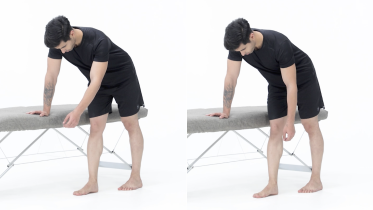 Pendulum exercise for the shoulder
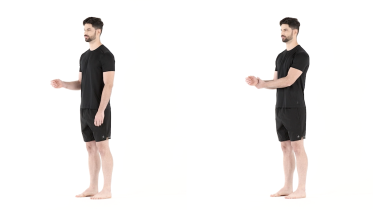 Isometric shoulder external rotation
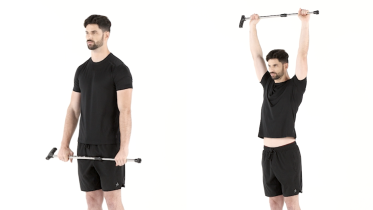 Shoulder flexion with a stick
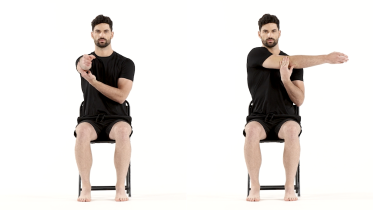 Cross body shoulder stretch
The cross body stretch is optional, and it is usually given when a physio finds the back of the shoulder is tight rather than handed to everyone. When these stop feeling like work, the band exercises in the rotator cuff tendinopathy program are the next step up.
When to see a physio (physical therapist)
Two weeks of no improvement is the NHS threshold for seeing a doctor about shoulder pain, and so is pain that is getting worse or an arm that is very difficult to move. Losing sleep for a fortnight counts on its own, whatever the daytime pain is doing. An assessment earns its keep by sorting out the source, because the cuff, the joint capsule, the AC joint on top of the shoulder and the neck each lead to a different plan.
Go in with the specifics. How many times you wake, which side you were lying on, whether rolling off settles it in a minute or an hour, how the arm behaves reaching behind your back, and what you did in the 24 hours before a bad night will get a physio to an answer faster than a general description will. Kulkarni and colleagues (2015) describe a pathway in which physiotherapy is given roughly 6 weeks to show something, then another 6 if it is helping, before a specialist opinion is sought. Your surgical team stays in charge of that decision if you have had an operation on the shoulder.
Related exercise programs
See a doctor promptly if
- Emergency: chest pain or tightness, which may spread to your arm, neck or jaw, or shoulder or arm pain that comes with shortness of breath, sweating or feeling sick. This can be a heart attack. Call emergency services straight away.
- Emergency: the shoulder feels as if it has slipped out of place, looks a different shape or suddenly locks so you cannot move the arm, or the pain is severe after a fall or an injury. Go to an emergency department straight away, without driving yourself, and do not try to put the shoulder back in yourself.
- Emergency: your arm, hand or fingers turn cold, pale, blue or gray compared with the other side. Call emergency services or go to an emergency department straight away, and do not drive yourself. The blood supply to the arm may be blocked.
- Same day: the shoulder is hot, red and swollen, or you have a fever or feel unwell. This can be a joint infection. Go to an emergency department the same day.
- Same day: sudden, very bad shoulder pain, or you suddenly cannot lift or move your arm at all. Get medical help the same day.
- Same day: pins and needles or numbness in the arm that does not go away, no feeling in part of the arm, or weakness that is getting worse. Get medical advice the same day. For pain spreading down the arm from your neck, ask for an urgent appointment with your doctor. If one side of your face or body suddenly goes numb or weak, or your speech becomes slurred or muddled, call emergency services, even if it goes away.
- Within a day or two: severe pain in both shoulders that has come on recently. Ask for an urgent appointment with your doctor.
- Within a day or two: new shoulder pain and you have had cancer, now or in the past, or you are losing weight without trying. See your doctor within a day or two and mention it. If you are being treated for cancer now, contact your cancer team the same day.
- Within a few days: the pain started after a fall, a pull or another injury, especially if the arm has been weak since, for example you cannot lift it out to the side or hold it up. This can be a broken bone or a torn tendon. Ask for an urgent appointment with your doctor, within days rather than weeks, because UK shoulder surgeons advise urgent referral for a rotator cuff tear caused by an injury.
- Within a few days: you are over 50 and have aching and stiffness in both shoulders, often in the neck or hips too, that is worst in the morning and lasts more than 45 minutes after you get up. See your doctor within a few days, as this can be an inflammatory condition (polymyalgia rheumatica) rather than a local shoulder problem. If you also get a new headache, pain or tenderness at your temples or on your scalp, or jaw pain when you eat or talk, get medical advice the same day, and if your vision changes, call emergency services.
- Within a few days: night pain is common with shoulder problems, but get checked within a few days if the pain is constant, no rest or change of position eases it at all, and it keeps getting worse. If you have had cancer, now or in the past, or are losing weight without trying, see your doctor sooner, within a day or two, and mention it. If you are being treated for cancer now, contact your cancer team the same day.
- Within 2 weeks: the shoulder has gone stiff as well as sore, so that helping the arm up with your other hand, or lying down to take gravity out of it, does not get it any further than it goes on its own. That pattern points more toward the joint capsule than the tendons, and the two need different programs. Book an appointment with a doctor or physio.
Common questions
Why does my shoulder hurt at night but not during the day?
Lying down changes two things. Your body weight now travels through the shoulder in a way it does not when you are upright, and a review of sleep in rotator cuff problems found that back sleepers had lower pressure under the bony roof of the shoulder than side or front sleepers (Daher and colleagues, 2024). The second change is attention: an ache you barely register while you are busy has the whole night to itself once the lights go out. Broken sleep then leaves the shoulder more tender the following day: Finan and colleagues (2013) found that disturbed sleep predicts later pain more consistently than pain predicts later sleep trouble. None of that means the shoulder is being damaged while you sleep.
What is the best sleeping position for shoulder pain?
No trial has compared them, so this is practice rather than proof. Most people get on with one of two set-ups: on your back, with a folded towel or a thin pillow under the upper arm so the arm rests level with your body instead of sagging backward; or on the good side, with a pillow in front of your chest for the sore arm to lie on, so it is not hanging across you unsupported. Front sleeping tends to be the least comfortable, because it leaves the arm turned and held out for hours. Try one set-up for several nights before you judge it, since shoulders take a while to settle. From about 28 weeks of pregnancy the NHS advises going to sleep on your side rather than on your back, because going to sleep on your back in the last months is linked to a higher risk of stillbirth. So use the side-lying set-up, with the sore arm resting on a pillow in front of you, and leave lying on your back until after the birth. The NHS also says not to worry if you wake up on your back: settle onto your side again and carry on.
Is frozen shoulder or rotator cuff pain worse at night?
Both wake people, and you cannot tell them apart by the hour alone. In rotator cuff problems, sleep disturbance is reported by roughly 70% to 89% of people (Daher and colleagues, 2024), and a systematic review of sleep and rotator cuff tears reports that only 11% of people with a symptomatic tear describe their sleep as normal (Longo and colleagues, 2019). Frozen shoulder is usually more painful at night in its early months, when pain rather than stiffness is the main problem. The difference a physio looks for is stiffness: in frozen shoulder the arm does not go further even when someone else moves it for you, whereas a painful cuff will usually allow more range when the muscles relax.
Is shoulder pain at night a sign of cancer?
It is rare, and waking because you rolled onto that shoulder is not the pattern that worries a clinician. What does is pain that is there all the time, that no rest or change of position eases at all, and that keeps getting worse week by week. That combination is on the warning signs list on this page with how quickly to act. New shoulder pain matters sooner if you have had cancer, now or in the past, or you are losing weight without trying, and it is worth saying so at the appointment rather than waiting to be asked.
Why do my fingers go numb with shoulder pain at night?
Numb fingers are often a separate problem from the shoulder. Carpal tunnel syndrome at the wrist and an irritated nerve root in the neck both tend to wake people, and an arm tucked under a pillow can go numb from pressure alone and recover once you move. Rotator cuff pain on its own does not usually cause numbness. If pins and needles in the arm or hand do not go away once you change position, if part of the arm or hand has no feeling, or if weakness is getting worse, get medical advice the same day. If one side of your face or body suddenly goes numb or weak, or your speech becomes slurred or muddled, call emergency services, even if it goes away.
Is shoulder pain at night linked to perimenopause?
Nobody has shown that the menopause transition causes it. What is known is who gets these problems: OrthoInfo says frozen shoulder most commonly affects people between the ages of 40 and 60 and occurs in women more often than men, which overlaps with the menopause transition. A 2024 review in Climacteric proposed the term musculoskeletal syndrome of menopause for the joint pain, muscle loss, bone loss and worsening osteoarthritis that go with falling estrogen (Wright and colleagues, 2024). That is a name for a group of symptoms, not evidence that the menopause transition causes shoulder pain at night, and whether hormone treatment changes shoulder pain has not been settled, so that decision belongs with your own doctor. So new night pain in the shoulder is common at this stage of life, and it is assessed and treated the same way as at any other age.
References
- Daher M, Lopez R, Covarrubias O, Boufadel P, Fares MY, Abboud JA. Sleep disturbances in rotator cuff pathology: insights into mechanisms and clinical implications. Clinics in Shoulder and Elbow. 2024;27(4):514-518. https://doi.org/10.5397/cise.2024.00010
- Longo UG, Facchinetti G, Marchetti A, et al. Sleep disturbance and rotator cuff tears: a systematic review. Medicina (Kaunas). 2019;55(8):453. https://doi.org/10.3390/medicina55080453
- Desmeules F, Roy JS, Lafrance S, et al. Rotator cuff tendinopathy diagnosis, nonsurgical medical care, and rehabilitation: a clinical practice guideline. Journal of Orthopaedic and Sports Physical Therapy. 2025;55(4):235-274. https://doi.org/10.2519/jospt.2025.13182
- Kelley MJ, Shaffer MA, Kuhn JE, et al. Shoulder pain and mobility deficits: adhesive capsulitis. Clinical practice guidelines linked to the International Classification of Functioning, Disability, and Health from the Orthopaedic Section of the American Physical Therapy Association. Journal of Orthopaedic and Sports Physical Therapy. 2013;43(5):A1-A31. https://doi.org/10.2519/jospt.2013.0302
- Lewis J. Rotator cuff related shoulder pain: assessment, management and uncertainties. Manual Therapy. 2016;23:57-68. https://doi.org/10.1016/j.math.2016.03.009
- Kulkarni R, Gibson J, Brownson P, Thomas M, Rangan A, Carr AJ, Rees JL. Subacromial shoulder pain. BESS/BOA Patient Care Pathways. Shoulder and Elbow. 2015;7(2):135-143. https://doi.org/10.1177/1758573215576456
- Merolla G, Singh S, Paladini P, Porcellini G. Calcific tendinitis of the rotator cuff: state of the art in diagnosis and treatment. Journal of Orthopaedics and Traumatology. 2016;17(1):7-14. https://doi.org/10.1007/s10195-015-0367-6
- Finan PH, Goodin BR, Smith MT. The association of sleep and pain: an update and a path forward. Journal of Pain. 2013;14(12):1539-1552. https://doi.org/10.1016/j.jpain.2013.08.007
- Wright VJ, Schwartzman JD, Itinoche R, Wittstein J. The musculoskeletal syndrome of menopause. Climacteric. 2024;27(5):466-472. https://doi.org/10.1080/13697137.2024.2380363
- American Academy of Orthopaedic Surgeons. Rotator cuff tears. OrthoInfo. https://www.orthoinfo.org/en/diseases--conditions/rotator-cuff-tears/
- American Academy of Orthopaedic Surgeons. Frozen shoulder. OrthoInfo. https://www.orthoinfo.org/en/diseases--conditions/frozen-shoulder/
- NHS. Shoulder pain. Page last reviewed 22 May 2023. https://www.nhs.uk/symptoms/shoulder-pain/
- NHS. 27 weeks pregnant: the best sleeping positions during pregnancy. Best Start in Life week by week guide. https://www.nhs.uk/best-start-in-life/pregnancy/week-by-week-guide-to-pregnancy/2nd-trimester/week-27/
- NHS. Heart attack. Page last reviewed 31 March 2026. https://www.nhs.uk/conditions/heart-attack/
- NHS. Polymyalgia rheumatica. Page last reviewed 23 April 2023. https://www.nhs.uk/conditions/polymyalgia-rheumatica/
- NHS. Temporal arteritis. Page last reviewed 14 August 2023. https://www.nhs.uk/conditions/temporal-arteritis/
Written and checked by the PocketPhysio editorial team. Last updated 2026-09-30.
This page is general education, not a diagnosis or a personal treatment plan. See a physiotherapist or doctor for advice about your own situation.