
Shoulder clicking: what the noise means and when it matters
Warning signs, and when to get help
Why does my shoulder click?
Because a shoulder is built out of parts that slide over each other. The ball sits shallow in its socket and is held there by a sleeve of tissue, tendons cross the joint on every side, one of them runs in a groove at the top of the arm bone, and the shoulder blade glides across the back of the rib cage every time the arm moves. Surfaces that slide, under a load that keeps changing, make a noise now and then.
The noise also moves around, and that matters. It changes with the position of the arm, with how much weight is in your hand and with how warm the shoulder is, so one lift clicks and the next one does not, and the same shoulder can be quiet on Tuesday and loud on Wednesday. A finding that shifts with how you happen to be standing is not measuring the state of the joint.
Why joints make noise at all is a bigger question than the shoulder, and our page on cracking joints takes it, including what the research on joint cracking can and cannot show. This page stays with the shoulder: this movement, this click, and whether to keep lifting.
Is shoulder clicking bad for your shoulder?
On its own, there is nothing to say that it is. A noise is not pain, it is not weakness, and it is not a measure of wear. What follows is narrower than what you will read on most clinic blogs, and the narrow version is the one that holds up.
The NHS shoulder pain page is useful for what it does and does not say. Its self-care advice for an ordinary sore shoulder is to stay active and keep the shoulder gently moving rather than stop using it completely. Its threshold for seeing a doctor is pain that is getting worse, pain that has not improved after 2 weeks, or an arm that is very difficult to move. Noise on its own appears on neither list.
Where that page does name clicking is in its table of symptoms and possible causes, and the company it keeps there is the whole point. Clicking or locking sits alongside a tingling, numb or weak arm, and the possible cause given is shoulder instability, sometimes because of hypermobility. So the sentence this page can give you has two halves: a click with nothing else is not something a national health service asks you to act on, and a click with tingling, numbness or weakness is.
Here is the honest position, because you may have been told otherwise. We looked for a statement from the NHS, NICE or the American Academy of Orthopaedic Surgeons saying plainly that painless shoulder clicking is normal, and there is not one to quote. The knee has that sentence from the NHS, on our page about knee clicking and cracking, and the jaw has its own version from a US national institute, on jaw clicking and pain. The shoulder has never been given it, and borrowing a sentence written about a different joint would be easy and still untrue. It matters less than it sounds, because what you do next turns on what the shoulder does, not on what the noise is called.
Where the noise comes from: four places, and why nobody can name it from the sound
What follows is anatomy, not a research finding. No source this page could read has established which structure makes a given shoulder noise, so treat the four places below as where the sound might come from and not as a diagnosis.
- The front of the shoulder. Several tendons cross the joint here, and the long head of the biceps runs in a shallow groove at the top of the arm bone, where a tendon passing over a bony edge can snap across it. A snapping feeling at the front is answered on our biceps tendinopathy page.
- Behind, where the shoulder blade glides on the rib cage. That is a sliding surface, not a true joint, and it can creak or clunk as the blade travels, often most obviously when the arm is loaded, as in a push. How the blade moves is covered by our shoulder blade control program.
- The small joint on top, where the outer end of the collarbone meets the shoulder blade. Noise from there sits in a spot you can put one finger on. Our AC joint sprain program covers it, and that page already asks you to get seen if the shoulder clicks, catches or feels unstable.
- Inside the ball and socket. The socket is rimmed by a ring of cartilage (the labrum), and the surfaces travel across each other through every lift. This is the place that matters when the noise comes with catching, locking or a sense that the joint is about to give.
Patients bring a wide vocabulary to the same shoulder. Clicking, cracking, popping, clunking, grinding and creaking all turn up describing the same joint, and none of those words points reliably at one of the four places above. That is why nobody can tell you where your noise comes from over the phone, and why a recording of the sound is worth less than two minutes of examining the arm.
When shoulder clicking needs checking
If you read one section here, read this one. Four pictures change what you do today, and in all four the noise is a passenger.
A click or a lock with tingling, numbness or a weak arm
This is the pairing the NHS puts in writing, and it points toward instability, sometimes on the back of generally loose joints (hypermobility). Pins and needles or numbness in the arm that do not go away, no feeling in part of the arm, or weakness that is getting worse need medical advice the same day, and that line is written out in the warning signs below. Hypermobility covers loose joints in general, and shoulder dislocation covers a shoulder that has come out.
A click with pain, loss of movement or weakness
Here the cluster is what counts. OrthoInfo's symptom list for a tear of the rim of cartilage around the socket includes catching, locking and popping, and it sets them beside deep pain with overhead or reaching activity, a sense of instability, dislocations, occasional night pain, less movement than before, and loss of strength. The same page says those symptoms are not always specific and depend on which part of the rim is torn, which is a fair warning against reading your own diagnosis off a symptom list. What to take from it is simple enough: when the noise has arrived with pain, with a shoulder that does less than it did, or with weakness, get the shoulder examined rather than the sound described.
A pop at the moment of an injury
A noise that happened once, during a fall, a heavy pull or a catch, belongs in a different category from one that repeats every time you lift. A sudden pop or tearing feeling that brings sharp pain, new weakness or trouble lifting the arm needs medical advice the same day. So does pain that started with a fall or a pull when the arm has been weak since, and the warning signs below say what to tell whoever sees you, because how it happened changes how fast you are seen.
A shoulder that locks, changes shape, or feels as if it has slipped out
That is an emergency department rather than an appointment, and the line below sets it out in full, including not driving yourself and not trying to put the shoulder back in. One more belongs with it: an arm, hand or fingers that turn cold, pale, blue or gray compared with the other side. A shoulder that is hot, red and swollen, or shoulder pain with a fever, is on the same day list below instead, and can be an infection in the joint.
Each of those is written out with its own timing in the warning signs at the foot of this page, and they are not all at the same level of urgency.
Shoulder clicking with no pain
Check the rest of the arm before you take that heading at face value, because no pain is not the whole test. Four things. Whether the arm is as strong as the other one, whether it moves as far, whether the shoulder feels loose or as if it might slip, and whether you get tingling or numbness down the arm. If all four are clear, nothing needs doing about the noise. Keep using the arm, including in the movement that makes the sound, and stop giving the sound your attention. If one of them is not clear, this is not your section, and when shoulder clicking needs checking further up the page is.
That order matters, because the easy misreading of a page like this one is to check for pain, find none and stop reading. A shoulder can be weaker than the other one, or stop short of where it used to go, or feel as though it will give way, while the click itself stays painless. Tingling or numbness down the arm counts too, and it is the pairing the NHS puts next to clicking and locking in its own table. Any of them is worth an appointment whether or not it hurts, and the noise is not what makes it so.
Painless now does not mean never worth mentioning. A noise that is new and comes with a shoulder that feels loose, a noise that started after the shoulder was dislocated, and a quiet click that has turned into a catch all earn an appointment. A long-standing painless click that has not changed in years is at the other end of that scale, and it is one of the least interesting findings in shoulder practice.
Resist two habits. One is performing the click for other people, which shows a clinician nothing they cannot find for themselves in half a minute. The other is checking it through the day to see whether it still does it, which keeps a harmless noise at the front of your mind from breakfast onward.
There is a third habit, quieter than those two and more expensive. Avoiding the movement that makes the noise costs you range and strength, slowly enough that you do not notice, and then the movement you were avoiding genuinely is harder than it used to be. That is the one route by which a painless click leads somewhere bad, and it runs through what you stopped doing rather than through the joint.
Shoulder clicking with pain
Different question, different answer. When the click hurts, the pain is what gets assessed and treated, and the noise does not decide the plan. Your shoulder gets judged by what it will do, which is a far more useful examination than listening to it.
Notice where the pain sits in the movement before you are seen. Pain that builds partway up and eases at the top, pain only at the very top over the joint on top of the shoulder, and a shoulder that stops short in every direction are three different patterns, and shoulder pain when lifting your arm works through them. If the pain is at its worst in bed, shoulder pain at night covers the positions and the gentler starting exercises.
The usual programs for a painful shoulder are shoulder impingement and rotator cuff tendinopathy, which cover much the same ground under two names. Frozen shoulder stands apart, because it brings stiffness in every direction instead of pain in one arc, and shoulder osteoarthritis is the page to read if the shoulder has become stiff and the pain has built over years. None of those pages is about the noise, and none should be started while anything in the warning signs below applies.
The NHS threshold for taking shoulder pain to a doctor is usable as it stands: pain getting worse, pain that has not improved after 2 weeks, or an arm that is very difficult to move. When you go, describe the shoulder rather than the sound. Which movement brings it on, where in the range, whether the arm is weaker than the other one, whether it feels as if it will give way, and whether it has ever come fully out are the five answers that shorten an appointment.
Clicking in the shoulder press, the bench press and lateral raises
Changing the lift changes the noise and leaves the rule alone. Hand position, bar path, the weight on it, and whether you are pressing or raising all change which tissues are loaded and when, so a shoulder can be noisy overhead and silent on a bench, or the reverse. Painless noise in a press is still painless noise.
Judge three other things instead: whether the lift hurts, whether the arm is weaker than it was, and how the shoulder feels the next morning. The pain monitoring model is the rule for how much is too much, and it is built on the next day rather than on the set you are in.
What this page will not do is tell you that a grip change or a different bar fixes the sound, because nothing it could verify supports a technique fix for a named lift. If a particular lift hurts as well as clicks, deal with the pain: lower the load, work in the range that does not hurt, and read shoulder pain on the bench press if the bench is where it bites. A lift you can do without pain, with normal strength, is not made risky by being loud.
Clicking after a dislocation, and a shoulder that feels as if it will come out
A dislocated shoulder is the exception, where a new noise deserves more attention than usual, because the real question is whether the joint is stable. Hold OrthoInfo's list for long-standing shoulder instability up against your own shoulder: repeated dislocations, repeated instances of the shoulder giving out, and a persistent feeling that it is loose or slipping in and out of the joint. Noise is not on that list and the feeling of looseness is, which tells you which of the two to report.
Instability does not need a dislocation to have happened first. The same source says some people with it have never dislocated a shoulder and simply have looser ligaments, which is called hyperlaxity when it is part of their normal anatomy, and that looseness can also develop from repeated overhead movement in swimming, tennis and volleyball or from work that keeps the arms up. If your joints are loose in general, hypermobility is the page for that, and shoulder dislocation covers what follows one.
Two things not to do. Do not test whether it will come out, and do not treat a shoulder that went back in by itself as a shoulder that did not come out. It came out, and that is an emergency department rather than an appointment, which is the line in the warning signs below. Ask which positions to leave alone until it has been checked, instead of deciding for yourself, and if the shoulder is out of place now, locked or a different shape, the emergency line in the warning signs below applies.
If you were over 40 when the shoulder came out, ask for one more thing: have the strength of the cuff tendons checked as well. The British Elbow and Shoulder Society and British Orthopaedic Association pathway for traumatic anterior shoulder instability asks for a careful examination of rotator cuff strength after a dislocation at that age, and for urgent referral if any doubt remains about the tendons (Brownson and colleagues, 2015).
Clicking or clunking in a shoulder that has been replaced or repaired
This page does not answer that one, and the reason is that it has no source for it. There is a statement from OrthoInfo that clicking in a replaced knee is normal, and it is about knees. Nothing this page could verify says the same about a replaced or repaired shoulder, so the knee's sentence stays on the knee. Your surgical team is who to ask, and a new noise in an operated shoulder is one to raise with them instead of settling at home.
Say which operation you had and when. A standard replacement, a reverse replacement and a rotator cuff repair are three different operations with different parts in them, and we found no source that establishes what a noise means in any of the three, so that answer has to come from the team that did yours. If you do not know which one you had, say so instead of guessing, because the hospital that did it holds the operation note and can tell you, and not knowing changes nothing about what you do next, which is to report the noise.
Two things do not wait for that answer. A replaced shoulder can come out of joint, and if it does, that is the emergency line in the warning signs below, whichever type of replacement you have. And infection around a replaced shoulder is more common after a reverse replacement than after a standard one (Fink and Sevelda, 2017), so pain, stiffness or a shoulder that has begun to feel loose after a reverse replacement is worth taking to your team early rather than watching it.
What should not wait for a routine appointment is a shoulder that has become more painful, weaker or less able since the operation, or a noise that hurts. Contact your surgical team the same day instead of waiting, and do not wait for a fever either: an infection around a replaced shoulder can show itself as pain, stiffness or a joint that has begun to feel loose, with normal blood tests (Fink and Sevelda, 2017), and that line is in the warning signs below.
If the operation was years ago and there is no team left to ring, ring the hospital that did it and ask for the orthopedic or shoulder service, and tell your own doctor the same day that you have a replaced or repaired shoulder and that you are asking to be checked for an infection around it, so that neither of them treats it as ordinary shoulder pain. Rotator cuff repair rehab and shoulder replacement rehab describe the usual stages, and your own team's protocol overrides both. Those two pages also list the warning signs for the weeks after an operation: a wound that turns more red, hot, swollen or painful or starts to leak, an arm that swells instead of settling, or a fever all mean the same day rather than the next appointment, and an emergency department if you feel very unwell. Sudden breathlessness or chest pain means emergency services.
What to do about a noisy shoulder
Nothing, if there is no pain, no weakness, no loss of movement, no tingling or numbness in the arm and no feeling that the joint is loose. That is the position most people reading this are in, and it is a real answer, not a way of closing the conversation down.
Build four habits instead. Keep the arm moving through its full range, including the position that clicks. Judge how much you are doing by the next morning rather than by the sound. Get the shoulder looked at if the noise changes or gains company. And stop monitoring it, because a noise you check thirty times a day becomes a problem whether or not it ever was one.
If the shoulder hurts as well, treat the pain and let the noise do as it likes. In practice that means working the cuff and the shoulder blade muscles inside the range that does not hurt, adding load slowly, and giving it longer than feels reasonable before you judge it. The exercises below are the usual starting set for that, and they are the same whether the shoulder is loud or silent.
Exercises for a noisy shoulder
Nothing here targets the noise, and none of it will quieten a shoulder. These are the standard starting points for the cuff and the shoulder blade muscles, in the order they are usually taught: a swing the arm's own weight does the work in, then a hold with no movement, then resisted turning out, then shoulder blade control, then the lift itself with a wall helping.
Expect the shoulder to carry on clicking while you work, and treat it as background. Stop an exercise if it gives you sharp or catching pain, or pain that builds with each repetition. If the shoulder is clearly worse the next day or the night pain comes back, drop back a step rather than stopping altogether.
Going up is the part most home programs leave out. Move one thing at a time, and only once the amount you are doing now has been comfortable and back to normal by the next morning for a week or two: a few more repetitions, or a slightly stronger band, or a little higher up the wall, and never two of those in the same week. If the next morning tells you it was too much, go back to the last amount that passed that test. The pain monitoring model sets the rule out in full, and this way of stepping up is common physio practice rather than a tested protocol for a noisy shoulder.
The numbers below, and the ones on each exercise page, end with a line about your physio adjusting them, and if you do not have a physio that is not a dead end. Start at the bottom of every range and use the next-morning rule as your adjuster. To get the numbers set properly, ask your doctor for a referral to physiotherapy, or book a physiotherapist directly, and ask for the shoulder to be examined, not for a sheet of exercises.
Check these before you start. After shoulder surgery, including a rotator cuff repair, or after a shoulder fracture or dislocation, follow your surgeon's or physio's plan, and do only the movements and range they have cleared. Many plans allow only passive movement at first, where the arm is moved for you and its muscles stay relaxed. If you have had a shoulder replacement, rest your hand on the wall and let it slide, without pushing into it, since the arm should not take your weight yet, and keep to the range your own team has set.
Four more, by exercise. If your shoulder has dislocated before or feels loose, check with your physio before the serratus punch and ask how far to reach. The pendulum is done leaning forward over a table, so if you feel dizzy as you lean, stand up slowly and sit down, and if you faint while exercising, call emergency services, even if you feel fine again quickly. If you have high blood pressure, breathe steadily through every hold and never hold your breath. The serratus punch is done lying on your back, so if you are pregnant and past the first three months, check with your physio before exercising flat on your back.
Anything on the warning signs list below comes before all of this, and that link takes you straight to it rather than past the exercises. A shoulder that is hot and swollen, an arm that has been weak since an injury, or a shoulder that locks or feels as if it has slipped out needs seeing rather than exercising, and each line carries its own timing.
Exercises that can help
These five are the usual starting set for the rotator cuff and the shoulder blade muscles, in order: a swing that uses no muscle of its own, a hold with no movement, resisted turning out, shoulder blade control lying down, then the lift itself with a wall taking part of the weight. The shoulder will probably carry on clicking through all of them, which is expected and is not a reason to stop. Common starting points, each with how often it goes, because they are not all the same: 30 to 60 seconds of swinging in each direction, a few times a day, for the pendulum; 5 to 10 holds of 5 to 10 seconds at gentle pressure, once or twice a day, for the isometric; 2 to 3 sets of 10 to 15 slow repetitions with a light band, once a day, for the outward turning; 2 to 3 sets of 10 reaches with a short hold and no weight in the hand, once a day, for the serratus punch; and 10 to 15 slow slides, once or twice a day, for the wall slides. The pendulum is the one of the five meant to be repeated through the day. The band and the punch are once a day, and doing them more often is not a faster route. Start at the bottom of each range rather than the top, and read how to go up in the section above before you do. Read the checks in the section above before the first set, and read the warning signs below before any of it.
The exercises below carry their own stop signs and precautions. Open the line under an exercise and read them before you try it.
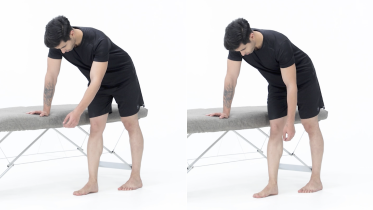 Pendulum exercise for the shoulder
Stop signs and precautions for the pendulum exercise for the shoulder
Before you start
- The pendulum is common for frozen shoulder and in the first weeks after some shoulder operations. Do it only if your own team has said it is right for you.
- After shoulder surgery, including a rotator cuff repair, or after a shoulder fracture or dislocation, follow your surgeon's or physio's plan, and do only the movements and range they have cleared. Many plans allow only passive movement at first, where the arm is moved for you and its muscles stay relaxed.
- After a repair of the biceps tendon at the elbow, or another repair, break or operation at the elbow or forearm, leave this one out until your surgeon or physio has cleared the elbow to straighten fully. There is no smaller version of it. The arm hangs fully straight and relaxed, so the elbow goes to its full straight position under the weight of the arm and the hand, which puts a tendon repaired at the elbow in its longest position with nothing of yours holding it back. If your team has set a limit on how far the elbow may straighten, or you are wearing a sling, brace, cast or splint after an operation or a break at the elbow or forearm, this exercise is not yet for you, and taking the arm out of it, or changing a brace setting to let the arm hang, is not the way round that limit. Teams differ on when full straightening is allowed after these operations, so the go-ahead comes from yours.
When to stop and get help
- Shoulder pain gets sharper or keeps building while you swing.
- You feel dizzy when leaning forward. Stand up slowly and sit down. If you faint while exercising, call emergency services, even if you feel fine again quickly.
- Your arm or hand goes numb, tingles or gets pins and needles.
- Pins and needles in your arm or hand that do not go away after you stop, or part of your arm or hand goes numb. Get medical advice the same day. If one side of your face or body suddenly goes numb or weak, or your speech becomes slurred or muddled, call emergency services, even if it goes away.
- A sudden pop or tearing feeling in the shoulder that brings sharp pain, new weakness or trouble lifting the arm. Stop and contact your surgical team the same day, or get medical advice the same day if you have not had surgery.
- The shoulder feels as if it has slipped out of place, looks a different shape or suddenly locks so you cannot move the arm, or your hand turns cold, pale or blue. Go to an emergency department straight away, without driving yourself, and do not try to put the shoulder back in yourself.
 Isometric shoulder abduction
Stop signs and precautions for the isometric shoulder abduction
Before you start
- After shoulder surgery, including a rotator cuff repair, or after a shoulder fracture or dislocation, follow your surgeon's or physio's plan, and do only the movements and range they have cleared. Many plans allow only passive movement at first, where the arm is moved for you and its muscles stay relaxed. This press loads the tendon on top of the shoulder (supraspinatus), which is the one most often repaired in rotator cuff surgery, so after a cuff repair it is usually held off for several weeks, until your surgeon and physio say you can start.
- If you have high blood pressure, keep breathing steadily through every hold.
When to stop and get help
- You feel a sharp pain or a catch at the top of the shoulder as you press.
- Pain or tingling spreads down the arm.
- Pins and needles in your arm or hand that do not go away after you stop, or part of your arm or hand goes numb. Get medical advice the same day. If one side of your face or body suddenly goes numb or weak, or your speech becomes slurred or muddled, call emergency services, even if it goes away.
- The shoulder aches more after the holds and is still sore a few minutes later.
- A sudden pop or tearing feeling in the shoulder that brings sharp pain, new weakness or trouble lifting the arm. Stop and contact your surgical team the same day, or get medical advice the same day if you have not had surgery.
- The shoulder feels as if it has slipped out of place, looks a different shape or suddenly locks so you cannot move the arm, or your hand turns cold, pale or blue. Go to an emergency department straight away, without driving yourself, and do not try to put the shoulder back in yourself.
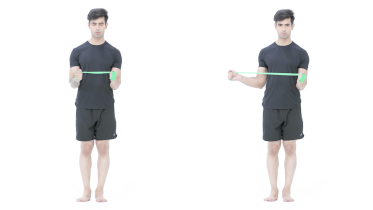 Shoulder external rotation with band
Stop signs and precautions for the shoulder external rotation with band
Before you start
- After shoulder surgery, including a rotator cuff repair, or after a shoulder fracture or dislocation, follow your surgeon's or physio's plan, and do only the movements and range they have cleared. Many plans allow only passive movement at first, where the arm is moved for you and its muscles stay relaxed. Resisted rotation usually starts later, and the range may be limited at first, so check with your physio before adding a band.
When to stop and get help
- You feel a sharp pain or a catch in the shoulder as the forearm turns out.
- Pain or tingling spreads down the arm.
- Pins and needles in your arm or hand that do not go away after you stop, or part of your arm or hand goes numb. Get medical advice the same day. If one side of your face or body suddenly goes numb or weak, or your speech becomes slurred or muddled, call emergency services, even if it goes away.
- A sudden pop or tearing feeling in the shoulder that brings sharp pain, new weakness or trouble lifting the arm. Stop and contact your surgical team the same day, or get medical advice the same day if you have not had surgery.
- The shoulder feels as if it has slipped out of place, looks a different shape or suddenly locks so you cannot move the arm, or your hand turns cold, pale or blue. Go to an emergency department straight away, without driving yourself, and do not try to put the shoulder back in yourself.
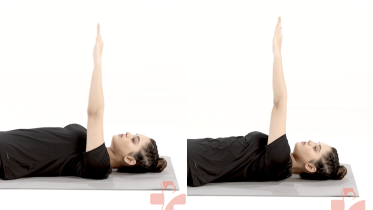 Serratus punch
Stop signs and precautions for the serratus punch
Before you start
- If your shoulder has dislocated before or feels loose, check with your physio before you start and ask how far to reach. After shoulder surgery, including a rotator cuff repair, or after a shoulder fracture or dislocation, follow your surgeon's or physio's plan, and do only the movements and range they have cleared. Many plans allow only passive movement at first, where the arm is moved for you and its muscles stay relaxed.
When to stop and get help
- You feel a sharp pain or a catch at the front or top of the shoulder.
- The shoulder feels unstable, as if it might slip out.
- Pain or tingling spreads down the arm.
- Pins and needles in your arm or hand that do not go away after you stop, or part of your arm or hand goes numb. Get medical advice the same day. If one side of your face or body suddenly goes numb or weak, or your speech becomes slurred or muddled, call emergency services, even if it goes away.
- A sudden pop or tearing feeling in the shoulder that brings sharp pain, new weakness or trouble lifting the arm. Stop and contact your surgical team the same day, or get medical advice the same day if you have not had surgery.
- The shoulder feels as if it has slipped out of place, looks a different shape or suddenly locks so you cannot move the arm, or your hand turns cold, pale or blue. Go to an emergency department straight away, without driving yourself, and do not try to put the shoulder back in yourself.
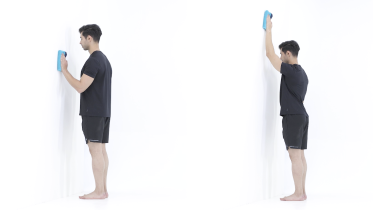 Wall slides with a towel
Stop signs and precautions for the wall slides with a towel
Before you start
- After shoulder surgery, including a rotator cuff repair, or after a shoulder fracture or dislocation, follow your surgeon's or physio's plan, and do only the movements and range they have cleared. Many plans allow only passive movement at first, where the arm is moved for you and its muscles stay relaxed.
- If you have had a shoulder replacement, rest your hand on the wall and let it slide, without pushing into it, since the arm should not take your weight yet, and keep to the range your own team has set. Many plans keep weight off the arm for the first months after a replacement, and the moment you lean into the wall the arm is taking load it is not ready for.
When to stop and get help
- Something catches in the shoulder, or you get a sharp pain, as the arm goes up.
- Your arm starts to tingle, or pain spreads down it.
- Pins and needles in your arm or hand that do not go away after you stop, or part of your arm or hand goes numb. Get medical advice the same day. If one side of your face or body suddenly goes numb or weak, or your speech becomes slurred or muddled, call emergency services, even if it goes away.
- A sudden pop or tearing feeling in the shoulder that brings sharp pain, new weakness or trouble lifting the arm. Stop and contact your surgical team the same day, or get medical advice the same day if you have not had surgery.
- The shoulder feels as if it has slipped out of place, looks a different shape or suddenly locks so you cannot move the arm, or your hand turns cold, pale or blue. Go to an emergency department straight away, without driving yourself, and do not try to put the shoulder back in yourself.
If what brought you here was the general question about noisy joints rather than this shoulder, cracking joints covers the whole body, and knee clicking and cracking covers the knee, which is where most of the research on joint noise happens to have been done.
When to see a physio (physical therapist)
Book an assessment if the noise has arrived with pain, with less movement, with weakness, or with a sense that the shoulder might let you down, and book one if it has worried you enough that you have been avoiding things you would otherwise do. That last reason stands on its own. The NHS line for a doctor's appointment is set out further up this page, and 2 weeks without improvement is the part most people wait past.
An examination settles more than any description can. A physio compares how far the arm goes when you lift it with how far it goes when they lift it, tests turning in and turning out against resistance, watches whether the shoulder blade does its share, checks whether the joint feels loose at the end of its range, and checks your neck, because a neck refers pain into a shoulder convincingly. The noise itself takes up about ten seconds of that appointment.
Go the same day rather than booking if the arm has been weak since an injury, if you suddenly cannot lift it, or if the shoulder is hot, red and swollen. If the pain started with a fall or a pull, lead with that: the British Elbow and Shoulder Society and British Orthopaedic Association pathway for subacromial shoulder pain advises urgent referral for a rotator cuff tear caused by an injury (Kulkarni and colleagues, 2015), which is why that story is handled faster than the same weakness arriving slowly. Shoulder pain by body area lists the other shoulder pages here, and every warning sign below carries its own timing.
Related exercise programs
Warning signs
Get emergency help now
- Emergency: chest pain or tightness, which may spread to your arm, neck or jaw, or shoulder or arm pain that comes with shortness of breath, sweating or feeling sick. This can be a heart attack. Call emergency services straight away.
- Emergency: the shoulder feels as if it has slipped out of place, looks a different shape or suddenly locks so you cannot move the arm, or the pain is severe after a fall or an injury. Go to an emergency department straight away, without driving yourself, and do not try to put the shoulder back in yourself.
- Emergency: the shoulder has come out of the joint and gone back in by itself, whether it is the first time or it has happened before. People describe that as the shoulder popping out and going back, jumping out and clunking back in, or slipping right out and then back, and a shoulder that goes back in by itself has still been dislocated. Go to an emergency department straight away, without driving yourself, even if it feels settled and you can move the arm. A shoulder that has been out needs X-rays in two directions, to show the joint is properly back in place and to look for a broken bone, and a check of the nerves and the circulation in the arm. Feeling settled is not the same as being back in place, and that check does not wait for an appointment.
- Emergency: your arm, hand or fingers turn cold, pale, blue or gray compared with the other side. Call emergency services or go to an emergency department straight away, and do not drive yourself. The blood supply to the arm may be blocked.
Get help today
- Same day: sudden, very bad shoulder pain, or you suddenly cannot lift or move your arm at all. Get medical help the same day.
- Same day: severe pain in both shoulders that has come on recently. Get medical advice the same day.
- Same day: a sudden pop or tearing feeling in the shoulder that brings sharp pain, new weakness or trouble lifting the arm. Stop and contact your surgical team the same day, or get medical advice the same day if you have not had surgery.
- Same day: the pain started after a fall, a pull or another injury, especially if the arm has been weak since, for example you cannot lift it out to the side or hold it up. This can be a broken bone or a torn tendon. Get medical advice the same day, and say how it happened and that the arm has been weak since, because UK shoulder surgeons advise urgent referral for a rotator cuff tear caused by an injury.
- Same day: the shoulder is hot, red and swollen, or you have a fever or feel unwell. This can be a joint infection, which needs treatment quickly. Go to an emergency department the same day, and call emergency services if you feel very unwell.
- Same day: you have had a shoulder replacement or other shoulder surgery, and the pain keeps building week after week, or it settled and has come back and is getting worse, or the shoulder is getting stiffer, or it has started to feel loose, even with no fever, no redness and nothing to see. An infection around a replaced shoulder is often caused by a germ that lives in the skin, and it can show itself as pain, stiffness or a loose joint alone, with normal blood tests (Fink and Sevelda, 2017). Contact your surgical team the same day and ask to be checked, rather than waiting for a fever that may never come. The check is a sample of fluid or tissue taken from the joint, and the laboratory has to hold it for 2 to 3 weeks because this germ grows slowly, which is why asking early matters.
- Same day: you are over 50 and have aching and stiffness in both shoulders, often in the neck or hips too, that is worst in the morning and lasts more than 45 minutes after you get up. This can be an inflammatory condition (polymyalgia rheumatica) rather than a local shoulder problem. If you also get a new headache, pain or tenderness at your temples or on your scalp, or jaw pain when you eat or talk, get medical advice the same day, and if your vision changes, call emergency services. Even without those extra signs, see your doctor within a few days about the aching and stiffness.
- Same day: pins and needles or numbness in the arm that does not go away, no feeling in part of the arm, or weakness that is getting worse. Get medical advice the same day. For pain spreading down the arm from your neck, ask for an urgent appointment with your doctor. If one side of your face or body suddenly goes numb or weak, or your speech becomes slurred or muddled, call emergency services, even if it goes away.
- Same day: pain at night or at rest that is constant, that no rest or change of position eases at all, and that keeps getting worse. If you are being treated for cancer now, contact your cancer team the same day.
Book an appointment
- Within a day or two: new shoulder pain and you have had cancer, now or in the past, or you are losing weight without trying. See your doctor within a day or two and mention it.
- Within a day or two: pain at night or at rest that is constant, that no rest or change of position eases at all, and that keeps getting worse. If you have had cancer, now or in the past, or are losing weight without trying, see your doctor sooner, within a day or two, and mention it. This applies even if the pain is not getting worse.
- Within a few days: the shoulder clicks or catches painfully, or the noise has arrived alongside pain, less movement than you had before, or a shoulder that does less than it did. Book an assessment with a physio or doctor in the next few days, and see your doctor if the pain is getting worse or has not improved after 2 weeks, which is what the NHS advises. If the arm has been weak since an injury, or the weakness is getting worse, that is a same day matter and it has its own line above, and so is a click that hurts in a shoulder that has been replaced, repaired or operated on.
- Within a few days: the shoulder keeps giving way, feels loose, or feels as if it slips in and out of the joint, without ever coming fully out. Book an assessment with a physio or doctor rather than waiting for it to happen again, say whether it has ever come fully out, and ask which positions to leave alone until it has been checked. If the shoulder is out of place now, locked, or a different shape, that is an emergency and it has its own line above, and so is a shoulder that has come out and gone back in by itself, the first time as much as the fifth.
- Within a few days: night pain is common with shoulder problems, but get checked within a few days if the pain is constant, no rest or change of position eases it at all, and it keeps getting worse.
Common questions
What causes shoulder clicking?
Sliding tissue, in one of four places: tendons crossing the front of the joint, the shoulder blade gliding on the rib cage behind, the small joint on top where the collarbone meets the shoulder blade, or the ball and socket itself. Which one is making your noise cannot be worked out from the sound, and that is not a limit of your description. It is a limit of the method, because the words patients use for shoulder noise do not map onto structures. The useful question is not where the click comes from but what travels with it: pain, weakness, less movement, a loose feeling, or tingling down the arm. A click with none of those is the common version and needs nothing done about it.
Why does my shoulder click when I raise my arm?
Raising the arm is the movement that asks the most of the shoulder, so it is where a click most often shows up. The space under the bony roof narrows as the arm goes up, the shoulder blade has to rotate and tilt out of the way, and tendons slide across bone through the whole arc, so there is plenty for a noise to come from. If the lift is painless and the arm is as strong and goes as far as the other one, the noise is not telling you anything you need to act on. If the same lift hurts, or stops short, the pain and the restriction are what get assessed, and our page on shoulder pain when lifting your arm works through where in the arc it catches you. An arm you cannot lift at all is a different matter from one that is painful to lift, and it is on the same day list in the warning signs on this page.
Why does my shoulder click when I rotate it?
Turning the arm in and out moves the cuff tendons, and the biceps tendon at the front, across bone in a small arc, which is a good recipe for a repeatable click at one particular point in the turn. People notice it most reaching into a back pocket, fastening a bra strap or putting on a coat. A noise at the same point every time, with no pain, is the ordinary version of this and gets no treatment. What to report is a turn that catches instead of clicking, a turn that has become painful, or a shoulder that feels as if it is about to slip as you turn it out with the elbow away from your side. That last one is a stability question, not a noise question, and it belongs in the section on this page about a shoulder that feels as if it will come out.
My shoulder clicks during a shoulder press. Should I stop?
Not for the noise alone. Changing the lift changes which tissues are loaded and when, so the same shoulder can be noisy overhead and silent on a bench, and a click that appears when you add weight is still a click. Three things decide whether to carry on: whether the lift hurts, whether the arm is weaker than it was, and how the shoulder feels the next morning. If all three are fine, the lift is fine, noise included. If the press hurts, drop the load and work in the range that does not hurt rather than training through it, and read shoulder pain on the bench press if that is the lift giving you trouble.
How do you fix a clicking shoulder?
You usually do not, and that is the honest answer, not an evasion. Nothing we could verify shows that a click can be trained, stretched or taped out of a shoulder, and no technique fix for a named lift is supported by anything this page could read. What can be fixed is whatever the noise came with. A painful, weak or restricted shoulder responds to a graded program for the cuff and the shoulder blade muscles, which is what the exercises on this page are, and an unstable shoulder is a different plan again. Judge progress by what the arm will do and by how the shoulder feels the next morning, because a shoulder often gets stronger and far more comfortable while making exactly the same sound.
Why does my shoulder click after a dislocation?
A shoulder that has been dislocated is the one situation where a new noise deserves more attention, not because the sound is dangerous but because the question underneath it is whether the joint is stable. OrthoInfo's list for long-standing shoulder instability names repeated dislocations, repeated instances of the shoulder giving out, and a persistent feeling that the shoulder is loose or slipping in and out of the joint. Noise is not on that list and looseness is, which tells you which of the two to report. Get it assessed rather than tested at home, and if the shoulder is out of place, locked or a different shape, that is the emergency line in the warning signs on this page. So is a shoulder that has come out and gone back in by itself, the first time as much as a repeat, even if it feels settled: it still came out, and it is checked with X-rays in two directions, to show the joint is properly back in place and to look for a broken bone, and by examining the nerves and the circulation in the arm, before anything else. Our shoulder dislocation program covers what follows one.
References
- NHS. Shoulder pain. Page last reviewed 22 May 2023. https://www.nhs.uk/symptoms/shoulder-pain/
- NHS. Dislocated shoulder. Page last reviewed 16 September 2026. https://www.nhs.uk/conditions/dislocated-shoulder/
- NHS. Heart attack. Page last reviewed 31 March 2026. https://www.nhs.uk/conditions/heart-attack/
- American Academy of Orthopaedic Surgeons. Chronic shoulder instability and dislocation. OrthoInfo. https://www.orthoinfo.org/en/diseases--conditions/chronic-shoulder-instability/
- American Academy of Orthopaedic Surgeons. Shoulder joint tear (glenoid labrum tear). OrthoInfo. https://www.orthoinfo.org/en/diseases--conditions/shoulder-joint-tear-glenoid-labrum-tear/
- Kulkarni R, Gibson J, Brownson P, Thomas M, Rangan A, Carr AJ, Rees JL. Subacromial shoulder pain. BESS/BOA Patient Care Pathways. Shoulder and Elbow. 2015;7(2):135-143. https://doi.org/10.1177/1758573215576456
- Brownson P, Donaldson O, Fox M, Rees JL, Rangan A, Jaggi A, Tytherleigh-Strong G, McBernie J, Thomas M, Kulkarni R. BESS/BOA Patient Care Pathways: Traumatic anterior shoulder instability. Shoulder and Elbow. 2015;7(3):214-226. https://doi.org/10.1177/1758573215585656
- Fink B, Sevelda F. Periprosthetic joint infection of shoulder arthroplasties: diagnostic and treatment options. BioMed Research International. 2017;2017:4582756. https://doi.org/10.1155/2017/4582756
Written and checked by the PocketPhysio editorial team. Last updated 2026-11-03.
This page is general education, not a diagnosis or a personal treatment plan. See a physiotherapist or doctor for advice about your own situation.