
Shoulder arthritis (shoulder osteoarthritis) exercises and physiotherapy
Warning signs, and when to get help
What is shoulder arthritis?
Shoulder arthritis is wear and damage to the cartilage in one of the two joints at the shoulder, and which one it is changes almost everything about the page you need. OrthoInfo describes the acromioclavicular joint as the one on the top of the shoulder, where the collarbone meets the tip of the shoulder blade, and the glenohumeral joint as the one where the head of the arm bone sits in the socket of the shoulder blade. This page is about the ball and socket joint, which is what people usually mean by shoulder arthritis and what clinicians call glenohumeral osteoarthritis. If your pain sits on the bony bump at the top, AC joint sprain covers that joint instead.
OrthoInfo names five kinds that turn up here. Osteoarthritis, the wear-and-tear type, which it says usually affects people over 50. Rheumatoid arthritis, which attacks joints throughout the body and is covered on our rheumatoid arthritis page. Post-traumatic arthritis, a form of osteoarthritis that develops after an injury such as a fracture or a dislocation.
Two more complete the list. Arthritis can also develop after a large, long-standing rotator cuff tear, which OrthoInfo calls rotator cuff tear arthropathy. And avascular necrosis is where the blood supply to the head of the arm bone is disrupted.
That last pair is why a torn cuff keeps coming up on this page. A cuff that has been torn for years lets the ball ride upward against the socket, and the joint wears from there, which also decides which operation a surgeon would offer. If you have been told you have a tear as well, rotator cuff tear exercises sets out that decision, and rotator cuff tendinopathy covers a painful cuff with no tear.
One combination needs saying plainly, because no exercise program answers it. OrthoInfo says a large, long-standing cuff tear together with advanced arthritis can bring severe pain and weakness, and that someone in that position may not be able to lift the arm away from the side at all. It also names severe shoulder pain with difficulty lifting the arm away from the side or over the head among the reasons a surgeon would consider a reverse replacement. If that is where your shoulder is, the question in front of you is a surgical one rather than a rehab one, and the next step worth taking is an assessment by a shoulder surgeon. Working the elbow, the hand and the rest of the arm, and holding on to the movement you have, still earns its place while you wait, but nothing on this page gives back an arm that a cuff beyond repair can no longer lift.
On the program below, that means working through stages 1 and 2, where your good arm or the wall shares the work instead of the cuff lifting the arm on its own, and leaving the side lying turn in stage 3 out until somebody has examined the shoulder. The band turns at your side are usually manageable, because turning the arm is a different job from lifting it, but ask whoever examines you about those as well.
Arthritis in the shoulder and neck is one of the commonest things people search for here, and it usually means two separate problems that happen to sit close together. Wear in the neck joints (cervical spondylosis) gives neck and shoulder pain or stiffness that comes and goes, and the NHS treats pins and needles in an arm, alongside pain in the neck or arm, as a reason to ask for an urgent appointment. Pain coming from the shoulder joint itself does not usually run below the elbow and does not tingle. Our neck pain page covers the neck side, and if the pain spreads down the arm with numbness, cervical radiculopathy is the one to read.
Where is shoulder arthritis pain felt, and what else does it do?
Pain is the most common symptom, and the place it sits tells you which joint is involved. OrthoInfo puts glenohumeral pain in the side or back of the shoulder and acromioclavicular pain on the top of it. Night pain is common and sleeping may be difficult. A grinding, clicking or snapping sound as the shoulder moves (crepitus) is also on its list, and on its own it is not a sign of damage.
What people describe in clinic is narrower than any symptom list. Reaching behind to a seatbelt or a back pocket goes first. Then comes anything overhead, then anything held away from the body, and by the time somebody books an appointment they are usually dressing one-handed in a particular order without having planned it. The APTA guideline reports the same shape from the research: arm function is affected, with overhead activities and external rotation the most affected, along with social and work tasks that use the arm (Michener and colleagues, 2023).
The stiffness is the part most exercise pages skim over, and it is measurable. The guideline's diagnostic picture includes shoulder pain lasting more than 3 months and a global reduction in range of motion, with the greatest loss in passive external rotation with the arm at the side (Michener and colleagues, 2023). That is the movement you use to turn a key, hold a phone to your ear or get your arm into a coat sleeve, and it is why the three stick exercises in stage 2 carry more of this program than the strengthening does.
Do shoulder arthritis exercises work?
Exercise is the standard first treatment and the evidence for it in this particular joint is thin. Both halves of that sentence are true, and the pages that give you only the first half are not doing you a favor.
The APTA published a clinical practice guideline on physical therapist management of glenohumeral joint osteoarthritis in 2023, and it is the most careful look anyone has taken at the question. Its statement about people who have not had a replacement is that physical therapist services may benefit them, graded as best practice with insufficient evidence quality, which is the guideline's lowest rung. Its statement about what kind of treatment to choose is blunter still: no one specific intervention performed by a physical therapist is superior to another for these patients, and no literature exists comparing physical therapist interventions in them (Michener and colleagues, 2023). For contrast, the only treatment recommendation in that guideline rated strong on high-quality evidence is about rehab after a replacement, where a sling and progressive exercises for range and strength are advised.
So why do it. Because it is low risk, because it is what the specialist bodies advise, and because the thing it works on is the thing that limits people. Arthritis Society Canada says regular exercise of the shoulder muscles can help reduce pain and improve range of motion and function, and OrthoInfo lists physical therapy exercises that may improve the range of motion, strength and function of the shoulder among the first treatments. Neither of those claims rests on the kind of trial evidence that exists at the knee. Expect a modest gain, judge it on what your arm can reach in 6 to 12 weeks, and keep the other options in view.
The guideline's grades read worse than they are, and the difference matters before you decide. Both of the guideline's statements about people who have not had a replacement are made, in its own words, in the absence of high or moderate quality evidence, and on comparing one treatment with another it says no literature exists at all (Michener and colleagues, 2023). So nobody has tested shoulder exercise properly in this joint and found it wanting. It has not been tested, which is a different thing, and it is the reason the useful test is your own shoulder over 6 to 12 weeks rather than a figure from a trial.
NICE belongs beside the APTA grades, because it reaches a firmer conclusion from a wider base. Its osteoarthritis guideline covers the condition at any joint, and it names the shoulder directly when it gets to joint replacement. Its first recommendation on treatment is to offer therapeutic exercise, tailored to the person, to everyone with osteoarthritis (NG226, recommendation 1.3.1). It also asks clinicians to say out loud that joint pain may increase when you start, that doing the exercise regularly anyway is still good for the joint, and that sticking with it over the long term is what increases the benefit (NG226, recommendation 1.3.3). That is the honest shape of the advice. A positive recommendation across the condition, with no shoulder-specific trials underneath it.
One study cuts against the comfortable version, and it is the most honest thing in this literature. A US claims database study of 2,710,463 adults aged 55 and over diagnosed with glenohumeral osteoarthritis between 2010 and 2021 asked whether adding physical therapy to non-surgical care delayed a shoulder replacement. It did not. In the group that had no steroid injection, a replacement had been done by 5 years in 0.78% of those who had physical therapy and 0.37% of those who did not, and the authors concluded that preoperative physical therapy is not associated with a decreased probability of requiring a replacement (Hoveidaei and colleagues, 2024).
Read that with the authors' own warnings attached. It is retrospective, built from billing codes, and it measured no pain, function or severity at all, which is why they say the results offer a narrow perspective. The people sent for physical therapy were almost certainly the ones with worse shoulders, so the figures cannot be turned round to mean that physical therapy sends people to surgery.
Keep one set of numbers from it, though. In every group the study compared, with an injection or without one and with physical therapy or without it, the 5 year replacement rate fell between 0.37% and 1.13%, so roughly 1 person in 100 or fewer. Whatever else this condition does, it does not usually end in an operation.
How to use this program
Read the warning signs at the end of this page before your first session. After shoulder surgery, including a rotator cuff repair, or after a shoulder fracture or dislocation, follow your surgeon's or physio's plan, and do only the movements and range they have cleared. Many plans allow only passive movement at first, where the arm is moved for you and its muscles stay relaxed.
Pick the stage that matches your shoulder this week, and start at stage 1 if you are not sure. Move up when the current stage feels easy and the shoulder settles well afterward. Each exercise page gives a typical starting dose, and as a rough guide the movement work suits most days while the band work does better on 2 to 3 days a week with a day in between. Your physio will adjust the exercises and the numbers to suit you.
Where a dose gives a range of sessions a day, start at the bottom of it. Add a second or third round only once the shoulder is no more sore the next morning, because more sessions is not the same as faster progress in a joint like this one. Going back down a stage is part of the program rather than a failure: if the shoulder turns irritable again, use the stage 1 exercises for a few days and then pick up where you left off.
Most of the equipment can be improvised. A broom handle, a walking stick or a length of dowel all work as the stick, and wall slides need nothing but a clear stretch of wall and a small towel for the hand to slide on. The outward band turn holds both ends of the band in your own hands, so it needs no anchor, while the inward turn and the row need the band fixed to something solid at about waist height, which a door handle does. An over-door pulley is the one piece you may not have, and without one the shoulder flexion with a stick and lying shoulder flexion with a stick exercises take the arm in the same direction with your good arm doing the same job.
A little discomfort is common and is usually fine if it settles by the next morning and is not building up from week to week. Sharp pain, or a shoulder that is clearly worse the next day, means the load was too much for now. The fix is almost always a smaller dose rather than a dropped exercise: fewer repetitions, a lighter band, less range. Our pain monitoring model sets out the 24-hour rule in more detail.
Check with your doctor before you start if you have a heart or lung condition, or blood pressure that is not under control. Breathe normally through every repetition rather than holding your breath, especially if you have high blood pressure. If chest pain, pressure or tightness does not ease quickly when you rest, spreads to your arm, neck, jaw, stomach or back, or comes with sweating, feeling sick, feeling light-headed or being short of breath, call emergency services straight away, as this can be a heart attack. If it eases quickly and none of these happen, get medical advice the same day, and do not exercise again until you have been checked. If you have fallen recently or feel unsteady, do the standing exercises next to a kitchen counter.
Falls deserve more attention than people give them after a shoulder replacement. Of 198 people followed after a shoulder replacement at one hospital, 21 of them, about 1 in 10, had a fall in the 90 days after they went home, and one of those falls broke the bone around the implant (Sridharan and colleagues, 2020). If you have had a replacement, work beside a counter whatever your balance is normally like, clear the floor where you exercise, and tell your surgical team about any fall onto that arm even if it feels all right afterward.
If this shoulder has been replaced, your own protocol comes first, exactly as it does after any other operation, and the movement it affects most in this program is turning the arm outward. To reach the joint in an anatomic replacement the surgeon takes down a tendon at the front of the shoulder (the subscapularis) and repairs it on the way out, and turning the arm outward stretches that repair while it heals. The APTA guideline says a limit of 30 degrees on turning outward should be considered during the early healing stage for exactly that reason, and reports that a repair that fails to heal leaves more pain, a less stable shoulder and a weaker inward turn (Michener and colleagues, 2023). The stick exercise for turning outward in stage 2 is written to push that range, so it is not a stage 2 exercise for a recently replaced shoulder. Shoulder replacement rehab has the small, assisted version meant for that stage, and your own protocol sets the limit either way.
Other parts of the program are an early-weeks problem after any replacement, and the reason this time is position and load rather than the repair. After an anatomic replacement, OrthoInfo sets out three limits. For the first 6 weeks, do not take the arm into what it calls an extreme position, meaning straight out to the side, or back behind your body. Do not push yourself up out of a chair or a bed with that arm. And lift nothing heavier than a glass of water for the first 2 to 6 weeks. After a reverse replacement it gives the same advice about position and sets the limit at 5 lb (about 2 kg), or whatever weight your surgeon sets, for the first 6 weeks. Those are general instructions and your own team's are the ones that count: they may run longer, and reaching the end of any of these periods is not clearance on its own, so ask before you add load or range. OrthoInfo has one more warning that belongs beside them, because it catches the people who are doing well: if the shoulder was severely painful before the operation, moving it without pain can lull you into doing more than you were told, and early overuse can leave the shoulder badly limited.
What that rules out of this program in the early weeks after either operation is specific, and for a shoulder that has not been operated on it rules out nothing. The sideways stick lift in stage 2 takes the arm straight out to the side, and the band and side lying work in stage 3 puts load on the arm, so neither of those belongs in the early weeks whichever operation you had. The wall slide stays in, with the hand resting on the wall rather than pressing into it, since the arm should not be taking load yet. If you are not sure where you are up to, stay with stage 1 and ask your team before you go further.
The warning list at the end of the page is long, and part of it is not about every reader. Seven of its 23 signs are there for a shoulder that has been operated on, and each of those names the operation, the new joint or your surgical team, so you can tell which ones apply to you. The rest apply whether or not you have had surgery, and two of them matter more than the others while you work through this program. A shoulder that feels as if it has slipped out of place, looks a different shape or suddenly locks is emergency care. An arm that has lost lift since a fall, a jolt or a sudden pull needs advice the same day even if it is not especially painful, because weakness after an event is a different problem from a stiff, aching joint.
The exercise program
Stage 1: Settle it and keep it moving
Before your first session, read the warning signs at the end of the page, and if this shoulder has been operated on, read the paragraphs on surgery and on a replacement in How to use this program above, because parts of stage 2 and stage 3 are held back in the early weeks. This stage is for a shoulder that hurts at rest, wakes you at night, or is too irritable to lift. Nothing here asks the arm to raise its own weight: the pendulum lets the joint move while the arm hangs loose, the pulley lets your good arm do the lifting, and the two gentle holds work the muscles that turn the arm outward and take it out to the side while the shoulder itself stays still. The cross body stretch is for the back of the shoulder and is done lightly rather than pushed, because a joint blocked by bony change will not stretch out and forcing it leaves it sore. The exercise pages give typical starting doses of 30 to 60 seconds in each direction for the pendulum, a few times a day, 10 to 15 slow pulls once to 3 times a day on the pulley, 5 to 10 holds of 5 to 10 seconds for each of the gentle presses, once or twice a day, and a 20 to 30 second stretch hold, 2 to 3 times on each side, once or twice a day. Your physio will adjust this, and little and often beats one long session with a stiff shoulder.
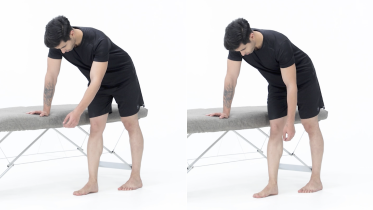 Pendulum exercise for the shoulder
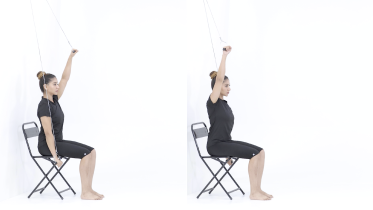 Shoulder pulley flexion
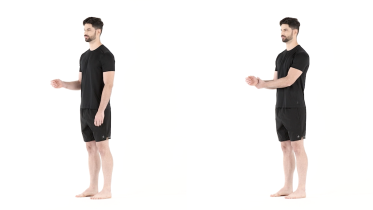 Isometric shoulder external rotation
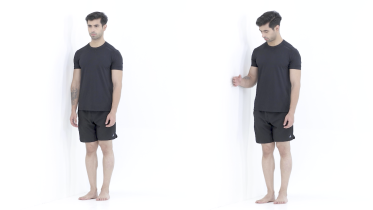 Isometric shoulder abduction
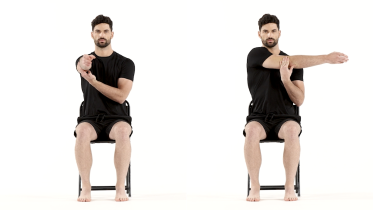 Cross body shoulder stretch
Stage 2: Get the range back
When stage 1 feels easy and the shoulder settles well afterward, often after 2 to 4 weeks. If you have had a shoulder replacement, two of these five are held back in the early weeks, the outward turn with the stick and the sideways stick lift, so read the replacement paragraphs in How to use this program above first and keep to the range your own team has set. A third needs changing rather than dropping: in the wall slide, rest the hand on the wall and let it slide without pushing into it, because the arm should not be taking load until your team has cleared it. This is the part of the program that earns its place, because the movement this joint loses first is turning the arm outward with the elbow at your side, and the three stick exercises are how you reach it with your good arm sharing the work. Wall slides rebuild reaching upward with the wall carrying part of the arm, and if there is a painful spot partway up, stop just below it for now. Seated thoracic extension is in here because a stiff upper back quietly takes movement away from the shoulder, which makes the last few inches of any reach harder than they need to be. Typical doses are 10 to 15 slow lifts, 1 to 3 times a day, for the forward and the sideways stick, 3 to 5 holds of 15 to 30 seconds for the outward turn, once or twice a day, 10 to 15 slides once or twice a day, and 5 to 10 slow repetitions of the thoracic extension, once or several times a day in breaks from sitting. Your physio will adjust this.
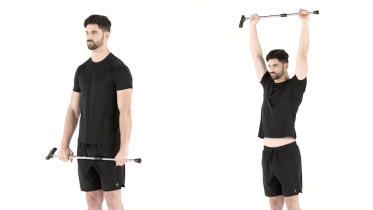 Shoulder flexion with a stick
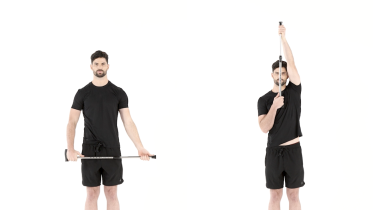 Shoulder abduction with a stick
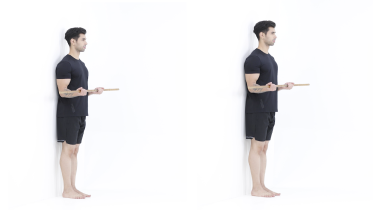 Shoulder external rotation with a stick
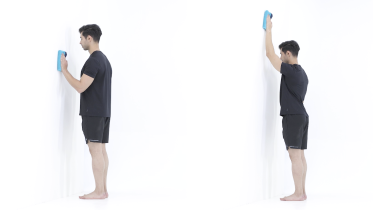 Wall slides with a towel
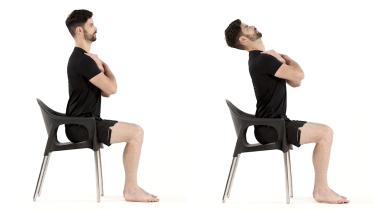 Seated thoracic extension
Stage 3: Strength for everyday reaching
When stage 2 feels easy, the shoulder is no worse the next morning, and reaching to chest height is no longer a problem. Keep the stage 2 movement work going and add these to it. Two checks come first. The side lying turn is the only exercise here that asks the cuff to lift the weight of the arm against gravity, so if you have been told you have a large or long-standing rotator cuff tear, or cuff tear arthropathy, have it looked at before you add it. Most people have never been told what their cuff looks like, so do this check first, and do it sitting or standing rather than trying to watch a shoulder you are lying on. Bring the sore arm out to the side with your good arm, to about shoulder height or as high as it goes comfortably, let go, and see whether you can hold it there for a few seconds, catching it with the good arm as it comes down. An arm that drops as soon as you let go is not holding its own weight yet, so leave the side lying turn out and get the shoulder examined. An arm that will not reach shoulder height even with help is stiff rather than weak, which says nothing about the cuff, and the range of motion work in stages 1 and 2 is where the gain is. Once you do start the exercise, the shrug is the sign to go by, and on your side you feel it rather than see it: the top of the shoulder and your neck tighten and the shoulder rides toward your ear. Stop and leave it for now if that is what it takes to turn the arm up. The band turns are the gentler way in. Do the side lying turn on a bed rather than on the floor, and get down and up by sitting on the edge, lowering yourself onto your good side with your good arm and reversing that afterward, because pushing up on the sore arm is the part that catches people out. The second check is for a shoulder that has been replaced. None of the band or side lying work in this stage starts before your own team has cleared strengthening. Resisted turning inward is held back longer after an anatomic replacement, because the tendon the surgeon took down and repaired at the front of the shoulder is the one that turns the arm inward, and a reverse replacement has its own early limits, which are different ones. Protocols differ on when strengthening starts, so this page sets no date for it: ask your own team, and the shoulder replacement rehab program linked above sets out what each operation holds back and for how long. Once they have cleared it, the inward band turn at your side is one of the better ways to rebuild what that tendon does. The two band turns, outward and inward, are both done with the elbow resting at your side, and between them they train the muscles that rotate the arm and hold the ball centered in its socket, which is worth more to a worn joint than any big overhead lift. Turning inward is the movement behind reaching for a seatbelt or a back pocket, and it is the one most people have never trained. The scapular squeeze and the band row train the muscles that set the shoulder blade up for every reach you make. Typical doses are 2 to 3 sets of 10 to 15 slow repetitions for each of the two band turns, the side lying turn and the band row, with a light band where a band is used and nothing in the hand for the side lying turn, on 2 to 3 days a week with a day in between, plus 10 to 15 squeezes of about 5 seconds for the scapular squeeze, 2 to 3 times a day. Build the repetitions before you reach for a stronger band, and your physio will adjust this.
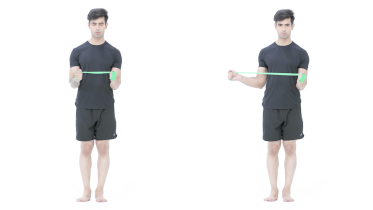 Shoulder external rotation with band
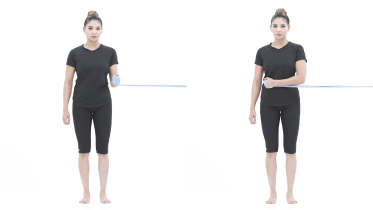 Shoulder internal rotation with band
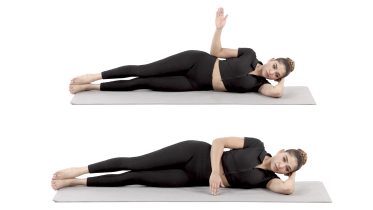 Side-lying external rotation
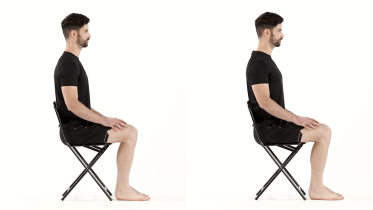 Scapular squeeze
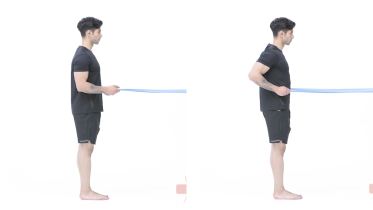 Resistance band row
Shoulder arthritis exercises to avoid
Almost nothing, if you change it rather than drop it. Arthritis Society Canada names the two activities that make shoulder arthritis worse as lifting heavy objects and raising the arms above the head, and in the same breath warns that too much reduction in physical activity can be harmful, because strength and range of motion in an affected joint have to be maintained. Both halves of that are the advice. Heavy lifting also appears in the APTA guideline as one of the occupational factors associated with this diagnosis (Michener and colleagues, 2023).
One distinction stops that advice clashing with the program above. What causes the trouble is overhead work with load, the hand holding or pushing weight above shoulder height. Taking the arm up with help and nothing in the hand, which is what the pulley, the sticks and the wall slides do, is range of motion work rather than lifting, and for a stiff joint it is the most useful part of the whole program.
Nothing in the three stages asks you to hold or press a weight above shoulder height, and nothing asks the arm to carry your body weight: there is no pushing up out of a chair, no leaning on the hand, no hands and knees. The one place the hand meets a surface is the wall slide, where the steps ask for light pressure into the towel so the hand neither sticks nor slips. That is steering rather than load, and its own page says to stand tall instead of leaning in, so that none of your weight goes through the arm. If this shoulder has been replaced, keep the hand resting on the wall without pushing into it at all until your team has cleared load through the arm.
In the gym, the ones that usually have to change are overhead pressing, upright rows, dips, bench press through full range and lateral raises taken above shoulder height. Keeping the hands below shoulder height and closer to the body fixes most of them. Rows, pulldowns to the chest, pushing movements at chest height and anything for the legs rarely need touching at all.
Everyday life is where the useful changes are. Carry a bag on the other side or across the body instead of hanging it from the sore arm. Put what you use daily between hip and shoulder height so the overhead reaching stops being a dozen times a day. Push rather than pull where you have the choice, and get the ladder work and the ceiling painting done by somebody else for now. OrthoInfo's own first line of treatment is changing how you move the arm, and it is the one that costs nothing.
What else helps with shoulder arthritis pain?
Most people end up on a combination. OrthoInfo's nonsurgical list is rest and activity change, physical therapy, anti-inflammatory medication taken with food, a corticosteroid injection, moist heat for temporary relief, and ice for 20 to 30 minutes, 2 or 3 times a day, not applied directly to the skin. It says the steroid injection can dramatically reduce the inflammation and pain, and that the effect is often temporary, which is the sentence to hold on to when one is offered. NICE puts a number on temporary. It asks clinicians to explain that an injection into the joint gives short-term relief only, of 2 to 10 weeks (NG226, recommendation 1.4.10).
A second kind of injection gets offered for worn knees, and it should not be carried across to this joint on the strength of that. OrthoInfo says joint lubricants, which are used for arthritis of the knee, have not been shown to work in an arthritic shoulder, and it does not recommend them for that joint at present. If a course of them is put to you for your shoulder, that is the sentence to ask about.
On supplements, the same page is unusually direct: there is little scientific evidence that glucosamine and chondroitin sulfate treat arthritis. They are generally safe, and that is a different claim from working. NICE goes further than little evidence. It tells clinicians not to offer glucosamine for osteoarthritis, and to say plainly that there is no strong evidence of benefit if someone asks about it (NG226, recommendations 1.4.6 and 1.4.7).
NICE is also clear about the things that get sold for a worn joint and should not be. It says not to offer TENS, therapeutic ultrasound, interferential therapy, laser, pulsed short-wave therapy or neuromuscular electrical stimulation for osteoarthritis, because there is not enough evidence that any of them help (NG226, recommendation 1.3.9). It keeps hands-on treatment to the hip and the knee, and only alongside exercise rather than in place of it, adding that there is not enough evidence for manual therapy used on its own (NG226, recommendations 1.3.6 and 1.3.7). For a joint other than the knee, which includes the shoulder, it suggests considering an anti-inflammatory gel or cream (NG226, recommendation 1.4.3).
The NHS adds what is true of osteoarthritis at every joint. There is no cure, the condition does not necessarily get any worse over time, and treatment can relieve the symptoms. It calls exercise one of the most important treatments whatever your age or level of fitness, lists painkillers from paracetamol through anti-inflammatory tablets and creams, and says steroid injections work quickly and can ease pain for several weeks or months. For sleep, which is where this condition does most of its damage to people's lives, shoulder pain at night is the practical page.
Where a shoulder replacement fits
Four replacement operations get used for a worn ball and socket joint, and the state of your rotator cuff is the main thing that decides which, with the state of the socket close behind it. OrthoInfo gives three reasons a surgeon would not put a component into the socket at all: the socket still has good cartilage, the socket bone is too thin or too weak to hold one, or the cuff tendons are torn and cannot be repaired. The cuff and the socket between them explain most of the confusion people arrive with, so take them slowly.
An anatomic total shoulder replacement replaces the arthritic joint surfaces with a highly polished metal ball and a plastic socket, and OrthoInfo says the good candidates for it are generally people with bone-on-bone osteoarthritis whose rotator cuff tendons are intact. NICE reaches that from the other side and makes it the default: where the rotator cuff is not torn and there is enough bone in the socket, a conventional total shoulder replacement is the operation to offer (NG157, recommendation 1.9.1).
The two partial replacements leave the socket alone. A stemmed hemiarthroplasty replaces the head of the arm bone with a metal ball, and OrthoInfo puts it forward when the wear is confined to that head and the socket cartilage is healthy and intact, when the socket bone is badly weakened or there is too little of it to take a component, and when there is arthritis alongside severely torn cuff tendons. A resurfacing hemiarthroplasty replaces just the surface of the head with a cap and no stem, which OrthoInfo describes as an option when the socket cartilage is intact and there is a reason to preserve bone in the arm. For osteoarthritis specifically, OrthoInfo says patients get better pain relief from a total replacement than from a hemiarthroplasty, and it adds that surgeons sometimes settle the choice between the two in the operating room, once they can see the joint.
The reverse total shoulder replacement swaps the parts round, putting the ball on the shoulder blade and the socket on the arm bone. OrthoInfo says the deltoid, not the rotator cuff, is what then powers the arm and holds it in position, and it lists a completely torn rotator cuff that cannot be repaired, cuff tear arthropathy and a previous shoulder replacement that was unsuccessful among the reasons for using it. The reason the cuff decides this is mechanical rather than a matter of preference: OrthoInfo says a socket component is not advised when the rotator cuff tendons are torn and cannot be repaired, because a conventional replacement needs those tendons to hold the ball in the socket and work the arm. One point before you picture what you are likely to be offered: OrthoInfo states that the vast majority of shoulder replacements now done in the United States are reverse replacements, so although an intact cuff makes the anatomic total the recommended operation, it is no longer the commoner one.
Arthroscopy, a keyhole clean-up, sits apart from those four and is done much earlier. OrthoInfo says cases of mild glenohumeral arthritis may be treated with it, that the pain relief is often temporary, and that it is not typically recommended for advanced arthritis. NICE is blunter and says not to offer arthroscopic washout or debridement for osteoarthritis at all (NG226, recommendation 1.7.1). If a keyhole clean-up is put to you for a worn joint, that is the recommendation to ask about.
None of this is a decision a web page can make, and the timing is not a date. OrthoInfo describes the people who benefit as those with severe shoulder pain that interferes with everyday activities, moderate to severe pain at rest, which may be bad enough to prevent sleep, loss of movement or weakness, and no substantial improvement from medication, injections and physical therapy. The rest pain is the criterion in its own right, so a shoulder that aches badly while you sit still counts even if you are still sleeping through it. The APTA guideline says surgery should be reserved for patients who fail nonoperative management (Michener and colleagues, 2023).
NICE sets out the same two tests and names this joint while doing it: consider referral for joint replacement when someone with hip, knee or shoulder osteoarthritis has symptoms that are substantially affecting their quality of life, and treatment without surgery is not working or is not suitable (NG226, recommendation 1.6.1). It adds that the decision rests on clinical assessment rather than a scoring system, and that nobody should be kept from a referral because of their age, their sex, smoking, other conditions or their weight (NG226, recommendations 1.6.2 and 1.6.3). That last one matters if you have been told you are too old or too heavy to be considered. Ask your surgeon what state your cuff is in, which design they would use and why, and what movement they expect you to get back, because the answers to those three questions differ between the designs.
There are a few things to do before an operation. Get the shoulder as strong and as mobile as it will go, which the program above does: the APTA guideline's statement that physical therapist services delivered preoperatively may benefit postoperative outcomes is graded best practice with no studies behind it, and the evidence it reasons from is hip and knee replacement, not shoulder, so treat it as sensible rather than proven. NICE looked at the same question and could not make a recommendation either way, putting preoperative rehabilitation for shoulder replacement into its list for future research instead (NG157). Two guidelines arriving separately at the same shrug is the reason for the hedge. And read the rehab before you need it, because the early limits are where people come unstuck.
Two practical ones belong with that, both from OrthoInfo. Anti-inflammatory tablets and most arthritis medications are usually stopped 2 weeks before the operation because they can cause excessive bleeding, and if you take blood thinners or a GLP-1 medication such as semaglutide or tirzepatide, those come with their own stopping instructions from the doctor who prescribed them. The other is skin: tell your team about any cut, scratch, graze, rash or bite on the arm being operated on, because a break in the skin lets bacteria in and an operation gets cancelled over one. Ask your own team for the dates and the list, because this is one of the places a general page cannot be specific enough to be safe.
We do not stage that recovery here. Shoulder replacement rehab has the stages, the sling times, the lifting limits, the positions to keep away from and the full warning list for the operation itself, including the blood clot, wound and nerve block routes. Your own team's protocol overrides both pages.
On how long an implant lasts, OrthoInfo gives no figure, and nor will you find a trustworthy single number, because survival differs by design and by why the operation was done. What it does say is that the prosthesis may wear down and the components may loosen from the bone, and that excessive wear, loosening or dislocation may require more surgery. Ask for the figures your surgeon's own unit gets with the design they are offering you. NICE puts that conversation on the surgical team rather than on you to chase: the discussion before a replacement should cover the benefits and risks of the procedures and implant types available, including the possibility of needing more surgery later (NG157, recommendation 1.1.2).
The infection warnings on a replaced shoulder deserve their own paragraph, because they are not the ones people expect. OrthoInfo's page on infection after a joint replacement says the symptoms vary widely, that sometimes there are no symptoms at all, that an infection can appear a few months or even years after the operation, and that fever is no longer considered a sign of an infection after a joint replacement. Its own advice is to watch for redness at the incision site, joint swelling and persistent pain, with the words not fever added in brackets. The first entry on its list of traditional symptoms is pain that does not change with activity, and that one is worth holding on to because it is the opposite of how a worn joint behaves. Arthritis pain is aggravated by activity and eases when you stop, so pain in a replaced shoulder that sits at the same level whether you use the arm or rest it is a reason to ask rather than a reason to wait. A normal temperature proves nothing either, which is why the warning list on this page routes a replaced shoulder that keeps getting more painful to the surgical team the same day even when there is nothing at all to see.
When to see a physio or doctor
Book an appointment if the shoulder is getting worse or has not improved after 2 weeks, or if it is very difficult to move the arm, which are the NHS thresholds for shoulder pain. See someone sooner than that if pain is stopping you sleeping, because sleep is the thing this condition takes first, and the one most worth treating.
Get an assessment at the start as well, even if you are confident the program suits you. Somebody needs to watch you lift the arm, because stiffness in this joint is easy to mistake for weakness and the two need different work. The other reason is that the APTA guideline's own differential list for this diagnosis includes rotator cuff pathology, adhesive capsulitis and labral tears (Michener and colleagues, 2023), and a stiff shoulder with a normal X-ray is more likely to be frozen shoulder than arthritis. Shoulder impingement, calcific tendinitis and the comparison at impingement, bursitis or a rotator cuff tear cover the rest of that list.
Go back for review rather than adding repetitions if the shoulder is no better after 6 to 12 weeks of regular work, or if pain is stopping you doing the exercises at all. A hot, red, swollen shoulder with a fever is not an exercise question and is in the warning signs above with its own timing. So is an arm that has stopped lifting. The heart and lung check that belongs before your first session is in How to use this program, above.
This page is education rather than advice about your shoulder, and nothing on it overrides what your own surgeon or physiotherapist has told you.
For physiotherapists
Set expectations with the guideline in front of the patient. Michener and colleagues (2023) is the APTA clinical practice guideline for GHOA, and its non-operative statements are graded best practice on insufficient evidence quality: PT services may benefit patients who have not had TSA, no single intervention is superior to another, and no literature exists comparing PT interventions in this population. The two action statements that reach strong on high evidence are both post-arthroplasty or diagnostic: post-operative sling plus progressive ROM and strengthening, and MRI as a confirmatory rather than exclusionary test. Note the exclusion attached to the post-operative statement: studies of non-primary OA, meaning cuff tear arthropathy and reverse TSA, were excluded from it, so it does not carry across to a reverse replacement. History, examination and radiographs together are moderate. Pre-operative PT is best practice with an aggregate evidence quality of zero included studies. Nothing in the guideline defines a dose, which it states explicitly, so the doses on this page come from the exercise pages and from standard practice rather than from a guideline.
NICE supplies what a single-joint guideline cannot, and both of the relevant ones include the shoulder. NG226, osteoarthritis in over 16s: offer therapeutic exercise to everyone with OA (1.3.1), consider supervised sessions (1.3.2), say in advance that pain may rise on starting and that long-term adherence is what increases the benefit (1.3.3), manual therapy only at hip and knee and only alongside exercise, with no evidence for it alone (1.3.6, 1.3.7), no electrotherapy of any kind (1.3.9), topical NSAID considered at non-knee joints (1.4.3), no glucosamine (1.4.6, 1.4.7), intra-articular steroid relief 2 to 10 weeks (1.4.10), referral for replacement on symptom impact plus failed or unsuitable non-surgical care, by clinical assessment rather than a score, with no exclusion for age, sex, smoking, comorbidity or BMI (1.6.1 to 1.6.4), and no arthroscopic lavage or debridement (1.7.1). NG157, joint replacement for hip, knee and shoulder: offer conventional total shoulder replacement where the cuff is intact and glenoid bone is adequate (1.9.1), and no recommendation possible on pre-operative rehabilitation for shoulder replacement, which it moved to its research recommendations. NG226's weight-loss and aerobic sentences, which our knee and hip pages carry, are deliberately not imported here, because the APTA guideline records that obesity has not been found to be an independent risk factor for GHOA, so the joint-loading argument behind them at the lower limb does not transfer to this joint.
On falls, read the primary paper rather than the guideline's summary of it. Sridharan and colleagues (2020) found an outpatient fall rate of 10.6%, 21 of 198 patients, in the 90 days after discharge following anatomic or reverse TSA or hemiarthroplasty, with ED evaluation in 5 of those 21, readmission in 4, injury away from the shoulder in 4, and periprosthetic humeral fracture in 1. Independent risk factors were female sex, longer hospital stay and a history of a movement disorder. The APTA guideline's one-sentence account reads as though the whole 10.6% ended in an emergency visit and a readmission, which is not what the paper reports, so the page states the fall rate and the single fracture separately.
The diagnostic picture to work from: shoulder pain over 3 months, global ROM loss with the greatest loss in passive external rotation at the side, and a decreased critical shoulder angle on a true AP radiograph. Prevalence, radiographic, 17% to 20% of adults over 65 and up to 17% of patients presenting with shoulder pain. Risk factors named: age, female prevalence higher without being an independent risk factor, rotator cuff tears, instability, prior trauma and heavy-lifting occupations. Differentials the guideline asks you to work through are rotator cuff pathology, adhesive capsulitis and labral tears, with no instability findings and no AC joint point tenderness on examination; it also notes that assessment of psychological factors may be indicated. Reported activity limitation is loaded toward overhead tasks and external rotation, plus sleep disturbance from difficulty falling asleep and night waking.
Hoveidaei and colleagues (2024) is worth having to hand when a patient asks whether exercise will keep them off the table. PearlDiver M-161 Ortho, 2,710,463 patients with GHOA diagnosed 2010 to 2021, age under 55 excluded, TSA within 1 year excluded, under 5 years of follow-up excluded, propensity matched on age, sex, CCI, obesity, tobacco and diabetes, stratified by corticosteroid injection. TSA at 5 years was 1.13% with PT against 0.65% without in the injection stratum (OR 1.74, 95% CI 1.56 to 1.93) and 0.78% against 0.37% without injection (OR 2.11), all P < 0.001. Confounding by indication is the obvious reading and the authors' limitations section does not resist it: retrospective, claims-coded, with no measure of OA severity, pain, function, strength or quality of life, and their own phrase is that the results offer a narrow perspective. Use it for the absolute rates, which are reassuring, and not for a causal claim in either direction.
Programming notes. External rotation at the side is the primary impairment and the three stick exercises are the main lever; the ER stick dose on its own page is 3 to 5 holds of 15 to 30 seconds, which is appropriate here, unlike on the post-arthroplasty pages where it is reframed as small assisted ROM. Isometrics carry the irritable phase and are deliberately submaximal. Thoracic extension is included because glenohumeral elevation is partly thoracic and these patients are usually older with a stiffer thorax. The loaded work is rotational and scapular rather than elevation under load, and no exercise in the program takes the hand above shoulder height with resistance. There is no lateral raise, no overhead press and no weight-bearing position through the arm. Band row with external rotation sat in stage 3 in the first draft and was removed in clinical review: it finishes with the elbows at about shoulder height and the hands pointing at the ceiling beside the head against band tension, which is loaded elevation into abduction with external rotation. It breaks the design rule above, it is the anterior apprehension position, it asks for ER range most of these shoulders have already lost, and it is restricted after an anatomic TSA. Its targets, the posterior cuff and the scapular retractors, are covered by the band and side lying ER, the scapular squeeze and the plain band row, so nothing unique was lost. Resisted internal rotation at the side replaced it, which adds the rotation direction the program had not trained and the one patients use to reach behind, with the usual caveat that it loads a healing subscapularis after an anatomic replacement. Do not put the 90/90 row back without re-deriving that design rule first. Screen at each visit for cuff integrity, since cuff tear arthropathy changes the surgical pathway, and for the post-arthroplasty triggers if the patient has an implant: periprosthetic infection presenting as pain alone with normal serum markers (Fink and Sevelda, 2017; Updegrove and colleagues, 2015), component loosening, subscapularis failure after an anatomic replacement, and periprosthetic or acromial fracture after a fall, which on its own is reason to screen balance and falls history at the first visit.
Delivery notes, from working through the page as the patient does. Every per-exercise frequency in the three stage texts now matches the exercise page it came from: stage 1 had given the pendulum, both isometrics and the stretch as reps and hold times with no frequency at all, next to an instruction that little and often beats one long session, which a literal reader can turn into any number of sessions a day, and stage 2 had left the external rotation stick and the thoracic extension the same way. The stage texts also now say to start at the bottom of any range of sessions and to drop back a stage for a few days in a flare, which is the route down that the page lacked. Stage 1's exercise order was changed to match the order its own text describes, pendulum, pulley, the two isometric holds, then the stretch. The early-weeks replacement gate was widened from the external rotation stick alone to the sideways stick lift and the loaded work in stage 3, on OrthoInfo's post-operative instructions for both designs, which rule out the arm straight out to the side or behind the body for 6 weeks, pushing up on the arm, and lifting more than a glass of water for 2 to 6 weeks after an anatomic replacement or 5 lb (about 2 kg) for 6 weeks after a reverse one; the reverse replacement is now named in stage 3 instead of being left to be read across from the anatomic paragraph. Cuff tear arthropathy gained a stage-level route, stages 1 and 2 with the side lying turn left out, because the surgical sentence told that reader her position was surgical without telling her what to do with the program in front of her.
Four points settled at second opinion, recorded so they are not quietly undone. The page's claim that nothing in the program takes weight through the arm was re-derived against the wall slide's own steps, which ask for light pressure of the hand into the towel: that is steering, not body weight, so the exercise stays, the claim now says body weight and names the wall slide's light pressure, and the replacement reader is told to rest the hand without pushing, which is what conditions/shoulder-replacement-rehab already tells that reader. The stage 3 cuff gate gained a self-test that does not depend on seeing a shoulder you are lying on: assisted elevation to about shoulder height, let go, hold, catch it, which separates an arm that drops from an arm that is only stiff; the shrug stays as the cue during the exercise and is described as something felt. OrthoInfo's 6 week position limits and its weight limits stay on the page, attributed, with its own deferral of the weight to the surgeon added and a statement that the end of one of those periods is not clearance in itself, because a reader with no protocol in her hand is safer with a dated restriction than with none. The thoracic extension dose keeps its exercise page's "once or several times a day" with no ceiling: it is unloaded, trunk-driven and self-limited, the page's own instruction to start at the bottom of any range of sessions governs it, and inventing a page-only ceiling would have split it from the exercise page under clinical review rule 8 for no clinical gain. The replacement gates were moved to the end of "How to use this program", keeping them above the exercise cards, so the reader with no operation reaches her stage and her dose before the surgical content.
Post-arthroplasty gating, settled at surgical review. The subscapularis is the reason resisted internal rotation is held after an anatomic TSA, and it is also the reason external rotation range is capped, which the page had not said. A deltopectoral approach takes the subscapularis down by tenotomy, peel or lesser tuberosity osteotomy and repairs it, the guideline's own benefit and harm section for the post-operative statement advises considering a limit of 30 degrees of external rotation during early healing, and impaired subscapularis or osteotomy healing produces more pain, instability and reduced active internal rotation (Michener and colleagues, 2023). In the trial behind that statement, non-healing of the lesser tuberosity osteotomy was 19% (5 of 27) with immediate ROM against 4% (1 of 28) with ROM delayed to 4 weeks. So the stage 2 external rotation stick, which is written to push range, now carries a replacement gate in "How to use this program" rather than relying on the shared post-surgical sentence, which names cuff repair, fracture and dislocation and not replacement. No week figure is given for resisted internal rotation, deliberately: the one high-quality trial used a sling for 4 weeks, then 4 weeks of assisted and active ROM, then strengthening, the guideline's research recommendations ask for comparative studies on strengthening timing and note that fixation method varies, and surgeons genuinely differ, so the page defers to the reader's own protocol and says so. The fall or knock onto the operated arm line was added byte identical to conditions/shoulder-replacement-rehab, which was its only carrier: the page's own prose already told a replacement reader to report any fall onto that arm and no line in the warning list did. An acromial or scapular spine stress fracture after a reverse replacement is routed here by the loosening and subscapularis line, which takes new weakness or new pain on lifting to the surgical team the same day with the X-ray question; the fuller reverse-specific clause naming pain over the top of the shoulder lives on the replacement rehab page and was not duplicated here, because the trigger, the action and the heading would all have matched a line this page already has.
Warning signs
Get emergency help now
- Emergency: chest pain or tightness, which may spread to your arm, neck or jaw, or shoulder or arm pain that comes with shortness of breath, sweating or feeling sick. This can be a heart attack. Call emergency services straight away.
- Emergency: the shoulder feels as if it has slipped out of place, looks a different shape or suddenly locks so you cannot move the arm, or the pain is severe after a fall or an injury. Go to an emergency department straight away, without driving yourself, and do not try to put the shoulder back in yourself.
- Emergency: your arm, hand or fingers turn cold, pale, blue or gray compared with the other side. Call emergency services or go to an emergency department straight away, and do not drive yourself. The blood supply to the arm may be blocked.
- Emergency: since your operation, you suddenly become short of breath, you get chest pain or pain in your upper back that may be worse when you breathe in, you cough up blood, your heart is beating very fast, or you faint. Call emergency services straight away, even if your arms and legs look normal. These can be signs of a blood clot in the lungs (pulmonary embolism).
- The shoulder is hot, red and swollen, or you have a fever or feel unwell. This can be a joint infection, which needs treatment quickly. Go to an emergency department the same day, and call emergency services if you feel very unwell.
Get help now, day or night
- At any time after your operation, even years later, the shoulder is hot, red and swollen, you have shoulder pain with a fever, or the redness, warmth, swelling or pain in your shoulder is not getting better or is getting worse, for example the shoulder pain keeps building both when you move and when you rest. This can be an infection around the new joint. Contact your surgical team straight away, day or night, or the ward you went home from, and if you cannot reach them, go to an emergency department the same day.
Get help today
- Same day: since your operation, your wound becomes more red, hot, swollen or painful, starts to leak or ooze, is still leaking in the second week or has never stopped, has pus coming out of it or its edges start to come apart, or you have a high temperature or feel hot, cold or shivery. Contact your surgical team or get medical advice the same day. Redness can be harder to see on brown or black skin. If you feel very unwell, go to an emergency department. If you have a very high or very low temperature, shivering you cannot control, you are breathing very fast or finding it hard to breathe, you are confused or your speech is slurred, your skin, lips or tongue look blue, gray, pale or blotchy (on brown or black skin this can be easier to see on the palms of the hands or soles of the feet), or you have a rash that does not fade when you press it, call emergency services, as this can be sepsis.
- Same day: pain in the new joint that keeps building week after week, or pain that had settled and then comes back and goes on getting worse, even with no fever, no redness and nothing to see. An infection around a new shoulder joint is often caused by a germ that lives in the skin of the shoulder, and it can show itself as pain alone, with none of the usual signs and with normal blood tests (Fink and Sevelda, 2017; Updegrove and colleagues, 2015). Infection is one of the commonest reasons a replaced shoulder stays painful, and it is found by tests rather than by how the shoulder looks, so contact your surgical team the same day and ask to be checked, rather than waiting for a fever that may never come.
- Same day: over days or weeks the arm loses movement it had already gained, or lifting or turning it becomes weaker or much more painful again, or the shoulder starts to feel loose and unreliable rather than stiff. The parts of a replacement can work loose, and after an anatomic replacement the tendon the surgeon repaired at the front can pull away, which shows up as a weak arm when you push the hand into your stomach or turn the arm inward. Both of those show on an X-ray or a scan, and both are easier to deal with when they are found early. Stop the exercises, rest the arm, contact your surgical team the same day and ask whether you need an X-ray. If you cannot reach them, get urgent medical advice.
- Same day: a fall or knock onto the operated arm that leaves the shoulder more painful, swollen or bruised, or stops you moving the arm as far as before. Stop the exercises and contact your surgical team or get medical advice the same day. If the pain is severe, you cannot move the arm, or the arm or hand goes numb or tingly, go to an emergency department straight away, and do not drive yourself.
- Same day: since your operation, your arm or hand is getting more swollen instead of settling, or has a new throbbing or cramping pain, warm skin, red or darker skin, or swollen veins that are sore to touch. Some bruising and swelling of the arm is common after this operation and fades over a few weeks, but a blood clot can sometimes form in the arm. Get medical advice the same day. If you are also short of breath or have chest pain, call emergency services.
- Same day: a calf or thigh that is newly swollen or getting more swollen, warm, tender, red or darker than usual, has swollen veins that are sore to touch, or has a throbbing or cramping pain that does not fit your injury or condition, or that feels different from normal muscle soreness after exercise. This can be a sign of a blood clot (deep vein thrombosis), especially after surgery, an injury, time in a cast or boot, a long trip or a spell of being much less mobile than usual. Get medical advice the same day. If you are also short of breath or have chest pain, call emergency services.
- Same day: sudden, very bad shoulder pain, or you suddenly cannot lift or move your arm at all. Get medical help the same day.
- Same day: the pain started after a fall, a pull or another injury, especially if the arm has been weak since, for example you cannot lift it out to the side or hold it up. This can be a broken bone or a torn tendon. Get medical advice the same day, and say how it happened and that the arm has been weak since, because UK shoulder surgeons advise urgent referral for a rotator cuff tear caused by an injury.
- Same day: lifting the arm or holding it up has got weaker since a fall, a jolt or a sudden pull, even if the shoulder is not especially painful. Get medical advice the same day and say what happened.
- Same day: a sudden pop or tearing feeling in the shoulder that brings sharp pain, new weakness or trouble lifting the arm. Stop and get medical advice the same day, or contact your surgical team the same day if you have had a replacement.
- Same day: pins and needles in your arm or hand that do not go away after you stop, or part of your arm or hand goes numb. Get medical advice the same day. If one side of your face or body suddenly goes numb or weak, or your speech becomes slurred or muddled, call emergency services, even if it goes away.
- Same day: severe pain in both shoulders that has come on recently. Get medical advice the same day.
- Same day: you are over 50 and have aching and stiffness in both shoulders, often in the neck or hips too, that is worst in the morning and lasts more than 45 minutes after you get up. This can be an inflammatory condition (polymyalgia rheumatica) rather than wear in the shoulder joint. If you also get a new headache, pain or tenderness at your temples or on your scalp, or jaw pain when you eat or talk, get medical advice the same day, and if your vision changes, call emergency services. Even without those extra signs, see your doctor within a few days about the aching and stiffness.
- Same day: pain at night or at rest that is constant, that no rest or change of position eases at all, and that keeps getting worse. If you are being treated for cancer now, contact your cancer team the same day.
Book an appointment
- Within a day or two: new shoulder pain and you have had cancer, now or in the past, or you are losing weight without trying. See your doctor within a day or two and mention it.
- Within a day or two: pain at night or at rest that is constant, that no rest or change of position eases at all, and that keeps getting worse. If you have had cancer, now or in the past, or are losing weight without trying, see your doctor sooner, within a day or two, and mention it. This applies even if the pain is not getting worse.
- Within a few days: pain at night or at rest that is constant, that no rest or change of position eases at all, and that keeps getting worse. See your doctor within a few days.
Common questions
What exercises should I avoid with shoulder arthritis?
There is no universal banned list, and the two things worth cutting back are named by Arthritis Society Canada: lifting heavy objects and raising the arms above the head, both of which it says can make shoulder arthritis worse. The same page is careful about the opposite error, and this program is too: it warns that too much reduction in physical activity can be harmful, because strength and range of motion in an affected joint have to be kept up. So the answer is almost never to stop an exercise, it is to lower the weight, keep whatever you are holding below shoulder height, and work within a range that does not hurt. Taking the arm up with help and nothing in the hand, which is what the pulley, the sticks and the wall slide in the program above do, is a different thing from lifting above your head, and in a stiff joint it is the most useful work there is. In practice the moves that cause trouble are overhead pressing, upright rows, dips, bench press at full range and lateral raises above shoulder height. Heavy lifting at work is also one of the occupational factors the APTA guideline lists as associated with this diagnosis (Michener and colleagues, 2023), which is worth knowing if your job is the reason the shoulder is sore every evening.
Can shoulder arthritis be reversed?
No, and nothing available regrows the cartilage that has worn away. The NHS puts it plainly for osteoarthritis at any joint: there is no cure, but the condition does not necessarily get any worse over time, and treatment can relieve the symptoms. That second half matters more than most people expect, because the picture patients arrive with is of a joint sliding steadily downhill, and that is not what has to happen. What can change is how much the shoulder hurts, how far it moves and what you can do with it. A replacement does not repair the joint either: OrthoInfo describes the operation as replacing the arthritic joint surfaces with a metal ball and a plastic socket, which is a different thing from healing them.
What is the best thing for shoulder arthritis?
There is no best thing, and the guideline that looked hardest at this says so outright. The APTA guideline on glenohumeral joint osteoarthritis concluded that no one specific intervention performed by a physical therapist is superior to another for this condition, and that no literature exists comparing physical therapist interventions in these patients (Michener and colleagues, 2023). Most people end up on a combination rather than a single treatment: exercise and changes to how you use the arm, anti-inflammatory medication, sometimes a steroid injection, and heat or ice for short-term comfort. OrthoInfo lists all of those among the nonsurgical options and is honest about the injection, saying its effect is often temporary. If you want a guideline to point at, NICE names the core treatments for osteoarthritis as therapeutic exercise and weight management where that applies, with information and support alongside them (NG226, recommendation 1.2.2), and tells clinicians to offer therapeutic exercise to everyone with the condition (NG226, recommendation 1.3.1). If you want one place to start, start with the range of motion work in stage 1 and 2 of the program above, because stiffness is the part of this condition that most reliably responds to being worked on.
Where is shoulder arthritis pain felt?
It depends which of the two shoulder joints is worn, and the locations are different enough to be useful. OrthoInfo says pain from the glenohumeral joint, the ball and socket, is felt in the side or back of the shoulder, while pain from the acromioclavicular joint is focused on the top of the shoulder where the collarbone meets the shoulder blade. Pain that runs below the elbow, or comes with pins and needles, is usually not coming from the joint at all. Night pain is common with this condition and sleeping can be difficult (OrthoInfo), and shoulder pain at night goes through what to do about that.
Can you get osteoarthritis in your shoulder?
Yes, although it is less common than in the knee or the hip, which is part of why the research behind it is so much thinner. The APTA guideline reports that degenerative changes of glenohumeral osteoarthritis have been seen on X-ray in 17% to 20% of adults over the age of 65, and in up to 17% of people presenting with shoulder pain (Michener and colleagues, 2023). OrthoInfo describes the wear-and-tear type as usually affecting people over 50. Age is a known risk factor, as it is elsewhere, and the guideline also names rotator cuff tears, shoulder instability, previous injury and occupations that involve heavy lifting.
Does shoulder arthritis show on an X-ray?
Usually, yes, and an X-ray is part of how the diagnosis is made rather than the whole of it. The APTA guideline rates history, physical examination and radiographs as useful together to tell glenohumeral osteoarthritis apart from other causes of shoulder pain, on moderate evidence, and the examination finding it names is a global reduction in range of motion with the greatest loss in passive external rotation with the arm at the side (Michener and colleagues, 2023). The same guideline rates MRI, on high evidence, as helpful for confirming the diagnosis but less useful for ruling it out. NICE comes at imaging differently, which matters if you are told you do not need an X-ray at all. It advises diagnosing osteoarthritis clinically, without imaging, in people 45 and over who have joint pain brought on by activity and either no morning stiffness or morning stiffness that lasts no longer than 30 minutes, and it says not to use imaging routinely unless there are features pointing to something else (NG226, recommendations 1.1.1 and 1.1.2). You do not need a scan before starting exercises, and you do need someone to examine the shoulder, because stiffness without X-ray change points toward frozen shoulder instead and that has a different program.
When is a shoulder replacement considered?
When the pain is disabling and treatment without surgery has stopped being enough, which is a conversation with a shoulder surgeon rather than a line you cross on a particular date. OrthoInfo lists the signs that people who benefit tend to have: severe shoulder pain that interferes with everyday activities such as dressing, washing or reaching into a cabinet, moderate to severe pain at rest, which may be bad enough to stop you sleeping, loss of movement or weakness, and failure to improve substantially with anti-inflammatory medication, cortisone injections and physical therapy. The APTA guideline takes the same position from the other side, saying surgery should be reserved for patients who fail nonoperative management (Michener and colleagues, 2023). Which operation you are offered depends mostly on the state of your rotator cuff, which the section above explains. If you are already booked or already operated on, shoulder replacement rehab is the page with the stages and the precautions in it.
References
- Michener LA, Heitzman J, Abbruzzese LD, Bondoc SL, Bowne K, Henning PT, Kosakowski H, Leggin BG, Lucado AM, Seitz AL. Physical Therapist Management of Glenohumeral Joint Osteoarthritis: A Clinical Practice Guideline from the American Physical Therapy Association. Physical Therapy. 2023;103(6):pzad041. Read in full 29 October 2026. https://doi.org/10.1093/ptj/pzad041
- Hoveidaei AH, Ghaseminejad-Raeini A, Kanaani Nejad F, Moosaie F, Mohammadi S, Khonji MS, Nwankwo BO, Gilotra MN, Conway JD. Rethinking the role of formal physical therapy in glenohumeral osteoarthritis: a nationwide study comprising more than two million patients in the United States. JAAOS Global Research and Reviews. 2024;8(11):e24.00225. https://doi.org/10.5435/JAAOSGlobal-D-24-00225
- National Institute for Health and Care Excellence. Osteoarthritis in over 16s: diagnosis and management. NICE guideline NG226. Published 19 October 2022. Recommendations read in full 29 October 2026. https://www.nice.org.uk/guidance/ng226
- National Institute for Health and Care Excellence. Joint replacement (primary): hip, knee and shoulder. NICE guideline NG157. Published 4 June 2020. Recommendations read in full 29 October 2026. https://www.nice.org.uk/guidance/ng157
- Sridharan MJ, Everhart JS, Frantz TL, Samade R, Neviaser AS, Bishop JY, Cvetanovich GL. High prevalence of outpatient falls following elective shoulder arthroplasty. Journal of Shoulder and Elbow Surgery. 2020;29(4):699-706. https://doi.org/10.1016/j.jse.2019.11.019
- American Academy of Orthopaedic Surgeons. Arthritis of the shoulder. OrthoInfo. Read 29 October 2026. https://www.orthoinfo.org/en/diseases--conditions/arthritis-of-the-shoulder/
- American Academy of Orthopaedic Surgeons. Shoulder joint replacement. OrthoInfo. Read 29 October 2026. https://www.orthoinfo.org/en/treatment/shoulder-joint-replacement/
- American Academy of Orthopaedic Surgeons. Reverse total shoulder replacement. OrthoInfo. Read 29 October 2026. https://www.orthoinfo.org/en/treatment/reverse-total-shoulder-replacement/
- American Academy of Orthopaedic Surgeons. Infection after joint replacement. OrthoInfo. Read 29 October 2026. https://www.orthoinfo.org/en/diseases--conditions/joint-replacement-infection/
- Arthritis Society Canada. Exercises for osteoarthritis of the shoulder. Part 1: introduction to exercise for osteoarthritis of the shoulder. Read 29 October 2026. https://arthritis.ca/healthy-living/exercises-for-osteoarthritis-of-the-shoulder/
- Fink B, Sevelda F. Periprosthetic joint infection of shoulder arthroplasties: diagnostic and treatment options. BioMed Research International. 2017;2017:4582756. https://doi.org/10.1155/2017/4582756
- Updegrove GF, Armstrong AD, Kim HM. Preoperative and intraoperative infection workup in apparently aseptic revision shoulder arthroplasty. Journal of Shoulder and Elbow Surgery. 2015;24(3):491-500. https://doi.org/10.1016/j.jse.2014.10.005
- NHS. Osteoarthritis. Read 29 October 2026. https://www.nhs.uk/conditions/osteoarthritis/
- NHS. Osteoarthritis: treatment. Read 29 October 2026. https://www.nhs.uk/conditions/osteoarthritis/treatment/
- NHS. Shoulder pain. Read 29 October 2026. https://www.nhs.uk/symptoms/shoulder-pain/
- NHS. Cervical spondylosis. Read 29 October 2026. https://www.nhs.uk/conditions/cervical-spondylosis/
- NHS. Septic arthritis. Page last reviewed 3 September 2026. https://www.nhs.uk/conditions/septic-arthritis/
- NHS. Polymyalgia rheumatica. Page last reviewed 23 April 2023. https://www.nhs.uk/conditions/polymyalgia-rheumatica/
- NHS. Dislocated shoulder. Page last reviewed 16 September 2026. https://www.nhs.uk/conditions/dislocated-shoulder/
- NHS. Sepsis. Page last reviewed 14 May 2026. https://www.nhs.uk/conditions/sepsis/
- NHS. Heart attack. Page last reviewed 31 March 2026. https://www.nhs.uk/conditions/heart-attack/
- NHS. DVT (deep vein thrombosis). Page last reviewed 30 April 2026. https://www.nhs.uk/conditions/deep-vein-thrombosis-dvt/
- NHS. Pulmonary embolism. Page last reviewed 15 October 2026. https://www.nhs.uk/conditions/pulmonary-embolism/
- NHS. Symptoms of a stroke. Page last reviewed 12 September 2024. https://www.nhs.uk/conditions/stroke/symptoms/
Written and checked by the PocketPhysio editorial team. Last updated 2026-10-29.
This page is general education, not a diagnosis or a personal treatment plan. See a physiotherapist or doctor for advice about your own situation.