
Calcific tendinitis of the shoulder: exercises and treatment
What is calcific tendinitis?
Calcific tendinitis (also spelled calcific tendonitis, and often called calcific tendinopathy) means a deposit of calcium crystals has formed inside one of the rotator cuff tendons, the sheet of tendon from the four small muscles that turn and steady the shoulder. The tendon over the top of the shoulder (supraspinatus) is the one most often affected. Reviews report that it is most common between about 30 and 60, that women are affected about twice as often as men, and that 10 to 25 percent of people have deposits in both shoulders (Sansone 2018).
A deposit on an X-ray is not always the cause of pain. Deposits turn up in shoulders that do not hurt at all, and reviews estimate that only about half of people who have one ever get symptoms (Sansone 2018). An X-ray or ultrasound scan shows the deposit, but your doctor or physio will still match it to your story and an examination.
Why does calcific tendinitis suddenly get so painful?
The deposit goes through a cycle. Surgeons describe a forming phase, a resting phase and then a resorptive phase, when the body starts to break the calcium down and clear it (Uhthoff 1997, Merolla 2016). Most people with symptoms are in that resorptive phase (Merolla 2016), and it is thought the pain comes from an inflammatory reaction as the deposit is broken down (Sansone 2018).
In practice that often looks like a shoulder that becomes very painful quite suddenly, hurts at rest and at night, and is too sore to lift. It is frightening when it comes out of nowhere. A first flare like this needs a same-day medical check (see the warning signs below), because a joint infection or a torn tendon can start in a similar way.
The long-lasting, grumbling kind
Other people never have one big flare. Instead the shoulder aches on and off for months, hurts when they reach up or lie on it, and looks a lot like rotator cuff tendinopathy or shoulder impingement. In the largest recent trial, the people taking part had pain for at least 3 months and deposits at least 5 mm across, and those with a sudden acute flare were left out (Moosmayer 2023).
That trial also found something useful for this group. At 2 years, people whose deposit had disappeared on the X-ray did no better than people whose deposit had not changed at all (Moosmayer 2023). The authors suggest that changes in the tendon itself, not just the calcium, drive the pain. That is one reason the exercise approach for the chronic kind is much the same as for rotator cuff tendinopathy.
How this page differs from the other shoulder pages
The rotator cuff tendinopathy page covers tendon pain in general, including scans, steroid injections and the fuller tendon-loading program. The shoulder impingement page answers questions about posture and surgery to make more space. This page is about what is different when there is calcium in the tendon: the acute flare, whether the deposit needs removing, and treatments such as shockwave and needling that are used mainly for calcific deposits.
What treatments help calcific tendinitis?
Most people start with nonsurgical care. Reviews describe rest from painful activity, anti-inflammatory painkillers and physiotherapy as the first approach, with movement exercises to stop the shoulder stiffening and strength exercises for the rotator cuff and shoulder blade (Merolla 2016, Sansone 2018). The Dutch Orthopaedic Association guideline says calcific deposits can be treated with shockwave or with ultrasound-guided needling (barbotage) when needed (Diercks 2014). No trial has settled which of these works best. Here is what the evidence shows for each.
Steroid injection. Reviews call an injection during the acute flare debatable, with studies showing a benefit, no effect or even a worse result (Merolla 2016). In the Moosmayer trial of people with long-lasting pain, a steroid injection with a sham procedure eased pain and improved function more than a sham procedure with local anesthetic at 2 and 6 weeks, but not at 4 months (Moosmayer 2023). So it may ease a bad spell for a few weeks. Whether to have one is up to you and your doctor. If you have diabetes, tell your doctor first: a systematic review found that a steroid injection into a joint can push blood sugar up for several days, and advised checking your levels for up to a week afterward (Choudhry 2016).
Shockwave therapy. A German trial of 144 people found that two sessions of high-energy shockwave improved shoulder function and pain, and shrank the deposits, more than a sham treatment at 6 months (Gerdesmeyer 2003). A Cochrane review of 32 trials, most in people with calcific deposits, found small average gains and very few clinically important benefits, more side effects reported than with a sham in the few trials that counted them, and all trials open to bias (Surace 2020). Put simply, the evidence is mixed.
Needling and lavage (barbotage). Here a doctor uses an ultrasound scan to guide a needle into the deposit and wash some of the calcium out, usually with a steroid injection as well. A Dutch trial of 48 people found this did better than a steroid injection alone at 1 year (de Witte 2013), but by 5 years the two groups were no different (de Witte 2017). In the larger sham-controlled trial from Norway and Sweden, all three groups improved, and lavage with steroid did no better than a sham procedure at 4 months or at 2 years (Moosmayer 2023).
Surgery. An operation to remove the deposit is usually considered only when more than 6 months of nonsurgical treatment has not helped (Merolla 2016). After any shoulder operation, follow your surgeon's and physio's plan rather than this page. The rotator cuff repair rehab page covers rehab after a cuff repair.
Does exercise help calcific tendinitis?
Exercise is part of every approach, but it has rarely been tested on its own in calcific deposits. The best clue comes from the Moosmayer trial: every group had a home program of four shoulder exercises done twice a day for 8 weeks, and all three groups improved by similar amounts, including the group that had only a sham procedure. That does not prove the exercises caused the improvement. It does show that people doing a simple home program and waiting for the natural cycle often got better without the deposit being removed.
So the program below has two jobs. During a flare, it keeps the shoulder moving so it does not stiffen, as the reviews advise (Merolla 2016). Once the flare is over, or if yours is the grumbling kind, it gradually strengthens the rotator cuff and shoulder blade muscles.
How to use this program
Start at stage 1 if you are in a flare or cannot tell. Go on to the next stage once the one you are on feels easy and your shoulder is no worse the following morning. If your shoulder has ached for months without a flare, you can usually start at stage 2.
Each exercise page gives a typical starting dose, and the stage notes above sum them up. As a rough guide, many programs use 2 to 3 sets of 8 to 15 slow repetitions for the band exercises, once a day or every other day, and 5 to 10 holds of 5 to 10 seconds for the static holds. If you have high blood pressure, breathe steadily through every hold and repetition and never hold your breath. Your physio will adjust this, both the exercises and the numbers, to your shoulder and what you need to get back to.
During a flare, stay in the range that does not make the pain sharply worse. Later on, mild discomfort that eases soon after you finish is common and usually fine, as long as the shoulder is no worse the next morning. Stop any exercise that gives you sharp or catching pain, or pain that builds with each repetition. If the shoulder is clearly worse the next day or a flare comes back, drop back a stage rather than stopping altogether.
The exercise program
Stage 1: Get through a flare and keep the shoulder moving
For the very painful spell when the shoulder hurts at rest, at night and with almost any movement. The aim is only to stop the shoulder stiffening while the pain settles, so stay in a range that does not make it sharply worse. The pendulum lets the arm hang and swing from your body, while the table slide and the stick lift let the good arm or the table take the weight of the sore one. Once small movements are easier, add the two static holds, pushing gently and well short of your hardest and breathing normally through each hold. Many programs use 30 to 60 seconds of pendulum swings in each direction a few times a day, 10 to 15 slides or stick lifts 1 to 3 times a day, and 5 to 10 holds of 5 to 10 seconds once or twice a day.
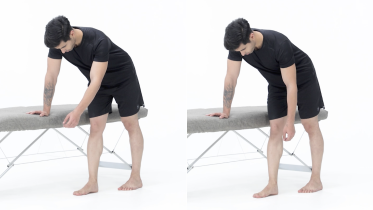 Pendulum exercise for the shoulder
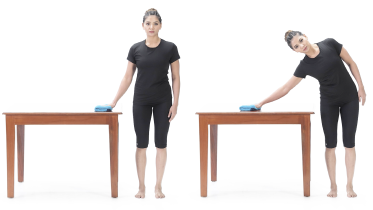 Sideways table slide
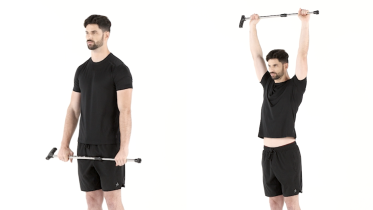 Shoulder flexion with a stick
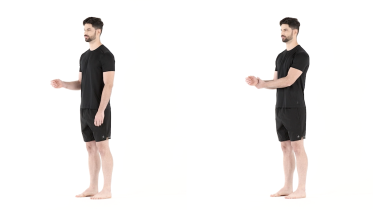 Isometric shoulder external rotation
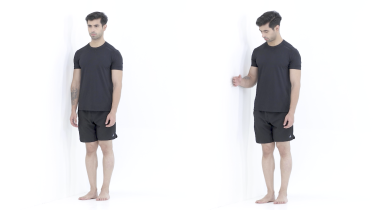 Isometric shoulder abduction
Stage 2: Strengthen the rotator cuff with the arm low
When the flare has passed, so the shoulder no longer hurts at rest and small everyday movements are comfortable, or if your shoulder has ached on and off for months rather than flaring. The side-lying turn, with no weight in the hand, is a gentle first step from the holds to a moving arm. The band turns work the muscles that turn the arm out and in with the elbow tucked at your side, and the band row works the muscles that steady the shoulder blade. Wall slides rebuild reaching up with the wall taking some of the arm's weight, so stop just below any painful spot. Many programs use 2 to 3 sets of 10 to 15 slow repetitions for the band and side-lying work, once a day or every other day, and 10 to 15 wall slides once or twice a day.
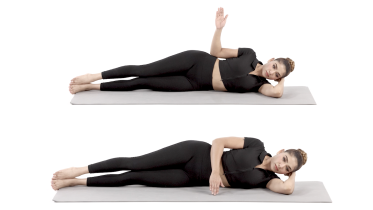 Side-lying external rotation
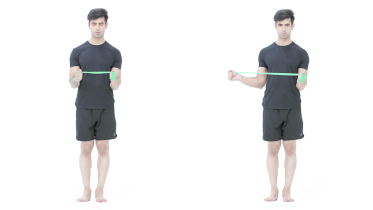 Shoulder external rotation with band
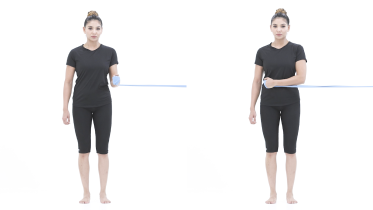 Shoulder internal rotation with band
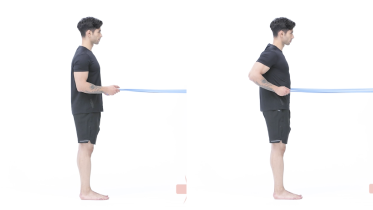 Resistance band row
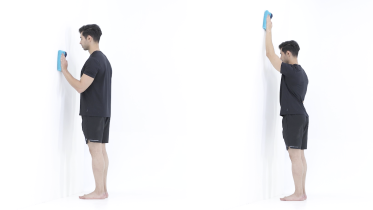 Wall slides with a towel
Stage 3: Build strength with the arm raised
When 3 sets of the stage 2 band exercises feel easy and the shoulder is no worse the next morning, keep those going and add these. Lifting the arm out to the side against a band loads the tendon over the top of the shoulder (supraspinatus), which is where a deposit most often sits, so stop at shoulder height at first. The 90/90 band turn, the serratus punch and the prone Y raise work the rotator cuff and shoulder blade muscles with the arm higher, and rolling a ball up the wall takes the arm above shoulder height with some support. Many programs use 2 to 3 sets of 8 to 15 for the band work, 2 to 3 sets of 10 punches, 2 to 3 sets of 8 to 12 Y raises with a 3 to 5 second hold, and 1 to 3 sets of 10 to 15 ball rolls. Raise the arm a little higher week by week, not all in one session.
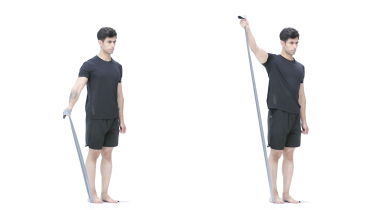 Shoulder abduction with band
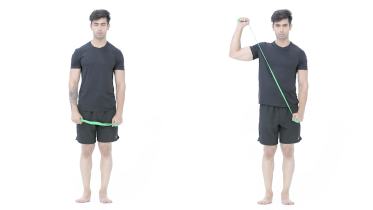 90/90 external rotation with band
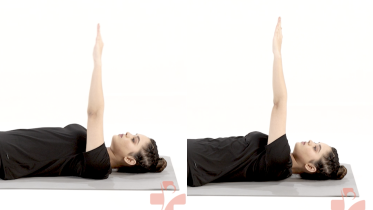 Serratus punch
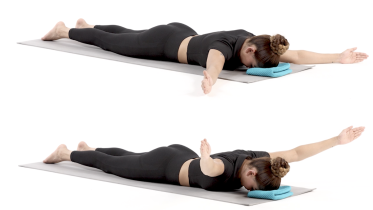 Prone Y raise
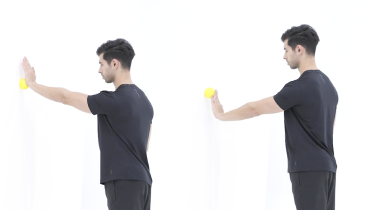 Wall ball shoulder flexion
Living with a flare
The NHS advice for shoulder pain is to keep gently moving the shoulder and not to stop using it completely, because that can slow recovery, while avoiding the things that make it worse. Painkillers such as paracetamol or ibuprofen, and a heat or cold pack, can help you keep moving. A pharmacist can tell you whether a medicine is safe for you.
Sleep is often the hardest part of a flare. Many people find it easier to lie on the good side hugging a pillow, or on their back with a pillow under the sore arm. Keep the things you use every day at waist or chest height for a while, and carry bags in the other hand.
When to see a physio or doctor
The NHS advises seeing a physio or doctor if shoulder pain is getting worse, has not improved after 2 weeks, or makes it very hard to move your arm. With calcific tendinitis it is worth being assessed early, because a scan can confirm the deposit and rule out other causes. A shoulder that stays stiff in every direction after a flare can be a frozen shoulder, and pain that spreads from the neck may need the neck pain program instead.
If pain lasts for several months despite a good program, ask about a specialist opinion on injection, shockwave or needling. Whatever stage you are at, read the warning signs below. Every one of them needs medical attention, and some need it straight away.
For physiotherapists
This page covers rotator cuff calcific tendinopathy in adults, using the Uhthoff phases in plain language. For the acute resorptive phase, the reviews advise analgesia and passive or assisted range of motion to limit stiffness (Merolla 2016), so stage 1 is deliberately low load. For chronic presentations the program follows the loading approach on the rotator cuff tendinopathy page. Direct trials of exercise alone in calcific tendinopathy are scarce, so progression is best guided by the 24-hour response.
The procedural evidence is conflicting. De Witte and colleagues found a 1-year advantage for barbotage plus subacromial corticosteroid over corticosteroid alone that was lost by 5 years. Moosmayer and colleagues (220 participants, deposits of at least 5 mm, symptoms of at least 3 months, acute resorptive cases excluded) found no benefit of lavage with corticosteroid, or sham lavage with corticosteroid, over sham at 4 months on the Oxford Shoulder Score or over 24 months, and at 24 months no significant OSS difference between disappeared and unchanged deposits (deposits still visible but changed scored worse than disappeared ones).
Sham lavage with corticosteroid beat sham at 2 and 6 weeks, and lavage with corticosteroid beat sham at 6 weeks and on pain at 2 weeks, and 143 participants had further treatment after 4 months, so the 24-month comparison is diluted. The Cochrane review of shockwave (Surace 2020) found no subgroup difference by calcification status, and low to moderate certainty evidence of few clinically important benefits. Protocols and energy doses varied widely.
Reviews also report associations with diabetes and thyroid disorders (Sansone 2018), based mostly on older data. The page raises diabetes with patients only in relation to steroid injection (Choudhry 2016), because neither association changes the program.
See a doctor promptly if
- Chest pain or tightness, which may spread to your arm, neck or jaw, or shoulder or arm pain that comes with shortness of breath, sweating or feeling sick. This can be a heart attack. Call emergency services straight away.
- The shoulder is hot, red and swollen, or you have a fever or feel unwell. This can be a joint infection. Go to an emergency department the same day.
- The shoulder feels as if it has slipped out of place, looks a different shape or suddenly locks so you cannot move the arm, or the pain is severe after a fall or an injury. Go to an emergency department straight away, without driving yourself, and do not try to put the shoulder back in yourself.
- Your arm, hand or fingers turn cold, pale, blue or gray compared with the other side. Call emergency services or go to an emergency department straight away, and do not drive yourself. The blood supply to the arm may be blocked.
- Sudden, very bad shoulder pain, or you suddenly cannot lift or move your arm at all. Get medical help the same day.
- The pain started after a fall, a pull or another injury, especially if the arm has been weak since, for example you cannot lift it out to the side or hold it up. This can be a broken bone or a torn tendon. Ask for an urgent appointment with your doctor, within days rather than weeks, because UK shoulder surgeons advise urgent referral for a rotator cuff tear caused by an injury.
- Pins and needles or numbness in the arm that does not go away, no feeling in part of the arm, or weakness that is getting worse. Get medical advice the same day. For pain spreading down the arm from your neck, ask for an urgent appointment with your doctor. If one side of your face or body suddenly goes numb or weak, or your speech becomes slurred or muddled, call emergency services, even if it goes away.
- Severe pain in both shoulders that has come on recently. Ask for an urgent appointment with your doctor.
- You are over 50 and have aching and stiffness in both shoulders, often in the neck or hips too, that is worst in the morning and lasts more than 45 minutes after you get up. See your doctor within a few days, as this can be an inflammatory condition (polymyalgia rheumatica) rather than calcific tendinitis. If you also get a new headache, pain or tenderness at your temples or on your scalp, or jaw pain when you eat or talk, get medical advice the same day, and if your vision changes, call emergency services.
- New shoulder pain and you have had cancer, now or in the past, or you are losing weight without trying. See your doctor within a day or two and mention it. If you are being treated for cancer now, contact your cancer team the same day.
- Night pain is common with this condition, but get checked within a few days if the pain is constant, no rest or change of position eases it at all, and it keeps getting worse. If you have had cancer, now or in the past, or are losing weight without trying, see your doctor sooner, within a day or two, and mention it. If you are being treated for cancer now, contact your cancer team the same day.
Common questions
Does calcific tendinitis go away on its own?
Often, yes. Reviews describe a natural cycle in which the body breaks down and clears the deposit, and in many people the pain eases once that happens (Merolla 2016, Sansone 2018). In the Norwegian and Swedish trial of people whose pain had lasted at least 3 months, the deposit had gone on its own, without any procedure to remove it, in 52 of the 199 shoulders X-rayed at 2 years (Moosmayer 2023). Some people keep a painful shoulder for much longer, though.
How long does calcific tendinitis last?
It varies a great deal. Many cases end with the deposit being reabsorbed and the pain easing after a few months (Moosmayer 2023), while a smaller group keep pain for a long time. The NHS says shoulder pain in general can take 6 months or longer to recover from. Surgery is usually only discussed when pain has not settled after more than 6 months of nonsurgical treatment (Merolla 2016).
Is shockwave therapy good for calcific tendinitis?
It can help some people, but the benefit is smaller than many clinics suggest. A German trial of 144 people found better shoulder function and smaller deposits after high-energy shockwave than after a sham treatment (Gerdesmeyer 2003). A Cochrane review of 32 trials, most of them in people with calcific deposits, found very few clinically important benefits and some uncertainty about safety (Surace 2020). Ask what energy level and how many sessions are planned, and what it will cost.
Should the calcium deposit be removed?
Not always, and removing it does not guarantee less pain. In a well-run trial, washing out the deposit with a needle (lavage or barbotage) plus a steroid injection did no better than a sham procedure at 4 months or 2 years, even though the deposit cleared more often (Moosmayer 2023). An earlier, smaller Dutch trial of 48 people found needling plus steroid better than steroid alone at 1 year, but by 5 years the two groups were no different (de Witte 2013, 2017). It remains an option to discuss when pain lasts.
What should I avoid with calcific tendinitis?
During a bad flare, avoid lifting, carrying and reaching up with that arm for a while, but keep the shoulder gently moving so it does not stiffen. The NHS advises not to stop using a painful shoulder completely, and not to make up your own strenuous exercises or use heavy gym equipment. As the pain settles, build heavier and overhead activities back up in small steps. Your physio can help you work out what to cut back, and for how long.
References
- Merolla G, Singh S, Paladini P, Porcellini G. Calcific tendinitis of the rotator cuff: state of the art in diagnosis and treatment. Journal of Orthopaedics and Traumatology. 2016;17(1):7-14. https://doi.org/10.1007/s10195-015-0367-6
- Sansone V, Maiorano E, Galluzzo A, Pascale V. Calcific tendinopathy of the shoulder: clinical perspectives into the mechanisms, pathogenesis, and treatment. Orthopedic Research and Reviews. 2018;10:63-72. https://doi.org/10.2147/ORR.S138225
- Uhthoff HK, Loehr JW. Calcific tendinopathy of the rotator cuff: pathogenesis, diagnosis, and management. Journal of the American Academy of Orthopaedic Surgeons. 1997;5(4):183-191. https://doi.org/10.5435/00124635-199707000-00001
- Moosmayer S, Ekeberg OM, Hallgren HB, et al. Ultrasound guided lavage with corticosteroid injection versus sham lavage with and without corticosteroid injection for calcific tendinopathy of shoulder: randomised double blinded multi-arm study. BMJ. 2023;383:e076447. https://doi.org/10.1136/bmj-2023-076447
- de Witte PB, Selten JW, Navas A, et al. Calcific tendinitis of the rotator cuff: a randomized controlled trial of ultrasound-guided needling and lavage versus subacromial corticosteroids. American Journal of Sports Medicine. 2013;41(7):1665-1673. https://doi.org/10.1177/0363546513487066
- de Witte PB, Kolk A, Overes F, Nelissen RGHH, Reijnierse M. Rotator cuff calcific tendinitis: ultrasound-guided needling and lavage versus subacromial corticosteroids: five-year outcomes of a randomized controlled trial. American Journal of Sports Medicine. 2017;45(14):3305-3314. https://doi.org/10.1177/0363546517721686
- Gerdesmeyer L, Wagenpfeil S, Haake M, et al. Extracorporeal shock wave therapy for the treatment of chronic calcifying tendonitis of the rotator cuff: a randomized controlled trial. JAMA. 2003;290(19):2573-2580. https://doi.org/10.1001/jama.290.19.2573
- Surace SJ, Deitch J, Johnston RV, Buchbinder R. Shock wave therapy for rotator cuff disease with or without calcification. Cochrane Database of Systematic Reviews. 2020;(3):CD008962. https://doi.org/10.1002/14651858.CD008962.pub2
- Choudhry MN, Malik RA, Charalambous CP. Blood glucose levels following intra-articular steroid injections in patients with diabetes: a systematic review. JBJS Reviews. 2016;4(3):e5. https://doi.org/10.2106/JBJS.RVW.O.00029
- Diercks R, Bron C, Dorrestijn O, et al. Guideline for diagnosis and treatment of subacromial pain syndrome: a multidisciplinary review by the Dutch Orthopaedic Association. Acta Orthopaedica. 2014;85(3):314-322. https://doi.org/10.3109/17453674.2014.920991
- NHS. Shoulder pain. Page last reviewed 22 May 2023. https://www.nhs.uk/symptoms/shoulder-pain/
- NHS. Heart attack. Page last reviewed 31 March 2026. https://www.nhs.uk/conditions/heart-attack/
- NHS. Polymyalgia rheumatica. Page last reviewed 23 April 2023. https://www.nhs.uk/conditions/polymyalgia-rheumatica/
- NHS. Temporal arteritis. Page last reviewed 14 August 2023. https://www.nhs.uk/conditions/temporal-arteritis/
Written and checked by the PocketPhysio editorial team. Last updated 2026-09-28.
This page is general education, not a diagnosis or a personal treatment plan. See a physiotherapist or doctor for advice about your own situation.