Sideways table slide
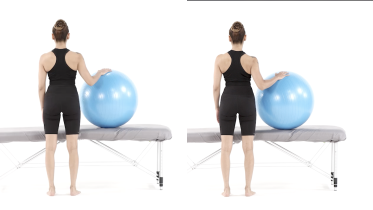
In a sideways table slide you stand beside a table with your hand on a towel, then lean your body sideways so the hand glides away from you and the arm moves out to the side. The table takes the weight of the arm, so the shoulder moves with very little muscle work (assisted range of motion). It is often used for a stiff or sore shoulder, and early in rehab when lifting the arm on its own is not yet possible or allowed.
How to do the sideways table slide
- Stand side-on to a sturdy table or kitchen counter, close enough to rest your sore hand on it with the elbow straight. Put a small towel under the hand so it slides easily.
- Rest the hand flat on the towel, palm down, and let your other arm hang by your side.
- Keep the elbow straight and bend your trunk sideways toward the table, letting the hand slide away from you along the top.
- Go only as far as the shoulder allows, with a gentle stretch at most, and hold briefly.
- Straighten up slowly so the hand slides back toward you, then repeat.
What you should feel
Movement and a mild stretch under and around the shoulder as the hand slides out. The arm itself should feel relaxed.
Common mistakes
- Pushing the towel with the arm instead of letting your body lean do the work.
- Tensing your neck or hitching the shoulder toward your ear.
- Bending the elbow as the hand slides.
- Sliding so far that the stretch turns into pain.
How often
Often 10 to 15 slow slides, 1 to 3 times a day. How far the hand glides matters more than the number. Your physio will adjust this.
Stop and check with your physio if
- The shoulder feels like it is slipping out.
- You get a sharp pain or a catch in the shoulder as the hand slides out.
- Pain or pins and needles run down the arm.
- Pins and needles in your arm or hand that do not go away after you stop, or part of your arm or hand goes numb. Get medical advice the same day. If one side of your face or body suddenly goes numb or weak, or your speech becomes slurred or muddled, call emergency services, even if it goes away.
- A sudden pop or tearing feeling in the shoulder that brings sharp pain, new weakness or trouble lifting the arm. Stop and contact your surgical team the same day, or get medical advice the same day if you have not had surgery.
- The shoulder feels as if it has slipped out of place, looks a different shape or suddenly locks so you cannot move the arm, or your hand turns cold, pale or blue. Go to an emergency department straight away, without driving yourself, and do not try to put the shoulder back in yourself.
From the clinic
Use a table that will not shift, keep your feet still, and have your free hand ready to steady yourself if you feel wobbly as you lean. If you feel unsteady on your feet or standing is awkward, do the same slide sitting on a chair beside the table. The pendulum exercise and shoulder abduction with a stick are other assisted ways to move the arm. Once the arm can lift out to the side on its own without pain, many programs move on to lifting it without the table.
After shoulder surgery, including a rotator cuff repair, or after a shoulder fracture or dislocation, follow your surgeon's or physio's plan, and do only the movements and range they have cleared. Many plans allow only passive movement at first, where the arm is moved for you and its muscles stay relaxed. Ask how far the arm may go out to the side, and stop if the shoulder feels like it is slipping out. Keep the palm facing down on the towel, which stops the arm turning outward. An arm lifted out to the side and turned outward, most of all near shoulder height, is the position where a shoulder that has dislocated forward is most likely to slip out again.
Written and checked by the PocketPhysio editorial team. Last updated 2026-09-28.
This page is general education, not a diagnosis or a personal treatment plan. If you have pain, an injury or a health condition, see a physiotherapist or doctor before starting new exercises.