
Proximal humerus fracture: exercises for a broken upper arm near the shoulder
What is a proximal humerus fracture?
The humerus is the bone of the upper arm. Its top end, the proximal humerus, is the ball that fits into the socket of the shoulder joint, and a break there usually happens in a fall (Cambridge University Hospitals). OrthoInfo lists the usual signs as severe pain, a badly swollen shoulder, very limited movement and bruising around the top of the arm.
Doctors describe the break by where it runs, for example through the neck of the bone just below the ball, and by whether the pieces have moved out of place (displaced). In older adults it can follow a simple trip or fall. A break that happens that easily, after a minor injury, is called a fragility fracture (North Bristol).
Who this page is for
Read on if you are an adult with a broken shoulder that is being treated in a sling or a collar and cuff, with no operation. If you had surgery, with a plate, screws or a nail, or a new top put on the arm bone (shoulder replacement), your surgeon's and physio's plan comes first. That also goes if the shoulder was dislocated as well, if the break is only in the bony bump at the side of the shoulder where the rotator cuff attaches (the greater tuberosity), or if a nerve was found to be injured. Children and teenagers, whose bones are still growing, need a plan from their own fracture clinic, doctor or physio.
A dislocated shoulder without a break has its own shoulder dislocation program, which moves on faster because no bone has to heal. For breaks lower down, see the broken elbow program and the broken wrist program.
How a broken shoulder is treated
After an X-ray, most of these breaks are treated with a sling. OrthoInfo says most can be managed without surgery if the pieces of bone are not badly out of place. When surgery is needed, the pieces are held with plates, screws or pins, or the top of the arm is replaced.
For many displaced breaks, surgery does not seem to give a better result. In the UK ProFHER trial, 250 adults with a displaced break through the neck of the bone, average age 66, had either surgery or a sling followed by the same rehab, and shoulder function over 2 years was much the same (Rangan 2015). A trial of 88 people aged 60 or over in four northern European countries found the same at 2 years (Launonen 2019). A 2022 Cochrane review of 47 trials rated this finding as high certainty, but noted there was too little evidence for people under 60, high-energy injuries and some less common types of break (Handoll 2022). Your surgeon will talk you through the choice for your own break.
How long should you wear a sling for a broken shoulder?
Hospitals differ. Two NHS leaflets give about 3 to 6 weeks (Gateshead; North Tees and Hartlepool), one sets no fixed time and encourages coming out of it for light tasks once your pain is under control (Hull), and another says about 6 to 12 weeks (Gloucestershire). Follow your own fracture clinic's advice.
The Brighton and Sussex fracture clinic advises taking the arm out every day to wash and to do your exercises. North Bristol adds that you should let it hang straight at the elbow at least twice a day. Do not put a pillow or other support under your elbow or behind your upper arm, because it can push on the broken bone and add to the pain (North Bristol).
Pain, swelling and bruising in the first weeks
A broken shoulder hurts, and for the first week or two it may hurt more rather than less. One NHS leaflet says it is quite common for the pain to increase in the first 1 to 2 weeks because of swelling, and that the whole arm may swell and bruise, including the hand and fingers (North Bristol). Another says the bruising gradually moves down toward the elbow over about two weeks (Cambridge University Hospitals). Moving the hand and elbow helps the swelling go down.
Many people sleep better propped up on pillows or in a chair at first. Taking regular painkillers, for example paracetamol (acetaminophen), often makes the early exercises easier. Stick to the dose on the pack. If you are unsure which ones are safe for you, check with a pharmacist or your doctor.
Does moving the shoulder early help?
It seems to help in the first months, though the evidence is limited. In a French trial of 74 people with an impacted break, where the pieces are pushed together, moving the shoulder gently within 3 days gave better function and more lift at 6 weeks and 3 months than 3 weeks in a sling, and no break slipped out of place or failed to heal (Lefevre-Colau 2007). In a UK trial of 86 people, starting physio within a week gave less pain and better function at 16 weeks than waiting 3 weeks, and by a year the gap had narrowed (Hodgson 2003).
The Cochrane review rated the evidence on early versus later movement as very low certainty, so it cannot say for sure which is better in the long run (Handoll 2022). That is one reason plans vary so much between hospitals. Your fracture clinic will judge when your break is stable enough to move.
How long does a proximal humerus fracture take to heal?
Most of these breaks knit in about 6 to 12 weeks (Hull; Gateshead; North Tees and Hartlepool). The shoulder takes longer to feel right. OrthoInfo says that after a less severe injury, improvement is often fairly quick after the first 4 to 6 weeks, and pain, strength and movement can keep improving for up to 12 months. One NHS leaflet says strength usually takes up to a year to come back (Gloucestershire).
Some loss of movement is common. One virtual fracture clinic warns that you may never fully lift the arm straight up again (Brighton and Sussex), and another NHS leaflet says some stiffness is inevitable (Chelsea and Westminster). Do not lift anything heavier than a cup of tea for the first 6 weeks (Cambridge University Hospitals), and avoid heavy lifting until your clinic says so, often about 12 weeks (North Tees and Hartlepool).
How to use this program
After shoulder surgery, including a rotator cuff repair, or after a shoulder fracture or dislocation, follow your surgeon's or physio's plan, and do only the movements and range they have cleared. Many plans allow only passive movement at first, where the arm is moved for you and its muscles stay relaxed. Wait for your fracture clinic or physio to clear you before each new stage and each new exercise. The weeks in each stage are taken from UK hospital leaflets and trials. Treat them as a rough guide rather than a timetable.
Doses are on each exercise page. As a rough pattern, the early movements are done 2 to 4 times a day, the holds once or twice a day and the band work once a day or every other day. Your physio will adjust this.
Expect some ache all the way through. One NHS leaflet advises avoiding movements that hurt more than 4 out of 10 (Chelsea and Westminster). From stage 2 on, discomfort that eases soon after you finish is fine, as long as the shoulder feels no worse the next morning. Sharp pain, pain that grows with each repetition, or a shoulder that is plainly sorer or more swollen the next day means you have overdone it. Go back a stage for a few days.
The exercise program
Stage 1: Hand, elbow and pendulum work while in the sling
Your fracture clinic decides when this begins. For the hand, wrist and elbow that is often straight away, and for the pendulum anywhere from the first few days to about 2 to 3 weeks. Out of the sling, open and close your hand (often 5 to 10 slow movements, 3 to 4 times a day), tip the wrist up and down (often 2 to 3 sets of 10 to 15, 1 to 3 times a day) and slowly bend and straighten the elbow with the upper arm hanging by your side (often 10 to 15, 2 to 3 times a day). In the pendulum, lean on a table and let the sway of your body move the relaxed arm in small swings, often for 30 to 60 seconds in each direction, a few times a day. If your balance is poor, skip the pendulum and ask your physio for a seated option. The shoulder blade squeeze, often 10 to 15 squeezes held for about 5 seconds, 2 to 3 times a day, keeps the muscles around the shoulder blade working while both hands rest on your thighs. An ache is expected with a broken shoulder, but sharp pain, or pain that builds with each movement, means do less.
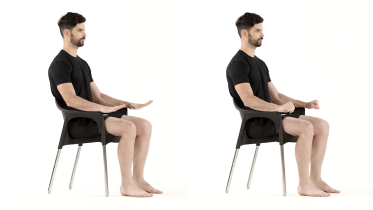 Open and close the hands
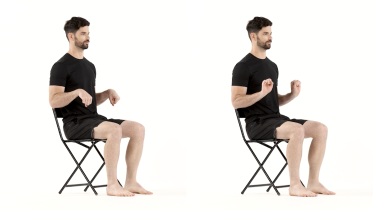 Wrist flexion and extension
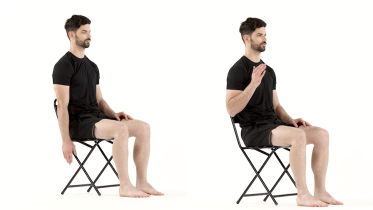 Elbow flexion and extension
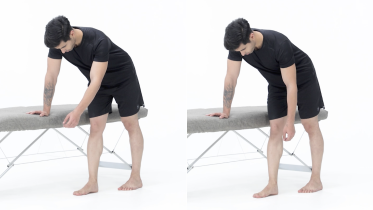 Pendulum exercise for the shoulder
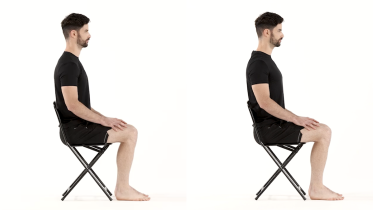 Scapular squeeze
Stage 2: Assisted movement for the shoulder
Start when your fracture clinic or physio says the shoulder can be moved with help, often around 3 to 4 weeks after the break. In these exercises your good arm or a table does the work while the broken arm stays relaxed and goes along: the lying stick lift (often about 10 slow lifts) and the seated or standing stick lift (often 10 to 15), both 1 to 3 times a day, the sideways table slide (often 10 to 15 slides, 1 to 3 times a day) and the stick turn. For a healing break, push the stick turn only to a gentle stretch and use short holds, often about 5 seconds, 10 times, rather than the longer holds on its exercise page. Unless your clinic has cleared you to go higher, keep each lift below shoulder height until about 6 weeks, as many plans do. Some plans let the lying stick lift go higher from about 4 weeks. Stop each lift where your clinic tells you, even though the videos go higher. The sling usually comes off gradually in this stage, as the pain allows and your clinic advises. A mild ache is fine if it fades soon after you finish and the shoulder feels no worse when you wake up.
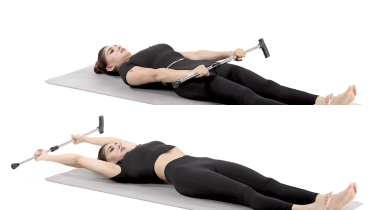 Lying shoulder flexion with a stick
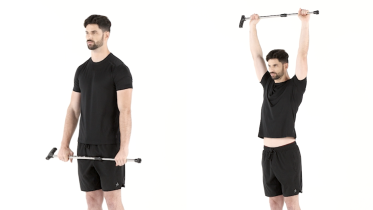 Shoulder flexion with a stick
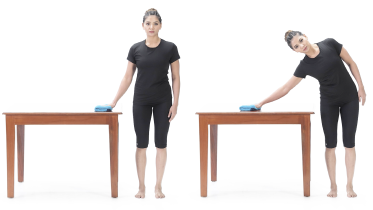 Sideways table slide
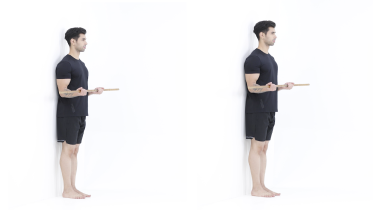 Shoulder external rotation with a stick
Stage 3: The arm starts to move on its own
This stage begins once your fracture clinic or physio is happy with how the bone is healing, often around 6 weeks, and the sling has been put away. Now the shoulder muscles start to lift and turn the arm themselves: the side lying swing (often 1 to 3 sets of 10, once or twice a day), the wall slides (often 10 to 15, once or twice a day) and the side lying outward turn with nothing in your hand (often 2 to 3 sets of 10 to 15, once a day). The three static holds, done with the arm by your side and a gentle push, wake up the rotator cuff, often 5 to 10 holds of 5 to 10 seconds, once or twice a day. If the break went through the bony bump where the rotator cuff attaches (the greater tuberosity), ask your physio before you start any exercise in this stage, because the rotator cuff muscles that lift and turn the arm pull on that piece of bone. Reaching up above your head is often the last movement to come back, so build it over weeks rather than days.
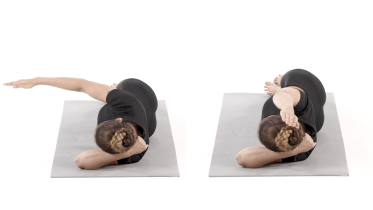 Side lying shoulder flexion
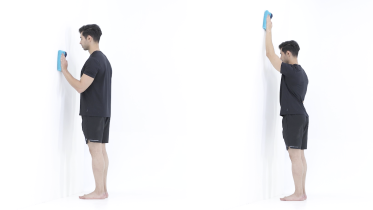 Wall slides with a towel
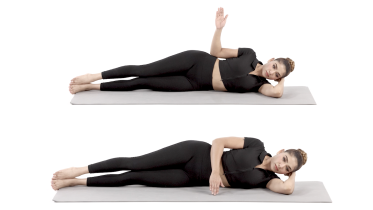 Side-lying external rotation
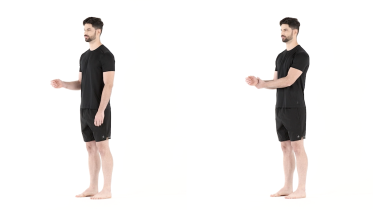 Isometric shoulder external rotation
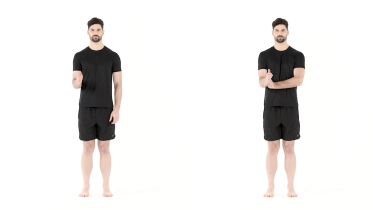 Isometric shoulder internal rotation
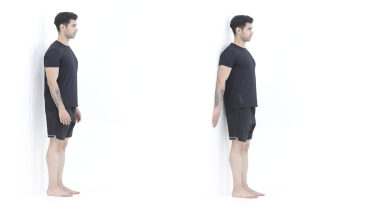 Isometric shoulder extension
Stage 4: Building strength for daily jobs
Strength work begins once your fracture clinic or physio clears the bone to take some load, often somewhere between 6 and 12 weeks after the break. The two band turns and the band row build the rotator cuff and the muscles that hold the shoulder blade steady, often with a light band for 2 to 3 sets of 10 to 15, once a day or every other day. Wall push-ups load the arm with part of your body weight. Wait until you are cleared for them, stand with your feet near the wall at first, and work up to 2 to 3 sets of 10 to 15 a few days a week. One NHS leaflet holds back heavy lifting for about 12 weeks and another leaves heavy activities until 3 to 6 months. In the meantime, build up the real jobs you need, like reaching into a cupboard or carrying shopping, a little at a time. Harder jobs may ache for months. Pain that gets worse from one week to the next is different, and needs checking.
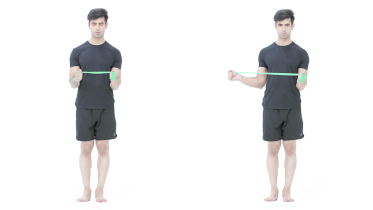 Shoulder external rotation with band
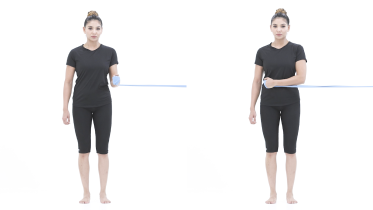 Shoulder internal rotation with band
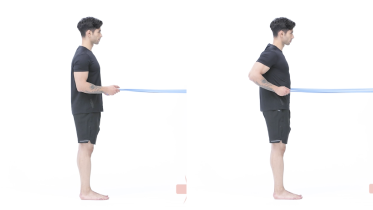 Resistance band row
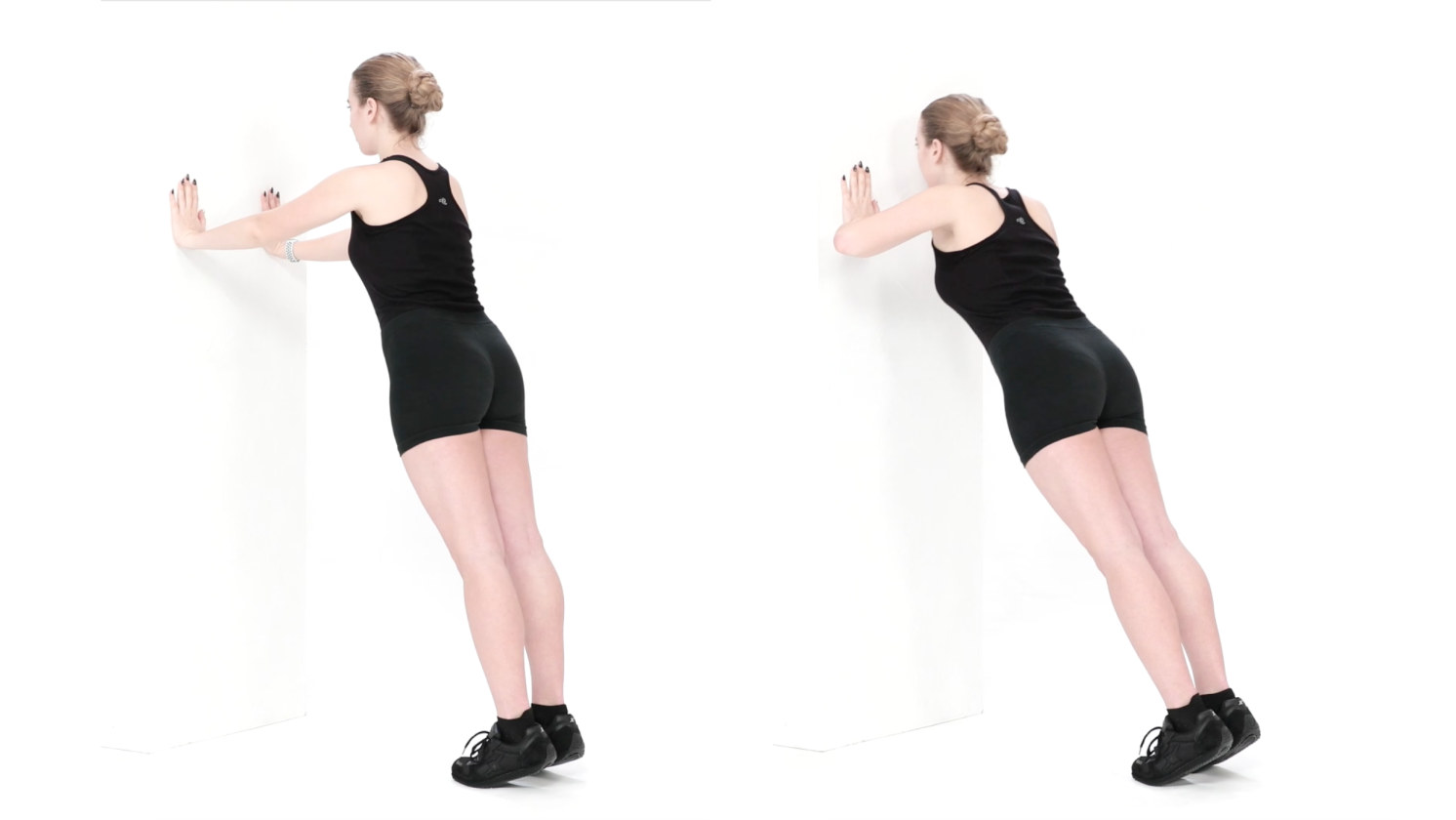 Wall push-ups
Checking your bones after a broken shoulder
If the top of your arm broke in a trip or a fall from standing height, your bones may have lost some strength. People who have had a fragility fracture have a higher chance of breaking another bone (North Bristol). The Royal Osteoporosis Society advises that if you have broken a bone easily, you talk to your doctor about your chance of osteoporosis and of breaking more bones.
Some hospitals have a fracture liaison service that contacts you to do a fracture risk assessment (North Bristol). If no one has brought up your bone health, raise it with your doctor. Exercise for stronger bones is covered in the osteoporosis program. Tests and medicine are for your doctor to decide.
Lowering the chance of another fall
It is worth finding out why you fell. One NHS leaflet advises asking your doctor for a referral to a specialist falls service if you have had one or more falls or are still worried about falling (North Bristol). A blackout before the fall, or no memory of it, needs medical advice the same day if nobody has looked into it yet. UK guidance from NICE suggests having the heart checked within 24 hours after some blackouts, including in people over 65 whose blackout came without warning (NICE CG109).
Regular work on strength and balance can cut your risk of falling again. The balance and falls prevention program shows how. You can often begin some of its balance work while the shoulder is still healing, holding on to a sturdy support with your good hand. Ask your physio before you start.
When to see a physio or doctor about your shoulder
OrthoInfo says shoulder exercises, usually as part of a supervised physical therapy program, are often needed after a shoulder fracture. If your hospital has not arranged physio and you are struggling to use the arm 6 weeks after the break, ask your doctor or fracture clinic for a referral (North Bristol). A physical therapist (physiotherapist) can also help when progress stalls, when you still cannot lift the arm high enough to wash your hair or reach a shelf, or when you need to get back to heavier work.
Plenty of people manage with a home program alone. The warning signs below tell you how fast to act on each problem.
For physiotherapists
The page sets out a staged home framework for adults with a proximal humerus fracture managed non-operatively. UK trust pathways differ: pendular exercise from the first 72 hours (Brighton and Sussex virtual fracture clinic) or from about 2 to 3 weeks (Hull; Gateshead), active-assisted flexion and external rotation from 3 to 4 weeks (Brighton; Gloucestershire; North Bristol), arm below shoulder height and no heavy lifting in weeks 3 to 6, and active range from about 6 weeks (Brighton). The NITEP protocol (Launonen 2019) used a collar and cuff or sling for 3 weeks with immediate pendulum exercise and elbow, wrist and finger movement, then supervised active range of motion from 3 weeks, with a median of 4 physiotherapy visits.
ProFHER (Rangan 2015; n = 250, mean age 66, displaced fractures involving the surgical neck) found no difference in Oxford Shoulder Score averaged over 2 years (39.07 vs 38.32, P = 0.48), with similar complications and secondary surgery. NITEP (n = 88, age 60 or over, displaced 2-part fractures) found no difference in DASH at 2 years (18.5 operative vs 17.4 non-operative). The 2022 Cochrane review (47 trials, 3,179 participants) reports high-certainty evidence of no clinically important difference in function at 1 and 2 years, and insufficient evidence for people under 60, high-energy trauma, two-part tuberosity fractures and less common fractures.
Lefevre-Colau (2007; n = 74, impacted fractures) found passive mobilization within 72 hours gave better Constant scores than 3 weeks of immobilization at 6 weeks (10.1 points) and 3 months (9.9 points), better forward elevation, less pain at 3 months and no displacement or nonunion. Hodgson (2003; n = 86, two-part fractures) found less pain and better function at 16 weeks with physiotherapy within 1 week, with smaller, non-significant differences at 52 weeks. Cochrane rates early versus delayed mobilization (5 trials, 350 participants) as very low certainty evidence.
Check neurovascular status at every visit. Visser (2001) found EMG denervation in 67% of 143 fractures, involving the axillary nerve in 58% and the suprascapular nerve in 48%, and clinical detection alone proved difficult. Also screen for loss of position after a new fall, CRPS, and progress that stalls. Isolated greater tuberosity fractures, fracture-dislocations and operatively managed fractures follow the treating team's protocol, and fragility fractures should prompt fracture liaison and falls referral.
See a doctor promptly if
- Emergency: chest pain or tightness, which may spread to your arm, neck or jaw, or shoulder or arm pain that comes with shortness of breath, sweating or feeling sick. This can be a heart attack. Call emergency services straight away.
- Emergency: your arm, hand or fingers turn cold, pale, blue or gray compared with the other side. Call emergency services or go to an emergency department straight away, and do not drive yourself. The blood supply to the arm may be blocked.
- Emergency: the shoulder feels as if it has slipped out of place, looks a different shape or suddenly locks so you cannot move the arm, or the pain is severe after a fall or an injury. Go to an emergency department straight away, without driving yourself, and do not try to put the shoulder back in yourself.
- Emergency: a new fall or knock on the healing arm, followed by numbness, tingling or pins and needles in the arm or hand, a hand that turns cold, pale or blue, or an upper arm or shoulder that has changed shape or sits at an odd angle. The same applies to a bone showing through the skin or a cut that is bleeding heavily. Go to an emergency department or call emergency services straight away, and do not drive yourself.
- A new fall or knock that leaves the healing shoulder more swollen, bruised or painful, or that stops you moving the arm as far as before, without numbness or a change in shape. Stop the exercises and get medical advice the same day. If the pain is severe or you cannot move the arm, go to an emergency department straight away, and do not drive yourself.
- Pain that keeps getting worse and has not settled within 48 hours, or new swelling. Contact your fracture clinic or get medical advice the same day.
- A numb patch on the outer side of the upper arm that nobody has checked, or any new change in the feeling of your hand or new loss of movement in your hand or wrist, at any stage after the break. Contact your fracture clinic or get medical advice the same day. A nerve can be stretched or bruised when the top of the arm breaks, most often the nerve to the muscle over the outside of the shoulder (axillary nerve), and it needs checking.
- Pins and needles in your arm or hand that do not go away after you stop, or part of your arm or hand goes numb. Get medical advice the same day. If one side of your face or body suddenly goes numb or weak, or your speech becomes slurred or muddled, call emergency services, even if it goes away.
- A sudden pop or tearing feeling in the shoulder that brings sharp pain, new weakness or trouble lifting the arm. Stop and contact your surgical team the same day, or get medical advice the same day if you have not had surgery.
- The shoulder is hot, red and swollen, or you have a fever or feel unwell. This can be a joint infection. Go to an emergency department the same day.
- Your forearm, hand or upper arm is getting more swollen instead of settling, or becomes warm, tender, red or darker than usual, has swollen veins that are sore to touch, or has a throbbing or cramping pain that feels different from normal muscle ache. Some bruising and swelling of the whole arm, down to the hand, is expected after a broken upper arm and settles over a few weeks, but a blood clot can sometimes form in the arm. Do not massage it. Stop and get medical advice the same day. If you are also short of breath or have chest pain, call emergency services.
- Since the fracture or cast, the hand is getting more painful rather than less, the skin becomes very sensitive to light touch, or the hand changes color, temperature, swelling or sweating compared with the other one, or looks shiny. See your doctor or physio as soon as you can, within a few days at most, as this can be complex regional pain syndrome (CRPS) and early treatment may help.
- Night pain is common after a broken shoulder, but see your doctor within a few days if pain at night or at rest keeps getting worse rather than easing as the weeks go by. If you have had cancer, now or in the past, or are losing weight without trying, see your doctor sooner, within a day or two, and mention it. This applies even if the pain is not getting worse. If you are being treated for cancer now, contact your cancer team the same day.
- Your shoulder is still very painful, is not getting steadily easier, or you still cannot lift the arm enough to feed, wash or dress yourself, 3 months after the break. This is not an emergency, but contact your fracture clinic or ask your doctor for a review in the next week or two.
- You have fallen two or more times in the past year, or you keep tripping, stumbling or feeling that your legs might give way. Book an appointment with your doctor within a few days and ask about a falls assessment. Tell them about every fall, even the ones where you were not hurt.
- Emergency: you have a new fall and cannot remember the fall or how it happened. Go to an emergency department straight away, and do not drive yourself. You may have blacked out or hit your head without knowing it.
- You blacked out before the fall that broke your arm, or you cannot remember that fall, and nobody has checked why. Get medical advice the same day. A blackout needs its own check, especially if you are over 65 or it came without warning.
Common questions
How long does a proximal humerus fracture take to heal?
The bone itself usually heals in about 6 to 12 weeks, according to several UK hospital leaflets (Hull; Gateshead; North Tees and Hartlepool). Getting the use of the arm back takes longer. The American Academy of Orthopaedic Surgeons' OrthoInfo site says that when the injury was not severe, improvement is often fairly quick after the first 4 to 6 weeks, and pain, strength and movement can keep improving for up to 12 months. One NHS leaflet says it usually takes up to a year to get shoulder strength back (Gloucestershire).
How painful is a proximal humerus fracture?
Very painful at first, for most people. OrthoInfo lists severe pain, a badly swollen shoulder and very limited movement among the usual signs. One NHS leaflet says it is quite common for the pain to increase in the first 1 to 2 weeks because of swelling (North Bristol). Sleeping propped up and taking painkillers as advised both help. Pain that keeps getting worse and has not settled within 48 hours needs a call to your fracture clinic the same day.
How do you treat a proximal humerus fracture?
Most are treated without surgery. OrthoInfo says most can be managed this way if the pieces of bone are not badly out of place. Treatment is a sling for comfort, early movement of the hand, wrist and elbow, and then staged shoulder exercises. In the UK ProFHER trial of 250 adults with a displaced break, shoulder function over 2 years was much the same with or without surgery (Rangan 2015). Those trials mostly included older adults after a fall, so for younger people and high-energy injuries the evidence is thin, and your surgeon will advise on your break (Handoll 2022).
How long do you wear a sling for a broken shoulder?
It varies between hospitals, so follow what your fracture clinic told you. Two NHS leaflets give about 3 to 6 weeks (Gateshead; North Tees and Hartlepool), one sets no fixed time and encourages coming out of it for light tasks once your pain is under control (Hull), and another says about 6 to 12 weeks (Gloucestershire). In a trial in Finland, Estonia, Sweden and Denmark, people wore a collar and cuff or sling for 3 weeks and started pendulum swings straight away (Launonen 2019). Unless you have been told otherwise, the arm comes out of the sling to wash and to exercise.
When can I drive after a broken shoulder?
Not while you still need the sling. One NHS leaflet says not to drive while you wear it (Cambridge University Hospitals), another says not for at least 4 to 6 weeks after the injury (Gloucestershire), and a third gives about 6 to 8 weeks (North Tees and Hartlepool). Before you drive, you should be able to hold the steering wheel comfortably, move the gear stick and pull up the hand brake (Hull). Check with your fracture clinic first, and with your insurer if in doubt.
How should I sleep with a broken shoulder?
Propped up, at least at first. Several NHS leaflets suggest sleeping more upright, on extra pillows or in a chair, and one says to keep wearing the sling at night (Hull; Chelsea and Westminster; Cambridge University Hospitals). Do not put a pillow under your elbow or behind your upper arm, because it can push on the broken bone and add to the pain (North Bristol). Later, some people find lying on the good side with pillows for support comfortable, taking care not to roll onto the injured arm (Gloucestershire).
References
- Rangan A, Handoll H, Brealey S, et al. Surgical vs nonsurgical treatment of adults with displaced fractures of the proximal humerus: the PROFHER randomized clinical trial. JAMA. 2015;313(10):1037-1047. https://doi.org/10.1001/jama.2015.1629
- Handoll HH, Elliott J, Thillemann TM, Aluko P, Brorson S. Interventions for treating proximal humeral fractures in adults. Cochrane Database of Systematic Reviews. 2022;(6):CD000434. https://doi.org/10.1002/14651858.CD000434.pub5
- Launonen AP, Sumrein BO, Reito A, et al. Operative versus non-operative treatment for 2-part proximal humerus fracture: a multicenter randomized controlled trial. PLoS Medicine. 2019;16(7):e1002855. https://doi.org/10.1371/journal.pmed.1002855
- Lefevre-Colau MM, Babinet A, Fayad F, et al. Immediate mobilization compared with conventional immobilization for the impacted nonoperatively treated proximal humeral fracture. A randomized controlled trial. Journal of Bone and Joint Surgery (American). 2007;89(12):2582-2590. https://doi.org/10.2106/JBJS.F.01419
- Hodgson SA, Mawson SJ, Stanley D. Rehabilitation after two-part fractures of the neck of the humerus. Journal of Bone and Joint Surgery (British). 2003;85(3):419-422. https://doi.org/10.1302/0301-620x.85b3.13458
- Visser CP, Coene LN, Brand R, Tavy DL. Nerve lesions in proximal humeral fractures. Journal of Shoulder and Elbow Surgery. 2001;10(5):421-427. https://doi.org/10.1067/mse.2001.118002
- American Academy of Orthopaedic Surgeons. Shoulder trauma (fractures and dislocations). OrthoInfo. https://www.orthoinfo.org/en/diseases--conditions/shoulder-trauma-fractures-and-dislocations/
- North Bristol NHS Trust. Shoulder fractures in the older person (proximal humeral fracture). Patient information NBT002398, May 2024. https://www.nbt.nhs.uk/our-services/a-z-services/orthopaedic-emergency-trauma/orthopaedic-emergency-trauma-patient-information/shoulder-fractures-older-person-proximal-humeral-fracture
- Cambridge University Hospitals NHS Foundation Trust. Proximal humeral fractures. Patient information, version 3, November 2023. https://www.cuh.nhs.uk/patient-information/proximal-humeral-fractures/
- Hull University Teaching Hospitals NHS Trust. Proximal humerus fracture (shoulder): advice regarding healing and recovery. Last updated 30 April 2026. https://www.hey.nhs.uk/patient-leaflet/27613/
- Gateshead Health NHS Foundation Trust. Proximal humerus fracture. Patient information. https://www.gatesheadhealth.nhs.uk/resources/proximal-humerus-fracture/
- Gloucestershire Hospitals NHS Foundation Trust. Proximal humeral fracture. Patient information GHPI1844_06_24. https://www.gloshospitals.nhs.uk/your-visit/patient-information-leaflets/proximal-humeral-fracture/
- North Tees and Hartlepool NHS Foundation Trust. Shoulder fracture. Patient information PIL1524, version 1. https://www.nth.nhs.uk/resources/shoulder-fracture/
- Brighton and Sussex University Hospitals NHS Trust virtual fracture clinic. Proximal humerus fracture care plan. https://www.fracturecare.co.uk/care-plans/shoulder/proximal-humerus-fracture/shoulder-proximal-humerus/
- Chelsea and Westminster Hospital NHS Foundation Trust. Shoulder injury / fractured proximal humerus. Patient leaflet. https://www.chelwest.nhs.uk/your-visit/patient-leaflets/surgery-services/shoulder-injury-fractured-proximal-humerus
- NHS. Broken arm or wrist. Page last reviewed 26 May 2023. https://www.nhs.uk/conditions/broken-arm-or-wrist/
- Royal Osteoporosis Society. Symptoms of osteoporosis. https://theros.org.uk/information-and-support/about-osteoporosis-and-osteopenia/osteoporosis-symptoms/
- NHS. DVT (deep vein thrombosis). Page last reviewed 30 April 2026. https://www.nhs.uk/conditions/deep-vein-thrombosis-dvt/
- NHS. Dislocated shoulder. Page last reviewed 16 September 2026. https://www.nhs.uk/conditions/dislocated-shoulder/
- NHS. Heart attack. Page last reviewed 31 March 2026. https://www.nhs.uk/conditions/heart-attack/
- NHS. Complex regional pain syndrome. Page last reviewed 27 October 2022. https://www.nhs.uk/conditions/complex-regional-pain-syndrome/
- National Institute for Health and Care Excellence. Transient loss of consciousness ('blackouts') in over 16s. Clinical guideline CG109. 2010, last updated November 2023. https://www.nice.org.uk/guidance/cg109
Written and checked by the PocketPhysio editorial team. Last updated 2026-09-28.
This page is general education, not a diagnosis or a personal treatment plan. See a physiotherapist or doctor for advice about your own situation.