
Dislocated shoulder exercises and physiotherapy
What happens when a shoulder dislocates
Your shoulder is a ball and socket joint with a very shallow socket, which is why it moves so freely and also why it can come out. In a dislocation the ball comes right out of the socket. OrthoInfo, from the American Academy of Orthopaedic Surgeons, notes that it most commonly slides forward (an anterior dislocation). People who have dislocated a shoulder before are at higher risk of doing it again.
This page is for adults after a forward dislocation that a doctor has put back in and checked, whether it is the first time or it has happened before. It does not cover a shoulder that came out backward, a dislocation that came with a broken bone, or rehab after surgery to stabilize the shoulder. With a broken bone, even one that does not need an operation, your fracture clinic's plan comes first, and after surgery your surgeon's program does. The same goes for your shoulder team's plan if a scan shows a torn rotator cuff tendon or you have been told a nerve was injured. If the person with the dislocated shoulder is a child, follow the plan from their own doctor and physio rather than this page.
What to do straight after a dislocation
Do not try to put the shoulder back in yourself. The NHS advice is to go to an emergency department if you have hurt your shoulder and cannot move the arm, or it looks out of place or has changed shape. Do not drive yourself: ask someone to take you, or call emergency services if you cannot get there by yourself. While you wait, the NHS suggests supporting the arm in a sling or with a towel, keeping the upper arm still, holding an ice pack wrapped in a cloth on the shoulder for up to 20 minutes every 2 to 3 hours, and taking paracetamol for the pain.
At the hospital, the doctor usually takes an X-ray, puts the joint back in with pain relief or sedation, and takes another X-ray to check it is back in place and rule out other injuries. They also check the nerves and blood supply to the arm. You then go home with a sling to support the arm.
How long should you wear a sling after a dislocated shoulder?
Usually for a short time, from about 1 week up to a few weeks. The NHS says you will need a sling for the first few weeks. A 2026 Dutch multidisciplinary guideline advises 1 week of relative immobilization once the shoulder is back in place, followed by physical therapy aimed at getting use of the arm, coordination and a sense of joint position back early (van Gastel and colleagues, 2026). A review of trials by Paterson and colleagues (2010) found that in people under 30, keeping the arm in a sling for 3 weeks or longer did not lower the chance of another dislocation compared with 1 week or less. Your doctor may still advise a different time for your shoulder, so follow what you were told.
You may have heard of a brace that holds the arm turned outward instead of across the body. A Cochrane review of 7 trials with 704 people could not say whether it lowers the risk of another dislocation compared with a normal sling, because the evidence was very uncertain (Braun and McRobert, 2019). Most people are given a standard sling.
Does physiotherapy help after a dislocated shoulder?
It is the usual first treatment, but the research on exercise itself is thin. The Cochrane review found no trials that tested rehabilitation after a dislocation, only trials of sling position (Braun and McRobert, 2019). Kavaja and colleagues (2018) pooled 22 trials and found moderate-quality evidence that about half of people managed with physiotherapy after a first dislocation did not dislocate again.
A Danish trial compared two exercise programs. Eshoj and colleagues (2020) gave 56 people with a first or repeat dislocation 12 weeks of either a supervised program that built from basic control to sport-level exercises, or a simpler home program. The supervised group scored better on a shoulder instability questionnaire, although the difference was just short of the amount the researchers had set as clearly worthwhile. Fewer in that group went on to have or be referred for surgery (11% against 25%), but that difference could have been down to chance.
Will my shoulder dislocate again?
For young people the risk is high. In a study of 252 people aged 15 to 35 treated without surgery, the shoulder became unstable again in 55.7% within 2 years and in 66.8% within 5 years (Robinson and colleagues, 2006). Young men had the highest risk, women a much lower one, and most repeat problems started within the first 2 years.
A review of 15 studies found repeat dislocation rates ranging from 19% to 88% (Wasserstein and colleagues, 2016). Being under 20 was the biggest risk factor they found, with far higher odds than for people over 20, and being male raised the odds too. People whose dislocation came with a break of the bony bump at the top of the arm (the greater tuberosity) had a lower risk. Paterson and colleagues (2010) also found that being under 30 at the first dislocation predicted a repeat.
When is surgery discussed?
Most people are managed with a sling and exercises first. The Dutch guideline says surgery may be discussed for people under 40, contact athletes, and people who have lost a significant amount of bone from the socket (van Gastel and colleagues, 2026). OrthoInfo adds a shoulder that has dislocated several times, and notes that some young athletes choose surgery after a first dislocation.
In trials, surgery to repair the torn rim of the socket (the labrum) lowered the risk of dislocating again, with moderate-quality evidence (Kavaja and colleagues, 2018). The same review found no trial evidence about how well surgery works once a shoulder has become unstable over time. An operation brings its own risks and a long rehab, so it is a choice to talk through with a shoulder surgeon. If you do have surgery, follow the program your surgeon gives you rather than this page.
If you are over 40
Other injuries become more common with age. In a database of 3,633 people after a forward dislocation, 13.5% had a nerve problem after the shoulder was put back in, and a third had either a torn rotator cuff tendon or a break at the top of the arm bone (Robinson and colleagues, 2012). These injuries were more common at 60 or older. The authors advise that anyone with a nerve problem after a dislocation has the rotator cuff checked, and the other way round.
One nerve doctors and physios check is the axillary nerve, which supplies the muscle over the outside of the shoulder and the skin on the outer upper arm. A numb patch there, or trouble lifting the arm out to the side, needs checking. The British Elbow and Shoulder Society pathway is built around early imaging for people over 40, so that a torn rotator cuff can be found and repaired early if needed. In one UK hospital that followed it, 23 of 40 people over 40 who had an urgent ultrasound scan had a full-thickness tear (Zhou and colleagues, 2021). If you are over 40, ask at your follow-up visit whether your rotator cuff has been checked, even if you can lift the arm.
How to use this program
Start at stage 1 unless your physio has told you otherwise, and move up only when the current stage feels easy and your shoulder is no worse the next morning. This applies after a repeat dislocation too. The strength stages take the longest, and they are the part to keep going once daily life feels normal again.
The numbers in each stage are common starting points, not a prescription. Your physio will adjust the exercises, the sets and the range to your shoulder, your age and what you need to get back to. The supervised program in the trial above, for example, started at 2 sets of 20 every day and moved to 2 sets of 10 three times a week as the exercises got harder (Eshoj and colleagues, 2020).
In stage 1, keep the exercises pain free. From stage 2 on, mild discomfort that settles soon after you finish and is no worse the next morning is acceptable. Sharp pain, pain that builds with each repetition, or any feeling that the shoulder is slipping or about to come out means stop that exercise. If the shoulder is clearly worse the next day, drop back a stage for a few days.
The exercise program
Stage 1: Protect the shoulder and keep it moving
For the days after the shoulder has been put back in, while you are in the sling or just out of it. Take the arm out of the sling only as your doctor or physio has advised, and keep your elbow, wrist and hand moving. The pendulum lets the joint move while the shoulder muscles stay relaxed, often for 30 to 60 seconds in each direction, a few times a day. The static holds wake up the muscles around the joint, most of them with the arm by your side: push gently and stay pain free, often 5 to 10 holds of 5 to 10 seconds, once or twice a day. The forward press is the odd one out, held out in front at shoulder height, so save it for when lifting the arm forward is comfortable, and for now leave out anything that takes the arm out to the side and turns it outward.
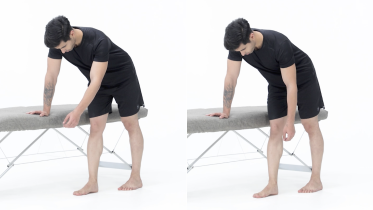 Pendulum exercise for the shoulder
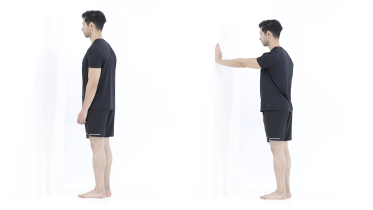 Isometric shoulder flexion
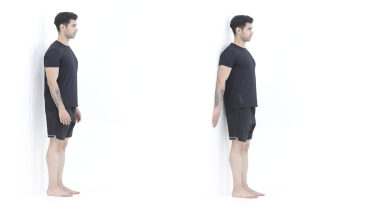 Isometric shoulder extension
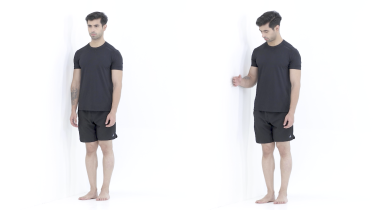 Isometric shoulder abduction
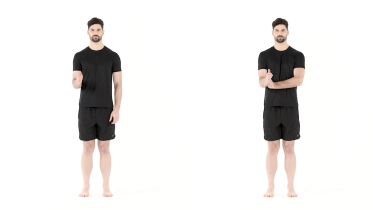 Isometric shoulder internal rotation
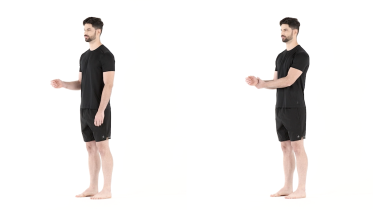 Isometric shoulder external rotation
Stage 2: Get the movement back
When the sling is off and the holds feel easy. The stick lifts and the wall slides bring the arm forward and up, and the sideways table slide takes it out to the side with the palm down; keep the arm below shoulder height when it goes out to the side unless your physio says otherwise. Many programs use 10 to 15 slow repetitions, 1 to 3 times a day (once or twice for the wall slides), and how far you move matters more than the count. The two side-lying turns, often 2 to 3 sets of 10 to 15 slow repetitions once a day or every other day, are the step from holds to a moving arm, with no weight in the hand for the outward turn and only a light one for the inward turn. Mild discomfort that settles soon after and is no worse the next morning is fine, but any feeling that the shoulder is slipping means stop.
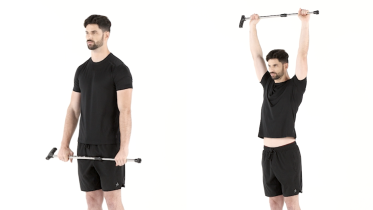 Shoulder flexion with a stick
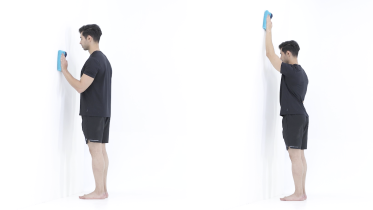 Wall slides with a towel
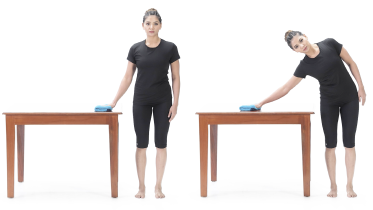 Sideways table slide
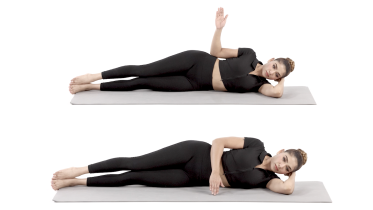 Side-lying external rotation
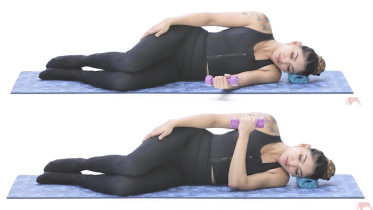 Side-lying shoulder internal rotation
Stage 3: Strengthen the rotator cuff and shoulder blade
When you can lift the arm to about shoulder height in front with little pain and the side-lying turns feel easy. Turning the arm out and in against a light band with the elbow at your side strengthens the rotator cuff, the small muscles that keep the ball centered in its socket, while the row, the straight-arm pulldown and the serratus punch train the muscles that steady the shoulder blade. Many programs use 2 to 3 sets of 10 to 15 slow repetitions for the band work and 2 to 3 sets of 10 reaches for the punch, once a day or a few days a week. The weight shift and the wall ball press start taking weight through the arm with control, often 5 to 10 holds once or twice a day (10 to 30 seconds for the weight shift, 5 to 10 seconds for the ball press). In this stage, keep the arms low, in front of you or by your sides, rather than lifted out to the side and back.
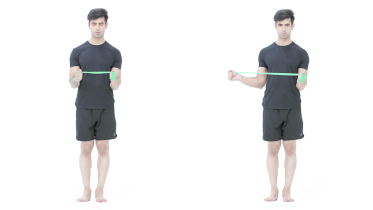 Shoulder external rotation with band
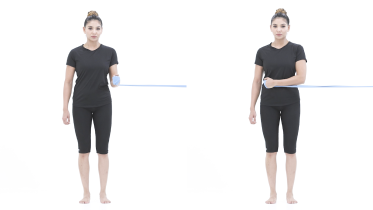 Shoulder internal rotation with band
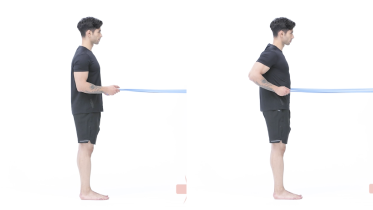 Resistance band row
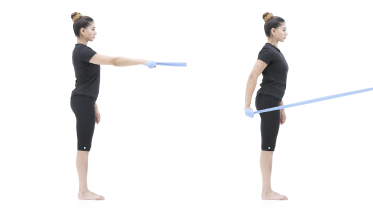 Straight-arm band pulldown
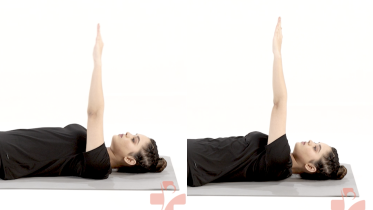 Serratus punch
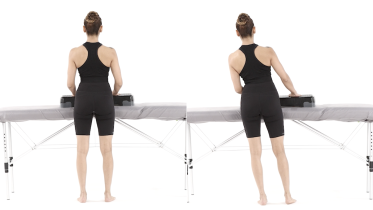 Standing weight shift onto the hands
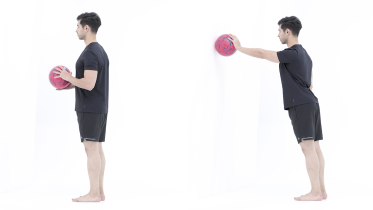 Wall ball press
Stage 4: Build toward work and sport
When 3 sets of the stage 3 exercises feel easy, the shoulder is no worse the next day, and it no longer feels unsteady in everyday use. The front raise and the band lift to the side build strength with the arm raised, often 2 to 3 sets of 8 to 12 for the front raise and 8 to 15 for the band lift, every other day or a few times a week, stopping at shoulder height unless your physio has cleared you to go higher. Wall push-ups, then the push-up plus, put your weight through the arms a few days a week, which gym work and many contact sports need. The 90/90 band turn trains the arm-up, turned-out position used in throwing and overhead sport, which is the position where a shoulder that dislocated forward is most likely to slip, so wait for your physio's go-ahead before you add it. Physios usually build the return to sport in steps, based on strength, control and how confident the shoulder feels rather than a fixed date.
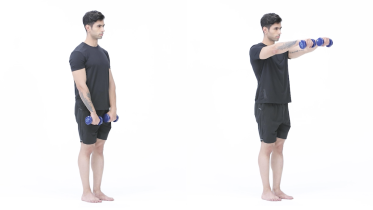 Dumbbell front raise
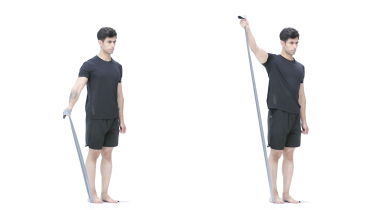 Shoulder abduction with band
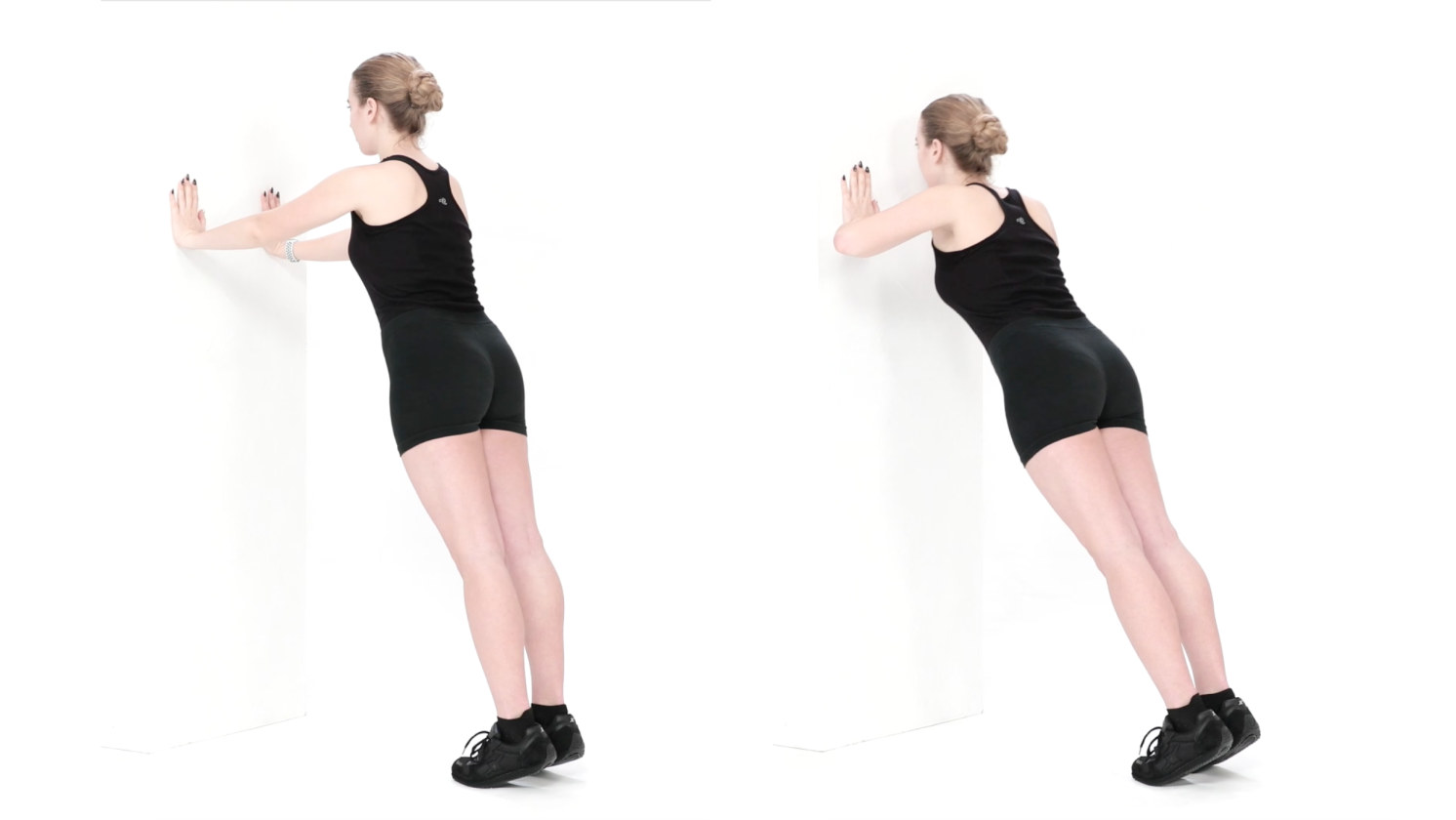 Wall push-ups
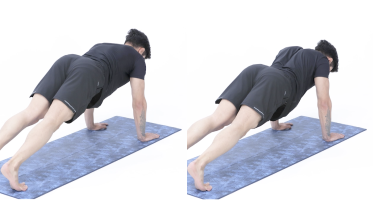 Push-up plus
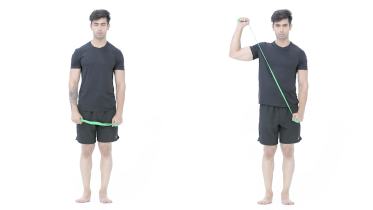 90/90 external rotation with band
Everyday tips while the shoulder settles
The position that tends to cause trouble is the arm lifted out to the side and turned back, as in throwing, reaching behind you into the back seat of a car, or sleeping with the hand behind your head. Many physios suggest avoiding it until your physio has checked the shoulder and says it is ready, then bringing it back slowly in stage 4. Work with things in front of you and below shoulder height where you can.
For sleep, many people find it easier on their back with a pillow under the sore arm, or on the good side hugging a pillow. The NHS says your doctor or physio will advise you on when it is safe to drive or play sport again. The answer depends on how the shoulder is recovering and what you need it to do.
When to see a physio or doctor
If the hospital has not arranged physiotherapy, ask your doctor about it. The NHS says a physio may recommend regular shoulder exercises to help reduce pain and stiffness. See your doctor or physio again if the shoulder slips out partly and goes back by itself, feels as if it will come out during everyday tasks or sport, or has come out more than once. OrthoInfo lists a shoulder that has dislocated several times as one reason a surgeon may suggest an operation.
It is also worth a check if you are not making progress after 6 to 12 weeks, the usual NHS recovery time, or if the arm stays weak. Get help straight away for any of the warning signs below.
For physiotherapists
This page gives patients a starting framework for nonoperative management after reduction of a traumatic anterior dislocation, first-time or recurrent. The 2026 Dutch multidisciplinary guideline recommends 1 week of relative immobilization, then physical therapy targeting early restoration of function, coordination and proprioception, and states that most of its recommendations rest on low GRADE evidence supplemented with expert opinion. Paterson (2010) found no benefit of sling immobilization beyond 1 week in patients under 30, and the 2019 Cochrane update (which replaced Hanchard 2014) remained uncertain about external rotation bracing and found no trials of rehabilitation.
The strongest trial data for exercise content come from the SINEX trial (Eshoj 2020), where a supervised neuromuscular program beat a home standard care program on WOSI at 12 weeks, with the between-group difference (228 points) below the prespecified MCID of 250. Screen patients over 40 for rotator cuff integrity and axillary nerve function; Robinson (2012) found cuff tears or tuberosity fractures in a third of 3,633 dislocations and a relative risk of 1.9 for neurological deficit when one was present. Progression here is by 24-hour response and apprehension, not by fixed timelines. Consider referral for a surgical opinion in patients under 40, contact athletes, suspected bone loss or recurrent instability.
See a doctor promptly if
- Chest pain or tightness, which may spread to your arm, neck or jaw, or shoulder or arm pain that comes with shortness of breath, sweating or feeling sick. This can be a heart attack. Call emergency services straight away.
- Your shoulder comes out again or stays out, feels as if it has slipped out of place, looks a different shape or suddenly locks so you cannot move the arm, or the pain is severe after a fall or an injury. Go to an emergency department straight away, without driving yourself, and call emergency services if you cannot get there. Do not try to put the shoulder back in yourself, and do not let a friend or teammate try.
- Your arm, hand or fingers turn cold, pale, blue or gray compared with the other side, or a swelling in your armpit keeps getting bigger. Call emergency services or go to an emergency department straight away, and do not drive yourself. The blood supply to the arm may be blocked.
- Numbness, pins and needles or weakness in the arm or hand, especially a numb patch on the outer side of the upper arm or trouble lifting the arm out to the side. This can mean a nerve was stretched when the shoulder came out, such as the nerve to the muscle on the outside of the shoulder (axillary nerve). Get medical advice the same day. If one side of your face or body suddenly goes numb or weak, or your speech becomes slurred or muddled, call emergency services, even if it goes away.
- You are over 40 and cannot lift your arm properly after the dislocation, for example you cannot raise it out to the side or hold it up. This can be a torn rotator cuff tendon or a nerve injury. See a doctor within a few days and ask whether you need a scan.
- The shoulder is hot, red and swollen, or you have a fever or feel unwell. This can be a joint infection. Go to an emergency department the same day.
- Night pain is common with this condition, but get checked within a few days if the pain is constant, no rest or change of position eases it at all, and it keeps getting worse. If you have had cancer, now or in the past, or are losing weight without trying, see your doctor sooner, within a day or two, and mention it. If you are being treated for cancer now, contact your cancer team the same day.
Common questions
How long do you wear a sling after a dislocated shoulder?
Usually from about 1 week up to a few weeks, so follow what your doctor told you. The NHS says you will need a sling for the first few weeks. A 2026 Dutch multidisciplinary guideline advises 1 week of relative immobilization after the shoulder is put back in. A review of trials by Paterson and colleagues (2010) found that in people under 30, a sling for 3 weeks or longer did not lower the risk of another dislocation compared with 1 week or less. Your doctor may advise a different time for your shoulder.
How long does a dislocated shoulder take to heal?
The NHS says it usually takes 6 to 12 weeks to recover from a dislocated shoulder, and it may take up to 16 weeks to fully return to some sports, and longer for some people. Your physio will adjust the program to how your shoulder is doing rather than to a date.
Will my shoulder dislocate again?
It might, and the risk depends mostly on your age and sex. In a study of 252 people aged 15 to 35 treated without surgery, the shoulder became unstable again in 55.7% within 2 years and 66.8% within 5 years, and young men had the highest risk (Robinson and colleagues, 2006). A review of trials found that about half of people managed with physiotherapy after a first dislocation did not dislocate again (Kavaja and colleagues, 2018). Women have a much lower risk, and being under 20 or under 30 at the first dislocation raises it.
Do I need surgery after a dislocated shoulder?
Most people are managed without it at first. A surgeon may discuss an operation if you are young, play a contact sport, have lost some bone from the socket, or the shoulder keeps coming out. Surgery to repair the torn rim of the socket lowered the risk of another dislocation in trials (Kavaja and colleagues, 2018), but it has its own risks and a long rehab. It is a decision to make with a shoulder surgeon.
Can you put a dislocated shoulder back in yourself?
No. The NHS advice is not to try to put your arm back in yourself, and to go to an emergency department. The doctor usually takes an X-ray first to confirm the dislocation and check for other injuries, then puts the joint back in with pain relief or sedation. Support the arm, keep it still and get to hospital.
When can I play sport again after a dislocated shoulder?
The NHS says it may take up to 16 weeks to fully return to some sports. Physios usually look for full, comfortable movement, good strength compared with the other side, and a shoulder that does not feel unsteady in the positions your sport needs. Contact and throwing sports usually come last. If you play a contact sport, ask a shoulder specialist about your risk of another dislocation before you go back.
References
- NHS. Dislocated shoulder. Page last reviewed 16 September 2026. https://www.nhs.uk/conditions/dislocated-shoulder/
- American Academy of Orthopaedic Surgeons. Dislocated shoulder. OrthoInfo. https://www.orthoinfo.org/en/diseases--conditions/dislocated-shoulder/
- van Gastel ML, Hekman KMC, Boon F, et al. Clinical practice on treatment of primary traumatic anterior shoulder dislocation: a multidisciplinary guideline. Acta Orthopaedica. 2026;97:531-537. https://doi.org/10.2340/17453674.2026.46434
- Paterson WH, Throckmorton TW, Koester M, Azar FM, Kuhn JE. Position and duration of immobilization after primary anterior shoulder dislocation: a systematic review and meta-analysis of the literature. Journal of Bone and Joint Surgery (American). 2010;92(18):2924-2933. https://doi.org/10.2106/JBJS.J.00631
- Braun C, McRobert CJ. Conservative management following closed reduction of traumatic anterior dislocation of the shoulder. Cochrane Database of Systematic Reviews. 2019;(5):CD004962. https://doi.org/10.1002/14651858.CD004962.pub4
- Kavaja L, Lähdeoja T, Malmivaara A, Paavola M. Treatment after traumatic shoulder dislocation: a systematic review with a network meta-analysis. British Journal of Sports Medicine. 2018;52(23):1498-1506. https://doi.org/10.1136/bjsports-2017-098539
- Eshoj HR, Rasmussen S, Frich LH, et al. Neuromuscular exercises improve shoulder function more than standard care exercises in patients with a traumatic anterior shoulder dislocation: a randomized controlled trial. Orthopaedic Journal of Sports Medicine. 2020;8(1):2325967119896102. https://doi.org/10.1177/2325967119896102
- Robinson CM, Howes J, Murdoch H, Will E, Graham C. Functional outcome and risk of recurrent instability after primary traumatic anterior shoulder dislocation in young patients. Journal of Bone and Joint Surgery (American). 2006;88(11):2326-2336. https://doi.org/10.2106/JBJS.E.01327
- Wasserstein DN, Sheth U, Colbenson K, et al. The true recurrence rate and factors predicting recurrent instability after nonsurgical management of traumatic primary anterior shoulder dislocation: a systematic review. Arthroscopy. 2016;32(12):2616-2625. https://doi.org/10.1016/j.arthro.2016.05.039
- Robinson CM, Shur N, Sharpe T, Ray A, Murray IR. Injuries associated with traumatic anterior glenohumeral dislocations. Journal of Bone and Joint Surgery (American). 2012;94(1):18-26. https://doi.org/10.2106/JBJS.J.01795
- Zhou R, Prasad G, Robinson S, Shahane S, Sinha A. The significance of urgent ultrasound scan for shoulder dislocation in patients above the age of 40: a prospective British Elbow and Shoulder Society pathway implementation study. Shoulder and Elbow. 2021;13(3):303-310. https://doi.org/10.1177/1758573220913285
- NHS. Heart attack. Page last reviewed 31 March 2026. https://www.nhs.uk/conditions/heart-attack/
Written and checked by the PocketPhysio editorial team. Last updated 2026-09-28.
This page is general education, not a diagnosis or a personal treatment plan. See a physiotherapist or doctor for advice about your own situation.