
AC joint sprain exercises and physiotherapy
What is an AC joint sprain?
The AC joint (acromioclavicular joint) is the small joint on top of your shoulder where the outer end of the collarbone meets the flat bony roof of the shoulder blade (the acromion). Ligaments hold it together: small ones around the joint itself, and stronger ones that tie the collarbone down to a bony knob at the front of the shoulder blade (the coracoclavicular ligaments). OrthoInfo, from the American Academy of Orthopaedic Surgeons, notes that the most common cause of an injury here is a fall directly onto the shoulder. The Cochrane review below describes it as one of the most common shoulder injuries in people who play sport.
You may hear it called an AC joint sprain, an AC joint separation or a shoulder separation. The NHS lists pain on top of the shoulder, where the collarbone and shoulder joint meet, as a sign of stretched or torn AC ligaments.
This is not the same as a dislocated shoulder, where the ball of the upper arm comes out of its socket. That is a different joint with a different rehab plan. This page is for adults. A child with a shoulder injury should be assessed by a doctor or physio before starting any program, and after AC joint surgery your surgeon's program comes first.
What the grades of an AC joint sprain mean
Doctors grade the injury from I to VI, based on which ligaments are torn and where the collarbone ends up on an X-ray. The descriptions below follow OrthoInfo and a 2024 review by Lindborg and colleagues.
- Grade I: the ligaments around the joint are stretched. The X-ray looks normal.
- Grade II: the ligaments around the joint are torn and the ones below are partly injured. The collarbone sits slightly out of line.
- Grade III: both sets of ligaments are torn, and the end of the collarbone sits clearly higher than the shoulder, which shows as a bump.
- Grade IV: the end of the collarbone is pushed backward.
- Grade V: the collarbone is pushed up much further than in grade III.
- Grade VI: the collarbone is pushed down under a bony knob at the front of the shoulder.
The grade matters because it guides treatment. Grades I and II do well without surgery, while grades IV to VI often need an operation (Cote and colleagues, 2010). Grade III sits in the middle and is where most of the debate is.
Do you need surgery for an AC joint sprain?
Most people do not. A review that set out best practice for grades I to III found agreement in the literature that these are managed without surgery, and that grades IV to VI are managed with surgery (Reid and colleagues, 2012). OrthoInfo notes that most people, even professional athletes, return to normal function without surgery, even if a clear bump remains.
The more serious injuries have been tested in trials. A Cochrane review of 6 trials with 357 people, mostly young men, found low-quality evidence that surgery gave no extra benefit in function, return to former activities or quality of life at one year compared with nonsurgical care (Tamaoki and colleagues, 2019). Function at 6 weeks may have been better without surgery, and surgery brought its own problems, such as trouble with the metal fixation and infection, mostly with older methods that are rarely used now. In a Canadian trial of 83 people with a complete AC dislocation, fixing the joint with a metal plate lined it up better on X-ray, but the nonsurgical group had less disability at 6 weeks and 3 months, and disability scores were the same from 6 months on. Fewer people in the nonsurgical group needed another operation (Canadian Orthopaedic Trauma Society, 2015).
When a higher grade injury needs a surgeon
Most surgeons recommend an operation for grades IV to VI, where the collarbone is pushed backward, far upward or down under the shoulder blade (Lindborg and colleagues, 2024). A 2022 treatment algorithm from a group of shoulder surgeons treats the first 3 weeks after the injury as the acute window for surgery (Berthold and colleagues, 2022). So if an X-ray shows a grade IV to VI injury, or the doctor is not sure of the grade, ask for a shoulder surgeon's opinion within the first couple of weeks rather than waiting to see how rehab goes.
Berthold and colleagues split grade III injuries into two groups. A stable joint with a shoulder blade that moves well may do well without surgery. A joint where the collarbone end also slides forward and back, and the shoulder blade still moves poorly despite rehab, may do better with an operation. Surgery may also be discussed for heavy manual workers and overhead athletes, although the authors note there is little evidence that these groups do better with it.
If a lower grade injury still hurts or feels unstable after 3 to 6 months of good nonsurgical care, a surgeon may discuss an operation then (Berthold and colleagues, 2022). For a grade II sprain that stays painful, a review describes removing a small piece from the end of the collarbone as one option (Lindborg and colleagues, 2024).
The first days after the injury: sling and gentle movement
According to OrthoInfo, the usual early treatment is a sling plus cold packs and pain medicine. The sling is for comfort, not to hold the joint in place. A 2024 review describes about 1 to 2 weeks in a sling for a grade I sprain, 3 to 4 weeks for a grade II, and 4 to 5 weeks for a grade III managed without surgery, with early movement as part of rehab (Lindborg and colleagues, 2024). Your doctor may advise a different time, so follow what you were told.
While you are in the sling, keep everything from the elbow down to the fingers moving. The NHS advice for shoulder pain is to keep gently moving the shoulder and not to stop using it completely. Ask a pharmacist or doctor which pain relief suits you. Sleeping on your back with a pillow under the sore arm, or on the good side, is often more comfortable in the first weeks.
If you are pregnant, one thing here changes. From about 28 weeks of pregnancy the NHS advises going to sleep on your side rather than on your back, because going to sleep on your back in the last months is linked to a higher risk of stillbirth. So use the good side, with the sore arm resting on a pillow in front of you, and leave lying on your back until after the birth. The NHS also says not to worry if you wake up on your back: settle onto your side again and carry on.
Does physiotherapy help an AC joint sprain?
It is the usual treatment, and rehab is part of care whether or not you have surgery (Cote and colleagues, 2010). OrthoInfo says the shoulder will need rehabilitation to restore motion, strength and flexibility either way. The review by Lindborg and colleagues (2024) describes rehab that focuses on the deltoid and trapezius, the two muscles that attach around the joint, along with the muscles that steady the shoulder blade.
The evidence for any particular program is thin. Reid and colleagues (2012) found no randomized trials of nonsurgical treatment for grades I to III, so their guideline rests on anatomy, how the joint moves, and clinical experience. The program below follows that general approach: protect and move, then rebuild strength, then load the arm in the positions your work or sport needs.
How to use this program
Start at stage 1 unless your physio has told you otherwise, and move up only when the current stage feels easy and the top of your shoulder is no worse the next morning. The sling times above give a rough idea of when stage 2 starts for each grade. Someone with a grade I sprain may move through the early stages in a couple of weeks, while a grade III usually takes longer.
Treat the numbers in each stage as common starting points rather than a prescription. Your physio will fit the exercises and sets, and how far you take each movement, to your shoulder, the grade of your injury and what you need to get back to.
Stage 1 should be pain free. From stage 2, some mild discomfort is fine as long as it fades soon after the session and the shoulder feels no worse the next morning. Sharp pain over the joint, pain that builds with each repetition, or a joint that is clearly more sore the next day means stop that exercise. Drop back a stage for a few days rather than stopping altogether.
The exercise program
Stage 1: Protect the joint and keep the arm moving
For the first days to weeks after the injury, while you use the sling for comfort. Take the arm out of the sling to keep your elbow, wrist and hand moving, and for the pendulum, which moves the shoulder while its muscles stay relaxed, often for 30 to 60 seconds in each direction, a few times a day; keep the swings small, and leave it out if letting the arm hang pulls on the sore spot. With a grade III injury, ask your physio before you start it, because the weight of a hanging arm pulls the shoulder down, away from the collarbone. The shoulder blade squeeze wakes up the muscles that hold the shoulder blade back, often 10 to 15 squeezes held for about 5 seconds, 2 to 3 times a day. The static holds work the rotator cuff with the arm by your side, often 5 to 10 holds of 5 to 10 seconds, once or twice a day. Keep everything in this stage pain free, and push gently rather than hard.
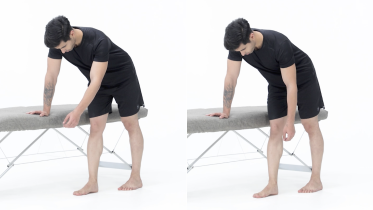 Pendulum exercise for the shoulder
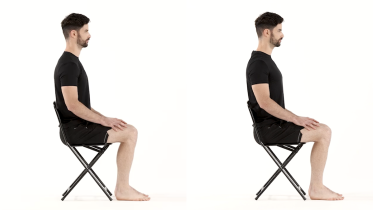 Scapular squeeze
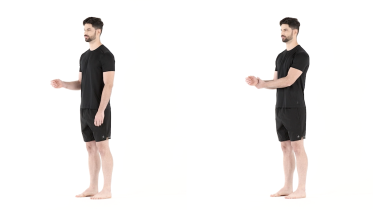 Isometric shoulder external rotation
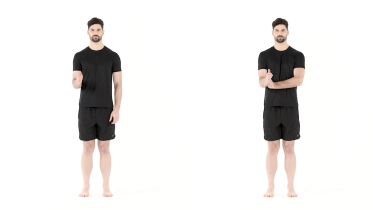 Isometric shoulder internal rotation
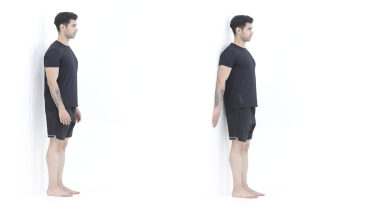 Isometric shoulder extension
Stage 2: Get the movement back
When the sling is off, or only used now and then, and everyday tasks at waist height are comfortable. The lying stick lift lets the good arm help the sore one up while you lie on your back, often about 10 slow lifts, 1 to 3 times a day, before you move on to the standing stick lift and the wall slides, often 10 to 15 slow repetitions, 1 to 3 times a day (once or twice for the wall slides). The sideways table slide takes the arm out to the side while the table carries its weight, often 10 to 15 slow slides, 1 to 3 times a day, and the side-lying outward turn, often 2 to 3 sets of 10 to 15 once a day with no weight in the hand, is the first step from holds to a moving arm. In practice, lifting the arm high overhead and reaching across your body are often the last movements to feel easy, so go only as far as stays comfortable and build the range over days. Mild discomfort that settles soon after and is no worse the next morning is fine.
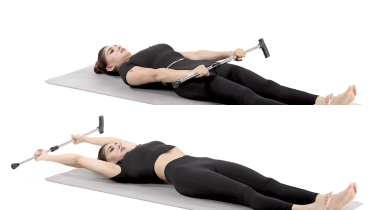 Lying shoulder flexion with a stick
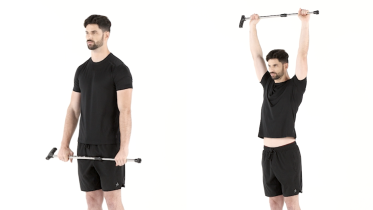 Shoulder flexion with a stick
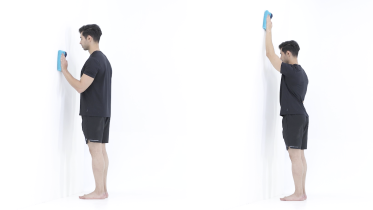 Wall slides with a towel
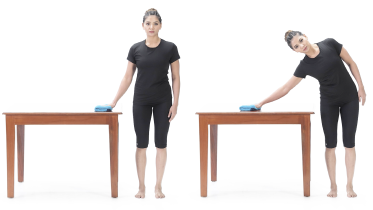 Sideways table slide
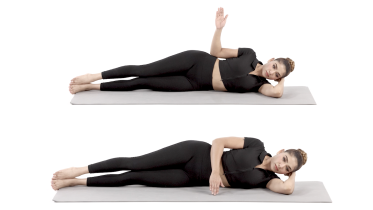 Side-lying external rotation
Stage 3: Strengthen the shoulder blade and rotator cuff
When you can lift the arm to about shoulder height with little pain and the stage 2 exercises feel easy. Turning the arm out and in against a light band with the elbow at your side strengthens the rotator cuff, while the band row and the serratus punch train the muscles that steady the shoulder blade; many programs use 2 to 3 sets of 10 to 15 for the band work and 2 to 3 sets of 10 reaches for the punch, once a day or every other day. Shrugs work the upper trapezius, which attaches to the outer end of the collarbone and is one of the two muscles rehab for this injury aims to strengthen, often 2 to 3 sets of 10 to 15. Start with no weight, and hold a light weight only once carrying a light bag on that side is comfortable, because a weight in the hand pulls down on the joint. Wall push-ups, often 2 to 3 sets of 10 to 15 a few days a week, are the first step toward putting weight through the arms. If carrying the weight or leaning on the arm leaves the top of the shoulder aching for the rest of the day, go lighter.
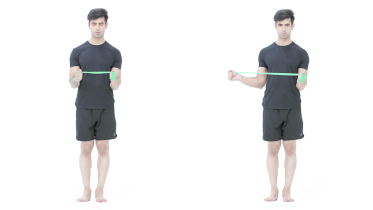 Shoulder external rotation with band
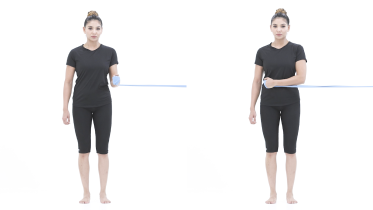 Shoulder internal rotation with band
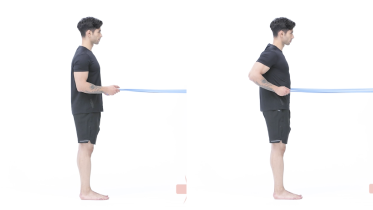 Resistance band row
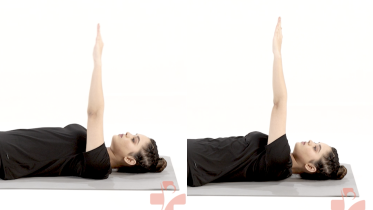 Serratus punch
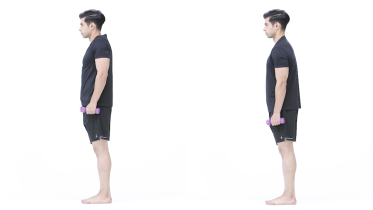 Shoulder shrugs
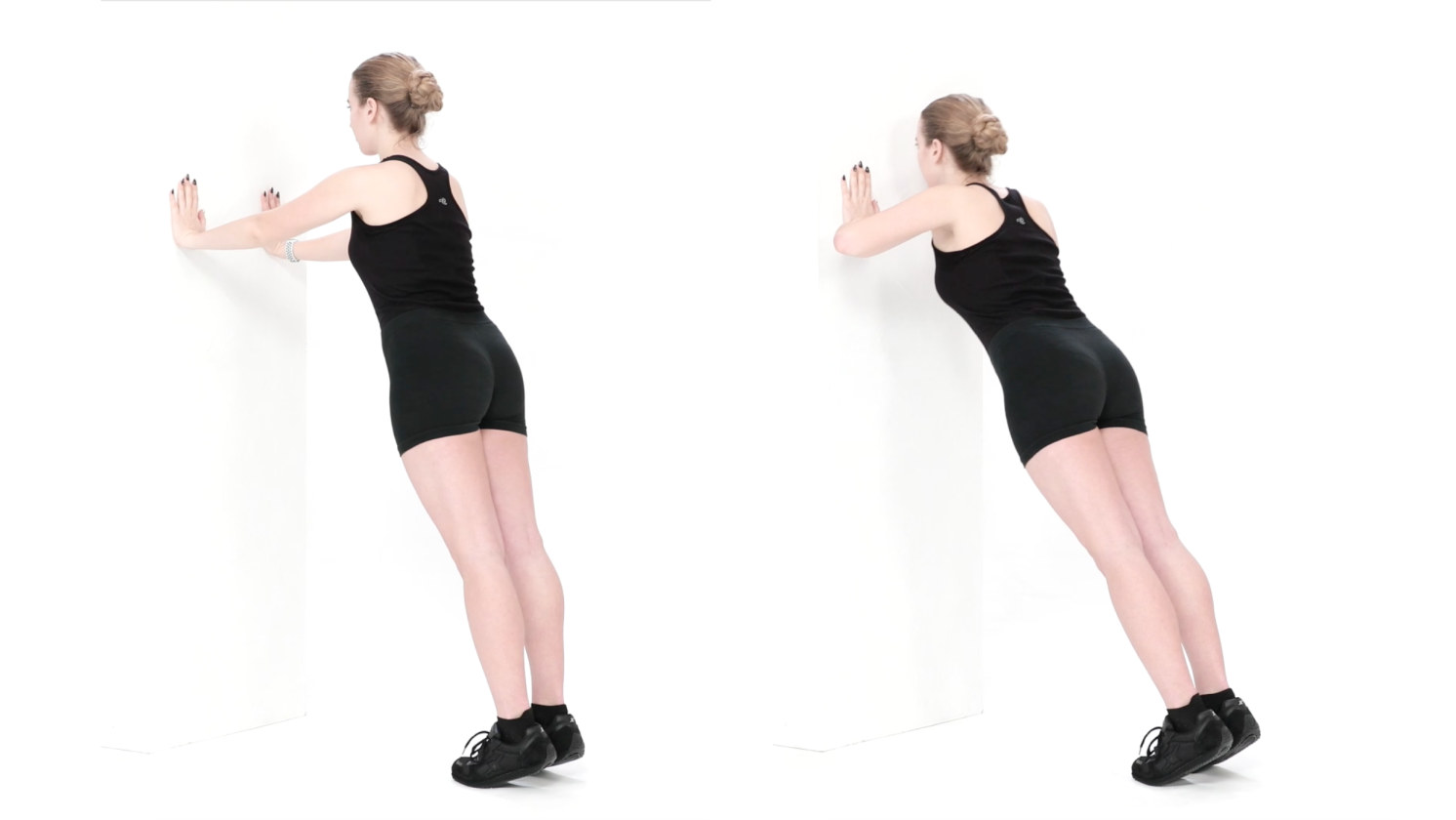 Wall push-ups
Stage 4: Build toward lifting and sport
When 3 sets of the stage 3 exercises feel easy and the joint is no worse the next day. The band lift to the side and the front raise build strength with the arm raised, often 2 to 3 sets of 8 to 15 for the band lift and 8 to 12 for the front raise, and the prone Y raise, often 2 to 3 sets of 8 to 12 with a 3 to 5 second hold, works the lower shoulder blade muscles with the arm up. The push-up plus (2 to 3 sets of 8 to 12, a few days a week) and the seated press (2 to 3 sets of 8 to 12 with a light weight, 2 to 3 times a week) bring back pushing, first in front of you and then overhead. The 90/90 band turn, often 2 to 3 sets of 8 to 15, trains the arm-up, turned-out position used in throwing and overhead sport. From here, heavier gym lifts and sport come back in steps, as described below the program.
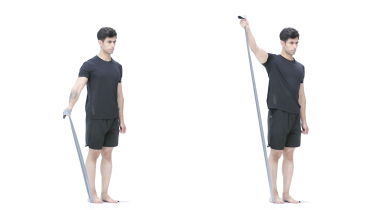 Shoulder abduction with band
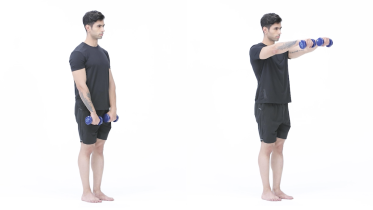 Dumbbell front raise
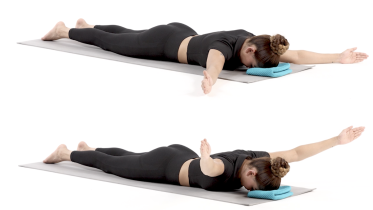 Prone Y raise
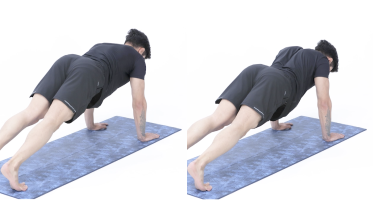 Push-up plus
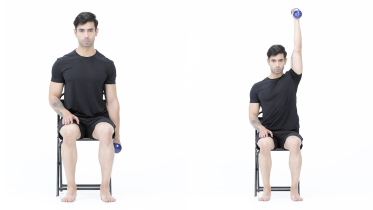 Seated dumbbell shoulder press
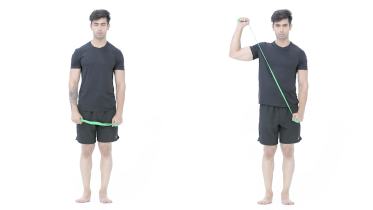 90/90 external rotation with band
Getting back to lifting and the gym
Heavy pushing, such as bench presses and dips, presses the two ends of the AC joint together, so it tends to come back last. Many physios bring back rows and pulldowns first, then presses in front of the body. Bench presses and dips come last, along with heavy overhead presses, started light and through a shorter range. That order is common practice rather than something trials have tested. One small study described in the Lindborg review followed 25 people with grade III injuries managed without surgery: shoulder movement and turning strength were normal, but bench press strength was 17% lower and 16% felt the result was not as good as they wanted.
A sign the load is too much is an ache on top of the shoulder that lasts into the next day, or pain at the bottom of a bench press or dip. Cut the weight or the range for a week or two, then build up again.
Getting back to sport
There is no fixed return date, and physios usually decide by how the shoulder performs rather than by the calendar. Before contact sport, they often look for full, comfortable movement, strength close to the other side, and no pain over the joint when you push up, carry, or land on the arm. Some players use padding over the joint when they return, which is common practice rather than tested. A review of AC and sternoclavicular injuries in contact sports found that the overhead demands of a sport affected how well people got back more than the amount of contact did (Moyal and colleagues, 2025). If you throw, swim or play a racket sport, expect the longest build-up.
AC joint arthritis
The AC joint can also wear over time, as with other joints, and it can wear years after an injury. OrthoInfo describes the pain of AC joint arthritis as focused on the top of the shoulder. Menge and colleagues (2014) note it can also feel like pain in the neck, shoulder or arm, which makes it easy to confuse with other problems. Wear on an X-ray or scan is common and often causes no pain: a review found signs of AC joint arthritis on 70% of MRI scans in people who were not seeking care for their shoulder (Rossano and colleagues, 2022).
Most people start with pain relief and physiotherapy while they cut back on whatever sets the pain off. A steroid injection is sometimes added (Menge and colleagues, 2014). A review of treatment for long-lasting AC joint arthritis found no studies that tested exercise or other non-drug treatments on their own, so the exercise advice here is based on practice, not trials (Farrell and colleagues, 2019). Physios often use exercises like those in stages 3 and 4, going easy on reaching across the body and on heavy pushing. If nothing helps after about 4 to 6 months, the most often reported cutoff, a surgeon may suggest removing a small piece from the end of the collarbone.
People who lift weights, especially those who bench press a lot, can get a related problem where the end of the collarbone becomes sore and thins (distal clavicle osteolysis). In a scoping review, bench pressing was the most common activity linked with it, and most people got better without surgery (Wilkinson and colleagues, 2026).
When to see a physio or doctor
After a fall onto the shoulder, get it checked the same day if you cannot use the arm normally or it is very swollen or bruised. If the shoulder looks a different shape or the pain is severe, go to an emergency department straight away, as in the warning signs below. An X-ray is how the grade is set and how a broken collarbone is ruled out.
The NHS advises getting urgent medical advice for shoulder pain that started after an injury or accident, such as a fall. If a doctor has already checked the bump and told you it comes from your AC joint injury, that bump on its own is expected. A new change in shape after another fall or blow needs an emergency department, and if the bump looks clearly bigger over the first weeks without a new injury, tell your doctor or physio within a few days, as the grade may need checking again.
See a physio or doctor if the shoulder is not getting better after a few weeks, if it clicks, catches or feels unstable, or if you cannot lift the arm properly. Pain that comes on gradually on top of the shoulder can come from the AC joint, but also from the rotator cuff, shoulder impingement or the neck, and each needs a different plan. Some of the warning signs below need help straight away, so read them before you start.
For physiotherapists
This page gives patients a starting framework for nonoperative management of Rockwood type I to III AC joint injuries, with a brief section on AC joint osteoarthritis. Reid (2012) found no RCTs of conservative management for grades I to III, so staging here follows general principles: comfort-led sling use, early range of motion, scapular and rotator cuff strengthening, then graded loading toward overhead and pushing tasks. The Cochrane review (Tamaoki 2019, 6 trials, 357 participants) found low-quality evidence of no difference in function at one year between operative and conservative treatment, and the COTS trial (2015) found hook plate fixation radiographically but not clinically superior for acute complete dislocations.
Berthold (2022) proposes surgery for acute types IV to VI within about 3 weeks, and distinguishes type IIIA (stable, no clavicular overriding on the cross-body adduction view, no significant scapular dysfunction) from type IIIB (horizontal instability and therapy-resistant scapular dysfunction), with the latter more likely to benefit from reconstruction. For chronic symptoms, it suggests surgery after 3 to 6 months of failed nonoperative care. After a fall onto the shoulder, rule out a clavicle fracture, and check the rotator cuff if weakness persists. For AC joint osteoarthritis, Farrell (2019) found no studies evaluating nonpharmacological interventions alone, and 4 to 6 months was the most common definition of failed conservative care before distal clavicle excision.
See a doctor promptly if
- Chest pain or tightness, which may spread to your arm, neck or jaw, or shoulder or arm pain that comes with shortness of breath, sweating or feeling sick. This can be a heart attack. Call emergency services straight away.
- After a fall or a blow to the shoulder or collarbone, bone is sticking out through the skin, the shoulder swells up very quickly, you are bleeding heavily, or you find it hard to breathe, have chest pain or cough up blood. Call emergency services straight away.
- The shoulder feels as if it has slipped out of place, looks a different shape or suddenly locks so you cannot move the arm, or the pain is severe after a fall or an injury. Go to an emergency department straight away, without driving yourself, and do not try to put the shoulder back in yourself.
- Your arm, hand or fingers turn cold, pale, blue or gray compared with the other side. Call emergency services or go to an emergency department straight away, and do not drive yourself. The blood supply to the arm may be blocked.
- After a fall or a blow to the shoulder, the shoulder is very swollen or bruised, or you cannot use your arm normally. Get it checked the same day, as the collarbone or the top of the arm may be broken.
- The shoulder is hot, red and swollen, or you have a fever or feel unwell. This can be a joint infection. Go to an emergency department the same day.
- Sudden, very bad shoulder pain, or you suddenly cannot lift or move your arm at all. Get medical help the same day.
- Pins and needles or numbness in the arm that does not go away, no feeling in part of the arm, or weakness that is getting worse. Get medical advice the same day. For pain spreading down the arm from your neck, ask for an urgent appointment with your doctor. If one side of your face or body suddenly goes numb or weak, or your speech becomes slurred or muddled, call emergency services, even if it goes away.
- The arm stays weak after the injury even as the worst pain eases, for example you cannot lift it out to the side or hold it up. This can be a torn rotator cuff tendon from the same fall. Ask for an urgent appointment with your doctor, within days rather than weeks, because UK shoulder surgeons advise urgent referral for a rotator cuff tear caused by an injury.
- Severe pain in both shoulders that has come on recently. Ask for an urgent appointment with your doctor.
- New shoulder pain and you have had cancer, now or in the past, or you are losing weight without trying. See your doctor within a day or two and mention it. If you are being treated for cancer now, contact your cancer team the same day.
- Night pain is common with this condition, but get checked within a few days if the pain is constant, no rest or change of position eases it at all, and it keeps getting worse. If you have had cancer, now or in the past, or are losing weight without trying, see your doctor sooner, within a day or two, and mention it. If you are being treated for cancer now, contact your cancer team the same day.
Common questions
How long does an AC joint sprain take to heal?
It depends on the grade, and there is no well-tested timeline. A 2024 review describes a sling for comfort for about 1 to 2 weeks after a grade I sprain and 3 to 4 weeks after a grade II, with rehab carrying on after that (Lindborg and colleagues, 2024). Higher grades take longer. Some people still notice occasional symptoms years later, so it is worth finishing the strength stages even once daily life feels normal.
Is a shoulder separation the same as a dislocated shoulder?
No. A shoulder separation is another name for an AC joint injury, at the joint where the collarbone meets the top of the shoulder blade. A dislocated shoulder means the ball of the upper arm has come out of its socket, which is a different joint and needs different care. OrthoInfo explains the difference. If your ball and socket joint came out, see the dislocated shoulder program instead.
Do I need surgery for an AC joint separation?
Most people do not. Grade I and II sprains are managed without surgery, and many grade III injuries are too. A Cochrane review found low-quality evidence that surgery gave no extra benefit in function, return to former activities or quality of life at one year compared with nonsurgical treatment (Tamaoki and colleagues, 2019). Surgeons usually recommend an operation for grades IV to VI, where the collarbone is pushed far out of place, so these need a surgeon's opinion early.
Will the bump on my shoulder go away?
Often it does not, after a higher grade injury. OrthoInfo notes that most people, even professional athletes, get back to normal function without surgery, even when a clear bump remains. In a Canadian trial of complete AC dislocations, surgery lined the joint up better on X-ray but did not give a better result for the shoulder (Canadian Orthopaedic Trauma Society, 2015). If the look of the bump bothers you, talk it through with a shoulder surgeon.
Can I lift weights with an AC joint injury?
Usually yes, once the shoulder has worked through the stages, but build up slowly. In practice, pulling exercises such as rows tend to come back before heavy pushing, and bench presses, dips and heavy overhead presses usually come last. If the top of the shoulder aches after a session and is still sore the next day, the load or the range was too much for now. Your physio will adjust this.
What is AC joint arthritis?
It is wear of the AC joint, which can come on with age or years after an injury there. OrthoInfo describes the pain as focused on the top of the shoulder. Treatment usually starts with changing the activities that hurt, pain relief and physiotherapy, and sometimes an injection. If that does not help after several months, a surgeon may suggest removing a small piece from the end of the collarbone.
References
- American Academy of Orthopaedic Surgeons. Shoulder separation. OrthoInfo. https://www.orthoinfo.org/en/diseases--conditions/shoulder-separation/
- American Academy of Orthopaedic Surgeons. Arthritis of the shoulder. OrthoInfo. https://www.orthoinfo.org/en/diseases--conditions/arthritis-of-the-shoulder/
- Tamaoki MJ, Lenza M, Matsunaga FT, Belloti JC, Matsumoto MH, Faloppa F. Surgical versus conservative interventions for treating acromioclavicular dislocation of the shoulder in adults. Cochrane Database of Systematic Reviews. 2019;(10):CD007429. https://doi.org/10.1002/14651858.CD007429.pub3
- Canadian Orthopaedic Trauma Society. Multicenter randomized clinical trial of nonoperative versus operative treatment of acute acromio-clavicular joint dislocation. Journal of Orthopaedic Trauma. 2015;29(11):479-487. https://doi.org/10.1097/BOT.0000000000000437
- Reid D, Polson K, Johnson L. Acromioclavicular joint separations grades I-III: a review of the literature and development of best practice guidelines. Sports Medicine. 2012;42(8):681-696. https://doi.org/10.2165/11633460-000000000-00000
- Cote MP, Wojcik KE, Gomlinski G, Mazzocca AD. Rehabilitation of acromioclavicular joint separations: operative and nonoperative considerations. Clinics in Sports Medicine. 2010;29(2):213-228. https://doi.org/10.1016/j.csm.2009.12.002
- Lindborg CM, Smith RD, Reihl AM, Bacevich BM, Cote M, O'Donnell E, Mazzocca AD, Hutchinson I. Current concepts in management of acromioclavicular joint injury. Journal of Clinical Medicine. 2024;13(5):1413. https://doi.org/10.3390/jcm13051413
- Berthold DP, Muench LN, Dyrna F, Mazzocca AD, Garvin P, Voss A, Scheiderer B, Siebenlist S, Imhoff AB, Beitzel K. Current concepts in acromioclavicular joint (AC) instability: a proposed treatment algorithm for acute and chronic AC-joint surgery. BMC Musculoskeletal Disorders. 2022;23(1):1078. https://doi.org/10.1186/s12891-022-05935-0
- Moyal AJ, Burkhart RJ, Adelstein JM, Voos JE, Apostolakos JM, Calcei JG. Acromioclavicular and sternoclavicular joint injuries in contact sports. Annals of Joint. 2025;10:31. https://doi.org/10.21037/aoj-25-19
- Farrell G, Watson L, Devan H. Current evidence for nonpharmacological interventions and criteria for surgical management of persistent acromioclavicular joint osteoarthritis: a systematic review. Shoulder and Elbow. 2019;11(6):395-410. https://doi.org/10.1177/1758573219840673
- Rossano A, Manohar N, Veenendaal WJ, van den Bekerom MPJ, Ring D, Fatehi A. Prevalence of acromioclavicular joint osteoarthritis in people not seeking care: a systematic review. Journal of Orthopaedics. 2022;32:85-91. https://doi.org/10.1016/j.jor.2022.05.009
- Menge TJ, Boykin RE, Bushnell BD, Byram IR. Acromioclavicular osteoarthritis: a common cause of shoulder pain. Southern Medical Journal. 2014;107(5):324-329. https://doi.org/10.1097/SMJ.0000000000000101
- Wilkinson M, Groch N, Freestone CA, Clements A, Obst S. Risk factors and management of atraumatic distal clavicular osteolysis: a scoping review. Shoulder and Elbow. 2026. https://doi.org/10.1177/17585732261479715
- Kulkarni R, Gibson J, Brownson P, Thomas M, Rangan A, Carr AJ, Rees JL. Subacromial shoulder pain. BESS/BOA Patient Care Pathways. Shoulder and Elbow. 2015;7(2):135-143. https://doi.org/10.1177/1758573215576456
- NHS. Shoulder pain. Page last reviewed 22 May 2023. https://www.nhs.uk/symptoms/shoulder-pain/
- NHS. Broken collarbone. Page last reviewed 2 August 2023. https://www.nhs.uk/conditions/broken-collarbone/
- NHS. Heart attack. Page last reviewed 31 March 2026. https://www.nhs.uk/conditions/heart-attack/
- NHS. 27 weeks pregnant: the best sleeping positions during pregnancy. Best Start in Life week by week guide. https://www.nhs.uk/best-start-in-life/pregnancy/week-by-week-guide-to-pregnancy/2nd-trimester/week-27/
Written and checked by the PocketPhysio editorial team. Last updated 2026-09-30.
This page is general education, not a diagnosis or a personal treatment plan. See a physiotherapist or doctor for advice about your own situation.