
Rotator cuff repair rehab: exercises and recovery after surgery
What is a rotator cuff repair?
The rotator cuff is a group of muscles closely wrapped around the top of the arm bone. They keep the shoulder joint in the right position and control its movements (Robert Jones and Agnes Hunt).
In a repair, the surgeon reattaches the torn tendon or tendons to the bone, either through a few small keyhole (arthroscopic) cuts or through a larger open cut over the top of the shoulder at the front. Usually it is the tendon over the top of the shoulder (supraspinatus) that is torn. Sometimes the tear is too big or the tendon too fragile for a full repair, so only part of it can be reattached (Oxford). In the UKUFF trial of 273 people aged 50 or over, keyhole and open repair gave a similar improvement at 2 years (Carr and colleagues, 2015).
This page is for adults in the weeks and months after a rotator cuff repair. After a partial or repeat repair, or a repair done alongside other shoulder surgery such as a stabilization, your team's plan may be quite different, so follow it rather than this page. If your shoulder pain came on gradually and you have not had surgery, the rotator cuff tendinopathy program is the better starting point.
Your surgeon's and physio's plan comes first
Every surgical team has its own plan. It depends on the size of the tear, how many tendons were repaired, the quality of the tendon and how secure the repair was. It tells you how long to wear the sling, which movements are allowed and when, and when the arm may start to work by itself. Where it differs from this page, follow your team's plan, and if you are not sure what your plan is, ask them before you change what you do.
The Oxford leaflet puts it plainly: because the size and strength of repairs vary, it can only give rough guidelines, and you must be guided by your surgical team at all times. Some repairs change particular exercises. After a repair of the tendon at the front of the shoulder (subscapularis), for example, Oxford leaves out the early exercise that turns the arm outward. Your physio will tell you which exercises to do and when to move on.
What recovery usually looks like
Every shoulder recovers at its own pace, so treat these as typical times, not targets. Most plans move through three phases: protecting the repair in a sling, getting the movement back, then rebuilding strength. Oxford gives a minimum of 3 weeks in the sling but usually 4, and up to 6 weeks after a major repair. OrthoInfo, from the American Academy of Orthopaedic Surgeons, says 4 to 6 weeks.
In the first phase, the shoulder is moved only for particular exercises. The ASSET consensus, written by a society of shoulder therapists, suggests 2 weeks of strict rest in the sling after small to medium repairs, then gentle movement done for the arm up to 6 weeks, and it recommends 6 weeks of strict rest with a later start when there are concerns about how the tendon will heal (Thigpen and colleagues, 2016). Oxford starts the second phase, getting everyday movement back, once you get the go-ahead between 3 and 6 weeks. The arm is used at waist level at first and gradually for light tasks away from the body.
Strengthening usually starts at about 12 weeks (Oxford; Thigpen and colleagues, 2016), or from 8 to 12 weeks according to OrthoInfo. OrthoInfo says most people have a useful range of movement and enough strength by 4 to 6 months. The Robert Jones and Agnes Hunt leaflet gives a total rehab time of about 9 months, and Oxford notes that the arm can keep improving for 1 to 2 years.
Why the early months are protected
A repaired tendon takes a long time to heal back onto the bone. The ASSET consensus says the repaired tendon does not approach normal strength until at least 6 months, and that when a repair fails, it tends to happen in the first 3 to 6 months (Thigpen and colleagues, 2016). That is why the early exercises move the arm for you, and why heavier loads wait.
Rest has a cost too. A shoulder that barely moves for weeks can stiffen, and OrthoInfo notes that early rehab lowers the chance of permanent stiffness. So the stages below try to do both jobs: move the joint enough to keep it free, and load it little enough to let the tendon heal.
How often stiffness happens depends on which source you read. Oxford says 1 to 5 in every 100 people have some stiffness or pain after this operation or develop a frozen shoulder. The Robert Jones and Agnes Hunt leaflet says about 20 in 100 have some pain or stiffness, and about 5 in 100 develop painful stiffness that gradually improves with physiotherapy. The ASSET consensus puts stiffness that is still there a year after surgery at 3 to 10 in 100 (Thigpen and colleagues, 2016).
The first weeks after surgery
Many people have a nerve block injected at the side of the neck, which leaves the arm numb and weak, often into the next day. Oxford says it usually wears off within 12 to 48 hours. Keep the arm in the sling until it has, and keep it away from heat and cold, because you could hurt it without feeling it. The block can also cause a droopy eyelid or a blocked nose on that side, a hoarse voice or feeling slightly breathless, and Oxford advises getting advice from the ward if any of these last more than 48 hours. Breathlessness that comes on suddenly, gets worse rather than better, or comes with chest pain is different: call emergency services straight away.
Oxford advises taking your pain relief regularly for the first 2 to 3 days, even if you are comfortable, as pain can sometimes come back suddenly. Bruising around the shoulder and upper arm and some swelling of the arm are common and fade over a few weeks. An ice pack with a damp tea towel between it and your skin, for 10 to 15 minutes several times a day, can help (Oxford), but take care over any skin that is still numb. Keep the wound dry until it has healed, usually 10 to 14 days, and your stitches or clips are usually ready to come out after about 10 days (Oxford).
Blood clots are rare after shoulder surgery, and Oxford puts them at fewer than 1 in 100 people. The NHS notes that the signs of a clot can sometimes show up in the arm as well as the leg. If you were given stockings, injections or tablets to lower the risk, use them exactly as your team told you. The warning signs of a clot are listed below.
Does early movement after a rotator cuff repair help?
It seems to be safe, but the gains are small. A review of 20 trials with 1,841 people compared starting rehab early after the operation with starting it later (Mazuquin and colleagues, 2021). Early rehab made no clear difference to pain or function at almost every point measured. It gave slightly better range of movement, but the differences were small and unlikely to matter much in daily life, and it did not seem to raise the risk of the repair tearing again.
The authors called for a large trial of a more individual approach, in which people start using the arm as soon as they feel able, within their own pain. A UK trial, RaCeR 2, is testing that against standard rehab with at least 4 weeks in the sling (Mazuquin and colleagues, 2024). Until its results are in, the timing is a decision for your surgeon, based on your repair.
The ASSET consensus is expert opinion, the lowest level of evidence, and its authors say the lack of consistent trial timelines rules out one clear rule for everyone. So the stages below follow NHS patient leaflets and that consensus rather than a single tested program. Your own team's plan still comes first.
How to use this program
Start only with the exercises your team has given you or cleared. Stage 1 is for the sling weeks. Move to stage 2 when your team says the arm can start working, often between 3 and 6 weeks, and to stage 3 when your team says strengthening can start, usually around 12 weeks. The timings come from NHS leaflets and common practice, so take them as a rough guide.
Each exercise page gives a typical starting dose. As a rough guide, both NHS leaflets suggest short sessions of 5 to 10 minutes about 4 times a day in the early weeks rather than one long session, and Oxford's early exercises start with about 5 slow repetitions, built up as your physio advises. The strength exercises later often use 2 to 3 sets of 10 to 15 slow repetitions, once a day or every other day, with a light band or weight. Your physio will adjust the exercises and the numbers to your shoulder and your plan.
Aching, discomfort or a stretching feeling during the exercises is normal (Oxford). Intense pain that lasts 30 minutes or more afterward means do the exercises more gently or less often, and if that does not help, tell your physio (Oxford; Robert Jones and Agnes Hunt). In stage 1, the operated arm stays relaxed and is moved for you, so do not lift it with its own muscles until your team says you can. Never force a movement, and stop at the limit your team set even if you could go further. Breathe normally through every repetition rather than holding your breath.
The exercise program
Stage 1: Protect the repair and keep the joint moving
For the sling weeks, typically the first 3 to 6 weeks, and only the exercises your surgeon or physio has given you. The sling comes off only for the exercises and for washing, and only once the nerve block has worn off. The operated arm stays relaxed while it is moved for you. In the pendulum it swings with the sway of your body. In the seated passive lift a helper, shown what to do by your physio, lifts it forward, and in the lying stick lift your other arm raises it with a stick. Each lift goes only as high as your team allows, often no higher than shoulder height in these weeks. In the lying lift, that means the arm pointing at the ceiling. The seated lift's own page shows the arm going right up, but in these weeks keep to the height your team set. The stick turn is gentler here than on its own page too. It is often done lying on your back with a folded towel under the upper arm, and the forearm goes only a short way out, often no more than a third of the way from pointing forward to pointing out to the side. Do not hold it at a stretch. Leave it out after a repair of the tendon at the front of the shoulder (subscapularis) unless your surgeon says otherwise. Shoulder blade depression, sitting with the arm hanging straight by your side, works the muscles that draw the shoulder blade down without lifting the arm. Many plans spread these over short sessions a few times a day. Each exercise often starts with about 5 slow, gentle repetitions, built up as your physio advises, and the pendulum with 30 to 60 seconds in each direction. An ache or a stretching feeling is normal, but pain that stays intense for 30 minutes or more means go more gently or less often.
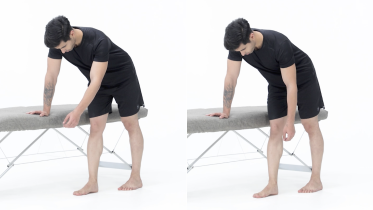 Pendulum exercise for the shoulder
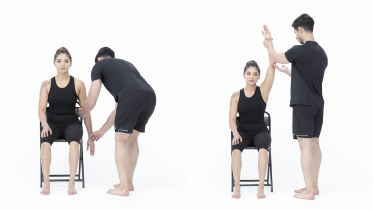 Seated passive shoulder flexion
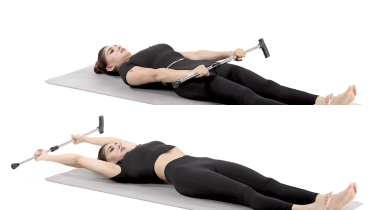 Lying shoulder flexion with a stick
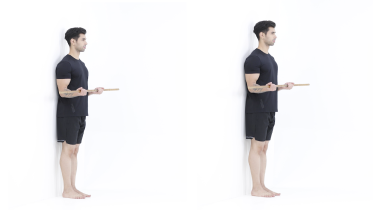 Shoulder external rotation with a stick
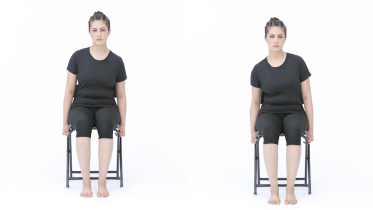 Shoulder blade depression
Stage 2: Get the movement back
When your team says the arm can come out of the sling and start working, often between 3 and 6 weeks after surgery. Passive lifting out to the side and the two pulley exercises add range. For the passive side lift you lie on your back while a helper, shown what to do by your physio, moves the arm, and on the pulleys your other arm does the pulling. Lifting the arm out to the side, and turning it out while it is raised, stretch the repair more than lifting it forward. So many plans bring these in later in this stage, and only as far as your team allows. Side lying shoulder flexion and the seated outward turn are often the first movements the arm makes by itself. In side lying, the arm swings level with the floor instead of lifting against its own weight. In the outward turn, the elbow stays bent to keep the load small. After a subscapularis repair, ask how far the arm may turn out before you start the seated outward turn, as many plans keep that turn limited for longer. The lying serratus punch, with a helper holding the arm up, and the lying shoulder blade press, with the arms by your sides, train the shoulder blade muscles without the arm carrying its own weight. Add the gentle outward press against your own hand only when your team says the repair can take resistance, and push well short of your hardest, often starting with about 5 holds of 5 seconds once or twice a day and building up as your physio advises. Use the arm for light tasks at waist height, but do not lift anything with weight in it, such as a kettle or a saucepan, until your team says you can, often 8 to 12 weeks after surgery.
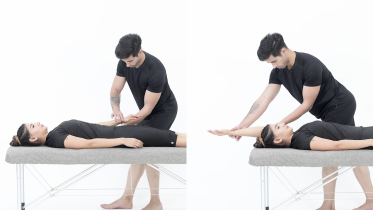 Lying passive shoulder abduction
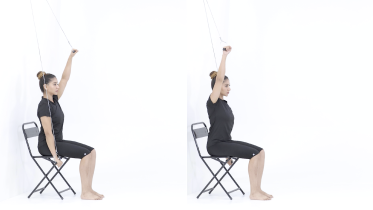 Shoulder pulley flexion
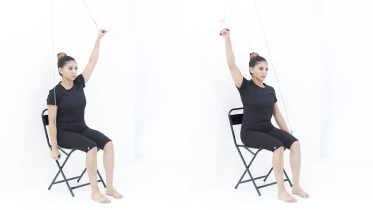 Shoulder pulley abduction
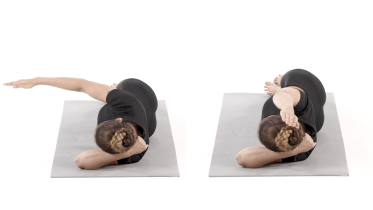 Side lying shoulder flexion
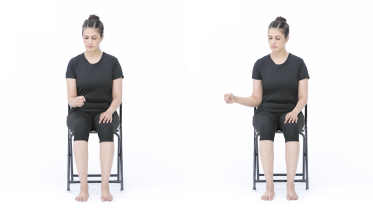 Seated shoulder external rotation
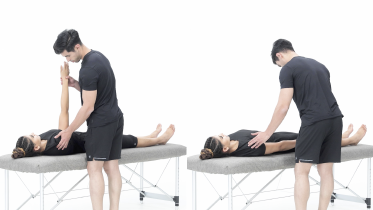 Lying serratus punch
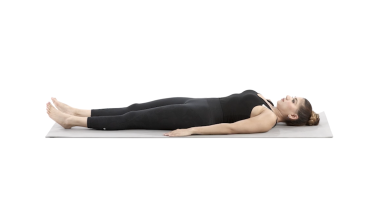 Lying shoulder blade press
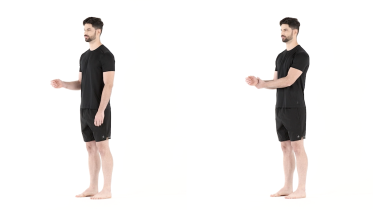 Isometric shoulder external rotation
Stage 3: Rebuild strength
Usually from about 12 weeks, when your team says strengthening can start. Wall ball flexion and side lying abduction without a weight get the arm working against gravity. Leave the wall ball until you can lift the arm above shoulder height without pain. The band turn strengthens the muscles that turn the arm out, often 2 to 3 sets of 10 to 15 slow repetitions once a day with a light band. Side lying abduction with a light dumbbell comes next, often about 1 kg (2 lb) or less at first, and the standing front hold, which lifts both arms to shoulder height with a similar light weight, comes last, often 2 to 3 times a week. Keep up the stage 2 movement exercises too, because a stiff shoulder does not strengthen well and pushing on can make it stiffer. Heavier lifting, manual work and racket sports usually wait until about 4 to 6 months, so plan the build-up with your physio if you need them.
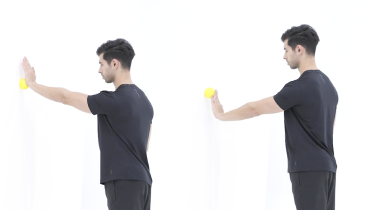 Wall ball shoulder flexion
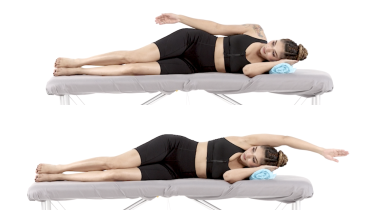 Side lying shoulder abduction
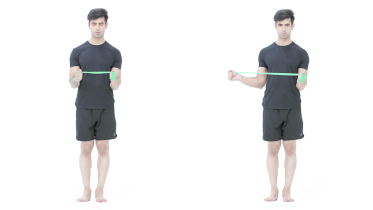 Shoulder external rotation with band
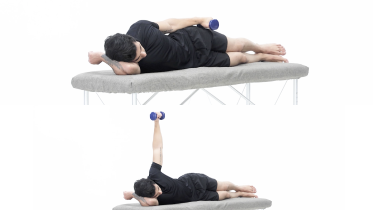 Side lying dumbbell abduction
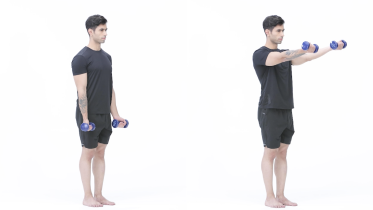 Dumbbell front hold
Daily life in the sling weeks
For at least 3 and possibly 6 weeks, Oxford advises not using the arm for everyday activities, especially anything that moves the elbow away from your body, and keeping it in the sling except for your exercises. You will be more or less one-handed, which affects dressing, washing, cooking and eating. You also cannot use that hand to steady yourself or break a fall, so take extra care on stairs, wet floors and uneven ground, and keep your free hand for the rail. Plan for help at home before the operation if you can, especially if you live alone or the operated arm is the one you write with. The Robert Jones and Agnes Hunt leaflet also recommends regular walks, to keep the rest of your body, heart and chest working while the arm rests.
Loose clothes that fasten at the front are easier. Put the operated arm into a sleeve first and take it out last (Oxford). A non-slip mat helps when you eat one-handed, and long-handled sponges and grabbers can save a lot of reaching. The armpit can get hot and sweaty in the sling, and a dry pad or clean cloth there helps (Robert Jones and Agnes Hunt).
Lifting, sport and getting back to normal
Oxford advises not lifting any weight with the arm, such as a kettle, iron or saucepan, for 8 to 12 weeks, and avoiding heavier lifting such as digging or manual work for 4 to 6 months. It also advises avoiding sudden, forceful movements with weight. Light tasks can start once the arm is out of the sling, often with the elbow kept close to your side at first.
For leisure, Oxford gives rough times of 8 to 12 weeks for gentle swimming, 12 weeks for light gardening such as weeding, 16 weeks for bowls and golf, and 4 to 6 months for tennis, squash and badminton. The Robert Jones and Agnes Hunt leaflet says front crawl should wait at least 3 months, and only after talking to your physio or surgeon. Start with short, easy sessions and build up. Your surgeon or physio can advise on anything else you want to get back to.
When to see a physio or doctor
Oxford says outpatient physio appointments are usually arranged for you after you leave hospital, and the ASSET consensus advises a formal course of physiotherapy after this operation. If nothing has been arranged, ask your surgical team. Your physio is the first call for questions about your exercises and how far to push them.
Contact your physio or surgical team sooner if the shoulder is getting stiffer rather than freer, pain stops you doing the exercises, or the arm is not getting stronger once active exercises start. One thing physios check is whether you can hold the arm up at the top once it has been lifted there for you. The ASSET consensus says not being able to can be a sign that the repair has torn again, and that the surgeon should then be contacted. It also notes that stiffness is not common a year after surgery, and that people with diabetes or thyroid problems may need extra work on movement in the first 6 weeks. The warning signs below say how quickly to get help.
For physiotherapists
This page gives patients a general framework after rotator cuff repair and defers to the surgeon's protocol throughout. The ASSET consensus (Thigpen and colleagues, 2016; level V, expert opinion) suggests 2 weeks of strict immobilization, protected PROM in scapular plane elevation and external rotation at 20 to 30 degrees of abduction from weeks 2 to 6, AROM from week 6 and progressive strengthening from week 12, with 6 weeks of strict immobilization when there are concerns about tissue healing. Its staged PROM targets (for example 90 to 120 degrees of forward elevation and 20 to 30 degrees of external rotation at week 6) are ceilings, not goals to exceed. It advises only submaximal isometric rotator cuff work, because maximal isometrics load the repair more than AROM, wall slides once active elevation reaches about 130 degrees without pain, long-lever resistance of 0 to 2 lb (0 to 1 kg) in weeks 12 to 20, and phase 4 loading (weeks 20 to 26) only for heavy manual workers and overhead athletes.
ASSET reports anatomic failure of 25 to 60%, not consistently linked to poorer function and usually in the first 3 to 6 months, and stiffness at 1 year of 3 to 10% (Oxford quotes 1 to 5% for stiffness or pain; RJAH about 20% with some pain or stiffness and about 5% with painful stiffness). It treats pain of 3/10 or more in phase 1, or 2/10 or more later, and staged ROM goals not met as signs not to progress. An inability to hold end-range elevation after passive placement may indicate a re-tear and warrants contact with the surgeon, particularly with an external rotation lag. Mazuquin and colleagues (2021; 20 RCTs, 1,841 patients) found no significant difference in pain or function except SANE at 6 months (MD 6.54, 95% CI 2.24 to 10.84), small ROM gains favoring early rehab (flexion MD 7.36 degrees at 6 weeks, 1.42 degrees at 1 year) and no increase in re-tears (OR 1.05, 95% CI 0.64 to 1.75), with most trials at high or unclear risk of bias. RaCeR 2 (protocol, Mazuquin and colleagues, 2024) is comparing early patient-directed rehab with standard rehab (sling at least 4 weeks) in 638 participants.
In UKUFF (Carr and colleagues, 2015), 273 patients aged 50 or over with degenerative tears had arthroscopic or open repair, with no difference in Oxford Shoulder Score at 24 months (-0.76, 95% CI -2.75 to 1.22). Re-tear at 12 months was 46.4% arthroscopic and 38.6% open; irreparable tears had the lowest scores and healed repairs the most improvement. Screen at each visit for DVT and pulmonary embolism, upper limb venous thrombosis (NHS), wound and deep infection, persistent neurological signs after an interscalene block (Oxford advises ward contact beyond 48 hours), axillary nerve injury (OrthoInfo; RJAH), progressive stiffness and loss of active elevation or external rotation.
In stage 1 the stick external rotation is framed as gentle supine self-assisted ROM (Oxford phase 1; ASSET phase 1 lists ER self-assisted with a stick) kept under about 30 degrees, not the 15 to 30 s end-range standing stretch on its exercise page, and is omitted after subscapularis repair unless the surgeon allows it (Oxford); the seated active ER in stage 2 carries a subscapularis range check. Shoulder blade depression stays in stage 1 as unloaded scapular movement with the arm by the side, like Oxford's and RJAH's phase 1 shoulder blade exercises. Passive and pulley abduction sit in stage 2 because ASSET limits phase 1 PROM to scapular plane elevation and external rotation at 20 to 30 degrees of abduction and adds ER at increasing abduction after week 9. Unweighted side-lying abduction sits in stage 3 because the lift starts at full long-lever gravity torque, and long-lever loads stay at 0 to 2 lb, or 0 to 1 kg (ASSET). The isometric press sits late in stage 2, as in Oxford's phase 2 resisted hand presses (5 s holds, 5 repetitions), with ASSET's submaximal caveat.
See a doctor promptly if
- Emergency: since your operation, you suddenly become short of breath, you get chest pain or pain in your upper back that may be worse when you breathe in, you cough up blood, your heart is beating very fast, or you faint. Call emergency services straight away, even if your arms and legs look normal. These can be signs of a blood clot in the lungs (pulmonary embolism).
- Emergency: chest pain or tightness, which may spread to your arm, neck or jaw, or shoulder or arm pain that comes with shortness of breath, sweating or feeling sick. This can be a heart attack. Call emergency services straight away.
- Emergency: your arm, hand or fingers turn cold, pale, blue or gray compared with the other side. Call emergency services or go to an emergency department straight away, and do not drive yourself. The blood supply to the arm may be blocked.
- Emergency: the shoulder feels as if it has slipped out of place, looks a different shape or suddenly locks so you cannot move the arm, or the pain is severe after a fall or an injury. Go to an emergency department straight away, without driving yourself, and do not try to put the shoulder back in yourself.
- Same day: your wound becomes more red, hot, swollen or painful, starts to leak or ooze, has pus coming out of it or its edges start to come apart, or you have a high temperature or feel hot, cold or shivery. Contact your surgical team or get medical advice the same day. Redness can be harder to see on brown or black skin. If you feel very unwell, go to an emergency department. If you have a very high or very low temperature, shivering you cannot control, you are breathing very fast or finding it hard to breathe, you are confused or your speech is slurred, your skin, lips or tongue look blue, gray, pale or blotchy (on brown or black skin this can be easier to see on the palms of the hands or soles of the feet), or you have a rash that does not fade when you press it, call emergency services, as this can be sepsis.
- Same day: since your operation, the shoulder is hot, red and swollen, you have shoulder pain with a fever, or the redness, warmth, swelling or pain in your shoulder is not getting better or is getting worse, for example the shoulder pain keeps building both when you move and when you rest. This can be an infection in the shoulder joint. Contact your surgical team or the ward you went home from straight away, and if you cannot reach them, go to an emergency department the same day.
- Same day: since your operation, your arm or hand is getting more swollen instead of settling, or has a new throbbing or cramping pain, warm skin, red or darker skin, or swollen veins that are sore to touch. Some bruising and swelling of the arm is common after this operation and fades over a few weeks, but a blood clot can sometimes form in the arm. Get medical advice the same day. If you are also short of breath or have chest pain, call emergency services.
- Same day: a calf or thigh that is newly swollen, warm, tender, red or darker than usual, has swollen veins that are sore to touch, or has a throbbing or cramping pain that does not fit your injury or condition, or that feels different from normal muscle soreness after exercise. This can be a sign of a blood clot (deep vein thrombosis), especially after surgery, an injury, time in a cast or boot, a long trip or a spell of being much less mobile than usual. Get medical advice the same day. If you are also short of breath or have chest pain, call emergency services.
- Same day: numbness, tingling, pins and needles or weakness in your arm or hand that is still there more than 48 hours after the operation, or that starts after the numbness from the nerve block has gone. The same applies to a droopy eyelid, a blocked nose, a hoarse voice, a numb cheek or slight breathlessness from the nerve block that lasts more than 48 hours. Contact your surgical team or the ward you went home from the same day. A nerve block usually wears off within 12 to 48 hours, and a nerve can rarely be injured during the operation. If one side of your face or body suddenly goes numb or weak, or your speech becomes slurred or muddled, call emergency services, even if it goes away. If your breathing gets harder rather than easier, you are short of breath at rest, or you also have chest pain, call emergency services straight away.
- Same day: a sudden pop or tearing feeling in the shoulder that brings sharp pain, new weakness or trouble lifting the arm, for example after a fall, a jolt, a sudden pull or lifting something heavy. The same applies if, after one of these, you suddenly cannot lift your arm or hold it up as well as you could before, even without a pop. Rest the arm, in its sling if you still have one, and contact your surgical team the same day, or get medical advice the same day if you cannot reach them. The repair may have torn again.
- Within a few days: your shoulder is not moving any further from week to week or is getting stiffer, pain stops you doing your exercises, or once active exercises have started the arm is not getting stronger, for example you still cannot hold it up after it has been lifted into place for you. This is not an emergency, but contact your physio or surgical team within the next few days. A stiff shoulder after this operation often improves with physiotherapy, and your team can check whether the repair is holding.
Common questions
How long do you wear a sling after rotator cuff surgery?
Usually 3 to 6 weeks, but it depends on your repair, so follow what your team told you. Oxford University Hospitals says a minimum of 3 weeks but usually 4, and up to 6 weeks after a major repair, at night as well as in the day. OrthoInfo, from the American Academy of Orthopaedic Surgeons, says most people use a sling for the first 4 to 6 weeks. The sling usually comes off only to wash and to do your exercises, and you then use it less and less as the repair heals (Oxford; Robert Jones and Agnes Hunt).
How long does it take to recover from rotator cuff surgery?
Several months at least. OrthoInfo says to expect complete recovery to take several months, with most people having a useful range of movement and enough strength by 4 to 6 months. The Robert Jones and Agnes Hunt leaflet gives a total rehab time of about 9 months. Oxford says most progress comes in the first 6 months, and the arm and shoulder can keep improving for 1 to 2 years.
Can a rotator cuff repair tear again?
Yes, and it is more common than many people expect, although it does not always mean a poor result. In the UKUFF trial of 273 people aged 50 or over, scans at 12 months showed the repair had torn again in 46.4% after keyhole surgery and 38.6% after open surgery, yet both groups improved a lot on a shoulder questionnaire, and people whose repair had healed did best (Carr and colleagues, 2015). OrthoInfo says the larger the tear, the higher the risk. The Robert Jones and Agnes Hunt leaflet says a re-tear rarely needs further surgery, and the ASSET consensus notes that most happen in the first 3 to 6 months, which is why the early months are protected. A sudden pop or tearing feeling with sharp pain, new weakness or trouble lifting the arm needs checking the same day.
How should I sleep after rotator cuff surgery?
Wear your sling at night as well as in the day for as long as your team advises (Oxford). If you lie on your back, a small towel or pillow under your elbow and upper arm often feels more comfortable. Oxford advises not lying on the operated side for 6 weeks, and not letting the elbow fall across the front of your body, which can happen when you lie on your other side. Once the sling is off, rest the arm on pillows in front of you if you lie on your good side.
When can I drive after rotator cuff surgery?
Usually not for at least 6 weeks. Oxford says driving is likely to be 2 to 3 weeks after you stop wearing the sling, usually between 6 and 12 weeks after the operation. The Robert Jones and Agnes Hunt leaflet says usually 6 to 8 weeks, depending on how much movement you have regained and whether you can do an emergency stop safely. Before you set off, check you can manage all the controls, and check your insurance (Oxford).
When can I lift things and go back to work after rotator cuff surgery?
Oxford advises not lifting any weight with the arm, even a kettle, for 8 to 12 weeks, and avoiding heavier lifting such as digging or manual work for 4 to 6 months. The Robert Jones and Agnes Hunt leaflet says you will not be able to lift weights with the arm until about 12 weeks. It adds that office and other non-manual workers can usually return after 3 to 6 weeks, and manual and overhead workers after 3 months. Oxford says to expect 4 to 12 weeks off work depending on the job, with lifting, overhead and manual tasks held back for 4 to 6 months, so ask your surgeon and physio what suits your repair and your job.
References
- Oxford University Hospitals NHS Foundation Trust. Rotator cuff repair: information for patients, surgery and rehabilitation. Leaflet OMI 107567, December 2024. https://www.ouh.nhs.uk/media/vpwp201w/107567repair.pdf
- The Robert Jones and Agnes Hunt Orthopaedic Hospital NHS Foundation Trust. Rotator cuff repair: information for patients. Hand and Upper Limb, November 2023. https://www.rjah.nhs.uk/media/3rajuclz/rotator-cuff-repair-leaflet-print-friendly-2023.pdf
- Thigpen CA, Shaffer MA, Gaunt BW, Leggin BG, Williams GR, Wilcox RB III. The American Society of Shoulder and Elbow Therapists' consensus statement on rehabilitation following arthroscopic rotator cuff repair. Journal of Shoulder and Elbow Surgery. 2016;25(4):521-535. https://doi.org/10.1016/j.jse.2015.12.018
- Mazuquin B, Moffatt M, Gill P, Selfe J, Rees J, Drew S, Littlewood C. Effectiveness of early versus delayed rehabilitation following rotator cuff repair: systematic review and meta-analyses. PLoS ONE. 2021;16(5):e0252137. https://doi.org/10.1371/journal.pone.0252137
- Carr AJ, Cooper CD, Campbell MK, et al. Clinical effectiveness and cost-effectiveness of open and arthroscopic rotator cuff repair [the UK Rotator Cuff Surgery (UKUFF) randomised trial]. Health Technology Assessment. 2015;19(80):1-218. https://doi.org/10.3310/hta19800
- Mazuquin B, Moffatt M, Realpe A, et al. Clinical and cost-effectiveness of individualised (early) patient-directed rehabilitation versus standard rehabilitation after surgical repair of the rotator cuff of the shoulder: protocol for a multicentre, randomised controlled trial with integrated Quintet Recruitment Intervention (RaCeR 2). BMJ Open. 2024;14(4):e081284. https://doi.org/10.1136/bmjopen-2023-081284
- American Academy of Orthopaedic Surgeons. Rotator cuff tears: surgical treatment options. OrthoInfo. https://www.orthoinfo.org/en/treatment/rotator-cuff-tears-surgical-treatment-options/
- NHS. Deep vein thrombosis (DVT). Page last reviewed 30 April 2026. https://www.nhs.uk/conditions/deep-vein-thrombosis-dvt/
- NHS. Pulmonary embolism. Page last reviewed 25 May 2023. https://www.nhs.uk/conditions/pulmonary-embolism/
- NHS. Sepsis. Page last reviewed 14 May 2026. https://www.nhs.uk/conditions/sepsis/
- NHS. Heart attack. Page last reviewed 31 March 2026. https://www.nhs.uk/conditions/heart-attack/
Written and checked by the PocketPhysio editorial team. Last updated 2026-09-28.
This page is general education, not a diagnosis or a personal treatment plan. See a physiotherapist or doctor for advice about your own situation.