Lying serratus punch
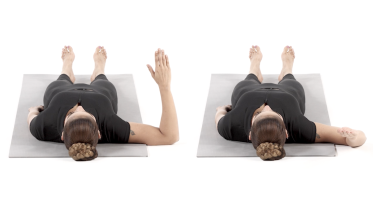
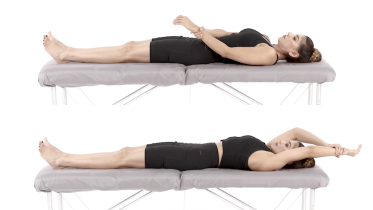
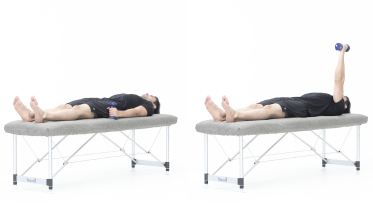
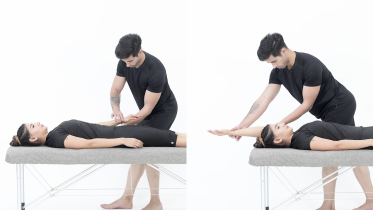
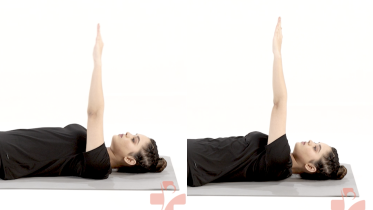
The lying serratus punch is done with a helper who takes the weight of your arm, so you can work the muscle on the side of the ribs that slides the shoulder blade forward (serratus anterior) without holding the arm up yourself. You lie on your back while the helper raises your straight arm to point at the ceiling, then you reach the hand a little higher so the shoulder lifts slightly off the bed. It lets you learn the movement before you try it without help.
How to do the lying serratus punch
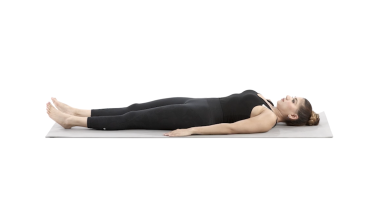
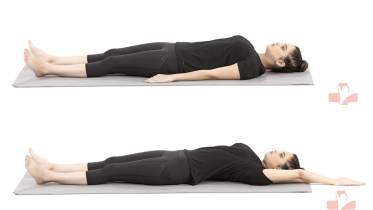
- Lie on your back on a bed or firm surface with your legs straight and your head resting down. Let your shoulder blades settle flat against the surface.
- Your helper stands at your side, one hand holding your wrist and the other around your shoulder to guide the shoulder blade. They lift your weaker arm, elbow straight, until it points at the ceiling, while your shoulder blades stay down.
- Reach your hand up toward the ceiling, elbow still straight. The shoulder rises a little off the bed as the shoulder blade slides forward around your ribs.
- Keep your head and back on the bed and your trunk still. Hold the reach briefly.
- Let the shoulder blade sink back to the bed. The helper keeps the arm pointing up for the next reach and lowers it to your side at the end of the set.
What you should feel
Work along the side of the ribs, just below the armpit. Your helper carries most of the arm, so the effort should feel small.
Common mistakes
- Pushing up with a bent elbow, when the reach should come from the shoulder blade.
- Lifting your head or rolling your body to reach further.
- Shrugging the shoulder toward your ear.
- The helper pulling the arm upward, rather than supporting it while you do the reach.
How often
Many programs start with 1 to 3 sets of 10 small reaches with a brief hold, once or twice a day. Your physio will adjust this.
Stop and check with your physio if
- A sharp pain or a catch at the front or top of the shoulder.
- Pain, pins and needles or numbness spreading down your arm or into your hand.
- Pins and needles in your arm or hand that do not go away after you stop, or part of your arm or hand goes numb. Get medical advice the same day. If one side of your face or body suddenly goes numb or weak, or your speech becomes slurred or muddled, call emergency services, even if it goes away.
- A sudden pop or tearing feeling in the shoulder that brings sharp pain, new weakness or trouble lifting the arm. Stop and contact your surgical team the same day, or get medical advice the same day if you have not had surgery.
- The shoulder feels as if it has slipped out of place, looks a different shape or suddenly locks so you cannot move the arm, or your hand turns cold, pale or blue. Go to an emergency department straight away, without driving yourself, and do not try to put the shoulder back in yourself.
From the clinic
The helper holds the arm steady and upright; the reach itself is yours. It is short, a few centimeters at most, and it comes from the shoulder blade gliding forward, not from the elbow. Once you can do it smoothly, the serratus punch without a helper is the usual next step. The wall ball press works the same muscle standing up.
After shoulder surgery, including a rotator cuff repair, or after a shoulder fracture or dislocation, follow your surgeon's or physio's plan, and do only the movements and range they have cleared. Many plans allow only passive movement at first, where the arm is moved for you and its muscles stay relaxed. It helps if your helper watches your physio set up the arm once before trying it at home. If the arm is weak after a stroke or a nerve injury, do not try this at home until your physio has shown your helper how to hold and lift it, because a weak shoulder is easily strained if the arm is pulled on. If you are pregnant and past the first three months, check with your physio before exercising flat on your back.
Written and checked by the PocketPhysio editorial team. Last updated 2026-09-28.
This page is general education, not a diagnosis or a personal treatment plan. If you have pain, an injury or a health condition, see a physiotherapist or doctor before starting new exercises.