
Shoulder replacement rehab: exercises after a total or reverse replacement
What is a shoulder replacement?
In a shoulder replacement, the surgeon removes the worn surfaces of the joint and fits artificial parts. OrthoInfo, the patient site of the American Academy of Orthopaedic Surgeons, lists the common reasons: several kinds of arthritis, including osteoarthritis, rheumatoid arthritis or arthritis after an old injury; a large rotator cuff tear that has worn the joint; loss of blood supply to the ball of the joint; and a badly broken shoulder.
There are two main designs. An anatomic total replacement copies the normal layout, with a metal ball on the arm bone and a plastic socket on the shoulder blade. A reverse replacement swaps them round, so the arm is lifted by the big muscle over the shoulder (deltoid) rather than the rotator cuff (OrthoInfo). Surgeons use it when the rotator cuff tendons are torn or no longer work, and Gateshead Health describes its main aim as easing pain.
This page covers adults after a planned anatomic or reverse replacement. The ASSET consensus (Kennedy and colleagues, 2020) uses the same anatomic guidance when only the ball is replaced (hemiarthroplasty). A replacement done for a broken shoulder, or a repeat operation, often follows a slower plan: North Tees and Hartlepool, for example, keeps the sling on for up to 6 weeks after those. If you broke the top of your arm and it is healing in a sling without an operation, the proximal humerus fracture program is the one for you. A rotator cuff repair has a different plan again.
Follow your own team's plan first
Each surgical team works to its own plan. What goes in it depends on the type of replacement, the way the surgeon got into the joint, whether a tendon was cut and repaired, and how good your bone and muscle are. It sets how long you wear the sling, which movements you may do and when, and how much you can lift. Where your plan and this page differ, your plan wins. If you are unsure what it says, ask before you change anything.
The times on this page are ranges collected from US and UK sources, not a protocol. No stage starts until your surgeon and physio say so, and your physio decides which exercises you do, how far you go and when you move on.
Anatomic or reverse: why the early limits differ
For an anatomic replacement, the surgeon usually gets into the joint through the tendon across the front of the shoulder (subscapularis), the one that turns the arm inward, and stitches it back at the end. The ASSET consensus, written by the American Society of Shoulder and Elbow Therapists, is built around letting that tendon heal (Kennedy and colleagues, 2020). That is why, early on, outward turning is kept small, you do no inward pressing or turning against resistance, and you neither reach behind your back nor lean on the arm. OrthoInfo also says not to push yourself up in bed or out of a chair with that arm, because it takes a forceful contraction of the muscles.
The worry with a reverse replacement is different: it comes out of place (dislocates) more easily than an anatomic one (Bardsley and colleagues, 2024). Gateshead Health gives that risk as 2 to 3 in 100 after a reverse replacement. The position to avoid early is the hand behind your back, as when you tuck in a shirt, because it takes the arm backward, across your body and into an inward turn all at once. North Tees and Hartlepool says no hand behind the back for 6 weeks and no letting the arm fall back past the line of your body, and OrthoInfo says to avoid the arm behind your body or straight out to the side for 6 weeks. Some surgeons also repair the front tendon during a reverse replacement and then limit outward turning and resisted inward turning as well, so ask whether yours did.
Some rules apply to both. For the first 6 weeks after any replacement, Gateshead Health advises against reaching behind your back, pushing up from a chair, brushing the back of your head or taking the arm out to the side in a high five position. Boudreau and colleagues (2007) argue that because a reverse shoulder depends on the deltoid, its rehab should differ from the anatomic plan.
What recovery usually looks like
These are typical times, not deadlines. The sling usually stays on for 2 to 6 weeks (OrthoInfo). Gateshead Health says up to 6 weeks, and North Tees and Hartlepool 4 weeks after a planned operation. The ASSET consensus keeps the sling on for 4 to 6 weeks after an anatomic replacement, with assisted movement only, then lets the arm start working by itself from about 6 weeks and adds light resistance from about 12 weeks (Kennedy and colleagues, 2020).
Most people can feed and dress themselves within about 2 weeks of an anatomic replacement (OrthoInfo). Gateshead Health expects the arm to move comfortably below shoulder height by 8 to 12 weeks, with strength and movement still improving up to 18 months. In the ASSET consensus, most of the gain in movement and function comes by 6 months, but strength can keep building for up to 2 years.
After a reverse replacement, OrthoInfo says you will most likely be able to lift the arm above shoulder height once rehab is done. Turning the arm and reaching behind you vary more, between people and between the two designs, so ask your surgeon what to expect from your shoulder.
Does early movement or supervised physio help?
For reverse replacements, several trials have compared moving the arm early with keeping it in a sling. In a US trial that followed 86 shoulders for a year, starting physio straight away and waiting 6 weeks gave similar gains, with no difference in complications (Hagen and colleagues, 2020). An Australian trial of 63 shoulders found no overall difference at 3, 6 or 12 months between early active rehab and a later program, although the early group lifted the arm a little better at 3 months (Edwards and colleagues, 2021). A Spanish trial of 64 people found no difference in pain or function between 3 weeks in a sling and none (Torrens and colleagues, 2025). And a 2026 review of 7 studies covering 1,606 shoulders found that moving the arm within 2 weeks gave a little more movement early on, the same results later and no rise in complications, though the authors rated the evidence as low in certainty (Alkhouri and colleagues, 2026).
For anatomic replacements the evidence is thinner. In a trial of 60 people, moving the shoulder straight away brought function back faster at first, but by 3 months function was the same, and by a year both groups had the same movement (Denard and Lädermann, 2016). The ASSET plan is expert opinion, not a tested program.
Supervised clinic sessions may matter less than people expect. In the SHORT trial, 216 people with a reverse replacement had either outpatient physical therapy (physiotherapy) or a home program taught by their surgeon, with no difference in movement, pain, function or complications at 1 and 2 years, and the home group's care cost less (Garrigues and colleagues, 2026). A 2020 review found too little evidence to say formal physio beats a program directed by the surgeon after an anatomic replacement, and no high-quality evidence yet to guide rehab after a reverse one (Kirsch and Namdari, 2020).
NICE, in England, advises that a physio or occupational therapist starts your rehab on the day of the operation if possible and within 24 hours. Before you leave hospital you should have a home exercise program with clear goals and someone to contact, and supervised sessions should be offered if daily tasks are hard or the home program is not meeting your goals (NICE NG157). None of this means skipping physio your team has arranged. What it does mean is that a home program you were taught well, and do regularly, counts for a lot.
How to use this program
Stick to the exercises your team has set or cleared. Stage 1 covers the sling weeks. Stage 2 begins when your team lets the arm work by itself, often around 6 weeks, and stage 3 when they clear strengthening, usually around 12 weeks. The ASSET consensus moves people on from the first phase once pain during the assisted movements is low, the wound has healed and the surgeon has checked the X-ray, and from the second once the arm lifts by itself as far as it goes with help.
You will find a typical starting dose on each exercise page. Early movements usually come in short sessions spread through the day: North Tees and Hartlepool's leaflet uses 2 sets of 10, 3 times a day, and the ASSET consensus suggests 3 to 5 short home sessions a day. The gentle presses are commonly 5 to 10 holds, each lasting 5 to 10 seconds, once or twice a day. Band work tends to be 2 to 3 sets of 10 to 15 slow repetitions, done daily or every other day. Your physio will adjust this.
Aching, discomfort or a stretch while you exercise is normal, according to North Tees and Hartlepool. If the pain is intense and still there more than about 30 minutes later, ease off by going less hard or less often, and tell your physio if that does not settle it.
In stage 1 the operated arm does no work of its own: keep it relaxed and let it be moved for you. Do not force any movement, and stop at your team's limit even when you feel you could go further. Keep breathing normally through each repetition. If you have high blood pressure, breathe steadily through every hold and never hold your breath.
The exercise program
Stage 1: Protect the new joint in the sling weeks
For the sling weeks, often the first 4 to 6, and only with the exercises your surgeon or physio has set. Out of the sling, keep the hand and elbow moving, gently squeeze your shoulder blades back with your hands resting on your thighs, and in the pendulum let the relaxed arm hang and swing in small circles as your body sways. For the passive lift, a helper your physio has shown raises the arm forward, no higher than your team has set, which in many plans is about shoulder height or a little above it, well short of the top of the video. If nobody can help you, ask your physio about a lift you can do alone, such as sitting at a table and sliding both hands forward on a cloth. Keep the stick turn much smaller than on its own page. After an anatomic replacement, many plans allow the forearm only a quarter to a third of the arc between pointing forward and pointing straight out to the side, with no hold at a stretch. After either type, some keep it pointing straight ahead for the first 4 weeks, so ask your team how far you may go whichever replacement you had. Whatever your operation, do not reach behind your back or push up on the operated arm to get out of a chair or bed in these weeks.
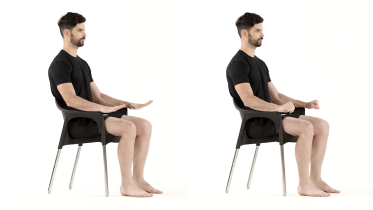 Open and close the hands
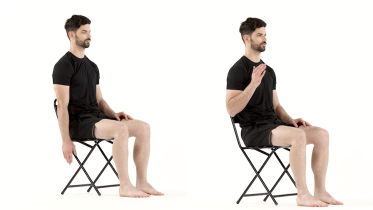 Elbow flexion and extension
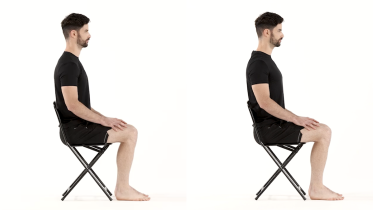 Scapular squeeze
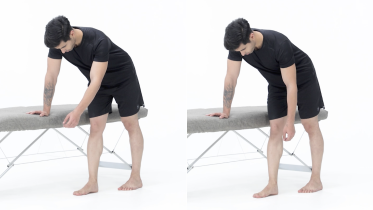 Pendulum exercise for the shoulder
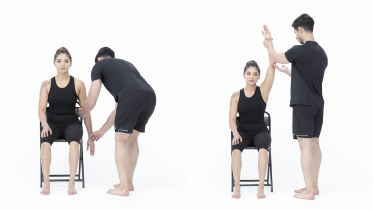 Seated passive shoulder flexion
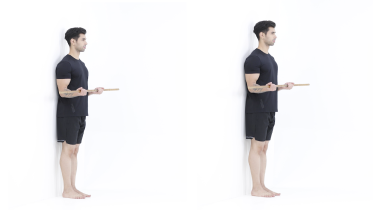 Shoulder external rotation with a stick
Stage 2: The arm starts to work by itself
Often from around 6 weeks after surgery, once your team says the arm can leave the sling and start doing some work. Use it for light tasks at waist and chest height, but keep to the lifting limit you were given and put no weight through it until they clear you. The pulley, the lying stick lift and the wall slide still let your other arm or the wall share the load. Side lying flexion is often the first lift the arm makes alone, because it swings parallel to the floor instead of holding up its own weight. The four gentle presses (forward, out to the side, back into a wall and outward against your hand) wake up the big muscle over the shoulder (deltoid), which does most of the lifting after a reverse replacement, and the seated outward turn brings back rotation within the range your team allows. Push well short of your hardest, and in the backward press keep your back and the arm against the wall, so the arm stays in line with your body and never goes behind it. Until your team says so, which is at least 6 weeks and in many plans about 12, leave out any inward press or inward turn against resistance after an anatomic replacement, or after a reverse one where the front tendon was repaired.
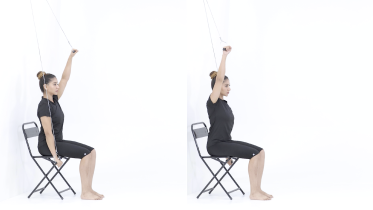 Shoulder pulley flexion
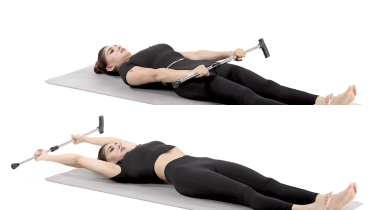 Lying shoulder flexion with a stick
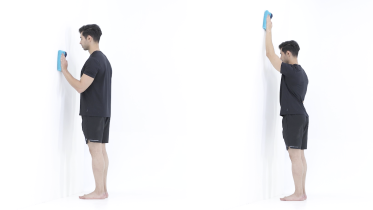 Wall slides with a towel
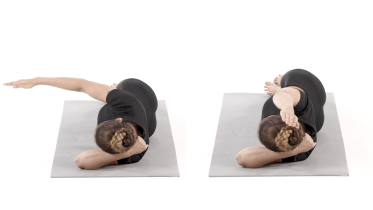 Side lying shoulder flexion
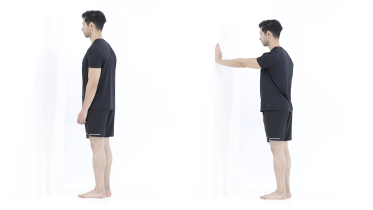 Isometric shoulder flexion
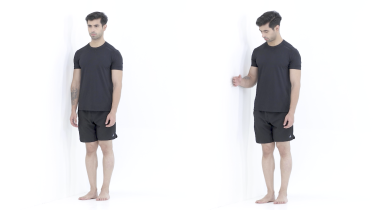 Isometric shoulder abduction
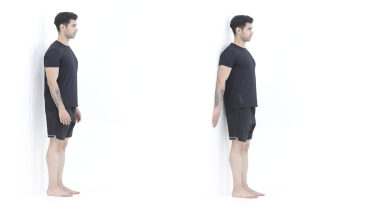 Isometric shoulder extension
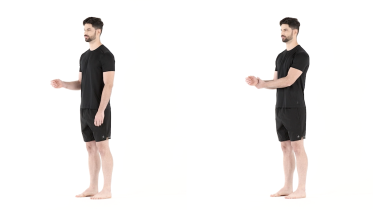 Isometric shoulder external rotation
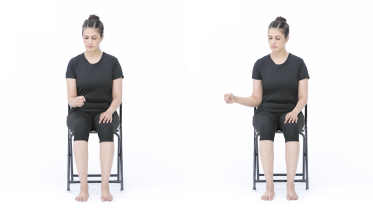 Seated shoulder external rotation
Stage 3: Rebuild strength
Strength work usually starts around 12 weeks, once your team gives the go-ahead. The outward band turn, then the inward press and the inward band turn, train the muscles that rotate the arm. After an anatomic replacement, start the inward work gently, because it loads the tendon that was repaired. Side lying abduction and wall ball flexion make the arm lift against gravity (hold off on the wall ball until you can raise the arm to shoulder height without pain), and lying dumbbell flexion adds a light weight that your physio chooses. For anatomic replacements, the ASSET consensus suggests keeping weights below shoulder height and in front of your body at this stage. Keep the stage 2 movement work going. Heavier lifting usually waits until about 6 months, and contact sports and repeated heavy lifting are best left out for good.
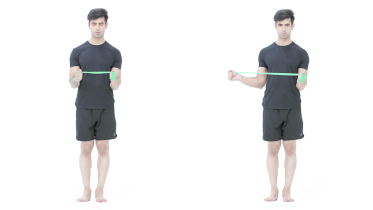 Shoulder external rotation with band
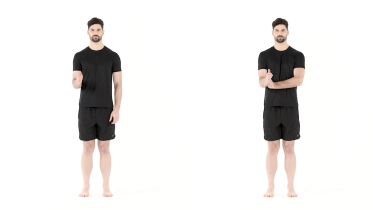 Isometric shoulder internal rotation
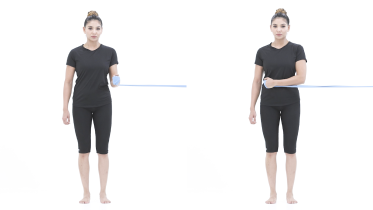 Shoulder internal rotation with band
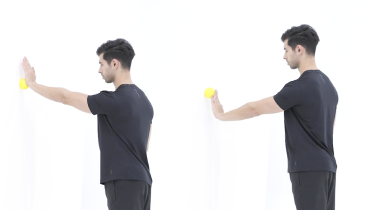 Wall ball shoulder flexion
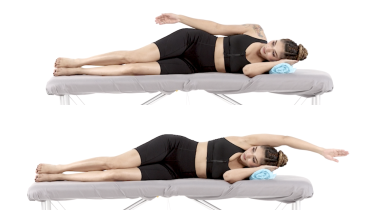 Side lying shoulder abduction
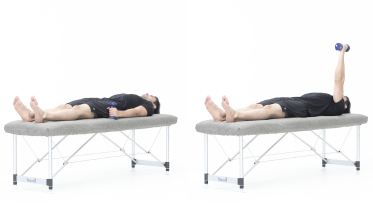 Lying dumbbell shoulder flexion
The first weeks at home
Most people have a nerve block to numb the arm for the operation. Gateshead Health says it can take up to 24 hours to wear off fully, while Oxford University Hospitals gives 12 to 48 hours for a block at the side of the neck. Leave the arm in the sling until the feeling is back, and keep heat and ice packs off it while it is numb, since you would not feel the skin being damaged.
On the side of the block you may also notice a droopy eyelid or a stuffy nose, and some people get a hoarse voice or feel a little breathless. Oxford advises calling the ward if any of these is still there after 48 hours. Bruising is common and fades over a few weeks (Gateshead Health), and the wound is usually checked 10 to 14 days after surgery, when any clips come out.
Gateshead Health describes blood clots after shoulder surgery as rare, but the NHS points out that the signs of one can appear in an arm, not just a leg. Use any stockings, injections or tablets you were given to lower the risk exactly as your team told you, and check with your surgeon before flying in the first 6 weeks (Gateshead Health). The signs of a clot are in the warning list further down this page.
In the sling you are close to one-handed, with no second hand to steady yourself or catch a fall. Go carefully on stairs, wet floors or rough ground, and keep your good hand free for the rail. Landing on a new shoulder can break the bone around the implant, which OrthoInfo notes can be weaker, or knock the joint out of place. If you have fallen before or feel unsteady, ask your physio about the balance and falls prevention program once your shoulder is ready for it.
Everyday tasks, driving and work
Lifting limits differ between hospitals. OrthoInfo says nothing heavier than a glass of water for the first 2 to 6 weeks after an anatomic replacement, and no more than 5 lb (about 2 kg), or the weight your surgeon sets, for the first 6 weeks after a reverse one. Gateshead Health is stricter: no lifting anything with real weight to it, such as a kettle, pan or iron, for at least 3 months. North Tees and Hartlepool advises no heavy lifting for 6 months. Where your team's advice and this page differ, go with the stricter one.
Driving advice varies just as much. OrthoInfo says no driving for 2 to 6 weeks after an anatomic replacement, Gateshead Health expects 8 to 12 weeks, once the sling is off and the shoulder moves well, and North Tees and Hartlepool says within 12 weeks. For work, Gateshead Health says most people with a light job need at least 8 weeks off, and longer if the job means heavy lifting or working overhead.
Wear loose tops that open down the front. Dress the operated arm first and undress it last. For the first weeks, move the things you use every day to waist height so you are not reaching up or behind you.
Sport and hobbies
As rough guides, Gateshead Health gives breaststroke swimming from about 6 weeks and golf after about 6 months, while North Tees and Hartlepool gives gentle swimming from about 4 months after a reverse replacement and 4 to 6 months after an anatomic one. The ASSET consensus suggests starting sports from about 4 months, for example chipping and putting in golf, with a full return not before 6 months. OrthoInfo advises against contact sports and repeated heavy lifting after any shoulder replacement. There is no guarantee of getting back to a particular sport, as Gateshead Health points out, so talk to your surgeon about what you want to do.
When to see a physio or doctor
Gateshead Health refers people to outpatient physio after the operation and asks them to ring if no appointment has arrived within 2 weeks. If you have heard nothing about physio, ask your surgical team. For questions about the exercises and how hard to push them, start with your physio.
Contact your physio or surgical team within a few days if the shoulder is stiffening instead of loosening, pain is stopping you doing the exercises, or pain that had settled is building again. For a sense of the risks, Gateshead Health puts stiffness or lasting pain at fewer than 5 in 100 people, infection at fewer than 1 in 100, injury to a nerve or blood vessel at 2 to 3 in 100 and a broken bone at about 2 in 100, more in soft bones. The warning signs below say how fast to get help for each.
For physiotherapists
This page gives patients a general framework after primary anatomic and reverse total shoulder arthroplasty, and the surgeon's protocol overrides it throughout. The ASSET consensus for aTSA (Kennedy and colleagues, 2020; expert opinion) sets phase 1 (to 4 to 6 weeks) as sling with PROM, elevation to 120 degrees, ER at the side to a maximum of 30 degrees after lesser tuberosity osteotomy and slower after subscapularis tenotomy or peel (surveyed surgeons favored 20 degrees), no ER in 90 degrees of abduction, pendulums, no weight bearing, no resisted IR and the hand to the greater trochanter only. Phase 2 (6 to 12 weeks) allows ER to 60 degrees, AROM against gravity, gentle functional IR behind the back and assistive device weight bearing but no closed chain work, and phase 3 (from 12 weeks) light resistance below shoulder level and anterior to the frontal plane, with heavy impact loading contraindicated. Progression criteria are pain under 3/10 with PROM, a healed incision and surgeon clearance after radiographs, then AROM against gravity equal to PROM. The panel notes that supine exercise soon after surgery is hard for many patients and favors seated table-supported and pulley PROM, and that subscapularis dysfunction is associated with more pain and instability and with loss of active IR.
No ASSET consensus for rTSA was found. Kennedy and colleagues 2021 is the SHORT trial protocol, reported in 2026 (Garrigues and colleagues; 222 shoulders, no difference in ROM, ASES, SANE, pain or complications between surgeon-directed home therapy and outpatient PT, with lower 1-year costs). The North Tees and Hartlepool rTSA protocol uses a sling for 4 weeks (elective) or up to 6 (trauma or revision), AAROM flexion and abduction in the safe zone, ER to neutral for 4 weeks, no resisted IR where the subscapularis was repaired, no hand behind back for 6 weeks, no extension past the midline and weight bearing through the arm at 12 weeks; its aTSA protocol allows submaximal isometrics except IR in phase 1 and resisted IR from 6 weeks. Hand behind back combines extension and adduction with internal rotation.
Early mobilization after rTSA: Hagen 2020 (107 shoulders enrolled, 86 at 1 year, immediate PT vs 6 weeks immobilization, similar ROM and ASES with no difference in complications, except a better ASES function score in the delayed group at 6 months), Edwards 2021 (63 shoulders, early active vs delayed deltoid-focused rehab, no between-group differences at 3, 6 or 12 months apart from better active flexion at 3 months in the early group), Torrens 2025 (64 patients, cuff-deficient shoulders, 3 weeks vs no immobilization, no difference in pain or Constant score, no complications) and Alkhouri 2026 (7 studies (2 RCTs and 5 cohorts), 1,606 shoulders, motion within 14 days modestly faster early ROM, equivalent outcomes at 6 to 12 months, dislocation 1.4% in both groups, low to moderate certainty). Kornuijt 2023 (100 patients, no subscapularis reattachment, 1 day in a sling then active rehab without precautions) reported 5 complications possibly related to the rehab, including 1 dislocation at 2 months and 1 acromion fracture. Denard and Lädermann 2016 studied 60 aTSA patients, all with a lesser tuberosity osteotomy, and found faster early function with immediate ROM, no difference in function from 3 months or in ROM at 1 year, and a higher osteotomy healing rate with delayed ROM that did not reach significance (96% vs 81%, P = 0.10). Kirsch and Namdari 2020 found no appreciable benefit of early over delayed motion after aTSA, insufficient evidence for formal PT over a physician-directed program after aTSA, and no high-quality evidence to guide rTSA rehab. NICE NG157 (1.10.1 to 1.10.5) recommends inpatient rehab within 24 hours, advice on self-directed, group or individual rehab before discharge, a clear goal and point of contact for self-directed rehab, and supervised rehab for ADL difficulty, ongoing functional impairment or unmet goals.
In stage 1 the stick ER is framed as gentle assisted ROM kept to about 20 to 30 degrees, or to neutral where the team uses the North Tees limit, instead of holding 15 to 30 s at end range as on its exercise page. The supine stick lift sits in stage 2: ASSET lists seated rope and pulley, table slide or supine well-arm assisted elevation for phase 1 and reports supine dowel-assisted elevation above the 15% subscapularis EMG threshold (24%), the North Tees stage 1 leaflet uses seated table slides and supine short-lever elevation supported under the elbow, and the North Tees rTSA protocol keeps the arm from resting behind the midline for 6 weeks. Stage 1 elevation is therefore the helper's PROM, with a seated table slide as the solo option to agree with the physio. The IR isometric and band IR sit in stage 3 for aTSA protection; they stay out for rTSA only when the subscapularis was repaired. Resistance band rows and wall push-ups are left out because of the extension and weight-bearing limits.
The isometric extension in stage 2 stays for rTSA because the arm is held at the midline against the wall and the North Tees 6-week extension limit has ended; the page tells patients to keep the arm in line with the body. The joint infection red flag routes suspected periprosthetic infection to the surgical team straight away with an emergency department the same day as the fallback, matching the shoulder fever level. Screen at each visit for dislocation, periprosthetic fracture after a fall, acromial or scapular spine stress fracture after rTSA (sudden pain and loss of active elevation weeks to months after surgery), wound and deep infection, upper or lower limb VTE, persistent neurological signs after the interscalene block, subscapularis failure after aTSA and stiffness that is getting worse.
See a doctor promptly if
- Emergency: since your operation, you suddenly become short of breath, you get chest pain or pain in your upper back that may be worse when you breathe in, you cough up blood, your heart is beating very fast, or you faint. Call emergency services straight away, even if your arms and legs look normal. These can be signs of a blood clot in the lungs (pulmonary embolism).
- Emergency: chest pain or tightness, which may spread to your arm, neck or jaw, or shoulder or arm pain that comes with shortness of breath, sweating or feeling sick. This can be a heart attack. Call emergency services straight away.
- Emergency: your arm, hand or fingers turn cold, pale, blue or gray compared with the other side. Call emergency services or go to an emergency department straight away, and do not drive yourself. The blood supply to the arm may be blocked.
- Emergency: the shoulder feels as if it has slipped out of place, looks a different shape or suddenly locks so you cannot move the arm, or the pain is severe after a fall or an injury. Go to an emergency department straight away, without driving yourself, and do not try to put the shoulder back in yourself.
- Same day: your wound becomes more red, hot, swollen or painful, starts to leak or ooze, has pus coming out of it or its edges start to come apart, or you have a high temperature or feel hot, cold or shivery. Contact your surgical team or get medical advice the same day. Redness can be harder to see on brown or black skin. If you feel very unwell, go to an emergency department. If you have a very high or very low temperature, shivering you cannot control, you are breathing very fast or finding it hard to breathe, you are confused or your speech is slurred, your skin, lips or tongue look blue, gray, pale or blotchy (on brown or black skin this can be easier to see on the palms of the hands or soles of the feet), or you have a rash that does not fade when you press it, call emergency services, as this can be sepsis.
- Same day: since your operation, the shoulder is hot, red and swollen, you have shoulder pain with a fever, or the redness, warmth, swelling or pain in your shoulder is not getting better or is getting worse, for example the shoulder pain keeps building both when you move and when you rest. This can be an infection around the new joint. Contact your surgical team or the ward you went home from straight away, and if you cannot reach them, go to an emergency department the same day.
- Same day: since your operation, your arm or hand is getting more swollen instead of settling, or has a new throbbing or cramping pain, warm skin, red or darker skin, or swollen veins that are sore to touch. Some bruising and swelling of the arm is common after this operation and fades over a few weeks, but a blood clot can sometimes form in the arm. Get medical advice the same day. If you are also short of breath or have chest pain, call emergency services.
- Same day: a calf or thigh that is newly swollen, warm, tender, red or darker than usual, has swollen veins that are sore to touch, or has a throbbing or cramping pain that does not fit your injury or condition, or that feels different from normal muscle soreness after exercise. This can be a sign of a blood clot (deep vein thrombosis), especially after surgery, an injury, time in a cast or boot, a long trip or a spell of being much less mobile than usual. Get medical advice the same day. If you are also short of breath or have chest pain, call emergency services.
- Same day: pins and needles in your arm or hand that do not go away after you stop, or part of your arm or hand goes numb. Get medical advice the same day. If one side of your face or body suddenly goes numb or weak, or your speech becomes slurred or muddled, call emergency services, even if it goes away.
- Same day: numbness, tingling, pins and needles or weakness in your arm or hand that is still there more than 48 hours after the operation, or that starts after the numbness from the nerve block has gone. The same applies to a droopy eyelid, a blocked nose, a hoarse voice, a numb cheek or slight breathlessness from the nerve block that lasts more than 48 hours. Contact your surgical team or the ward you went home from the same day. A nerve block usually wears off within 12 to 48 hours, and a nerve can rarely be injured during the operation. If one side of your face or body suddenly goes numb or weak, or your speech becomes slurred or muddled, call emergency services, even if it goes away. If your breathing gets harder rather than easier, you are short of breath at rest, or you also have chest pain, call emergency services straight away.
- Same day: a sudden pop, clunk or tearing feeling in the shoulder that brings sharp pain, new weakness or trouble lifting or turning the arm, for example after a fall, a jolt, a sudden pull or pushing up from a chair. The same applies if the shoulder clunks and feels as if it partly slipped out of place and went back, even if it settles straight away, or if, weeks or months after the operation, new pain comes on over the top or back of the shoulder and you suddenly cannot lift the arm as well as before, even without a pop or a fall. After a reverse replacement, that can be a crack in the bone at the top of the shoulder. Rest the arm, in its sling if you still have one, and contact your surgical team the same day, or get medical advice the same day if you cannot reach them.
- Same day: a fall or knock onto the operated arm that leaves the shoulder more painful, swollen or bruised, or stops you moving the arm as far as before. Stop the exercises and contact your surgical team or get medical advice the same day. If the pain is severe, you cannot move the arm, or the arm or hand goes numb or tingly, go to an emergency department straight away, and do not drive yourself.
- Within a few days: you have fallen two or more times in the past year, or you keep tripping, stumbling or feeling that your legs might give way. Book an appointment with your doctor within a few days and ask about a falls assessment. Tell them about every fall, even the ones where you were not hurt.
- Within a few days: your shoulder is not moving any further from week to week or is getting stiffer, pain stops you doing your exercises, or pain that had settled comes back and keeps building over days or weeks. This is not an emergency, but contact your physio or surgical team within the next few days so they can check the shoulder.
Common questions
What is the difference between a total and a reverse shoulder replacement?
In an anatomic total replacement, the worn ball at the top of the arm bone is replaced with a polished metal ball and the socket with a plastic one, so the joint keeps the shape of a normal shoulder (OrthoInfo). A reverse replacement switches them round: the metal ball goes on the shoulder blade and the plastic socket on the arm bone. With that design the big muscle over the shoulder (deltoid) lifts and positions the arm instead of the rotator cuff, which is why surgeons use it when the rotator cuff is badly torn or no longer works (OrthoInfo; Gateshead). The early precautions differ between the two, so if you are not sure which one you had, ask your team.
How long does it take to recover from a shoulder replacement?
Several months, and gains often carry on for a year or more. Gateshead Health says the arm should move comfortably below shoulder height within 8 to 12 weeks, and that strength and movement can go on improving for 18 months. In the ASSET consensus, most of the gain in movement and function comes by 6 months, while strength can go on building for up to 2 years (Kennedy and colleagues, 2020). For the first steps, OrthoInfo, run by the American Academy of Orthopaedic Surgeons, expects most people to eat, dress and groom themselves within about 2 weeks of an anatomic replacement.
How long do you wear a sling after a shoulder replacement?
Usually between 2 and 6 weeks, so go by what your own team told you. OrthoInfo gives 2 to 6 weeks depending on your surgery and your surgeon. Gateshead Health says up to 6 weeks, including in bed, and North Tees and Hartlepool uses 4 weeks after a planned operation and up to 6 after a fracture or a repeat operation. Some teams use the sling after a reverse replacement for comfort only (Bardsley and colleagues, 2024), and trials have found no clear harm from moving the arm early after a reverse replacement (Torrens and colleagues, 2025; Alkhouri and colleagues, 2026).
What movements should you avoid after a reverse shoulder replacement?
In the first weeks, mainly the positions that can make the new joint come out of place. OrthoInfo advises avoiding extreme positions, such as the arm behind your body or straight out to the side, for the first 6 weeks. North Tees and Hartlepool adds no hand behind the back and no letting the arm drop back past the line of your body, both for 6 weeks, and Gateshead Health advises against pushing up from a chair in the first 6 weeks. In everyday life that means tucking in a shirt at the back or reaching for a back pocket. Your own team's list comes first, and some teams also limit outward turning if they repaired the tendon at the front.
When can I drive after a shoulder replacement?
Hospitals give quite different times. OrthoInfo says not for 2 to 6 weeks after an anatomic replacement, while Gateshead Health expects 8 to 12 weeks, once you no longer need the sling and have good shoulder movement, and North Tees and Hartlepool says within 12 weeks, depending on your movement and control. You must be able to control the car safely, so check with your surgeon and your insurer before you drive.
How should I sleep after a shoulder replacement?
Gateshead Health advises not lying on the operated shoulder for the first 6 weeks and wearing the sling in bed for as long as you were told. On your back, a pillow under the upper arm and elbow often helps. On your other side, fold or hug a pillow in front of you and rest the operated arm on it (Gateshead Health).
References
- Kennedy JS, Garrigues GE, Pozzi F, Zens MJ, Gaunt B, Phillips B, Bakshi A, Tate AR. The American Society of Shoulder and Elbow Therapists' consensus statement on rehabilitation for anatomic total shoulder arthroplasty. Journal of Shoulder and Elbow Surgery. 2020;29(10):2149-2162. https://doi.org/10.1016/j.jse.2020.05.019
- Boudreau S, Boudreau ED, Higgins LD, Wilcox RB. Rehabilitation following reverse total shoulder arthroplasty. Journal of Orthopaedic and Sports Physical Therapy. 2007;37(12):734-743. https://doi.org/10.2519/jospt.2007.2562
- Garrigues GE, Cook CE, Kennedy J, et al. 2025 Neer Award Part 1: The SHORT trial: multicenter, randomized, controlled trial of surgeon-directed home therapy vs. outpatient rehabilitation by physical therapists for reverse total shoulder arthroplasty. Journal of Shoulder and Elbow Surgery. 2026;35(4):1129-1143. https://doi.org/10.1016/j.jse.2025.10.005
- Kennedy JS, Reinke EK, Friedman LGM, et al. Protocol for a multicenter, randomised controlled trial of surgeon-directed home therapy vs. outpatient rehabilitation by physical therapists for reverse total shoulder arthroplasty: the SHORT trial. Archives of Physiotherapy. 2021;11(1):28. https://doi.org/10.1186/s40945-021-00121-2
- Kirsch JM, Namdari S. Rehabilitation after anatomic and reverse total shoulder arthroplasty: a critical analysis review. JBJS Reviews. 2020;8(2):e0129. https://doi.org/10.2106/JBJS.RVW.19.00129
- Denard PJ, Lädermann A. Immediate versus delayed passive range of motion following total shoulder arthroplasty. Journal of Shoulder and Elbow Surgery. 2016;25(12):1918-1924. https://doi.org/10.1016/j.jse.2016.07.032
- Hagen MS, Allahabadi S, Zhang AL, Feeley BT, Grace T, Ma CB. A randomized single-blinded trial of early rehabilitation versus immobilization after reverse total shoulder arthroplasty. Journal of Shoulder and Elbow Surgery. 2020;29(3):442-450. https://doi.org/10.1016/j.jse.2019.10.005
- Edwards PK, Ebert JR, Joss B, Ackland T, Wang A. A randomised trial comparing two rehabilitation approaches following reverse total shoulder arthroplasty. Shoulder and Elbow. 2021;13(5):557-572. https://doi.org/10.1177/1758573220937394
- Torrens C, Gonzalez-Garcia C, Diez-Izquierdo M, Santana F. Three-week immobilization vs. no immobilization in primary reverse total shoulder arthroplasty: a randomized controlled trial. Journal of Shoulder and Elbow Surgery. 2025;34(11):2543-2549. https://doi.org/10.1016/j.jse.2025.02.015
- Alkhouri S, Lau A, Kuni T, Digiacomo D, Ahdout J, Bobeck J, Mousad AD. Early versus conventional postoperative rehabilitation after reverse total shoulder arthroplasty: a systematic review of functional outcomes and complications. Disability and Rehabilitation. 2026:1-14. https://doi.org/10.1080/09638288.2026.2683002
- Bardsley JL, Daw RL, Gibson J, Brownson P, Guisasola I, Kent M, Parmar R, Smith MG. Physiotherapy treatment for reverse total shoulder arthroplasty: results of a patient-centred rehabilitation guideline using functional and patient-reported outcome measures. Shoulder and Elbow. 2024;16(3):330-335. https://doi.org/10.1177/17585732221133532
- Kornuijt A, de Vries L, van der Weegen W, Hillen RJ, Bogie R, Stokman R, van Kampen D. Direct active rehabilitation after reverse total shoulder arthroplasty: an international multicentre prospective cohort safety study with 1-year follow up. BMJ Open. 2023;13(4):e070934. https://doi.org/10.1136/bmjopen-2022-070934
- American Academy of Orthopaedic Surgeons. Shoulder joint replacement. OrthoInfo. https://www.orthoinfo.org/en/treatment/shoulder-joint-replacement/
- American Academy of Orthopaedic Surgeons. Reverse total shoulder replacement. OrthoInfo. https://www.orthoinfo.org/en/treatment/reverse-total-shoulder-replacement/
- Gateshead Health NHS Foundation Trust. Shoulder replacement surgery. Patient information, last updated 8 July 2025. https://www.gatesheadhealth.nhs.uk/resources/shoulder-replacement-surgery/
- North Tees and Hartlepool NHS Foundation Trust. Total shoulder arthroplasty: post-operative protocol. Last reviewed 6 April 2023. https://www.nth.nhs.uk/resources/total-shoulder-arthroplasty/
- North Tees and Hartlepool NHS Foundation Trust. Reverse shoulder arthroplasty: post-operative protocol. Last reviewed 6 April 2023. https://www.nth.nhs.uk/resources/reverse-shoulder-arthroplasty/
- North Tees and Hartlepool NHS Foundation Trust. Reverse and total shoulder replacement. Stage 1: physiotherapy exercise and advice. Patient information PI076. https://www.nth.nhs.uk/resources/reverse-and-total-shoulder-replacement-stage-1-physiotherapy-exercise-and-advice/
- Oxford University Hospitals NHS Foundation Trust. Rotator cuff repair: information for patients, surgery and rehabilitation. Leaflet OMI 107567, December 2024. https://www.ouh.nhs.uk/media/vpwp201w/107567repair.pdf
- National Institute for Health and Care Excellence. Joint replacement (primary): hip, knee and shoulder. NICE guideline NG157. Published 4 June 2020. https://www.nice.org.uk/guidance/ng157
- NHS. Deep vein thrombosis (DVT). Page last reviewed 30 April 2026. https://www.nhs.uk/conditions/deep-vein-thrombosis-dvt/
- NHS. Pulmonary embolism. Page last reviewed 25 May 2023. https://www.nhs.uk/conditions/pulmonary-embolism/
- NHS. Sepsis. Page last reviewed 14 May 2026. https://www.nhs.uk/conditions/sepsis/
- NHS. Heart attack. Page last reviewed 31 March 2026. https://www.nhs.uk/conditions/heart-attack/
- NHS. Dislocated shoulder. Page last reviewed 16 September 2026. https://www.nhs.uk/conditions/dislocated-shoulder/
- NHS. Symptoms of a stroke. Page last reviewed 12 September 2024. https://www.nhs.uk/conditions/stroke/symptoms/
Written and checked by the PocketPhysio editorial team. Last updated 2026-09-29.
This page is general education, not a diagnosis or a personal treatment plan. See a physiotherapist or doctor for advice about your own situation.