
Rheumatoid arthritis exercises and physiotherapy
What is rheumatoid arthritis?
Rheumatoid arthritis is a long-term condition in which the immune system attacks the lining of the joints by mistake. The joints swell and become stiff and sore, and the NHS says it usually affects the hands, feet and wrists. The pain is often a throbbing ache that is worse in the morning and after resting. Morning stiffness often lasts longer than 30 minutes. Many people also feel tired and low on energy.
Symptoms come and go. The NHS describes flares, when the condition gets worse for a while, and says early diagnosis and treatment give many people months or even years between them.
Medicines are the main treatment: disease-modifying drugs (DMARDs) such as methotrexate slow the disease down. Steroids and anti-inflammatory painkillers are used alongside them, and so are biologic medicines. Those decisions belong with your rheumatology team. This page covers exercise and physio, which work alongside that care rather than replacing it.
How this page differs from other arthritis pages
Rheumatoid arthritis is not the same as osteoarthritis, the most common kind of arthritis. One clue the NHS gives is morning stiffness: in rheumatoid arthritis it often lasts longer than 30 minutes, which is less typical of osteoarthritis. If you have osteoarthritis, the knee osteoarthritis and hip osteoarthritis programs suit you better. Ankylosing spondylitis is another inflammatory arthritis, but it mainly affects the spine, so its program focuses on spinal movement and posture. This program covers joints all over the body, with extra attention on the hands.
Two related problems have their own pages. The NHS says carpal tunnel syndrome, pressure on the nerve that runs through the wrist, is common in rheumatoid arthritis, and the carpal tunnel syndrome program covers it. Steroid tablets taken for a long time can weaken your bones (osteoporosis). The osteoporosis program explains how to exercise safely for bone.
Does exercise help rheumatoid arthritis?
Yes. The 2018 EULAR recommendations, written by a European task force of health professionals and patient representatives, advocate physical activity as an integral part of standard care throughout the course of inflammatory arthritis, because the evidence shows it works and is safe and practical (Rausch Osthoff 2018). The 2026 British Society for Rheumatology guideline on pain says people with inflammatory arthritis should be encouraged to be physically active to improve their pain, with access to a physiotherapist with rheumatology expertise (Scott 2026). The NHS describes physio for rheumatoid arthritis as a way to improve fitness and muscle strength and make the joints more flexible.
The review behind the EULAR advice pooled trials in rheumatoid arthritis and spondyloarthritis, as well as hip or knee osteoarthritis. It found moderate effects of aerobic exercise on fitness and of strength training on muscle strength. Only a few trials reported side effects, and these were minor, such as a short-lived rise in pain. An older Cochrane review of eight trials came to a similar view. It recommended aerobic and strength training together as routine practice in rheumatoid arthritis (Hurkmans 2009).
The benefits are small to moderate, not dramatic. They add up when exercise becomes a lasting habit, and a Cochrane review found that physical activity may also ease tiredness a little (Cramp 2013). Exercise does not replace your medicines.
Exercise during a flare and in quieter spells
A flare is not a reason to stop moving. Arthritis UK advises slow, gentle movement during a flare rather than stopping altogether. Avoid intense or high-impact activity that can jar the joints, and never force a movement that hurts. It also suggests cutting activities down rather than dropping them, for example a 15-minute stroll instead of a 30-minute walk, or fewer repetitions and a lighter weight.
NRAS gives similar advice: while joints are particularly swollen and tender, focus on letting them settle and doing range of movement exercises. In this program, that means stage 1 for the flared joints and a pause in the strength work for them. Heat or cold packs before or after moving help some people. Contact your rheumatology team if the pain gets much worse, or if you are not sure whether to carry on.
The quieter spells are the time to build up. Strength and fitness improve over weeks, so steady work between flares pays off when the next one comes. After a flare, pick up where feels comfortable, which may be a step or two below where you left off, and build back gradually.
A flare that looks different from your usual ones needs checking. One joint that becomes far hotter, redder or more painful than the rest, especially with a temperature, can be an infection. See the warning signs below.
Hand exercises for rheumatoid arthritis
The NHS says a physio can give people with hand or wrist problems a tailored exercise program, mixing sessions with a therapist and practice at home. NICE suggests considering a tailored stretching and strengthening hand exercise program for adults with rheumatoid arthritis whose hands or wrists are painful and hard to use, if they take no medicines for it or their medicines have been stable for at least 3 months, taught by someone trained in this (NICE NG100).
That advice rests largely on the SARAH trial. It randomly assigned 490 adults with rheumatoid arthritis in their hands, whose medicines had been stable for at least 3 months, to usual care alone or usual care plus a tailored stretching and strengthening program (Lamb 2015). At 12 months, hand function had improved more in the exercise group. Pain and medicines stayed stable in both groups, and no serious side effects were linked to the exercises.
The SARAH program pairs movement exercises for the fingers, wrist and shoulders with strength work for grip and pinch, plus the fingers and the wrist. Resistance came from bands, balls or therapy putty (Srikesavan 2018; Boniface 2022). Therapists tailored and progressed each exercise over five or six supervised sessions, with daily exercise at home, across about 12 weeks (Heine 2012; Williams 2015). Stages 1 and 3 below follow the same idea with exercises from our library. A physio or occupational therapist trained in hand therapy can set the program for your own hands.
Protecting your joints in daily life goes with the exercise. The NHS says an occupational therapist can advise on protecting your joints at home and at work, and may suggest a splint or gadgets to help you open jars or turn on taps. Some hand exercises in the library are left out of this program on purpose. Finger spread with putty and towel wringing push the fingers toward the little finger side, the direction the fingers can drift in rheumatoid arthritis, so use them only if your physio or occupational therapist gives them to you. The same goes for the key grip: the thumb presses hard against the side of the index finger, which loads the base of the thumb and pushes the index finger that way too.
How to use this program
Start with stage 1 and make it a daily habit, on good days and flare days alike. Add stage 2 once stage 1 feels familiar. Stage 3 follows when your hands are not flaring and your medicines have not changed for at least 3 months, or you take none. That matches the NICE advice and the people who took part in the SARAH trial. Keep the earlier stages going as you add new ones.
Each exercise page gives a typical starting dose. As a rough guide, many programs use 5 to 15 slow repetitions of the stage 1 movements, 1 to 4 times a day. The stage 2 strength exercises are often done as 2 to 3 sets of 5 to 15, once a day or every other day, and brisk walking often starts at 10 to 20 minutes on most days. The stage 3 hand exercises usually start with a soft ball or a light weight and 10 to 15 slow repetitions, with the sets and how often a day given on each exercise page. Your physio will adjust this.
Working muscles should feel tired, and mild aching while you exercise is common. Joints are different. If a joint is more swollen, hot or stiff later that day or the next morning, or a movement gives you sharp pain, do less next time and tell your physio if it keeps happening.
The NHS notes that rheumatoid arthritis raises the risk of heart and circulation disease, including heart attacks and strokes, and lists regular exercise among the ways to lower it. With a heart condition or high blood pressure, check with your doctor before you start. If you have high blood pressure, breathe steadily through every repetition and never hold your breath. If you enjoy the water, a physio may also suggest hydrotherapy, exercise in a warm pool, as Arthritis UK describes.
The exercise program
Stage 1: Keep every joint moving
The base of the program, for every day and for flare days too. These take your fingers, thumb, wrists, shoulders and ankles through their range without any load, which helps with morning stiffness. Some people find them easier after using a warm pack. On flare days, keep the movements slow and smaller for the sore joints, and never force a position.
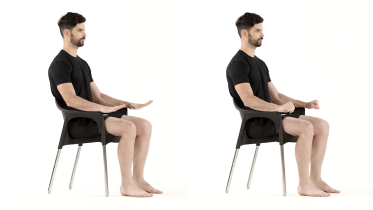 Open and close the hands
 Tendon glides
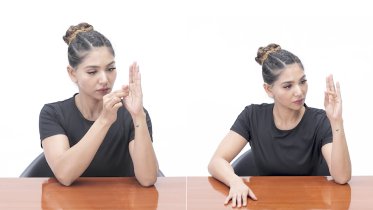 Thumb opposition
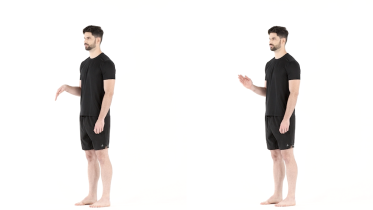 Wrist circles
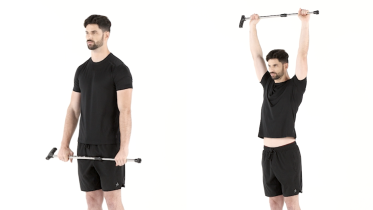 Shoulder flexion with a stick
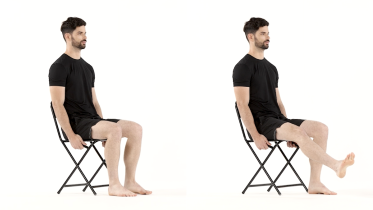 Ankle circles
Stage 2: Build whole-body strength and fitness
Add these once stage 1 is a habit, on days when your joints are not flaring. Sit to stand, the knee extension and the bridge strengthen your legs and hips without putting weight through your hands, and the band row works your upper back. If getting down to the floor is hard, do the bridge on a firm bed. If holding the band makes your hands sore, leave the row out and tell your physio. Brisk walking builds fitness for your heart and lungs, and you can start it at any stage.
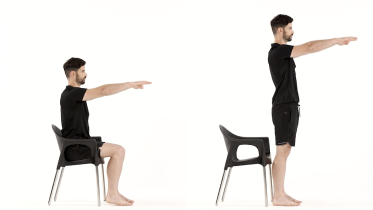 Sit to stand
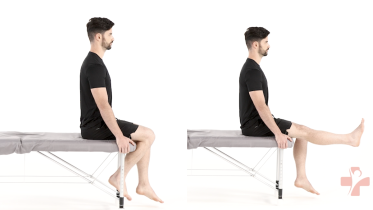 Seated knee extension
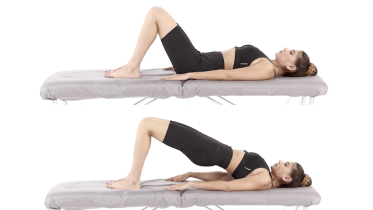 Glute bridge
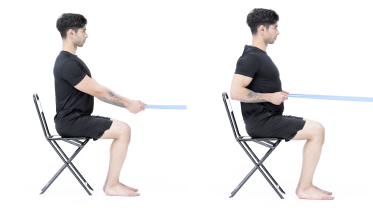 Seated row with band
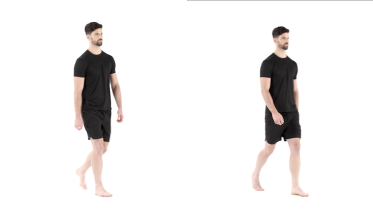 Brisk walking
Stage 3: Build hand strength
Resistance work for the hands, along the lines of the SARAH hand program, once your hands are not flaring. NICE suggests this kind of program if you take no medicines for rheumatoid arthritis, or your medicines have not changed for at least 3 months. The grip squeeze works the muscles that close the hand, and the wrist extension strengthens the muscles that lift the wrist. The SARAH program used a lowering-only (eccentric) version of the wrist exercise, which the wrist extension page describes. Start with a soft ball and a light weight, and leave both out on days when your hand joints are hot and swollen. Pinch strengthening is best set by your physio or hand therapist, who can choose a pinch that suits your joints.
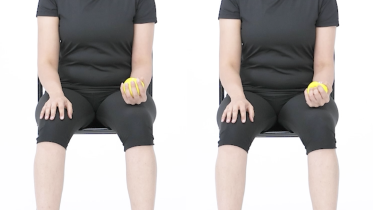 Hand grip squeeze
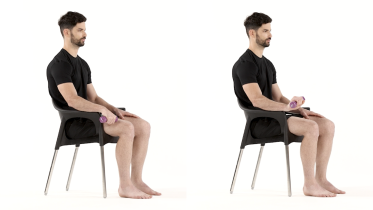 Wrist extension with weight
Protecting your neck
Rheumatoid arthritis can affect the joints at the very top of the neck. The NHS explains that after some years with the condition, these joints can slip out of place and press on the spinal cord, a problem called cervical myelopathy. It is uncommon, but when it does happen it is serious and needs treating quickly. The most common problem is looseness between the top two bones of the neck (atlantoaxial subluxation). Neck involvement can show up as persistent headaches, or as an electric shock feeling down the back when the head bends forward (Siempis 2023).
This program has no neck exercises for that reason. If you have rheumatoid arthritis and want to do neck exercises, for example from the neck pain program, check with your physio or doctor before you start. Some movements, such as tipping your head right back or pushing a stretch to the end of the range, may need to be changed or left out. Stretches that pull the head with your hand put extra load on the joints at the top of the neck, so leave the hand out unless your physio says otherwise.
Arthritis UK advises telling your healthcare team about neck pain, loss of balance, trouble walking, or weakness or numbness in your arms or legs. Some of these need help faster, so check the warning signs below. If you are due to have an operation under general anesthetic, the NHS notes that you may need a special check of your neck first, so tell the team that you have rheumatoid arthritis.
What to avoid or change
Leave the strength work out for any joint that is hot and swollen, and keep that joint to gentle movement until it settles. Outside a flare, few activities are off limits for everyone, but a large joint that is already badly damaged may need a lighter program, as the RAPIT trial suggests (de Jong 2003). Ask your physio to adapt it.
Look after your feet as well. The NHS says a podiatrist can offer joint supports or shoe insoles if rheumatoid arthritis causes foot problems. If your feet hurt when you walk, ask about this before you build up the walking in stage 2.
Long-term steroid tablets can cause thinning of the bones and muscle weakness, the NHS warns. If you have taken them for a long time, ask your doctor about your bones, and see the osteoporosis program for the changes it suggests for bending and lifting.
After a joint replacement or other surgery, follow your surgeon's program. If you are pregnant, check with your physio or rheumatology team before you start. This page is for adults: if a child or teenager has joint pain and swelling, with stiffness, their doctor can refer them to a specialist team.
When to see a physio or doctor
If your joints are swollen and stiff and they hurt, and you have no diagnosis yet, see your doctor. The NHS stresses that diagnosing rheumatoid arthritis quickly matters, because early treatment can stop it getting worse and lower the risk of joint damage.
Once you have a diagnosis, ask your rheumatology team about a physio with rheumatology expertise, as the 2026 British Society for Rheumatology guideline advises. If your hands or wrists are painful or hard to use, ask about a hand exercise program. The same guideline says people with pain during daily tasks or work should be able to see an occupational therapist. Tell your rheumatology team if flares are becoming more frequent or your medicines no longer control your symptoms. The warning signs below need faster help.
For physiotherapists
This page gives patients a starting framework, not a full plan. In SARAH, the seven mobility exercises were MCP flexion, tendon gliding, radial walking, finger abduction, wrist circumduction, hand behind head and hand behind back. The four strength exercises were gross grip, pinch grip, finger adduction and eccentric wrist extension, with dose set using the Borg rating of perceived exertion and progressed or regressed by protocol (Srikesavan 2018; Boniface 2022). Boniface 2022 found that a higher prescribed dose was associated with better overall hand function and grip strength at 4 months.
Radial walking and finger adduction have no page in our library yet, and neither do the behind-head and behind-back reaches, so add them yourself where they suit. Pinch strengthening is also left to you. Our key grip page is a lateral pinch, which loads the thumb carpometacarpal joint and puts an ulnar force on the index MCP joint, so the patient program leaves it out.
The 2026 BSR pain guideline recommends encouraging physical activity and exercise for pain in inflammatory arthritis, with access to a physiotherapist with rheumatology expertise (recommendation 14, GRADE 1C), and access to an occupational therapist with rheumatology expertise for pain during daily activities (recommendation 16, GRADE 1C). The meta-analysis informing the EULAR recommendations measured exercise against public health guidance: WHO's 150 minutes of moderate or 75 minutes of vigorous activity a week with muscle strengthening on at least 2 days, and the ACSM's addition of flexibility and neuromotor work on at least 2 days (Rausch Osthoff, RMD Open 2018). It pooled 49 trials and found moderate effects on cardiovascular fitness and muscle strength, and a small effect of activity promotion on physical activity behavior.
Screen the upper cervical spine before any neck work. Siempis 2023 names atlantoaxial subluxation as the most common cervical lesion in rheumatoid arthritis and lists corticosteroid use, hand and foot involvement and a high BMI as predictors of cervical involvement, noting that the incidence of instability has fallen since biologic medicines were added. The JOSPT neck pain guideline lists upper cervical ligamentous insufficiency among the serious conditions to screen for and refer (Blanpied 2017). In the RAPIT trial, intensive exercise did not increase radiographic damage of the large joints, except possibly in patients with considerable baseline damage (de Jong 2003), so grade load to the state of each large joint.
See a doctor promptly if
- Emergency: any sign of a stroke, even if it goes away. That means a face that droops on one side, an arm you cannot lift or keep up, slurred or muddled speech, weakness or numbness on one side of your body or face, sudden blurred vision, double vision or loss of sight, trouble swallowing, sudden dizziness with unsteadiness or falling over, a sudden severe headache, or a sudden fall where your legs give way but you do not black out (a drop attack). Call emergency services straight away. With neck pain, these can rarely come from a tear in an artery in the neck.
- Emergency: new problems walking, for example your legs feel stiff, heavy or weak or you have become unsteady on your feet, new trouble controlling your bladder or bowels, or hands that suddenly become clumsy, for example you can no longer do up buttons. Call emergency services straight away. These can be signs of pressure on the spinal cord in the neck.
- Emergency: you have had cancer, now or in the past, and your back or neck pain feels like a tight band around your body, or comes with pain spreading down an arm or leg, weakness, numbness or pins and needles in your arms or legs, trouble walking, or trouble controlling your bladder or bowels. Call your cancer team's emergency number straight away, or go to an emergency department if you do not have one or cannot get through. This can be cancer pressing on the spinal cord (metastatic spinal cord compression), which needs treatment straight away.
- Hands that have slowly become clumsy, for example trouble doing up buttons or dropping things, or numbness in both hands. Get medical advice the same day. These can be signs of pressure on the spinal cord in the neck (cervical myelopathy). If the clumsiness or numbness gets worse quickly, call emergency services straight away.
- Pain or tingling in both arms at the same time, rather than in one. Get medical advice the same day. This can also be a sign of pressure on the spinal cord in the neck.
- An electric shock feeling runs down your back or into your arms or legs as your head bends forward. Stop and get medical advice the same day.
- You have rheumatoid arthritis and get new neck pain, or a new headache at the back of your head that keeps coming back. If it comes with tingling or numbness in your hands or arms, get medical advice the same day. If you also feel unsteady on your feet or your legs feel stiff, heavy or weak, call emergency services straight away. Without any of those, tell your doctor or rheumatology team within a few days, and leave out any neck exercises until you have been checked.
- An arm or hand that is getting weaker. Get medical advice the same day.
- If chest pain, pressure or tightness does not ease quickly when you rest, spreads to your arm, neck, jaw, stomach or back, or comes with sweating, feeling sick, feeling light-headed or being short of breath, call emergency services straight away, as this can be a heart attack. If it eases quickly and none of these happen, get medical advice the same day, and do not exercise again until you have been checked.
- If you faint while exercising, call emergency services, even if you feel fine again quickly.
- One joint suddenly becomes much more painful, hot, red or swollen than your other joints or than your usual flares, or you have joint pain with a high temperature or feel hot, cold or shivery. Get medical advice the same day, and go to an emergency department if you feel very unwell. This can be a sign of infection in the joint, which needs treatment quickly. Rheumatoid arthritis and some of the medicines for it make infection more likely.
- A high temperature, or you feel hot, cold, shivery or generally unwell, while you take medicines for rheumatoid arthritis. Get medical advice straight away and tell your rheumatology team, as some of these medicines, such as methotrexate and biologic medicines, can make infections more likely. If you have a very high or very low temperature, shivering you cannot control, you are breathing very fast or finding it hard to breathe, you are confused or your speech is slurred, your skin, lips or tongue look blue, gray, pale or blotchy (on brown or black skin this can be easier to see on the palms of the hands or soles of the feet), or you have a rash that does not fade when you press it, call emergency services, as this can be sepsis.
- An eye that becomes red and painful. Get it checked the same day, for example at an urgent eye service or an urgent appointment with a GP or optician, and mention that you have rheumatoid arthritis, which can inflame the white of the eye (scleritis). If your vision changes, light hurts your eye, the eye turns very dark red, or you also have a severe headache and feel sick, go to an emergency department or emergency eye service straight away, and do not drive yourself.
- A cough that does not go away, or breathlessness that gets worse during your normal activities or when you lie down. If you take methotrexate, get medical advice straight away and tell your rheumatology team, as it can rarely inflame the lungs. Otherwise, book an appointment with your doctor if the cough has lasted 3 weeks or more or the breathlessness keeps getting worse, and mention your rheumatoid arthritis, which can sometimes inflame the lungs too. If you are suddenly more short of breath than usual, get medical advice the same day. If you are gasping, choking or cannot get your words out, your chest feels tight or heavy, your lips or skin turn very pale, blue or gray, or you feel suddenly confused, call emergency services.
- A calf or thigh that is newly swollen, warm, tender, red or darker than usual, has swollen veins that are sore to touch, or has a throbbing or cramping pain that does not fit your injury or condition, or that feels different from normal muscle soreness after exercise. This can be a sign of a blood clot (deep vein thrombosis), especially after surgery, an injury, time in a cast or boot, a long trip or a spell of being much less mobile than usual. Get medical advice the same day. If you are also short of breath or have chest pain, call emergency services.
- Suddenly being unable to straighten a finger or the end of your thumb, or lift it back, even without an injury. With rheumatoid arthritis, a tendon on the back of the hand can snap, so stop the hand exercises for that hand and have a doctor check it within a few days.
- Back pain after a minor fall or strain if you are older, have low bone density (osteoporosis) or have taken steroid tablets for a long time. Get medical advice the same day.
- Pain at night that keeps getting worse, beyond what your flares usually bring. See your doctor within a few days. If you have had cancer, now or in the past, or you have lost weight without trying, get medical advice the same day. If you are being treated for cancer now, contact your cancer team the same day.
- You have not been diagnosed, and several joints in your hands, wrists or feet are painful, swollen and stiff, especially in the morning. This is not an emergency, but see your doctor within a few days, because early treatment can stop the condition getting worse and lower the risk of joint damage.
Common questions
What is the best exercise for rheumatoid arthritis?
No single exercise stands out. The EULAR task force looked at whether the general activity guidelines for adults suit people with inflammatory arthritis, and the review behind it found that exercise done that way improved fitness and muscle strength (Rausch Osthoff 2018). In practice that means a mix: walking, cycling or swimming for fitness, strength work for the big muscle groups, daily movement for every joint, and hand exercises if your hands are affected. The best program is the one you keep doing, so build up slowly and pick activities you enjoy.
Should I exercise during a rheumatoid arthritis flare?
Usually yes, but more gently. Arthritis UK advises slow, gentle movement during a flare rather than stopping altogether, avoiding intense or high-impact activity, and never forcing a movement that hurts. NRAS suggests letting the swollen joints settle and doing range of movement exercises instead of your usual workouts. Contact your rheumatology team if the pain gets much worse or you are not sure whether to carry on.
Can exercise damage your joints if you have rheumatoid arthritis?
For most people, the evidence says no. In the RAPIT trial, 309 people with rheumatoid arthritis did a 2-year high-intensity exercise program or usual care, and the exercise did not increase damage to the large joints on X-ray, except possibly in people who already had considerable damage (de Jong 2003). In the review behind the EULAR recommendations, the few side effects that trials reported were minor, such as a short-lived rise in pain. If a large joint is already badly damaged, ask your physio to adapt the program for it.
Do hand exercises help rheumatoid arthritis?
Yes, for many people. In the SARAH trial, 490 adults with rheumatoid arthritis in their hands were given usual care, with or without a tailored stretching and strengthening program, and hand function improved more with the exercises at 12 months (Lamb 2015). Pain stayed stable in both groups and no serious side effects were linked to the exercises. NICE suggests considering a tailored hand exercise program for adults with rheumatoid arthritis whose hands or wrists are painful and hard to use.
Does exercise help with rheumatoid arthritis fatigue?
It may help a little. A Cochrane review found some evidence that physical activity reduces self-reported fatigue in adults with rheumatoid arthritis, although the benefit was small (Cramp 2013). The 2026 British Society for Rheumatology guideline also advises offering fatigue management to people with inflammatory arthritis who have pain. Start with short walks or gentle sessions and build up, rather than doing a lot on a good day and paying for it the next.
Is swimming good for rheumatoid arthritis?
It can be a good choice. NRAS describes swimming as an excellent form of physical activity because it puts very little strain on the joints. Arthritis UK notes that a physio may suggest hydrotherapy, exercise in a warm pool, usually at a hospital. It works well for fitness, and adding some strength work on land covers the rest of the mix.
References
- Rausch Osthoff AK, Niedermann K, Braun J, et al. 2018 EULAR recommendations for physical activity in people with inflammatory arthritis and osteoarthritis. Annals of the Rheumatic Diseases. 2018;77(9):1251-1260. https://doi.org/10.1136/annrheumdis-2018-213585
- Rausch Osthoff AK, Juhl CB, Knittle K, et al. Effects of exercise and physical activity promotion: meta-analysis informing the 2018 EULAR recommendations for physical activity in people with rheumatoid arthritis, spondyloarthritis and hip/knee osteoarthritis. RMD Open. 2018;4:e000713. https://doi.org/10.1136/rmdopen-2018-000713
- Scott IC, Smith TM, Babatunde O, et al. The 2026 British Society for Rheumatology guideline for pain management in people with inflammatory arthritis. Rheumatology (Oxford). 2026;65(7):keag320. https://doi.org/10.1093/rheumatology/keag320
- National Institute for Health and Care Excellence. Rheumatoid arthritis in adults: management (NG100). 2018. https://www.nice.org.uk/guidance/ng100
- Lamb SE, Williamson EM, Heine PJ, et al. Exercises to improve function of the rheumatoid hand (SARAH): a randomised controlled trial. The Lancet. 2015;385(9966):421-429. https://doi.org/10.1016/S0140-6736(14)60998-3
- Williams MA, Williamson EM, Heine PJ, et al. Strengthening And stretching for Rheumatoid Arthritis of the Hand (SARAH). A randomised controlled trial and economic evaluation. Health Technology Assessment. 2015;19(19):1-222. https://doi.org/10.3310/hta19190
- Heine PJ, Williams MA, Williamson E, et al. Development and delivery of an exercise intervention for rheumatoid arthritis: strengthening and stretching for rheumatoid arthritis of the hand (SARAH) trial. Physiotherapy. 2012;98(2):121-130. https://doi.org/10.1016/j.physio.2011.03.001
- Srikesavan C, Williamson E, Cranston T, et al. An online hand exercise intervention for adults with rheumatoid arthritis (mySARAH): design, development, and usability testing. Journal of Medical Internet Research. 2018;20(6):e10457. https://doi.org/10.2196/10457
- Boniface G, Sanchez-Santos MT, Norris M, et al. Understanding prescribed dose in hand strengthening exercise for rheumatoid arthritis: a secondary analysis of the SARAH trial. Musculoskeletal Care. 2022;20(4):899-907. https://doi.org/10.1002/msc.1646
- Hurkmans E, van der Giesen FJ, Vliet Vlieland TP, Schoones J, Van den Ende EC. Dynamic exercise programs (aerobic capacity and/or muscle strength training) in patients with rheumatoid arthritis. Cochrane Database of Systematic Reviews. 2009;(4):CD006853. https://doi.org/10.1002/14651858.CD006853.pub2
- de Jong Z, Munneke M, Zwinderman AH, et al. Is a long-term high-intensity exercise program effective and safe in patients with rheumatoid arthritis? Results of a randomized controlled trial. Arthritis and Rheumatism. 2003;48(9):2415-2424. https://doi.org/10.1002/art.11216
- Cramp F, Hewlett S, Almeida C, et al. Non-pharmacological interventions for fatigue in rheumatoid arthritis. Cochrane Database of Systematic Reviews. 2013;(8):CD008322. https://doi.org/10.1002/14651858.CD008322.pub2
- Siempis T, Tsakiris C, Anastasia Z, et al. Radiological assessment and surgical management of cervical spine involvement in patients with rheumatoid arthritis. Rheumatology International. 2023;43(2):195-208. https://doi.org/10.1007/s00296-022-05239-5
- Blanpied PR, Gross AR, Elliott JM, et al. Neck pain: revision 2017. Clinical practice guidelines linked to the International Classification of Functioning, Disability and Health from the Orthopaedic Section of the American Physical Therapy Association. Journal of Orthopaedic and Sports Physical Therapy. 2017;47(7):A1-A83. https://doi.org/10.2519/jospt.2017.0302
- NHS. Rheumatoid arthritis. Page last reviewed 8 March 2023. https://www.nhs.uk/conditions/rheumatoid-arthritis/
- NHS. Symptoms: Rheumatoid arthritis. Page last reviewed 8 March 2023. https://www.nhs.uk/conditions/rheumatoid-arthritis/symptoms/
- NHS. Treatment: Rheumatoid arthritis. Page last reviewed 8 March 2023. https://www.nhs.uk/conditions/rheumatoid-arthritis/treatment/
- NHS. Complications: Rheumatoid arthritis. Page last reviewed 8 March 2023. https://www.nhs.uk/conditions/rheumatoid-arthritis/complications/
- NHS. Septic arthritis. Page last reviewed 3 September 2026. https://www.nhs.uk/conditions/septic-arthritis/
- NHS. Red eye. Page last reviewed 27 October 2025. https://www.nhs.uk/symptoms/red-eye/
- NHS. Shortness of breath. Page last reviewed 30 January 2024. https://www.nhs.uk/symptoms/shortness-of-breath/
- NHS. Side effects of methotrexate. https://www.nhs.uk/medicines/methotrexate/side-effects-of-methotrexate/
- NHS. Deep vein thrombosis (DVT). https://www.nhs.uk/conditions/deep-vein-thrombosis-dvt/
- NHS. Symptoms of a stroke. https://www.nhs.uk/conditions/stroke/symptoms/
- NHS. Sepsis. https://www.nhs.uk/conditions/sepsis/
- NHS. Fainting. https://www.nhs.uk/symptoms/fainting/
- Arthritis UK. Rheumatoid arthritis: symptoms, causes and treatment. Last reviewed 13 July 2026. https://www.arthritis-uk.org/information-and-support/understanding-arthritis/conditions/rheumatoid-arthritis/
- Arthritis UK. How to maintain movement during a flare up. 20 January 2025. https://www.arthritis-uk.org/news/2025/january/how-to-maintain-movement-during-a-flare-up/
- National Rheumatoid Arthritis Society. Exercise for rheumatoid arthritis. Updated 17 March 2017. https://nras.org.uk/resource/exercise/
- British Society for Surgery of the Hand. Thumb extensor tendon (EPL) rupture. https://www.bssh.ac.uk/patients/conditions/30/thumb_extensor_tendon_epl_rupture
Written and checked by the PocketPhysio editorial team. Last updated 2026-09-28.
This page is general education, not a diagnosis or a personal treatment plan. See a physiotherapist or doctor for advice about your own situation.