Tendon glides
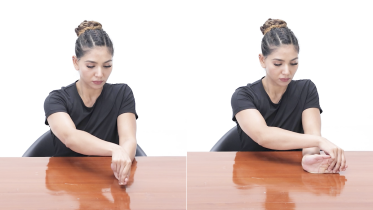
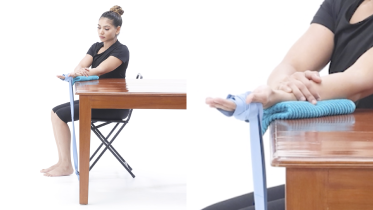
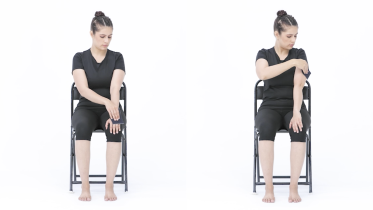
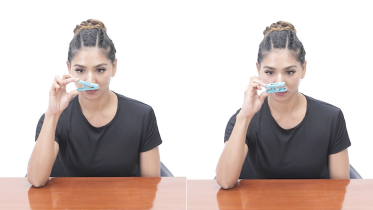
Tendon glides move your fingers through five positions, a straight hand, a tabletop and three different fists, so the tendons that bend your fingers slide through the wrist and hand. You sit at a table with your elbow resting on it and your hand held up, and move slowly from one position to the next. Hand therapists and physios often use them for stiff fingers and after hand and wrist injuries. They also turn up in programs for carpal tunnel symptoms.
How to do the tendon glides
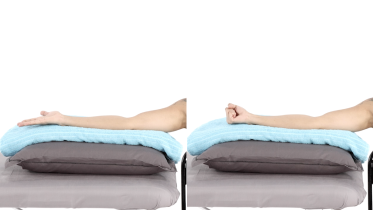
- Sit at a table and rest the elbow of the hand you are working on the tabletop, forearm upright and the hand in front of you. You can also do this standing.
- Start with your fingers straight and together, pointing up to the ceiling.
- Tabletop: bend only at the big knuckles, so your fingers stay straight but tip over level, like a tabletop. The thumb stays up.
- Flat fist: now bend the middle joints so your fingertips reach toward the heel of your hand. The end joints stay straight.
- Full fist: bend the end joints as well, so all your fingers curl snugly into the palm.
- Hook fist: straighten the big knuckles so they line up with your palm again, but keep the middle and end joints bent, fingertips touching the top of the palm just below the knuckles.
- Straighten your fingers back to the start. That is one round. The voice guide leaves out the tabletop and uses a different order (straight, hook fist, full fist, flat fist, then back). Either order works if your physio has not given you one.
What you should feel
Movement and a mild stretch in the fingers and palm, sometimes along the front of the forearm. Stiff fingers may feel tight at the end of each position, but it should not be painful.
Common mistakes
- Bending the big knuckles during the hook fist, or the middle joints during the tabletop.
- Rushing from one position to the next without reaching each one.
- Letting the wrist flop forward. Keep it roughly in line with your forearm.
- Pushing a stiff finger into place with the other hand, unless your physio has shown you how.
How often
Many programs go through the full sequence 5 to 10 times, holding each position for about 3 to 5 seconds, 2 to 4 times a day. Your physio will adjust this for you.
Stop and check with your physio if
- Sharp pain in a finger joint or in the palm.
- Tingling or numbness in the fingers that builds as you work through the positions. If one side of your face or body suddenly goes numb or weak, or your speech becomes slurred or muddled, call emergency services, even if it goes away.
- Fingers that are more swollen or stiff after the session than before.
- Emergency: while you are in a cast or splint, your fingers turn blue, white or pale, or feel cold. Do not wait to see if raising your hand helps. Go to an emergency department straight away, and do not drive yourself. The cast or splint may be cutting off the blood supply, or pressure may be building up inside the forearm (compartment syndrome), and both need checking quickly.
- In a cast or splint, the pain gets worse, your fingers feel numb or tingle or look more swollen, or the cast feels too tight. Stop, raise your hand above your head, keep moving your fingers and contact your fracture clinic or get medical advice straight away. If you cannot move your fingers, the pain is severe even after painkillers, or the numbness, tingling or swelling has not settled within 30 minutes of raising your hand, go to your fracture clinic or an emergency department straight away, and do not drive yourself.
- Since the fracture or cast, the hand is getting more painful rather than less, the skin becomes very sensitive to light touch, or the hand changes color, temperature, swelling or sweating compared with the other one, or looks shiny. See your doctor or physio as soon as you can, within a few days at most, as this can be complex regional pain syndrome (CRPS) and early treatment may help.
From the clinic
The fists are easy to mix up at first. Watch the video with your hand next to the screen and go slowly until each position matches. Stiff fingers often reach only part of a position in the beginning, so go as far as is comfortable rather than forcing it.
After a wrist fracture, keep moving your fingers and thumb as far as the cast or splint allows, unless your fracture clinic has told you otherwise. After a broken hand or finger, a tendon repair or other hand surgery, how far you may move the fingers and thumb is often limited for several weeks, so do only the movements your surgeon or hand therapist has shown you. After a flexor tendon repair or a carpal tunnel release, use this home version only if your surgeon or hand therapist has told you to. With rheumatoid or another inflammatory arthritis, keep the fists gentle on days when the joints are hot and swollen, and ask your physio what suits you. For carpal tunnel symptoms, these are often given alongside the median nerve glide.
Written and checked by the PocketPhysio editorial team. Last updated 2026-09-28.
This page is general education, not a diagnosis or a personal treatment plan. If you have pain, an injury or a health condition, see a physiotherapist or doctor before starting new exercises.