
Hand osteoarthritis exercises and physiotherapy
What is hand osteoarthritis?
Osteoarthritis is the most common kind of arthritis. In the hand, the NHS says it usually affects three areas: the base of the thumb, the finger joints closest to the fingertips and the middle joints of the fingers. Affected fingers can be painful and swollen as well as stiff, and bony bumps often form on the finger joints. Some fingers bend slightly sideways at the affected joints, and small, painful fluid-filled lumps (cysts) can appear on the backs of the fingers. Do not squeeze or prick a cyst yourself, as that can let infection into the joint (Watt 2025).
Arthritis at the base of the thumb, where it joins the wrist, can cause a bump there too. The NHS says it can make writing, opening jars or turning keys hard. Pain at the thumb base often shows up most with pinching and twisting.
Many people with hand osteoarthritis have flares. A UK review describes flares lasting a few days, and in its authors' experience they are often set off by heavy use (Watt 2025). The same review says the condition can affect one row of joints or several, and that many people improve over 2 to 5 years.
NICE advises that in people aged 45 or over whose joint pain comes with use, and whose morning stiffness lasts 30 minutes or less, osteoarthritis can be diagnosed from the symptoms and an examination, without an X-ray. The UK review agrees that hand osteoarthritis rarely needs a scan when the story and the examination fit (Watt 2025).
How hand osteoarthritis differs from other hand problems
Rheumatoid arthritis is the main one to rule out. It is inflammatory, and the NHS notes that its morning stiffness often goes on for more than 30 minutes. It favors the wrists and the big knuckles at the base of the fingers, while osteoarthritis favors the joints near the fingertips, the middle finger joints and the thumb base (Watt 2025). It needs medicines from a rheumatology team, so if your symptoms sound more like it, see your doctor and read the rheumatoid arthritis program.
Other hand problems can sit alongside osteoarthritis. A finger that clicks or locks as it bends is more likely trigger finger, a tendon problem with its own program. If the sore spot is on the thumb side of the wrist and it hurts to lift the thumb, it may be De Quervain's tenosynovitis. If your thumb and the next two fingers tingle, a pinched nerve at the wrist is the more likely cause, and the carpal tunnel syndrome program covers that.
Do exercises help hand osteoarthritis?
Yes, a little. A Cochrane review pooled small trials. Exercise eased hand pain and finger stiffness and helped hand function, but only by a small amount, and the evidence was low quality (Østerås 2017). The gains did not last at later follow-up, which suggests the exercises need to become a habit rather than a short course. The few side effects reported were more finger joint inflammation and hand pain.
The guidelines still include exercise. The 2018 EULAR recommendations name four non-drug treatments for hand osteoarthritis: education, gadgets (assistive devices), exercise, and splints (Kloppenburg 2019). A UK review describes the EULAR approach as movement exercises plus strengthening, and its authors add tendon glides and thumb movement for finger joint arthritis (Watt 2025). NICE's osteoarthritis guideline covers every joint. It advises exercise tailored to each person for everyone with osteoarthritis, and says joint pain may increase for a while when you start.
The program below follows that pattern. It is no cure, and nobody can promise it will change the joints. What it can do is make daily tasks a little easier.
Splints, aids and protecting your joints
Protecting your joints is not about resting your hands. The UK review describes it as taking load off the joints so they are under less strain in everyday tasks (Watt 2025). In practice that means using the whole hand, or both hands, instead of a tight pinch, and carrying heavy things close to your body. On long gripping jobs like gardening or knitting, stop for short breaks. Occupational therapists and hand therapists teach this in detail.
Gadgets do the same job. Jar openers and key turners help, as do thick or padded handles on cutlery and pens and lever handles on faucets. Each one cuts the force your joints need. The EULAR recommendations include assistive devices among the non-drug treatments (Kloppenburg 2019).
For arthritis at the base of the thumb, the other common step is a splint. The American College of Rheumatology strongly recommends one there, and makes a weaker (conditional) recommendation for splints on other hand joints (Kolasinski 2020).
The evidence is mixed, though. In the UK OTTER II trial, a thumb splint added nothing on top of a supported self-management program (Watt 2025). NICE is cautious too. It advises against offering splints and supports as routine, unless a joint is unstable or loaded unevenly, exercise alone is not enough, and the splint is likely to help you move and use the joint better. A physio or hand therapist can fit one and show you when to wear it.
Splints for the joints nearest the fingertips reduced pain in a 2019 review, and the UK review team's own trial of night splints for those joints found less pain and better straightening (Watt 2025). Ask your hand therapist whether one suits a particular finger.
Medicines, warmth and flares
Medicines are a decision for your doctor or pharmacist. The EULAR recommendations prefer treatments rubbed on the skin, with anti-inflammatory gels as the first choice, over tablets (Kloppenburg 2019), and NICE advises using medicines alongside exercise, at the lowest dose that works for the shortest time. If you are unsure whether a medicine suits you, or you are pregnant, a pharmacist can check.
Warmth helps some people move more easily, although the evidence for it in hand osteoarthritis is weak (Watt 2025). During a flare, keep the stage 1 movements going gently and ease off the strength work until it settles, usually after a few days. A joint that stays hot and red and swells up a lot is a different matter: see the warning signs below.
How to use this program
Begin with stage 1 and do it every day. Move on to stage 2 once stage 1 feels easy and your hands are not flaring, and to stage 3 once stage 2 leaves your hands settled the next day. The earlier stages stay in your routine as you add the later ones.
You will find a typical starting dose on each exercise page. Roughly, the finger movements and thumb opposition are often done as 5 to 10 slow rounds, 2 to 4 times a day. Thumb bending and thumb extension usually start at 2 to 3 sets of 10, 2 to 3 times a day. For the strength exercises in stages 2 and 3, begin with 5 to 15 repetitions on the lightest band, the softest putty or a soft ball, and build up to 2 or 3 sets.
With hand osteoarthritis, a cautious way to start is strength work every other day, about three times a week. A UK review points to some evidence that this is well tolerated, and the rest days are meant to avoid a rise in pain or swelling (Watt 2025). If your hands are no worse the next morning, your physio may build you up toward the once or twice a day the exercise pages suggest. Your physio will adjust all of this to suit your hands.
Some aching during or after the exercises is normal. It is fine as long as it eases soon after you stop and your joints are no stiffer or more swollen the following morning. Sharp pain in a joint means stop that exercise. If the joints are clearly worse the day after, that was too much, so ease off or return to the earlier stage.
After surgery on your hand or thumb, such as a thumb base operation or a joint fusion, follow the program from your surgeon or hand therapist rather than this one. The program is written for adults: a child or teenager with painful or swollen finger joints should see a doctor first. If you are pregnant, check with your midwife or doctor before starting.
The exercise program
Stage 1: Keep the finger and thumb joints moving
The base of the program, for good days and flare days alike. Opening and closing the hand and the tendon glides take every finger joint through its range, and the three thumb movements do the same for the thumb. Many people find these easier once the hands have warmed up, for example after washing up in warm water. Go as far as each joint moves comfortably and do not push a stiff or knobbly finger into place with your other hand.
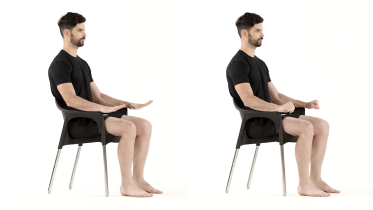 Open and close the hands
 Tendon glides
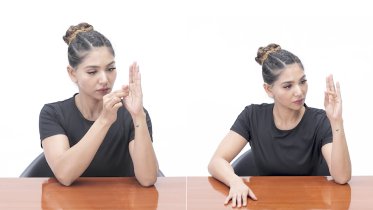 Thumb opposition
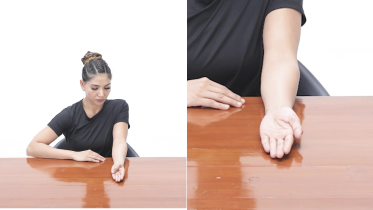 Thumb flexion
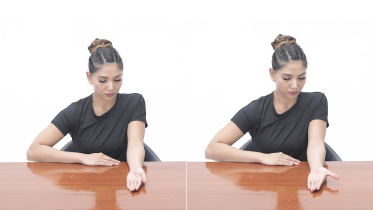 Thumb extension
Stage 2: Build strength to open and close the hand
Start this stage when stage 1 has become part of your day and your hands are settled rather than flaring. The band and putty exercises train the muscles that straighten and spread the fingers. The soft ball squeeze works your grip without asking for much force. Go light at first: the thinnest band, soft putty, a soft ball. A little aching is fine as long as it fades shortly after you finish and the next morning your hands are no stiffer or more swollen.
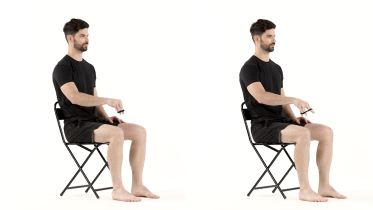 Finger extension with a rubber band
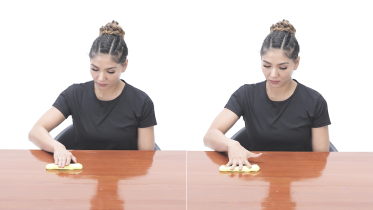 Finger spread with putty
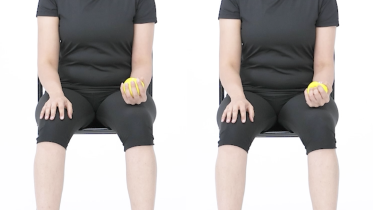 Hand grip squeeze
Stage 3: Thumb and pinch strength with joint care
This stage suits hands that handle stage 2 well, and it matters most if the base of your thumb hurts when you write, turn a key or open a jar. The putty thumb exercise strengthens the muscles that move the thumb out from the hand, and the clothespin and cloth pinches train pinch strength against a light, adjustable load. Pinching loads the joint at the base of the thumb, so ask your physio before you start them and keep the load light. Keep the thumb rounded, as if making an O, and do not let any thumb joint bend backward as you press.
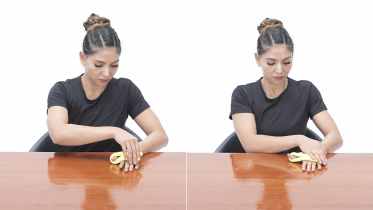 Thumb extension with putty
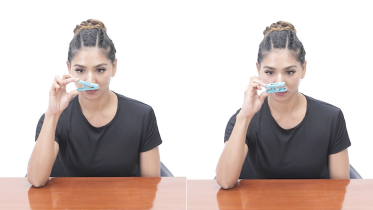 Clothespin pinch
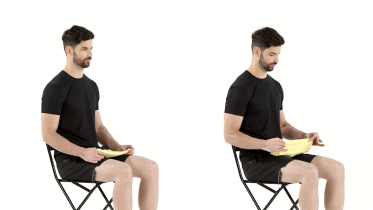 Pinch and pull with a cloth
When is surgery considered for hand osteoarthritis?
Surgery is usually kept for pain that has not improved with the treatments above (Watt 2025). For the joints nearest the fingertips, the usual operation fuses the joint so it no longer moves. For the middle finger joints, surgeons consider either a fusion or a joint replacement. At the base of the thumb, the preferred operation removes a small wrist bone (trapeziectomy). A hand surgeon will talk through what each option means for how you use your hand.
When to see a physio or doctor
The NHS advises seeing your GP if symptoms of osteoarthritis persist, so they can confirm the diagnosis and discuss treatment. A physical therapist (physiotherapist), occupational therapist or hand therapist can set your exercises, check your pinch and grip, and fit a splint. Ask for help sooner if the pain stops you working, caring for others or doing everyday tasks. For anything in the warning signs below, get help faster.
For physiotherapists
The patient text is a starting point for hand osteoarthritis managed without surgery. The Cochrane review (Østerås 2017; seven trials, searched to September 2015) pooled five trials for pain (381 participants): SMD -0.27, about 0.5 points on a 0 to 10 scale, NNTB 9. Function improved by SMD -0.28 (four trials, 369 participants; 95% CI -0.58 to 0.02, so it crosses no effect) and stiffness by SMD -0.36, about 0.7 points, NNTB 7. All were low-quality evidence, effects were not sustained at medium and long-term follow-up, and the few adverse events (more finger joint inflammation and pain) were very low certainty.
The 2018 EULAR update (Kloppenburg 2019) has five overarching principles and 10 recommendations. Recommendations 1 to 3 are the non-drug ones (education and assistive devices; exercise; orthoses), and topical NSAIDs are the first-line pharmacological choice. Intra-articular glucocorticoids are generally not recommended but may be considered for painful interphalangeal joints. The ACR 2019 guideline (Kolasinski 2020) strongly recommends exercise, a hand orthosis for first CMC joint osteoarthritis, and self-efficacy and self-management programs. It makes conditional recommendations for kinesiotaping at the first CMC, orthoses for other hand joints, and topical NSAIDs, intra-articular steroid and chondroitin for hand osteoarthritis.
Watt and colleagues (2025) recommend range of motion and strengthening in line with EULAR, adding tendon gliding for interphalangeal disease and thumb mobility work, and modifying the program for deformity. They cite OTTER II as the thumb base exercise program and report no added benefit of thumb base splinting over supported self-management in that trial. The stated rationale for splinting is support or counterpressure at the CMC joint during resistive pinch.
For dose, they cite 20 minutes three times a week with rest days as a well-tolerated dose, and in their own practice often use short daily sessions. The Cochrane trials ranged from two to three sessions a week to three to four times a day. This page starts strength work on alternate days and leaves daily loading to the treating physio.
NICE NG226 (1.3.11) advises against routinely offering insoles, braces, tape, splints or supports unless there is joint instability or abnormal biomechanical loading, therapeutic exercise is ineffective or unsuitable without the device, and the device is likely to improve movement and function. Stage 3 uses pad-to-pad pinch against a light graded load. The lateral key pinch page is left out, as on the rheumatoid arthritis program.
Screen for features that do not fit: wrist or MCP predominance, prolonged morning stiffness or frequent inflammatory flares suggest inflammatory arthritis. Watt 2025 also lists coexisting carpal tunnel syndrome, De Quervain's tenosynovitis, flexor tendinopathy, gout and CPPD. Surgery (DIP arthrodesis, PIP arthrodesis or implant arthroplasty, trapeziectomy at the thumb base) is reserved for symptoms that persist after non-surgical care.
See a doctor promptly if
- Emergency: any sign of a stroke, even if it goes away. That means a face that droops on one side, an arm you cannot lift or keep up, slurred or muddled speech, weakness or numbness on one side of your body or face, sudden blurred vision, double vision or loss of sight, trouble swallowing, sudden dizziness with unsteadiness or falling over, a sudden severe headache, or a sudden fall where your legs give way but you do not black out (a drop attack). Call emergency services straight away.
- Emergency: after an injury, a finger or thumb that points at an odd angle, looks blue or feels numb, or has a cut with bone showing or poking out. Go to an emergency department straight away, and do not drive yourself. The finger may be broken.
- A finger or thumb that became painful, swollen, bruised, stiff or hard to move after an injury, rather than slowly over weeks. Get medical advice the same day, and have it checked before you start these exercises.
- One finger joint or the base of your thumb suddenly becomes much more painful, hot, red or swollen than your other joints or than your usual flares, a cyst on the back of a finger bursts or leaks, or you have joint pain with a high temperature or feel hot, cold or shivery. Get medical advice the same day, and go to an emergency department if you feel very unwell. This can be a sign of infection in the joint, which needs treatment quickly. Gout can look much the same, and a doctor needs to tell the two apart. If you have a very high or very low temperature, shivering you cannot control, you are breathing very fast or finding it hard to breathe, you are confused or your speech is slurred, your skin, lips or tongue look blue, gray, pale or blotchy (on brown or black skin this can be easier to see on the palms of the hands or soles of the feet), or you have a rash that does not fade when you press it, call emergency services, as this can be sepsis.
- Morning stiffness in your hands that lasts longer than 30 minutes, soft, puffy swelling over the big knuckles at the base of the fingers or over the wrists, or painful, swollen joints in your feet as well. This is not an emergency, but see your doctor within a few days, because it can be a sign of an inflammatory arthritis such as rheumatoid arthritis rather than osteoarthritis, and early treatment can stop it getting worse.
- Numbness, tingling or pins and needles in your fingers. Osteoarthritis of the hand does not usually cause these, so see a doctor or physio within a week or two to find the cause, such as a trapped nerve at the wrist (carpal tunnel syndrome). If the numbness is there all the time, your hand or thumb is getting weaker, you keep dropping things, or the fleshy muscle at the base of your thumb looks flatter or thinner than on the other hand, see a doctor within a few days. If the weakness is getting worse from day to day, get medical advice the same day.
- Emergency: new problems walking, for example your legs feel stiff, heavy or weak or you have become unsteady on your feet, new trouble controlling your bladder or bowels, or hands that suddenly become clumsy, for example you can no longer do up buttons. Call emergency services straight away. These can be signs of pressure on the spinal cord in the neck.
- Numbness or tingling in both hands together with hands that have slowly become clumsy, for example trouble doing up buttons or dropping things. Get medical advice the same day. These can be signs of pressure on the spinal cord in the neck (cervical myelopathy) rather than a problem at the wrist. If the clumsiness or numbness gets worse quickly, call emergency services straight away.
- The pain is there at night or at rest and keeps getting worse. See your doctor within a few days. If you have had cancer, now or in the past, or are losing weight without trying, see your doctor sooner, within a day or two, and mention it. This applies even if the pain is not getting worse. If you are being treated for cancer now, contact your cancer team the same day.
Common questions
What are the best exercises for arthritis in the hands?
No single exercise stands out. The EULAR recommendations cover exercise alongside education, gadgets and splints, and a UK review describes the usual mix as movement exercises plus strengthening (Watt 2025). In practice that means moving every finger and the thumb through their range each day, then adding light grip and pinch strength. Pick exercises you can keep doing, because in trials the benefit had faded by later check-ups (Østerås 2017).
Should I wear a splint for thumb arthritis?
Maybe. The American College of Rheumatology strongly recommends a hand splint for arthritis at the base of the thumb (Kolasinski 2020). The evidence is not all one way: in the UK OTTER II trial, a thumb splint added nothing to a supported self-management program (Watt 2025), and NICE advises against routine splints unless a joint is unstable or loaded unevenly and exercise alone is not enough. A physio or hand therapist can tell you whether one suits your thumb. If you try one, judge it by what it does for your hand.
Is hand osteoarthritis the same as rheumatoid arthritis?
No. In osteoarthritis, the cartilage that lines the joint gets thinner and the bone beneath it changes. Rheumatoid arthritis is different: the immune system attacks the lining of the joint and inflames it. It is more likely to involve the wrists and the knuckles where the fingers meet the hand (Watt 2025), and people with it are often stiff for more than 30 minutes in the morning (NHS). It needs different medicines, so see your doctor if your symptoms sound more like it, and see the rheumatoid arthritis program if you have that diagnosis.
Will hand osteoarthritis keep getting worse?
Not for everyone. A UK review of hand osteoarthritis says many people improve over 2 to 5 years, especially women, and that knowing this can ease worry about it spreading (Watt 2025). Flares lasting a few days are common along the way, so one bad spell does not mean the arthritis is spreading.
Does heat help arthritis in the hands?
For some people, yes. Warmth can ease pain for a while and make the hands easier to move, though the evidence for it in hand osteoarthritis is weak (Watt 2025). An easy way to try it is to soak your hands in warm, not hot, water before your stage 1 exercises. If the feeling in your hands is reduced, for example with diabetes or carpal tunnel syndrome, test the water with your elbow first, as it is easy to burn skin you cannot feel well (Watt 2025).
References
- Kloppenburg M, Kroon FP, Blanco FJ, et al. 2018 update of the EULAR recommendations for the management of hand osteoarthritis. Annals of the Rheumatic Diseases. 2019;78(1):16-24. https://doi.org/10.1136/annrheumdis-2018-213826
- Kolasinski SL, Neogi T, Hochberg MC, et al. 2019 American College of Rheumatology/Arthritis Foundation guideline for the management of osteoarthritis of the hand, hip, and knee. Arthritis Care and Research. 2020;72(2):149-162. https://doi.org/10.1002/acr.24131
- Østerås N, Kjeken I, Smedslund G, et al. Exercise for hand osteoarthritis. Cochrane Database of Systematic Reviews. 2017;(1):CD010388. https://doi.org/10.1002/14651858.CD010388.pub2
- Watt FE, Kennedy DL, Gardiner MD, Vincent TL. Current and future advances in practice: practical management of hand osteoarthritis. Rheumatology Advances in Practice. 2025;9(4):rkaf093. https://doi.org/10.1093/rap/rkaf093
- National Institute for Health and Care Excellence. Osteoarthritis in over 16s: diagnosis and management (NG226). 2022. https://www.nice.org.uk/guidance/ng226
- NHS. Symptoms: Osteoarthritis. Page last reviewed 20 March 2023. https://www.nhs.uk/conditions/osteoarthritis/symptoms/
- NHS. Symptoms: Rheumatoid arthritis. Page last reviewed 8 March 2023. https://www.nhs.uk/conditions/rheumatoid-arthritis/symptoms/
- NHS. Septic arthritis. Page last reviewed 3 September 2026. https://www.nhs.uk/conditions/septic-arthritis/
- NHS. Sepsis. Page last reviewed 14 May 2026. https://www.nhs.uk/conditions/sepsis/
- NHS. Symptoms of a stroke. Page last reviewed 12 September 2024. https://www.nhs.uk/conditions/stroke/symptoms/
Written and checked by the PocketPhysio editorial team. Last updated 2026-09-28.
This page is general education, not a diagnosis or a personal treatment plan. See a physiotherapist or doctor for advice about your own situation.