
Dupuytren's contracture treatment and hand exercises
What is Dupuytren's contracture?
Under the skin of your palm is a tough layer of tissue (the palmar fascia) that anchors the skin. In Dupuytren's disease this layer slowly thickens and shortens (OrthoInfo). It starts with firm lumps (nodules), often in line with the ring finger. In about 1 in 3 people the lumps go on to form cords that pull a finger toward the palm, and that bent finger is the contracture (BSSH).
The NHS says it mainly affects the ring and little fingers, is common in both hands at the same time, and gets slowly worse over many months or years. It is not usually painful, but it can affect how you use your hand. BSSH says the lumps are sometimes sore to press in the early stages and that this almost always settles with time. Some people also get pads over the backs of the knuckles or lumps in the soles of the feet.
Nobody knows exactly what causes it. The NHS links it to a family history of the condition, smoking, drinking a lot of alcohol, diabetes and epilepsy. BSSH says it usually starts in middle age or later, is more common in men and in Northern Europe, and often runs in families.
Dupuytren's contracture or trigger finger?
Both can leave a finger bent, but they behave differently. In trigger finger the tendon catches at the base of the finger, so the finger clicks or locks and then snaps straight, often with pain at its base. A Dupuytren's cord does not click. The finger bends slowly over months or years and stays bent, and you can often feel a firm cord or lump in the palm. The treatments are different, so if you are not sure which you have, ask your doctor or physio to check.
Numbness or pins and needles in the thumb and first two fingers comes from a nerve, not from the palm tissue. That fits carpal tunnel syndrome better, which has its own carpal tunnel syndrome program.
Do exercises or stretching help Dupuytren's contracture?
Not for the cords. No exercise or stretch has been shown to stop them or to straighten a finger that has already bent. OrthoInfo says splinting is not known to stop a contracture getting worse, and that forcefully stretching the bent finger does not help and could injure the finger or hand. A 2016 review of non-surgical treatments for early Dupuytren's disease found only small, low-level studies, mostly case series and case reports, and the 5 studies of physical therapy were too small to show whether it works (Ball 2016).
That means the exercises here are not a treatment for Dupuytren's. They keep moving the parts of the hand the cords leave free, and they keep your grip strong for daily tasks while you watch and wait. OrthoInfo mentions steroid injections into a painful nodule to help with the symptoms, but says they are not likely to keep the disease from getting worse.
The table-top test: when to see a doctor
Lay your hand palm down on a table. Can the palm and every finger rest flat? If so, treatment is not usually needed yet, and BSSH says surgery is not needed while the fingers still straighten fully. Once the hand will no longer go flat on the table, BSSH says surgery is likely to help and should be discussed with a surgeon.
Doing the check again from time to time is how you catch a slow change. OrthoInfo says that as Dupuytren's progresses it becomes harder to treat and the results are less good. So once your hand no longer goes flat, or it gets in the way of daily tasks, ask about a referral to a hand surgeon rather than waiting for the finger to curl right into the palm.
Needle, injection or surgery: the treatment options
There is no cure, and in the early stages the NHS says it does not usually need treatment at all. If it is severe and you cannot straighten your fingers or use your hand normally, a GP may refer you to a specialist. There are three main ways to release a bent finger, and a hand surgeon will explain which suits your hand.
In a needle fasciotomy the surgeon breaks the cord with the tip of a needle passed through the skin. The NHS gives a recovery time of up to 2 weeks, but says the contracture is more likely to come back than after surgery. Complications are rare. OrthoInfo lists infection and injury to a nerve or blood vessel, as well as pain and stiffness.
With a collagenase injection, an enzyme is injected into the cord and left to work for 2 to 3 days to weaken it. At a separate visit the doctor then moves the finger in a controlled way until the cord gives (OrthoInfo). OrthoInfo says it usually causes less pain and swelling than major surgery, but the disease comes back more often, and it can rarely cause an allergic reaction or a tear in the tendon that bends the finger. BSSH says the injection is helpful in some cases. Availability depends on where you live: the European Medicines Agency lists its European Union license as withdrawn at the company's request for commercial reasons, and the NHS page does not list it, so ask your hand surgeon whether it is offered.
Surgery removes the cord through one or more cuts in the palm or finger (fasciectomy). For a cord that has come back, the surgeon may remove the skin over it too and cover the area with a skin graft (dermofasciectomy) (BSSH). The NHS gives a recovery time of 4 to 12 weeks for a fasciectomy and says it has the lowest risk of the contracture coming back of the standard options, with a dermofasciectomy lower still. Whichever you have, the NHS notes that the finger may not be completely straight afterward, may not be as strong and flexible as it used to be, and the contracture could come back after a few years.
After treatment: hand therapy and splints
After a needle procedure, an injection or an operation, follow the plan your hand surgeon or hand therapist gives you. BSSH says hand therapy is important for getting movement and function back, especially after bigger operations and skin grafts, and that the hand may be fitted with a splint to wear at night. OrthoInfo says to expect some pain, swelling and stiffness, and that therapy can help with strength and function and bring the swelling down. This page does not give an after-treatment program. If you want to use the exercises below after treatment, wait until your surgeon or hand therapist says they fit your plan.
How to use this program
This program is for Dupuytren's contracture that has not been treated, or for keeping the rest of the hand working while you wait for treatment. Choose the stage that fits your hand as it is now. If in doubt, begin at stage 1. Work each finger through the range it has and let a bent finger stop where the cord stops it.
The program is meant for adults; a child whose finger stays bent should see a doctor first. If you are pregnant, check with your midwife or doctor before starting.
Typical starting doses look like this. The tendon glide sequence is done 5 to 10 times through, with each position held for about 3 to 5 seconds, 2 to 4 times a day. For opening and closing the hand, 5 to 10 slow repetitions 3 to 4 times a day is common. Thumb opposition is usually 5 to 10 rounds through all four fingers, 2 to 3 times a day.
In stage 2, the band and putty exercises usually begin with 10 to 15 repetitions, for 2 to 3 sets, once or twice a day. The ball squeeze starts at 10 to 15 squeezes, each held for about 3 to 5 seconds, 1 to 3 times a day. The exercise pages give their own ranges, and your physio will fit the dose to your hand and the jobs you need it for.
Stage 1 should not hurt at all. In stage 2 you may feel some discomfort, and that is fine if it wears off quickly and your hand is no worse by the next morning. A hand that is sorer or stiffer the next day means the session was too much: do less, or go back a stage.
You will not find passive stretching of the bent finger here, whether with your other hand, a strap or a homemade splint, for the reasons OrthoInfo gives above. After treatment, your hand therapist may give you a splint and specific stretches as part of your plan.
The exercise program
Stage 1: Keep the whole hand moving
This stage is for a hand with lumps or cords in the palm, whether or not a finger has started to bend. Tendon glides and hand opening and closing work each finger through whatever range it still has, and touching the thumb to each fingertip keeps the thumb working. A finger held down by a cord will stop short in some positions, which is expected, so take it as far as it goes easily and do not push it straighter with your other hand. Keep every movement pain free. If a sore lump in the palm makes a full fist uncomfortable, make the fist looser.
 Tendon glides
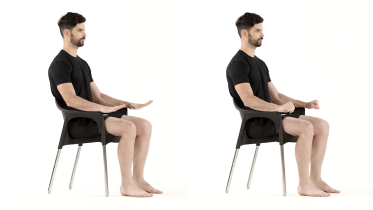 Open and close the hands
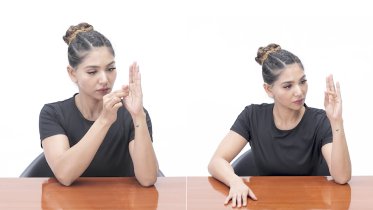 Thumb opposition
Stage 2: Light strength for gripping and daily tasks
Move on when the stage 1 movements feel easy. This stage does not treat the cords. It keeps the muscles that open and close the hand strong, so gripping and fiddly jobs stay easier. The band and putty exercises give the fingers something light to push against, and the soft ball squeeze trains closing the hand. If squeezing presses on a tender lump in your palm, use a softer ball or leave that one out. Mild soreness that goes soon after you stop is fine, as long as your hand is no worse the next morning.
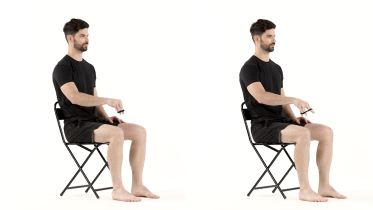 Finger extension with a rubber band
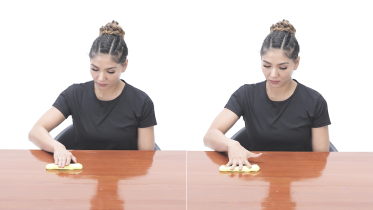 Finger spread with putty
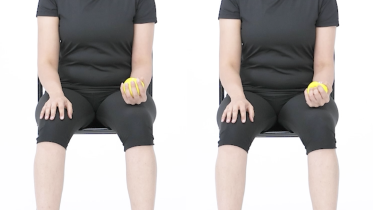 Hand grip squeeze
When to see a physio or doctor
The NHS advice is to see a GP once one or more fingers are bent and your hand will not go flat on a table, or the hand is making daily activities hard. A GP can confirm the diagnosis and refer you to a hand surgeon. A physical therapist (physiotherapist) or hand therapist can check the diagnosis too, set up your home program and, after any treatment, guide your recovery. A finger that bends over days or weeks, or a lump in your hand that grows quickly, needs a doctor within a few days. Act on any of the warning signs below as well.
For physiotherapists
The patient text covers untreated Dupuytren's disease and says plainly that exercise does not modify the cords. Ball and colleagues (2016) reviewed 26 studies of non-surgical treatment in early disease (contractures up to 30 degrees, Tubiana grades N to 1): 11 pharmacological, 5 physical therapy and 10 radiotherapy. All were level 4 or 5 evidence (20 case series, 1 cohort study, the rest case reports). Physical therapies were the most objectively assessed but underpowered, giving insufficient evidence of efficacy; intralesional steroid and radiotherapy appeared to soften nodules and slow progression, but the studies were poorly designed. BSSH states that published evidence does not support radiotherapy.
OrthoInfo states that splinting is not known to prevent progression, that forceful stretching of the contracted digit is unhelpful and may cause injury, and that steroid injection into a painful nodule may help symptoms but is unlikely to stop progression. Use active range of motion to keep uninvolved joints and digits moving and light resisted work to maintain grip, and avoid passive stretching of the contracted ray before treatment. Teach the table-top test for self-monitoring and refer for a surgical opinion when the hand cannot be placed flat or function is affected (BSSH, NHS).
Treatment choice sits with the hand surgeon. The NHS gives recovery of up to 2 weeks for needle fasciotomy and 4 to 12 weeks for fasciectomy, with higher recurrence after needle fasciotomy and the lowest after dermofasciectomy; OrthoInfo reports higher recurrence after collagenase than surgery and rare flexor tendon rupture. The European Medicines Agency lists the Xiapex marketing authorization as withdrawn at the holder's request for commercial reasons, so collagenase access varies by country.
After any procedure, follow the surgeon's or hand therapy unit's protocol for orthoses and exercise. Screen for trigger digit (catching and locking) and for median or ulnar nerve symptoms. Also look for inflammatory arthritis and a rapidly changing or atypical mass; NICE NG12 (1.11.4) advises considering an urgent direct access ultrasound for an unexplained lump that is increasing in size. After a procedure, ask about digital ischemia, flexor tendon rupture, persistent digital numbness, infection and CRPS. In a 20-year literature review of fasciectomy complications, Denkler (2010) reported CRPS in 5.5%, digital nerve injury in 3.4% and digital artery injury in 2%.
See a doctor promptly if
- Emergency: any sign of a stroke, even if it goes away. That means a face that droops on one side, an arm you cannot lift or keep up, slurred or muddled speech, weakness or numbness on one side of your body or face, sudden blurred vision, double vision or loss of sight, trouble swallowing, sudden dizziness with unsteadiness or falling over, a sudden severe headache, or a sudden fall where your legs give way but you do not black out (a drop attack). Call emergency services straight away.
- Emergency: since a needle procedure, injection or operation on your hand, a finger turns white, pale or blue, or feels cold compared with the others, and your medical team did not tell you to expect this or it lasts longer than they said. Go to an emergency department straight away, and do not drive yourself. The blood supply to the finger may have been damaged.
- A finger that becomes swollen along its length, red, hot and tender, and hurts a lot when you try to straighten it, so you keep it slightly bent, or a palm that becomes red, hot and swollen, especially after a cut, splinter, bite, injection or operation on the hand. Go to an emergency department straight away, and do not wait to see if it settles. An infection in the sheath around the tendon can spread quickly and often needs antibiotics through a drip and an operation. If you have a very high or very low temperature, shivering you cannot control, you are breathing very fast or finding it hard to breathe, you are confused or your speech is slurred, your skin, lips or tongue look blue, gray, pale or blotchy (on brown or black skin this can be easier to see on the palms of the hands or soles of the feet), or you have a rash that does not fade when you press it, call emergency services, as this can be sepsis.
- Since a needle procedure, injection or operation on your hand, the skin or wound where it was done becomes more red, hot, swollen or painful, or starts to leak. Contact your medical team the same day.
- Since a needle procedure, injection or operation on your hand, you suddenly cannot bend the treated finger, or the finger is still numb once any numbing injection has worn off. Contact your medical team the same day. A tendon or a nerve in the finger can rarely be injured during treatment.
- Since a needle procedure, injection or operation on your hand, the hand is getting more painful rather than less, the skin becomes very sensitive to light touch, or the hand changes color, temperature, swelling or sweating compared with the other one, or looks shiny. See your doctor or physio as soon as you can, within a few days at most, as this can be complex regional pain syndrome (CRPS) and early treatment may help.
- Emergency: after an injury, a finger or thumb that points at an odd angle, looks blue or feels numb, or has a cut with bone showing or poking out. Go to an emergency department straight away, and do not drive yourself. The finger may be broken.
- A finger that became painful, swollen, bruised, bent or hard to move after an injury, rather than slowly over months. Get medical advice the same day, and have it checked before you start these exercises.
- A finger that has bent over days or a few weeks rather than slowly over months or years, or a lump in your hand that is growing quickly or is painful and getting worse. This is not the usual pattern of Dupuytren's contracture, so see your doctor within a few days to find the cause.
- Numbness, tingling or pins and needles in your fingers that did not start after a procedure on your hand. These are not typical of Dupuytren's contracture, so see a doctor or physio within a week or two to find the cause, such as a trapped nerve at the wrist (carpal tunnel syndrome). If the numbness is there all the time, your hand or thumb is getting weaker, you keep dropping things, or the fleshy muscle at the base of your thumb looks flatter or thinner than on the other hand, see a doctor within a few days. If the weakness is getting worse from day to day, get medical advice the same day.
- Emergency: new problems walking, for example your legs feel stiff, heavy or weak or you have become unsteady on your feet, new trouble controlling your bladder or bowels, or hands that suddenly become clumsy, for example you can no longer do up buttons. Call emergency services straight away. These can be signs of pressure on the spinal cord in the neck.
- Numbness or tingling in both hands together with hands that have slowly become clumsy, for example trouble doing up buttons or dropping things. Get medical advice the same day. These can be signs of pressure on the spinal cord in the neck (cervical myelopathy) rather than a problem at the wrist. If the clumsiness or numbness gets worse quickly, call emergency services straight away.
- Several joints in your hands or feet are painful, swollen and stiff, not just the fingers pulled by a cord. This is not an emergency, but see your doctor in the next week or two, because it can be a sign of an inflammatory arthritis such as rheumatoid arthritis, and early treatment helps.
- The pain is there at night or at rest and keeps getting worse. See your doctor within a few days. If you have had cancer, now or in the past, or are losing weight without trying, see your doctor sooner, within a day or two, and mention it. This applies even if the pain is not getting worse. If you are being treated for cancer now, contact your cancer team the same day.
Common questions
Can Dupuytren's contracture be cured?
No. The NHS says there is no cure, and early on it usually needs no treatment. Treatment for a bent finger breaks or removes the cord, but the NHS notes the finger may not be completely straight afterward and the contracture could come back after a few years. BSSH adds that it can reappear in treated fingers or in new parts of the hand.
Can exercises or stretching straighten a Dupuytren's finger?
Not as far as anyone has shown. No exercise or stretch is known to stop the cords or undo a bend that is already there. OrthoInfo warns that forcing the bent finger straight does not help and could injure the hand, and that splinting is not known to stop the bend getting worse. A 2016 review found the studies of physical therapy for early Dupuytren's disease too small to show whether it works (Ball 2016). Gentle exercise still helps keep the rest of the hand moving and strong.
What is the table-top test for Dupuytren's?
It is a simple check you can do at home: put your hand palm down on a flat table and try to lay the palm and all the fingers flat. BSSH says surgery is not needed if the fingers can be straightened fully and is likely to help once it has become impossible to put the hand flat on a table. The NHS says to see a GP if one or more fingers are bent and you cannot put your hand down flat, or you are having difficulty with daily activities.
Is Dupuytren's contracture painful?
Not usually, according to the NHS, although it can affect how you use your hand. BSSH says the lumps in the palm are sometimes uncomfortable to press in the early stages, but that the discomfort almost always improves over time. If a finger is getting more painful, or pain at night keeps getting worse, have a doctor check it.
Is Dupuytren's contracture hereditary?
It often runs in families. BSSH says it is more common in Northern Europe than elsewhere, usually starts in middle age or later and affects more men than women. The NHS also links it to smoking, drinking a lot of alcohol, diabetes and epilepsy, although the exact cause is unknown.
Which is better for Dupuytren's, a needle procedure or surgery?
That depends on your hand, and it is a decision to make with a hand surgeon. The NHS says recovery after a needle fasciotomy takes up to 2 weeks against 4 to 12 weeks after a fasciectomy, but the contracture is more likely to come back after the needle procedure. Surgery that removes the cord has the lowest risk of it coming back, and removing the skin over the cord as well (a dermofasciectomy) lowers that risk further.
References
- NHS. Dupuytren's contracture. Page last reviewed 18 June 2024. https://www.nhs.uk/conditions/dupuytrens-contracture/
- British Society for Surgery of the Hand. Dupuytren's disease. Patient information. https://www.bssh.ac.uk/patients/conditions/25/dupuytrens_disease
- American Academy of Orthopaedic Surgeons. Dupuytren's disease. OrthoInfo. https://www.orthoinfo.org/en/diseases--conditions/dupuytrens-disease/
- Ball C, Izadi D, Verjee LS, Chan J, Nanchahal J. Systematic review of non-surgical treatments for early Dupuytren's disease. BMC Musculoskeletal Disorders. 2016;17(1):345. https://doi.org/10.1186/s12891-016-1200-y
- European Medicines Agency. Xiapex (collagenase Clostridium histolyticum): withdrawn marketing authorisation. https://www.ema.europa.eu/en/medicines/human/EPAR/xiapex
- National Institute for Health and Care Excellence. Suspected cancer: recognition and referral (NG12). Last updated 15 April 2026. https://www.nice.org.uk/guidance/ng12
- NHS. Sepsis. Page last reviewed 14 May 2026. https://www.nhs.uk/conditions/sepsis/
- NHS. Rheumatoid arthritis. Page last reviewed 8 March 2023. https://www.nhs.uk/conditions/rheumatoid-arthritis/
- NHS. Symptoms of a stroke. Page last reviewed 12 September 2024. https://www.nhs.uk/conditions/stroke/symptoms/
- NHS. Broken finger. Page last reviewed 20 November 2025. https://www.nhs.uk/conditions/broken-finger/
- NHS. Causes: Complex regional pain syndrome. Page last reviewed 27 October 2022. https://www.nhs.uk/conditions/complex-regional-pain-syndrome/causes/
- Denkler K. Surgical complications associated with fasciectomy for Dupuytren's disease: a 20-year review of the English literature. Eplasty. 2010;10:e15. https://pubmed.ncbi.nlm.nih.gov/20204055/
Written and checked by the PocketPhysio editorial team. Last updated 2026-09-28.
This page is general education, not a diagnosis or a personal treatment plan. See a physiotherapist or doctor for advice about your own situation.