
Boxer's fracture recovery and exercises by stage
Warning signs, and when to get help
What is a boxer's fracture?
A boxer's fracture is a break in the neck of the fifth metacarpal, which is the long bone in your palm that runs out to the little finger knuckle. The neck is the narrow part just behind the knuckle, so the break sits at the far end of the bone, close to the joint. OrthoInfo describes the fifth metacarpal as the most commonly broken bone in the hand, and the usual cause as punching or striking a hard object with the hand closed in a fist. It also lists a fall, a car accident and other trauma as causes, and the NHS hand therapy page cited here puts falls and sport alongside hitting something with a clenched fist, so a fight is not the only way this bone breaks.
Two things get mixed up with it. The fifth metatarsal is the matching bone in the foot, and a fifth metatarsal fracture is a different injury with a different program. Boxer's knuckle is also different: that is a tear in the soft tissue hood that keeps the extensor tendon sitting centrally over the knuckle, and it can follow the same punch without any break in the bone (Fenech, 2023).
Most people notice swelling across the back of the hand within an hour, bruising that spreads over the following days, and a knuckle that looks lower or flatter than the one next to it. OrthoInfo describes exactly that: the knuckle may look sunken in or depressed, which comes from the end of the bone tipping down into the palm.
Why is a bent knuckle often accepted?
Because this particular bone tolerates being bent far better than it looks as though it should. The fifth metacarpal sits on a mobile joint at the wrist end, so the hand can compensate for a fair amount of tipping without losing grip.
The numbers in use have moved over the years, which is why two clinicians can quote you different figures and both be reading the literature correctly. Older teaching accepted around 30 degrees. Current practice commonly works to a reference of about 60 degrees, and one randomized trial treated fractures angulated up to 70 degrees with a pressure bandage and immediate movement, with no difference from three weeks in a cast in range of motion, pain, satisfaction or return to work (Lixa and colleagues, 2024; Statius Muller and colleagues, 2003).
The study that makes this easiest to accept looked at function, not at angles. In 218 little finger metacarpal fractures treated without any attempt at straightening the bone, how severe the palmar angulation was did not affect little finger grip strength or the DASH score, and the 18 neck fractures that were operated on did no better than the 105 that were not (Westbrook and colleagues, 2008). So being told to accept a bent knuckle, in a fracture that fits those criteria, is a plan with evidence behind it rather than neglect.
What the bend does cost you is the appearance of the knuckle, and that part is usually permanent. People treated in a cast in one comparison were more satisfied with how the hand looked than people who had wires, where the scar became the complaint (Lixa and colleagues, 2024).
What is the difference between angulation and rotation?
Angulation is the bone tipping, and you see it as a sunken knuckle. Rotation is the bone twisting along its own length, and you see it in the fingers, not in the knuckle. They are not two grades of the same problem, and rotation is the finding that changes what happens next.
Close your hand slowly and look down at it. The fingers should fold in beside each other and the fingernails should sit in a smooth, even line. If the little finger crosses over or tucks under its neighbor, or points off to the side, that is the picture OrthoInfo describes as the injured finger crossing over its neighbor when making a fist. A hand can look almost normal when open and only show it on closing, which is why the open hand is not the test.
Rotation is treated as a formal reason to operate, along with an open fracture and pseudoclawing, where the knuckle is bent so far that the finger cannot straighten out level with the others (Lixa and colleagues, 2024). The trial that supported early movement up to 70 degrees applied it only to fractures that were not rotated (Statius Muller and colleagues, 2003). Rotation is also easier to correct early than late, so it belongs in front of your clinic the day you notice it, not at a routine review.
How a boxer's fracture is usually treated
Treatment starts with an X-ray and an examination of how the fingers line up, and then most of these fractures are held still in something simple. Buddy strapping, where the little finger is taped to the ring finger, is widely used for head, neck and shaft fractures, sometimes with a soft splint worn for about three weeks (North Tees and Hartlepool NHS Foundation Trust). An ulnar gutter cast, which holds the little and ring fingers along the outer edge of the hand, is the other common choice, and in one recent comparison the non-operative group had closed reduction followed by three weeks in it (Lixa and colleagues, 2024).
OrthoInfo puts immobilization for a hand fracture at 3 to 6 weeks depending on the location and the stability of the break, with a follow-up X-ray usually at about 1 to 2 weeks to confirm the alignment is holding. Which end of that range you are at, and whether your knuckles are covered at all, is a decision for the unit treating you.
Nobody has shown that one non-surgical method beats the rest. A Cochrane review of five trials in 252 adults found no single conservative method superior to another, and said plainly that the trials were of limited quality and size and that not one of them had measured hand function with a validated score (Poolman and colleagues, 2005). A later pooled analysis of seven randomized trials and 454 patients found buddy taping gave better pain scores at 12 weeks than reduction and casting, with no difference in satisfaction (Mohamed and colleagues, 2022). Both were working with small trials, so the honest reading is that several approaches work, not that one is correct.
Surgery, when it is used, is usually wires passed down inside the bone or a plate on its surface. In the comparison above, surgery left the bone straighter at discharge by about 10 degrees, which the authors described as a statistical difference that was not a clinical one, and the hand function scores at a year were much the same in both groups (Lixa and colleagues, 2024). Their conclusion was that surgery should be kept for complex fractures. None of the 60 fractures in that study, operated or not, had failed to join by the one year review, which fits what hand surgeons expect of this bone: it is the shape it heals in that gets discussed, not whether it heals.
Why a cut over the knuckle changes everything
A fracture caused by striking a person's mouth is a separate problem, and the wound matters more than the break. The skin over a closed fist lies almost directly on the extensor tendon and the knuckle joint capsule, so a tooth that breaks the skin can carry mouth bacteria into the joint and the tendon. A review of bite injuries to the hand describes these clenched fist injuries as the worst bite infections there are, and explains why: they are small, they look minor, and they are treated as minor (Malahias and colleagues, 2014).
The same review makes two points worth carrying into an emergency department with you. A fragment of tooth can be left behind in the wound, and a break in the metacarpal head can be missed on a plain X-ray. Washing the wound out properly is the treatment, in an operating room where that is needed, with antibiotics alongside rather than instead.
NHS advice is to call 111 for any bite from a person and any bite to the hand, and to go to an emergency department for a wound that is large or deep. On this page the advice goes further than that, deliberately: go to an emergency department the same day for any break in the skin over a knuckle after your hand hit someone's teeth, even a small one, even one that has already closed, and say what caused it rather than describing it as a cut.
The prescribing guideline behind that advice points the same way. NICE offers preventive antibiotics for a human bite that has broken the skin and drawn blood, treats the hand as a high-risk area where antibiotics are worth considering even if no blood was drawn, and refers a bite to hospital when the wound has gone into a joint, a tendon, a nerve or bone (NICE guideline NG184). Nobody can tell from outside the skin whether a tooth reached the knuckle joint, which is why the whole group goes in rather than the ones that look deep. Expect your tetanus cover to be checked at the same visit.
What does recovery from a boxer's fracture look like?
Swelling and bruising dominate the first week or two, and then the picture changes from a sore hand to a stiff one. The pain usually settles well before the function does, which catches people out.
Stiffness is the real long-term problem here, not pain and not the knuckle's shape. OrthoInfo is direct about the cause: a hand kept still for a long period can stiffen, and therapy exercises help limit it. The joints that lose the most are the big knuckles where the fingers meet the hand, which is why the tabletop finger bend is in stage 1 on its own instead of being folded into making a fist.
Grip is the slowest thing to come back, because grip needs the hand to hold force, not just to move. A rough sequence most people follow: full finger movement first, then the hand feeling like your own again, then grip, then confidence in using the hand hard. One NHS hand therapy service puts light tasks in the first three weeks, heavy tasks and non-contact sport at six weeks, and contact sport, boxing in particular, at 12 weeks (North Tees and Hartlepool NHS Foundation Trust).
Some ache across the back of the hand during harder tasks is common for a couple of months. Pain that climbs week by week instead of settling is not, and belongs in the warning signs rather than in a lighter session.
How to use this program
Stage 1 is for the weeks in strapping, a splint or a cast. After that, let your fracture clinic's advice decide when each stage starts, because it depends on how the break is held and what the X-rays show. Move up when the current stage feels easy and the hand is no worse the next morning, and stay where you are if you are not sure. These stages are written for adults. If the person with the fracture is still growing, follow the plan the fracture clinic gives instead of the stages here.
Each exercise page gives its own starting dose. Across this program that is mostly 5 to 10 slow rounds of the finger and wrist movements several times a day, then 2 to 3 sets of 10 to 15 for the grip work later on. Where a stage on this page gives a number and the exercise page gives a different one, use the stage, because the stage numbers are set for a healing metacarpal and the exercise pages are written for hands in general. Your physio or physical therapist will adjust the exercises and the numbers to your break and your job.
In stage 1 the movements should not hurt at the break. From stage 2 on, a stretch or mild discomfort is fine if it settles soon after you stop and the hand is no worse the next morning. Sharp pain at the knuckle, or pain that builds with each repetition, means stop.
Swelling needs one specific caution on this page. Keeping a swollen hand up helps, and the height is to about the level of your heart and no higher. Not higher than your heart and no ice, because if pressure is building up inside the forearm both of those cut down the blood reaching the hand (Willy and colleagues, 2016). The full line, including the point at which 30 minutes is long enough to wait, is in the warning signs at the end of this page.
Read those warning signs before you start stage 1 rather than after something happens. Three of them belong in your head from day one: fingers that turn blue, white or pale or feel cold, a hand that goes tight and hard across the palm or the back of the hand while the pain keeps climbing, and any cut over a knuckle from striking teeth. All three send you to an emergency department rather than to a clinic appointment.
The exercise program
The exercises below carry their own stop signs and precautions. Open the line under an exercise and read them before you try it.
Stage 1: The first weeks, keep the fingers moving
This covers the time in buddy strapping, a splint or a cast, which is often about three weeks. Movement is the whole point of this stage, because the knuckles stiffen faster than the bone heals. What is holding your hand decides which of the three exercises below you can do, so start there. Look at the hand and try, gently, to bend the big knuckles where the fingers meet the palm. If nothing covers them and they bend, your knuckles are free. If a splint or a cast comes over them and holds them still, they are not. Where the clinic told you something different from what you can see, the clinic wins. If you still cannot tell, do only what the clinic showed you and ring to ask before you add anything. If the knuckles are free, which is how buddy strapping and tape are meant to work, all three exercises are for now and the fingers are meant to move from the first days: OrthoInfo describes the taped neighbor as a moving splint rather than something that stops the finger. If a splint or a cast covers the knuckles, none of the three exercises below is for you yet, because all three bend those knuckles: they wait, and you move every joint the splint or cast leaves free instead, the thumb, the other fingers, the wrist if it is not covered, the elbow and the shoulder. Do not take a splint or a cast off to exercise unless your clinic has told you that you may. OrthoInfo's figure of usually three weeks before gentle hand exercises start belongs with the covered knuckles, and some hand casts are made to leave the fingers moving anyway, so your clinic's instruction decides this rather than the word cast. For the exercises that do apply to you, one NHS hand therapy service tells patients to start exercising the fingers straight away, even if it is uncomfortable, and to work through the exercises 4 to 5 times a day, 10 repetitions of each movement (North Tees and Hartlepool NHS Foundation Trust). Use those two numbers in this stage rather than the sets and frequency on the exercise pages, which are written for hands in general, and hold each position for the few seconds those pages describe. Use the hand for light tasks only in these weeks, such as eating, dressing and holding a phone. Fingers that turn blue, white or pale, or feel cold, are an emergency: stop, do not wait to see whether raising the hand helps, and go to an emergency department straight away, as the warning signs at the end of this page set out.
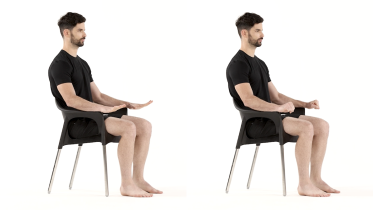 Open and close the hands
Stop signs and precautions for the open and close the hands
Before you start
- After a broken hand or finger, a tendon repair or other hand surgery, how far you may move the fingers and thumb is often limited for several weeks, so do only the movements your surgeon or hand therapist has shown you.
- After a wrist fracture, keep moving your fingers and thumb as far as the cast or splint allows, unless your fracture clinic has told you otherwise.
When to stop and get help
- Sharp pain in a finger joint, the palm or the wrist.
- Tingling or numbness in the fingers that comes on as you work. If one side of your face or body suddenly goes numb or weak, or your speech becomes slurred or muddled, call emergency services, even if it goes away.
- Your fingers puff up or feel stiffer once you have finished.
- Emergency: while you are in a cast or splint, your fingers turn blue, white or pale, or feel cold. Do not wait to see if raising your hand helps. Go to an emergency department straight away, and do not drive yourself. The cast or splint may be cutting off the blood supply, or pressure may be building up inside the forearm (compartment syndrome), and both need checking quickly.
- In a cast or splint, the pain gets worse, your fingers feel numb or tingle or look more swollen, or the cast feels too tight. Stop, rest your hand at about the level of your heart, keep moving your fingers and contact your fracture clinic or get medical advice straight away. Do not lift the hand higher than your heart and do not put ice on it, because if pressure is building up inside the forearm both of those cut down the blood reaching it. If you cannot move your fingers, the pain is severe even after painkillers, or the numbness, tingling or swelling has not settled within 30 minutes, go to your fracture clinic or an emergency department straight away, and do not drive yourself.
- Since the fracture or cast, the hand is getting more painful rather than less, the skin becomes very sensitive to light touch, or the hand changes color, temperature, swelling or sweating compared with the other one, or looks shiny. See your doctor or physio as soon as you can, within a few days at most, as this can be complex regional pain syndrome (CRPS) and early treatment may help.
 Tendon glides
Stop signs and precautions for the tendon glides
Before you start
- After a broken hand or finger, a tendon repair or other hand surgery, how far you may move the fingers and thumb is often limited for several weeks, so do only the movements your surgeon or hand therapist has shown you. After a flexor tendon repair or a carpal tunnel release, use this home version only if your surgeon or hand therapist has told you to. With rheumatoid or another inflammatory arthritis, keep the fists gentle on days when the joints are hot and swollen, and ask your physio what suits you.
- After a wrist fracture, keep moving your fingers and thumb as far as the cast or splint allows, unless your fracture clinic has told you otherwise.
When to stop and get help
- Sharp pain in a finger joint or in the palm.
- Tingling or numbness in the fingers that builds as you work through the positions. If one side of your face or body suddenly goes numb or weak, or your speech becomes slurred or muddled, call emergency services, even if it goes away.
- Fingers that are more swollen or stiff after the session than before.
- Emergency: while you are in a cast or splint, your fingers turn blue, white or pale, or feel cold. Do not wait to see if raising your hand helps. Go to an emergency department straight away, and do not drive yourself. The cast or splint may be cutting off the blood supply, or pressure may be building up inside the forearm (compartment syndrome), and both need checking quickly.
- In a cast or splint, the pain gets worse, your fingers feel numb or tingle or look more swollen, or the cast feels too tight. Stop, rest your hand at about the level of your heart, keep moving your fingers and contact your fracture clinic or get medical advice straight away. Do not lift the hand higher than your heart and do not put ice on it, because if pressure is building up inside the forearm both of those cut down the blood reaching it. If you cannot move your fingers, the pain is severe even after painkillers, or the numbness, tingling or swelling has not settled within 30 minutes, go to your fracture clinic or an emergency department straight away, and do not drive yourself.
- Since the fracture or cast, the hand is getting more painful rather than less, the skin becomes very sensitive to light touch, or the hand changes color, temperature, swelling or sweating compared with the other one, or looks shiny. See your doctor or physio as soon as you can, within a few days at most, as this can be complex regional pain syndrome (CRPS) and early treatment may help.
 Tabletop finger bend
Stop signs and precautions for the tabletop finger bend
Before you start
- After a broken hand or finger, a tendon repair or other hand surgery, how far you may move the fingers and thumb is often limited for several weeks, so do only the movements your surgeon or hand therapist has shown you.
- With rheumatoid arthritis in the knuckles, ask your physio or hand therapist whether this one suits your hands before you start.
- After a wrist fracture, keep moving your fingers and thumb as far as the cast or splint allows, unless your fracture clinic has told you otherwise.
When to stop and get help
- Sharp pain in a knuckle or any other finger joint.
- Numbness or tingling in your fingers during the exercise. If one side of your face or body suddenly goes numb or weak, or your speech becomes slurred or muddled, call emergency services, even if it goes away.
- The knuckles stay puffier or stiffer after the session than they were before.
- Emergency: while you are in a cast or splint, your fingers turn blue, white or pale, or feel cold. Do not wait to see if raising your hand helps. Go to an emergency department straight away, and do not drive yourself. The cast or splint may be cutting off the blood supply, or pressure may be building up inside the forearm (compartment syndrome), and both need checking quickly.
- In a cast or splint, the pain gets worse, your fingers feel numb or tingle or look more swollen, or the cast feels too tight. Stop, rest your hand at about the level of your heart, keep moving your fingers and contact your fracture clinic or get medical advice straight away. Do not lift the hand higher than your heart and do not put ice on it, because if pressure is building up inside the forearm both of those cut down the blood reaching it. If you cannot move your fingers, the pain is severe even after painkillers, or the numbness, tingling or swelling has not settled within 30 minutes, go to your fracture clinic or an emergency department straight away, and do not drive yourself.
- Since the fracture or cast, the hand is getting more painful rather than less, the skin becomes very sensitive to light touch, or the hand changes color, temperature, swelling or sweating compared with the other one, or looks shiny. See your doctor or physio as soon as you can, within a few days at most, as this can be complex regional pain syndrome (CRPS) and early treatment may help.
Stage 2: Strapping off, the knuckle and wrist moving freely
Start when your clinic has reviewed the hand and the strapping, splint or cast has come off, which is often around three weeks. Expect the little finger knuckle to be the stiff one and the hand to feel clumsy rather than sore. The two wrist movements are here because a splint that spanned the wrist leaves that stiff as well, and the ball exercise has a light pumping version for a hand that is still puffy, done with the hand resting at about the level of your heart and no higher, which means letting the forearm lean rather than standing it straight up from the elbow the way the video on that page shows. Short sessions several times a day beat one long one, and many programs use 5 to 10 slow repetitions of each movement, 2 to 4 times a day. Your physio will adjust this. Stiffness and a pulling feeling across the knuckles are expected; sharp pain at the break is not, and means stop and tell your clinic.
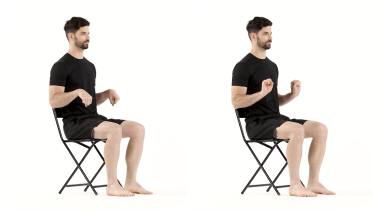 Wrist flexion and extension
Stop signs and precautions for the wrist flexion and extension
Before you start
- After a broken wrist, hand or forearm, or surgery on any of them such as a tendon repair, start only when your doctor, surgeon, physio or hand therapist says the bone or repair is ready for this, and follow their plan for how much to do.
When to stop and get help
- Sharp or catching pain in the wrist.
- Numbness or tingling in the hand or fingers that builds as you go. If one side of your face or body suddenly goes numb or weak, or your speech becomes slurred or muddled, call emergency services, even if it goes away.
- The wrist is more swollen, hot or stiff after the session.
- Since the fracture or cast, the hand is getting more painful rather than less, the skin becomes very sensitive to light touch, or the hand changes color, temperature, swelling or sweating compared with the other one, or looks shiny. See your doctor or physio as soon as you can, within a few days at most, as this can be complex regional pain syndrome (CRPS) and early treatment may help.
 Wrist radial and ulnar deviation
Stop signs and precautions for the wrist radial and ulnar deviation
Before you start
- After a broken wrist, hand or forearm, or surgery on any of them such as a tendon repair, start only when your doctor, surgeon, physio or hand therapist says the bone or repair is ready for this, and follow their plan for how much to do.
When to stop and get help
- Sharp pain on the thumb side or the little finger side of the wrist.
- Painful clicking or clunking in the wrist.
- Pins and needles or numbness in your hand or fingers. If one side of your face or body suddenly goes numb or weak, or your speech becomes slurred or muddled, call emergency services, even if it goes away.
- Since the fracture or cast, the hand is getting more painful rather than less, the skin becomes very sensitive to light touch, or the hand changes color, temperature, swelling or sweating compared with the other one, or looks shiny. See your doctor or physio as soon as you can, within a few days at most, as this can be complex regional pain syndrome (CRPS) and early treatment may help.
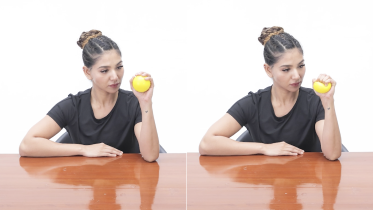 Ball grip and release
Stop signs and precautions for the ball grip and release
Before you start
- After a broken wrist, hand or forearm, or surgery on any of them such as a tendon repair, start only when your doctor, surgeon, physio or hand therapist says the bone or repair is ready for this, and follow their plan for how much to do.
When to stop and get help
- Sharp pain in the wrist, the palm or a finger joint.
- Numbness or tingling in your fingers that comes on as you squeeze. If one side of your face or body suddenly goes numb or weak, or your speech becomes slurred or muddled, call emergency services, even if it goes away.
- The hand is more swollen, hot or stiff after the session rather than less.
- Emergency: while you are in a cast or splint, your fingers turn blue, white or pale, or feel cold. Do not wait to see if raising your hand helps. Go to an emergency department straight away, and do not drive yourself. The cast or splint may be cutting off the blood supply, or pressure may be building up inside the forearm (compartment syndrome), and both need checking quickly.
- In a cast or splint, the pain gets worse, your fingers feel numb or tingle or look more swollen, or the cast feels too tight. Stop, rest your hand at about the level of your heart, keep moving your fingers and contact your fracture clinic or get medical advice straight away. Do not lift the hand higher than your heart and do not put ice on it, because if pressure is building up inside the forearm both of those cut down the blood reaching it. If you cannot move your fingers, the pain is severe even after painkillers, or the numbness, tingling or swelling has not settled within 30 minutes, go to your fracture clinic or an emergency department straight away, and do not drive yourself.
- Since the fracture or cast, the hand is getting more painful rather than less, the skin becomes very sensitive to light touch, or the hand changes color, temperature, swelling or sweating compared with the other one, or looks shiny. See your doctor or physio as soon as you can, within a few days at most, as this can be complex regional pain syndrome (CRPS) and early treatment may help.
Stage 3: Rebuilding grip
Move on when the fingers move freely and your fracture clinic or physio says the bone will take some load, which is often around six weeks. The same NHS hand therapy service puts heavy tasks and non-contact sport at six weeks rather than earlier (North Tees and Hartlepool NHS Foundation Trust). Grip is what you have lost, and it comes back with resisted work rather than with more movement. Start light, which means a soft ball or the softest putty, a squeeze at about half effort, and a set that ends while the hand still feels comfortable. Do not squeeze as hard as you can to find out where half is: half effort means a squeeze you could talk through, with the hand clearly working and nothing straining. The grip squeeze page tells you to squeeze as firmly as you comfortably can, and at this stage read that as firm but easy rather than maximal, because comfort is not a test of how much a recently healed knuckle will take. Between them the three pages offer two or three sessions a day. Take the lowest figure each one gives, which comes out at one session a day for all three together, because 200 or more resisted squeezes in a day is more than a knuckle at six weeks has any reason to do. Half effort is where this stage starts and not where it has to stay: build the squeeze up week by week, as far as your clinic or physio allows and no faster, which is what stage 4 is for. Breathe steadily through every squeeze and never hold your breath, which matters more if you have high blood pressure.
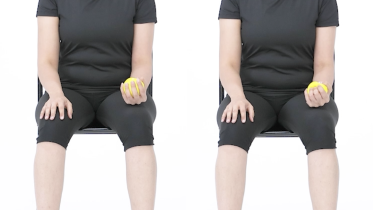 Hand grip squeeze
Stop signs and precautions for the hand grip squeeze
Before you start
- After a broken wrist, hand or forearm, or surgery on any of them such as a tendon repair, start only when your doctor, surgeon, physio or hand therapist says the bone or repair is ready for this, and follow their plan for how much to do.
- Keep breathing through each hold, because holding your breath while you strain can push your blood pressure up.
When to stop and get help
- Sharp pain in the wrist, a finger joint or at the base of the thumb.
- Your hand or fingers go numb or start to tingle. If one side of your face or body suddenly goes numb or weak, or your speech becomes slurred or muddled, call emergency services, even if it goes away.
- Hand joints that are more swollen, hot or stiff afterward.
- Since the fracture or cast, the hand is getting more painful rather than less, the skin becomes very sensitive to light touch, or the hand changes color, temperature, swelling or sweating compared with the other one, or looks shiny. See your doctor or physio as soon as you can, within a few days at most, as this can be complex regional pain syndrome (CRPS) and early treatment may help.
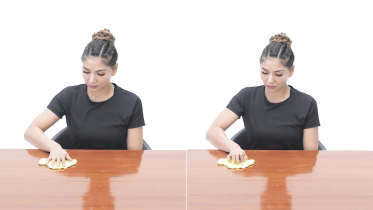 Putty finger curl
Stop signs and precautions for the putty finger curl
Before you start
- After a broken wrist, hand or forearm, or surgery on any of them such as a tendon repair, start only when your doctor, surgeon, physio or hand therapist says the bone or repair is ready for this, and follow their plan for how much to do. After a tendon repair on the palm side of a finger, a resisted fist pulls hard on the repair and usually comes later in rehab, so wait for your surgeon or hand therapist to say it is allowed. If you have rheumatoid arthritis or arthritis in the finger joints, ask your physio which grade to use, and leave the exercise out while your joints are hot and swollen.
- If you have high blood pressure, breathe steadily through every repetition and never hold your breath.
When to stop and get help
- Sharp pain in the palm, the wrist or any finger joint.
- A finger catches or locks as you curl it, or clicks with pain. Stop and tell your physio about it.
- Numbness or tingling in your fingers or hand that keeps building while you work. If it stays after you stop, or keeps getting worse, get medical advice the same day. If one side of your face or body suddenly goes numb or weak, or your speech becomes slurred or muddled, call emergency services, even if it goes away.
- Since the fracture or cast, the hand is getting more painful rather than less, the skin becomes very sensitive to light touch, or the hand changes color, temperature, swelling or sweating compared with the other one, or looks shiny. See your doctor or physio as soon as you can, within a few days at most, as this can be complex regional pain syndrome (CRPS) and early treatment may help.
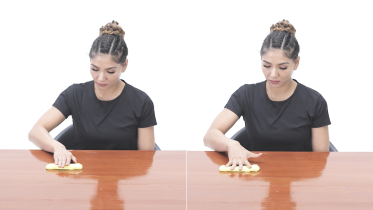 Finger spread with putty
Stop signs and precautions for the finger spread with putty
Before you start
- After a broken wrist, hand or forearm, or surgery on any of them such as a tendon repair, start only when your doctor, surgeon, physio or hand therapist says the bone or repair is ready for this, and follow their plan for how much to do. If you have rheumatoid or another inflammatory arthritis, ask your physio or hand therapist before using putty for this.
When to stop and get help
- Sharp pain in a finger joint or at the base of the thumb.
- Numbness or tingling in the fingers that gets worse as you go. If one side of your face or body suddenly goes numb or weak, or your speech becomes slurred or muddled, call emergency services, even if it goes away.
- Your finger joints are more swollen, hot or stiff after the session.
Stage 4: Full strength, twisting grip and contact sport
Start once stage 3 feels easy and your clinic or physio agrees the bone has healed. The gripper and the wet cloth add what real tasks ask for, a stronger squeeze and a grip that holds while the forearms turn against something. Many programs use 2 to 3 sets of 8 to 15 slow squeezes on the lightest gripper setting, once a day or every other day, and 5 to 10 wrings, and your physio will adjust this. Keep breathing through every squeeze and every wring. Holding your breath while you strain pushes your blood pressure up, which matters more if yours is already high, and a spring gripper is the exercise on this page most likely to tempt you into it. Both of those pages name the base of the thumb in their stop signs, because they are written for hands in general, and on this page the places to watch are your little finger knuckle and the little finger side of the hand. The gripper page also has you rest the forearm on the table little finger side down, which puts the table under the edge of the hand that broke. If that edge is still tender, turn the forearm so the thumb side rests down instead, or put a folded towel under it, rather than pressing on a sore spot for a whole set. Contact sport comes back last, and the same NHS service advises avoiding contact sport, boxing in particular, until 12 weeks after the injury (North Tees and Hartlepool NHS Foundation Trust). Punching anything at all, a bag included, belongs in that group rather than with the strength work.
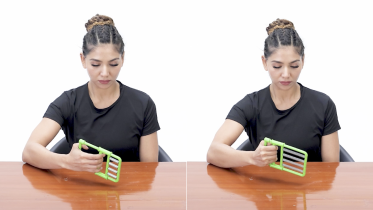 Hand gripper exercise
Stop signs and precautions for the hand gripper exercise
Before you start
- After a broken wrist, hand or forearm, or surgery on any of them such as a tendon repair, start only when your doctor, surgeon, physio or hand therapist says the bone or repair is ready for this, and follow their plan for how much to do.
When to stop and get help
- Sharp pain at the base of the thumb, in a finger joint or in the wrist.
- Your fingers start to tingle or go numb. If one side of your face or body suddenly goes numb or weak, or your speech becomes slurred or muddled, call emergency services, even if it goes away.
- A finger that catches, clicks painfully or locks as you open your hand.
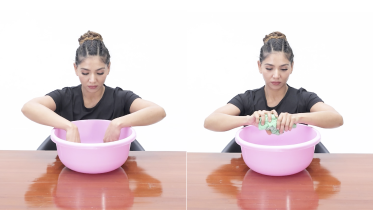 Towel wringing
Stop signs and precautions for the towel wringing
Before you start
- After a broken wrist, hand or forearm, or surgery on any of them such as a tendon repair, start only when your doctor, surgeon, physio or hand therapist says the bone or repair is ready for this, and follow their plan for how much to do.
- If you have rheumatoid arthritis or another inflammatory arthritis in your hands, only do this exercise if your physio or occupational therapist has given it to you. Joint protection advice for rheumatoid arthritis asks you to avoid wringing, and to let cloths drip dry instead. With other arthritis in your hands, such as osteoarthritis at the base of the thumb, check with your physio before you start, and leave it out on days when a joint is flaring, hot or swollen.
- With carpal tunnel syndrome, or after a carpal tunnel release, ask before you start, because gripping hard with a bent wrist can bring on tingling, and stop if your fingers tingle.
- If feeling in your hand is reduced, you cannot rely on it to tell you the water is too hot. Run the water lukewarm, test it with your other hand or your elbow before the hand you are working with goes in, and look that hand over for red marks, blisters or broken skin when you finish.
- After recent heart or chest surgery, get your surgeon's or surgical team's okay first, because wringing closes a strong twisting force between your two hands in front of the chest, which pulls across the healing breastbone. If the breastbone clicks, grinds, shifts or feels as if it is moving while you do it, stop, and contact your surgical team the same day.
When to stop and get help
- Sharp pain at the base of the thumb, on the thumb side of the wrist or at the outer elbow.
- Your fingers tingle or go numb, during or after wringing. If one side of your face or body suddenly goes numb or weak, or your speech becomes slurred or muddled, call emergency services, even if it goes away.
- Your finger or thumb joints swell, feel hot or stay stiffer for hours afterward.
What we notice in the clinic
The commonest mistake is the sensible one. The hand is strapped, so people protect it completely, and three weeks later the knuckles have stiffened into exactly the position the strapping held them in. Moving the fingers early is not bravado and it does not disturb the break when it is done as your clinic set out.
The second is never getting the hand checked at all, because the fingers still work. The fracture that needed something more than strapping is identified on an X-ray and by looking at how the fingers line up, and a hand that closes into a fist is not evidence that both of those are fine. If you did not go anywhere at the time and the knuckle is still sore and stiff a few weeks later, go now instead of waiting longer.
Then there is the fist check, which almost nobody is shown. Close the hand slowly in front of a mirror and compare it with the other one. Crossing or scissoring fingers is the single finding most worth reporting, and you can see it yourself in ten seconds.
Last, the thing people do not say out loud. Punching a person or a wall is a common cause of this break, and embarrassment is part of why the hand is not shown to anybody for a week. Nobody treating a hand is interested in how it happened beyond one detail, which is whether the hand hit teeth.
If your fracture was fixed with wires or a plate
Then this is not your program. What was done inside your hand, how stable the fixation is and how long the bone needs all change when you may move and grip, and only your surgical team knows those things. Their plan replaces every stage and every date here.
A wire or a plate holds the pieces in place while the bone heals. It is not proof that the bone has healed, so gripping hard, lifting and anything that reloads the knuckle waits for your team's say-so rather than for the pain to go. Where wires are left poking through the skin, how to keep that site clean is part of their instructions too, and taking them out is their job, not yours.
Three things apply whatever else they tell you: do not pull a wire, trim it or try to take one out; keep the hand out of baths, pools and washing-up water while the wires are in, unless your team has said otherwise; and ring them the same day if a wire works loose or starts to stick out further than it did. In the comparison cited earlier on this page every wire was removed between 6 and 12 weeks after the operation, with the timing set by how much new bone had formed on the X-ray (Lixa and colleagues, 2024). A wire that comes out through the skin also leaves a track running down to the bone, which is why a pin site that is getting redder or more painful, or starting to discharge, has a warning sign of its own below.
Three of the warning signs on this page are written for an operated hand: one for a wound or a fever, one for a pin site where a wire comes through the skin, and one for new severe pain, a grip that gives way, a finger that stops straightening or a sense that something inside the hand has shifted. All three ask you to contact your surgical team the same day instead of waiting for a routine appointment.
When to see a physio or doctor
See your fracture clinic, physio or doctor if the hand is not getting steadily easier once the strapping is off, if you cannot make a full fist by about six weeks, if your grip is not improving over several weeks, or if the little finger does not straighten out level with the others. Ask for a hand therapy referral if your work or sport needs real force from that hand.
Get it checked the same day if the fingers no longer line up when you close your hand, and go to an emergency department for any wound over a knuckle from striking teeth. The warning signs on this page give the route and the timing for each. The broken wrist program and the scaphoid fracture program cover the two common wrist breaks, which are different injuries with different timelines. Tendon glides and opening and closing the hand are the two movements most hand programs start with. The hand grip squeeze and ball grip and release are where the grip work begins.
For physiotherapists
This page covers adult fifth metacarpal neck fractures managed non-operatively, with a hand-over section for fixed fractures. Staging is written against the immobilization, not the calendar: stage 1 for the period in buddy strapping, splint or cast, stage 2 on removal and clinic review, stage 3 on the clinic or physio agreeing the bone will take load, stage 4 on agreed union. The week markers quoted in the stages, three weeks of light tasks, six weeks for heavy tasks and non-contact sport, 12 weeks for contact sport and boxing, come from the North Tees and Hartlepool hand therapy page and are given as that service's figures rather than as a universal protocol. NICE NG38 sets no timeline for a metacarpal fracture, so there is no guideline-level alternative to attribute. What it does ask is that the treating team gives the patient the expected time to return to usual activities in writing, which is why the stages gate on clinic clearance and quote the weeks as orientation only.
Two of the cited sources give different starting points for movement, which is why stage 1 is split by what is holding the hand. OrthoInfo puts gentle hand exercises at usually after three weeks, in a treatment section that covers casts, removable splints and buddy straps together; the North Tees hand therapy page tells patients to start exercising the fingers straight away and to work through the exercises 4 to 5 times a day. Read as populations rather than as a conflict, the two describe different hands, and each says the same thing about its own: OrthoInfo calls the taped neighbor a moving splint, and North Tees notes that its hand casts still allow finger movement. So stage 1 prescribes finger movement from the first days where the knuckles are free, holds the knuckles and moves every uncovered joint where a splint or cast covers them, tells the reader not to remove a splint or cast to exercise, and leaves the final word with the treating clinic. Its frequency and repetition figures are the North Tees ones.
Angulation figures are attributed, not endorsed: the approximately 60 degree working reference and the older 30 degree figure are reported as Lixa and colleagues report them, the 70 degree figure is the inclusion ceiling of Statius Muller and colleagues 2003 (n = 40 randomized, 35 completed, mean angulation 39 degrees, range 15 to 70), and the functional claim rests on Westbrook and colleagues 2008 (218 non-operatively treated little finger metacarpal fractures, 105 neck and 113 shaft, against 44 operative; palmar angulation severity did not affect little finger grip strength or DASH). No page sentence tells a reader what angle is acceptable in their own fracture.
Rotation is handled as a management-changing finding, not a severity grade, with the fist and nail-line check given to the patient, and it carries its own same-day warning line. Pseudoclawing is named in plain words as an operative indication alongside open fracture and rotation (Lixa and colleagues, 2024, introduction and discussion). The Lixa cohort excluded rotational deformity, so its equivalence findings apply only to non-rotated fractures, and the page does not generalize them.
The fight bite line is the one warning on this page that is stricter than the patient-facing source behind it. NHS advice for a human bite or a bite to the hand is to call 111, with an emergency department for a large or deep wound. The line sends every break in the skin over a knuckle after striking teeth to an emergency department the same day, on the grounds set out in Malahias and colleagues 2014: the dorsal MCP skin sits on the extensor hood and joint capsule, capsular breach can produce purulent arthritis, retained tooth fragments and occult metacarpal head fractures are described, and antibiotics are an adjunct to washout rather than a substitute. The review's figure for the proportion of bite injuries that become infected is not quoted on the page, because it reaches that review through a citation chain that has not been traced to the paper behind the number. NICE NG184 supports the direction without settling the tier: it offers prophylaxis for a human bite that has broken the skin and drawn blood, names the hand as a high-risk area, and refers to hospital any bite that has penetrated a joint, tendon, nerve or bone, which is a judgment no patient can make from the outside.
The cast warning lines need a strapping twin on this page. The house cast lines both open with "in a cast or splint", and the commonest immobilization for this fracture is buddy strapping or tape, so a reader whose tape is strangling a finger would match nothing. The page carries a strapping line at the same tier as the cast line, with removal of the tape as the first action, on the pattern of the BOA compartment syndrome standard, which asks for circumferential dressings to be released to the skin, the limb elevated and the patient re-evaluated within 30 minutes.
Removal rather than loosening is deliberate. Our mallet finger program tells a reader to loosen the tape and take a tight finger splint off, and that splint is holding a tendon in a position it must not leave, which is more to lose than a stable metacarpal neck fracture has. Statius Muller and colleagues treated these fractures with a pressure bandage for one week and immediate movement with no loss against three weeks in a cast, so the bone tolerates a short period out of tape. The reader is still told not to take a plaster cast off.
A pale, blue or cold finger has an emergency line of its own, separate from both the cast line and the strapping line. The house cast line opens "while you are in a cast or splint", and the strapping line sits in a tier that allows 30 minutes, so without that separate line one symptom would carry two urgencies on one page depending on what was holding the hand. The stricter reading is the sourced one: our mallet finger page puts a fingertip that turns blue, white or pale or feels cold at the emergency tier "in the splint or out of it", and the 30 minute re-evaluation in BOA standard 7 is a clinician reassessing a patient, not a patient waiting at home. Numbness, tingling, tightness and swelling stay in the lower tier, which keeps the strapping pair matched to the cast pair.
The falls lines belong on this page as well, although the mechanism here is usually a punch: the falls assessment line, the unexplained-fall emergency line and the blackout line. OrthoInfo names a fall among the causes of a boxer's fracture and the North Tees page puts falls first among the causes of metacarpal fractures, so the older reader who broke this bone in a fall is a real reader of this page, and the four sibling upper limb fracture pages carry the same lines. NICE NG38 asks for falls risk to be assessed from first presentation in anyone with a fracture (recommendation 1.5.1), which is the guideline-level warrant for them.
Compartment syndrome needs the hand named alongside the forearm. In the first-weeks emergency line the explanation reads forearm or hand, because the hand has its own closed compartments and, in a systematic review of the causes of traumatic hand compartment syndrome covering 129 patients, 7 of them had a fracture and a broken metacarpal was the commonest of those (Alsaedi and colleagues, 2023). The house cast and color line stands exactly as it is, on purpose: its trigger is a color change, it names two mechanisms behind one immediate action, and a reader with a discolored finger inside a cast is routed by what she can see, not by the explanation. The hand clause matters because the usual stretch test does not test the hand: passively straightening the fingers loads the long flexors, whose muscles sit in the forearm, while the intrinsic compartments are stretched by extending the knuckle with the middle joint bent. So rather than ask a reader with a fresh fracture to perform a test on herself, the trigger names a hand that goes tight and hard as something she notices.
Pin site care has a same-day line of its own instead of a widened wound line, because the commonest operation for this fracture leaves wires through the skin and a reader with wires and no incision matches nothing in a line about a wound: percutaneous antegrade intramedullary wires, removed at 6 to 12 weeks depending on callus, is the operative arm of the study this page cites (Lixa and colleagues, 2024), and pin site infection needing antibiotics, early wire removal or a further operation occurred in 85 of 1,213 hands and wrists fixed with percutaneous wires, most of them mild (van Leeuwen and colleagues, 2016). The failing-fixation line includes a sudden loss of active extension at the knuckle, because the extensor tendon lies directly on the back of the metacarpal and can catch or give way over a plate or a wire, which is assessed separately from the bone.
Three decisions are worth stating plainly so they are not reopened. Rotation keeps the same-day tier: it is a formal operative indication and easier to correct before callus forms, but it puts no nerve, vessel or skin at risk, and an out of hours emergency department cannot correct it, so a fracture clinic the same day is both the faster route and the right one. The reader takes buddy tape off herself: the tape is the circumferential layer with nothing else to release, and a metacarpal neck fracture is stable enough to tolerate a short period out of it, while the instruction not to remove a plaster cast holds. And no figure is given for the share of these fractures that are operated on, or for a non-union or malunion rate, because the readable hand fracture epidemiology pools carpal, metacarpal and phalangeal fractures into one operative proportion, which is the wrong denominator for this one fracture. The absence of non-union in the 60 fractures followed for a year by Lixa and colleagues is reported on the page as that study's own result, which is all it can carry: its surgical group's mean angulation of 53 degrees was lower than the commonly quoted 60 degree reference, which those authors attribute to their own department's threshold, so their 30 operated of 60 is a selection and not an incidence.
The dose caps sit on this page and not on the library exercise pages, which are written for hands in general. The library page for the hand grip squeeze instructs a squeeze as firmly as you comfortably can, so stage 3 caps the effort at about half and defines start light; the hand gripper exercise and towel wringing pages name the base of the thumb in their stop signs, so stage 4 redirects the reader's attention to the little finger knuckle and the ulnar border; ball grip and release is placed in stage 2 rather than stage 1 because its own entry gate asks for clearance that a stage 1 reader will not yet have, while its pumping variant is the swelling tool this fracture needs. Stage 4 also carries the breathing instruction, because the hand gripper exercise is the hardest squeeze in the program and its own page names breath holding only as a common mistake, while the two softer grip pages used in stage 3 state it as a precaution. The stages are stated as adult, with anyone still growing sent back to their own fracture clinic.
Stage 1's split needs a test the reader can perform, so she is told to look at the hand and try the knuckles gently, with the clinic's word overriding what she sees and a ring-and-ask route where she cannot tell. She is also told outright that none of the three listed exercises is for her yet if the knuckles are covered, because all three flex them and a reader who sees three tiles under the stage will otherwise do them. Stage 1 gives the North Tees repetition figure (10 of each movement) alongside its frequency, and the How to use section says the stage number replaces the exercise page number where the two differ. That rule is a cap rather than a license: the library pages put the wrist and tabletop work at 2 to 3 sets of 10 to 15, 1 to 4 times a day, which at the top of both ranges and 4 to 5 sessions is several times the source protocol's volume on a hand three weeks out of a fracture, and stage 2's own 5 to 10 repetitions is lower again than the pages it links to.
Stage 3 defines half effort by how the squeeze feels rather than as a fraction of an untested maximum, because half as hard as you could manage asks the reader to find her maximum in order to halve it, and that is a maximal grip test on a recently healed metacarpal. Stage 3 also sets its own session count instead of leaving it to the three library pages: at the top of their own ranges the grip squeeze, putty curl and finger spread come to roughly 225 resisted repetitions a day (45, 90 and 90, counted from their dosage lines), so the stage takes the lowest figure each page gives, which is one session a day for the three together. Stage 2 names the heart-level cap as an override of the ball page's upright forearm set-up, and stage 4 offers a thumb-side or towel-supported forearm position, because the gripper page rests the forearm little finger side down on the fractured border, which is the same objection that keeps passive finger flexion out of the program.
Passive finger flexion is left out of the program on purpose, although the stiff metacarpophalangeal joint is what it is for. Its set-up rests the hand on its little finger side on a table, which is the fractured border of this hand, and passive stretching of a recently healed metacarpophalangeal joint belongs with a hand therapist rather than in an unsupervised program. The page routes persistent stiffness to a hand therapy referral instead, including a within-a-few-days warning line for a fist that is not full by about six weeks.
Warning signs
Get emergency help now
- Emergency: your hand struck someone's mouth or teeth and there is any cut, graze, split or puncture in the skin over a knuckle, however small, and even if it has already closed over. Go to an emergency department straight away and say that the wound came from striking teeth, and do not drive yourself. A tooth can push mouth bacteria straight into the knuckle joint or into the tendon that straightens the finger, and these wounds usually need washing out properly, often in an operating room, with antibiotics alongside rather than instead. Go even if the hand feels fine, and say so at once if you feel feverish, the redness is spreading up the hand or arm, or pus is coming from the wound. If you have a very high or very low temperature, shivering you cannot control, you are breathing very fast or finding it hard to breathe, you are confused or your speech is slurred, your skin, lips or tongue look blue, gray, pale or blotchy (on brown or black skin this can be easier to see on the palms of the hands or soles of the feet), or you have a rash that does not fade when you press it, call emergency services, as this can be sepsis.
- Emergency: while you are in a cast or splint, your fingers turn blue, white or pale, or feel cold. Do not wait to see if raising your hand helps. Go to an emergency department straight away, and do not drive yourself. The cast or splint may be cutting off the blood supply, or pressure may be building up inside the forearm (compartment syndrome), and both need checking quickly.
- Emergency: your little finger is taped or strapped to its neighbor, or held in a soft splint, and the fingers turn blue, white or pale, or feel cold. Take the tape or strapping off, then go to an emergency department straight away, and do not drive yourself. If you cannot get it off with one hand, go anyway rather than spending time on it, and say at the door that a strapped finger has changed color. Do not wait to see whether the color comes back, and do not wait to see whether raising the hand helps. Tape wound around a finger can cut off the blood supply to it, and that needs checking quickly.
- Emergency: in the first weeks after the break, the pain is severe and keeps getting worse, it hurts badly when your fingers are gently straightened, the hand itself goes tight and hard across the palm or the back of the hand, you have new weakness or trouble bending your thumb or index finger, or numbness in your fingers keeps spreading or getting worse. Go to an emergency department straight away, and do not drive yourself. Pressure may be building up inside the forearm or inside the hand itself (compartment syndrome), or swelling may be pressing on the nerve at the wrist (acute carpal tunnel syndrome), and both need treatment quickly. The hand has its own closed compartments, and a broken metacarpal is the fracture most often behind it, so a hand that is tight and far more painful than it should be counts even when the forearm feels soft (Alsaedi and colleagues, 2023).
- Emergency: a new fall or knock on the healing hand, followed by numbness, tingling or pins and needles in the hand, or a hand that has changed color, changed shape or sits at an odd angle, or you heard a crack. The same applies to a bone showing through the skin or a cut that is bleeding heavily. Go to an emergency department or call emergency services straight away, and do not drive yourself.
- Emergency: you have a new fall and cannot remember the fall or how it happened. Go to an emergency department straight away, and do not drive yourself. You may have blacked out or hit your head without knowing it.
Get help now, day or night
- In a cast or splint, the pain gets worse, your fingers feel numb or tingle or look more swollen, or the cast feels too tight. Stop, rest your hand at about the level of your heart, keep moving your fingers and contact your fracture clinic or get medical advice straight away. Do not lift the hand higher than your heart and do not put ice on it, because if pressure is building up inside the forearm both of those cut down the blood reaching it. If you cannot move your fingers, the pain is severe even after painkillers, or the numbness, tingling or swelling has not settled within 30 minutes, go to your fracture clinic or an emergency department straight away, and do not drive yourself.
- Your buddy strapping or tape feels too tight, or the fingers it holds go numb, tingle or look more swollen. Take the tape or strapping off, or loosen a splint that fastens with straps, rest your hand at about the level of your heart and no higher, and contact your fracture clinic or get medical advice straight away. If you cannot get it off with one hand, make the call first rather than struggling with it, and say that the strapping is tight and you cannot get it off. Do not put ice on it. Tape wound around a finger can cut off the blood supply to it, and half an hour out of the strapping costs the break far less than that does. If the numbness, tingling or swelling has not settled within 30 minutes, go to your fracture clinic or an emergency department straight away, and do not drive yourself. A finger that looks pale, white or blue, or feels cold, is an emergency whatever is holding the hand: take the tape off and go to an emergency department straight away rather than waiting out the 30 minutes.
- Your cast or splint rubs painfully, or there is a blister-like soreness under it, or there is a bad smell, discharge or liquid coming from under the cast, or something has dropped down inside it. Contact your fracture clinic, plaster room or surgical team straight away, and out of hours go to an emergency department rather than waiting for the morning. Get medical advice the same day as well if you feel hot and shivery or have a high temperature. Skin under a cast can break down where you cannot see it.
Get help today
- Same day: your cast or splint feels too loose or uncomfortable, cracks, softens, gets wet or itches badly. Ring your fracture clinic or plaster room and ask to be seen, and go to an emergency department if they cannot see you that day. A cast that has gone loose or soft may no longer be holding the broken bone still.
- Same day: the hand or a knuckle is hot, red and swollen, or you have hand pain with a high temperature or feel hot, cold or shivery. Get medical advice the same day, and go to an emergency department if you feel very unwell. This can be a sign of infection in the joint, which needs treatment quickly. If you have a very high or very low temperature, shivering you cannot control, you are breathing very fast or finding it hard to breathe, you are confused or your speech is slurred, your skin, lips or tongue look blue, gray, pale or blotchy (on brown or black skin this can be easier to see on the palms of the hands or soles of the feet), or you have a rash that does not fade when you press it, call emergency services, as this can be sepsis.
- Same day: since your operation, your wound is oozing, leaking or has pus coming out of it, or its edges start to come apart, or your hand is tender, swollen, painful or red and it is not getting better or is getting worse, or you have a high temperature or feel hot and cold or shivery. Redness can be harder to see on brown or black skin. Contact your surgical team the same day, or get urgent medical advice if you cannot reach them. These can be signs of an infection in the wound or the knuckle joint. If you feel very unwell, go to an emergency department. If you have a very high or very low temperature, shivering you cannot control, you are breathing very fast or finding it hard to breathe, you are confused or your speech is slurred, your skin, lips or tongue look blue, gray, pale or blotchy (on brown or black skin this can be easier to see on the palms of the hands or soles of the feet), or you have a rash that does not fade when you press it, call emergency services, as this can be sepsis.
- Same day: your fracture was fixed with wires that come out through the skin, and the skin around a wire gets redder, hotter or more swollen, the redness spreads away from the wire, there is pus or cloudy fluid, there is a bad smell, or the pain at that spot is climbing rather than settling. Contact your surgical team or fracture clinic the same day, and get urgent medical advice the same day if you cannot reach them. Redness can be harder to see on brown or black skin. A wire that comes out through the skin leaves a track down to the bone, so an infection at a pin site is dealt with early rather than watched at home. A little clear or pink ooze in the first days after the operation is usual. Do not pull a wire, trim it or try to take one out yourself. Keep the hand out of baths, pools and washing-up water while the wires are still in unless your team has told you otherwise, and ring them the same day if a wire works loose, catches on clothing or starts to stick out further than it did. If you also feel hot, cold or shivery or have a high temperature, use the infection warning sign above, which says when a fever means an emergency department. Ringing about a pin site is the expected thing to do rather than a fuss: among 1,213 people whose hand or wrist fracture was fixed with wires through the skin, 85 of them, about 7 in 100, needed antibiotics, the wire removed early or a further operation for a pin site infection, and most of those infections were mild ones (van Leeuwen and colleagues, 2016).
- Same day: since your operation, you have new severe pain in the hand or at the knuckle, the finger gives way or clicks when you grip, you feel a new grinding or a sense that something inside the hand has shifted, the finger suddenly will not straighten at the knuckle when you try, or you cannot grip at all, whether that followed a fall, a knock, a twist or simply doing more than your plan allows. Stop the exercises, stop gripping and lifting with that hand, keep weight off it, and wear your splint if you were given one. Contact your surgical team the same day, or get assessed the same day at urgent care or an emergency department if you cannot reach them. Say that your metacarpal was fixed with wires or a plate, and ask whether the hand needs an X-ray. A wire or a plate can loosen or move, and a break that was fixed can shift before it has healed. Say as well if the finger has stopped straightening at the knuckle under its own power, because the tendon that straightens it runs along the back of that bone and can catch or give way where a plate or a wire sits under it, which is judged separately from the break. If the hand is numb, tingling, cold, pale or blue, or the knuckle has changed shape, follow the emergency warning signs above instead.
- Same day: your forearm, hand or upper arm is getting more swollen instead of settling, or becomes warm, tender, red or darker than usual, has swollen veins that are sore to touch, or has a throbbing or cramping pain that feels different from normal muscle ache. Some bruising and swelling is expected after a broken hand and settles over a few weeks, but a blood clot can sometimes form in the arm. Do not massage it. Stop and get medical advice the same day. If you are also short of breath or have chest pain, call emergency services.
- Same day: your little finger crosses over or under its neighbor when you close your hand, or it points off to one side, or your fingers no longer line up as they do on the other hand. Contact your fracture clinic the same day, or get medical advice the same day if you have not been given a clinic, and ask for the hand to be looked at rather than waiting for a routine appointment. If the clinic cannot fit you in within a day or two, say on the phone that the finger has started crossing, and ask your own doctor or an urgent care service to get the hand reviewed rather than waiting for the next routine slot. A twisted break is judged differently from a bent one and is one of the findings that changes the treatment, and it is easier to put right early than late.
- A new fall or knock that leaves the healing hand more swollen, bruised or painful, without numbness or a change in shape. Stop the exercises, use the other hand for everything and keep weight off that hand, and get medical advice the same day. Say that it is a new injury on a healing break and ask whether the hand needs another X-ray. In the evening or at night, use an urgent care or out of hours service rather than waiting for the clinic to open. A break that is healing can move, and a hand that still works is not proof that it has not. For the rest of that day and the next, a cast or strapping that feels tighter, pain that keeps climbing, fingers that go numb or tingle, or fingers that look pale or blue are the emergency signs at the end of this page.
- You blacked out before the fall that broke your hand, or you cannot remember that fall, and nobody has checked why. Get medical advice the same day. A blackout needs its own check, especially if you are over 65 or it came without warning.
- Same day: the hand hurts at night or at rest and the pain keeps getting worse rather than easing as the weeks go by. If you are being treated for cancer now, contact your cancer team the same day.
Book an appointment
- Since the fracture or cast, the hand is getting more painful rather than less, the skin becomes very sensitive to light touch, or the hand changes color, temperature, swelling or sweating compared with the other one, or looks shiny. See your doctor or physio as soon as you can, within a few days at most, as this can be complex regional pain syndrome (CRPS) and early treatment may help.
- Within a few days: once the splint or strapping is off, numbness or tingling in the little and ring fingers that is there all the time, or a hand that keeps dropping things. See a doctor or your fracture clinic within a few days rather than waiting for it to settle, and get medical advice the same day if the numbness or the weakness is getting worse from day to day.
- Within a few days: the knuckle is still stiff and you cannot make a full fist by about six weeks, or the finger will not straighten out level with the others. Ask your doctor or fracture clinic for a hand therapy referral within a few days rather than waiting longer, because a stiff knuckle is easier to move early and it is the problem that lasts after this break.
- Within a day or two: the hand hurts at night or at rest and the pain keeps getting worse rather than easing as the weeks go by. If you have had cancer, now or in the past, or are losing weight without trying, see your doctor sooner, within a day or two, and mention it. This applies even if the pain is not getting worse.
- Within a few days: the hand hurts at night or at rest and the pain keeps getting worse rather than easing as the weeks go by. See your doctor within a few days.
- You have had a fall, even if you were not hurt, or you keep tripping, stumbling or feeling that your legs might give way. Book an appointment with your doctor within a few days and ask about a falls assessment. Tell them about every fall, even the ones where you were not hurt.
Common questions
How long does a boxer's fracture take to heal?
For most people the bone is healed enough for normal daily use inside about six weeks, and the hand keeps improving for months after that. OrthoInfo puts immobilization for a hand fracture at 3 to 6 weeks depending on the location and how stable the break is, with a check X-ray usually taken about 1 to 2 weeks in to confirm the alignment is holding. The trials that treated these fractures without a cast used shorter periods still: in one randomized trial a pressure bandage for one week followed by immediate movement gave the same range of motion, pain and return to work as three weeks in an ulnar gutter cast (Statius Muller and colleagues, 2003). One NHS hand therapy service tells patients to keep to light tasks for the first three weeks, waits until six weeks for heavy tasks and non-contact sport, and until 12 weeks for contact sport and boxing (North Tees and Hartlepool NHS Foundation Trust). Your own dates come from your fracture clinic, because they depend on the break and on what you need the hand to do. NICE asks the team treating a fracture to give you, in writing as well as out loud, the expected time to get back to your usual activities and whether any effects are likely to be permanent, so those are fair questions to ask rather than an imposition (NICE guideline NG38).
Do boxer's fractures need surgery?
Most do not. The findings that are treated as reasons to operate are an open fracture, a rotated finger and pseudoclawing, where the knuckle is bent so far that the finger cannot straighten properly, along with a bend greater than the amount your unit accepts and breaks in several metacarpals at once (Lixa and colleagues, 2024). In that study 30 fractures treated with wires were compared with 30 treated in a cast, and at a year the hand function scores were much the same, 16 against 14 on the QuickDASH. Satisfaction with how the hand looked was lower after surgery, 71% against 100%, mostly because of the scar. The authors concluded that surgery should be reserved for complex fractures. There is no reliable published figure here for the share of boxer's fractures that end up being operated on, so this page does not give one.
Can a fifth metacarpal fracture heal on its own?
It heals with support rather than on its own, and the support can be simpler than people expect. A Cochrane review of five small trials in 252 adults found no single non-surgical method clearly better than another, and reported that the trials were limited in quality and size and that none had measured hand function with a validated score (Poolman and colleagues, 2005). A later review pooled seven randomized trials with 454 patients and found buddy taping gave better pain scores at 12 weeks than reduction and casting, with no difference in satisfaction (Mohamed and colleagues, 2022). Both reviews were working with small trials, so read them as showing that several approaches work rather than as proof that one is best. What is not optional is being assessed, because the X-ray is what tells you whether yours is one of the fractures that needs more than strapping.
Why does a twisted finger matter more than a bent knuckle?
Because the hand tolerates the two deformities completely differently. A bend in the bone, called angulation, shows up as a sunken or flattened knuckle and in practice is accepted up to a point: units commonly work to a reference of around 60 degrees, trial evidence found good results with immediate movement up to 70 degrees, and the amount of bend did not change grip strength or function in a series of 218 of these fractures (Lixa and colleagues, 2024; Statius Muller and colleagues, 2003; Westbrook and colleagues, 2008). A twist in the bone, called rotation, is a different problem, because it points the finger away from the line of the others and the fingers collide when you close the hand. OrthoInfo describes the injured finger crossing over its neighbor when making a fist. Rotation is treated as a formal reason to operate, and the trial that supported early movement applied it only to fractures that were not rotated. So the useful self-check is not how flat the knuckle looks but whether the fingers still line up when you slowly close your hand.
Will my knuckle always look sunken?
If the bone healed bent and nobody straightened it, the change in the knuckle is usually permanent. That is worth knowing in advance and it is not a sign the treatment went wrong. The evidence that makes it reasonable is about function rather than appearance: in 218 little finger metacarpal fractures treated without any attempt at reduction, the severity of the palmar angulation did not affect grip strength or the DASH score, and the 18 neck fractures that were operated on did no better than the 105 that were not (Westbrook and colleagues, 2008). People treated in a cast were also more satisfied with the look of the hand than people who had surgery, where the scar became the complaint (Lixa and colleagues, 2024). If the appearance bothers you, say so at your clinic appointment rather than afterwards, because the options narrow once the bone has united.
What should I do if I cut my knuckle on someone's teeth?
Treat it as an emergency and go to an emergency department the same day, even if the cut is tiny, has already closed and the hand feels normal. A wound over the knuckle made by a tooth is not an ordinary graze: the skin over a closed fist sits directly on the tendon and the joint capsule, so a tooth can carry mouth bacteria into the joint itself, and the review of bite injuries to the hand describes these as the worst bite infections precisely because they are treated as minor injuries at first (Malahias and colleagues, 2014). The same review notes that a fragment of tooth can be left in the wound and that a break in the metacarpal head can be missed on a plain X-ray. NHS advice is to call 111 for any bite from a person or any bite to the hand, and to go to an emergency department if the wound is large or deep. Antibiotics are given alongside washing the wound out, not instead of it, and NICE offers them for any human bite that has broken the skin and drawn blood (NICE guideline NG184). Two other checks come with the visit: your tetanus cover, and a blood test the NHS may offer after a bite from a person to look for hepatitis B, hepatitis C and HIV.
When can I punch a bag or go back to boxing?
Later than the hand feels ready for, and the one published patient timeline we could verify waits 12 weeks. That NHS hand therapy service advises light tasks for three weeks, no heavy tasks or non-contact sport until six weeks, and avoiding contact sport, boxing in particular, until 12 weeks after the injury (North Tees and Hartlepool NHS Foundation Trust). Hitting a bag belongs with contact sport rather than with strength training, because it reloads the knuckle in the exact direction that broke it. If boxing, martial arts or any job that involves striking is part of your life, get the date from your own clinic and ask about hand wrapping and technique at the same time.
Is a bump on the back of the hand after a boxer's fracture normal?
A firm lump over the back of the hand at the break is common while the bone heals, because new bone forms around the fracture and then remodels slowly over months. It is usually tender for a while and then stops being tender while still being visible. What does not belong in that pattern is a lump that is growing, a hand that is getting more painful rather than less, or a knuckle that is hot and red, and those are in the warning signs on this page. Boxer's knuckle is a different injury and sometimes gets confused with this one: it is a tear of the soft tissue hood that holds the extensor tendon centered over the knuckle, not a break in the bone, and it can follow the same punch (Fenech, 2023).
References
- American Academy of Orthopaedic Surgeons. Hand fractures. OrthoInfo. https://www.orthoinfo.org/en/diseases--conditions/hand-fractures/
- North Tees and Hartlepool NHS Foundation Trust. Hand therapy: metacarpal fractures. https://www.nth.nhs.uk/resources/hand-therapy-metacarpal-fractures/
- Statius Muller MG, Poolman RW, van Hoogstraten MJ, Steller EP. Immediate mobilization gives good results in boxer's fractures with volar angulation up to 70 degrees: a prospective randomized trial comparing immediate mobilization with cast immobilization. Archives of Orthopaedic and Trauma Surgery. 2003;123(10):534-537. https://doi.org/10.1007/s00402-003-0580-2
- Westbrook AP, Davis TRC, Armstrong D, Burke FD. The clinical significance of malunion of fractures of the neck and shaft of the little finger metacarpal. Journal of Hand Surgery (European Volume). 2008;33(6):732-739. https://doi.org/10.1177/1753193408092497
- Poolman RW, Goslings JC, Lee J, Statius Muller M, Steller EP, Struijs PAA. Conservative treatment for closed fifth (small finger) metacarpal neck fractures. Cochrane Database of Systematic Reviews. 2005;(3):CD003210. https://doi.org/10.1002/14651858.CD003210.pub3
- Mohamed MB, Paulsingh CN, Ahmed TH, et al. A systematic review and meta-analysis of the efficacy of buddy taping versus reduction and casting for non-operative management of closed fifth metacarpal neck fractures. Cureus. 2022;14(8):e28437. https://doi.org/10.7759/cureus.28437
- Lixa J, Vital L, Vieira P, Esteves A, Silva M, Pinho A, Vidinha V. A comparative retrospective study on surgical versus conservative treatment of simple fifth metacarpal neck fractures. Cureus. 2024;16(11):e73439. https://doi.org/10.7759/cureus.73439
- van Leeuwen WF, van Hoorn BT, Chen N, Ring D. Kirschner wire pin site infection in hand and wrist fractures: incidence rate and risk factors. Journal of Hand Surgery (European Volume). 2016;41(9):990-994. https://doi.org/10.1177/1753193416661280
- Malahias M, Jordan D, Hughes O, Khan WS, Hindocha S. Bite injuries to the hand: microbiology, virology and management. The Open Orthopaedics Journal. 2014;8:157-161. https://doi.org/10.2174/1874325001408010157
- Fenech M. Boxer's knuckle: sonographic anatomy and assessment of sagittal band tears of the dorsal hood. Australasian Journal of Ultrasound in Medicine. 2023;26(4):216-229. https://doi.org/10.1002/ajum.12363
- NHS. Animal and human bites. Page last reviewed 27 October 2025. https://www.nhs.uk/conditions/animal-and-human-bites/
- National Institute for Health and Care Excellence. Human and animal bites: antimicrobial prescribing. NICE guideline NG184. Published 4 November 2020. https://www.nice.org.uk/guidance/ng184
- National Institute for Health and Care Excellence. Fractures (non-complex): assessment and management. NICE guideline NG38. Published 17 February 2016. https://www.nice.org.uk/guidance/ng38
- British Orthopaedic Association. BOA Standard: Diagnosis and management of compartment syndrome of the extremities. Revised July 2025. Read 29 October 2026. https://www.boa.ac.uk/asset/D0432D40%2D5D99%2D4B64%2D9952F6EB1B60C166/
- Alsaedi O, Alshahir AA, Alsuhaibani O, Beek A, Alduheim M, Alzahim A, Alzolaibani SM, Alhusaini B. Etiology of trauma-related acute compartment syndrome of the hand: a systematic review. Cureus. 2023;15(4):e38218. https://doi.org/10.7759/cureus.38218
- NHS. Complex regional pain syndrome. Page last reviewed 27 October 2022. https://www.nhs.uk/conditions/complex-regional-pain-syndrome/
- NHS. Sepsis. Page last reviewed 14 May 2026. https://www.nhs.uk/conditions/sepsis/
- North Bristol NHS Trust. Care of plaster casts. October 2024. https://www.nbt.nhs.uk/care-of-plaster-casts
- Willy C, Stichling M, Engelhardt M, Vogt D, Back DA. [Acute therapeutic measures for limb salvage Part 1: Haemorrhage control, emergency revascularization, compartment syndrome]. Unfallchirurg. 2016;119(5):374-387. https://doi.org/10.1007/s00113-016-0179-z
Written and checked by the PocketPhysio editorial team. Last updated 2026-10-29.
This page is general education, not a diagnosis or a personal treatment plan. See a physiotherapist or doctor for advice about your own situation.