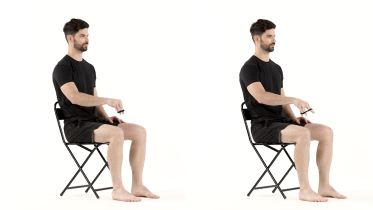
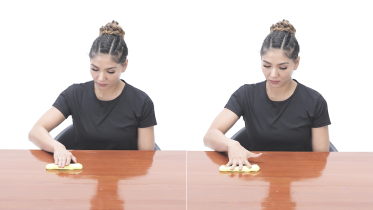
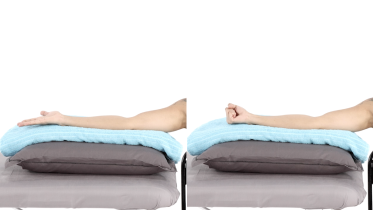
Passive finger flexion
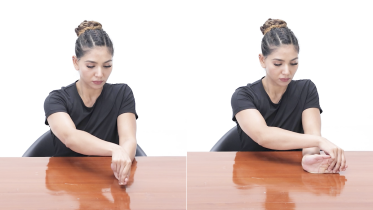
Passive finger flexion is a stretch for a finger that will not bend fully into a fist. With your forearm on a table and the hand resting on its little finger side, you use your other hand to fold one finger down at all three of its joints, then hold it there. The finger's own muscles stay relaxed while the other hand does the bending. Physios and hand therapists often use it for stiff fingers after a hand or wrist fracture or time in a cast or splint.
How to do the passive finger flexion
- Sit at a table and rest the forearm of the stiff hand on it. Turn the hand onto its side, palm facing in and little finger down, with the wrist straight and the fingers relaxed.
- With your other hand, take hold of the finger you are working on.
- Gently fold the finger down at the big knuckle, the middle joint and the end joint, so the fingertip curls in toward the palm. All three joints should bend.
- Stop at a firm stretch and hold it. Breathe normally and let the stiff hand stay relaxed.
- Let the finger straighten slowly, then move on to the next finger your physio has picked.
What you should feel
A stretch over the back of the knuckles and along the top of the finger, sometimes into the back of the hand. A stiff finger often feels tight and achy at the end of the bend, but it should not be sharp.
Common mistakes
- Bending only the big knuckle while the middle and end joints stay straight.
- Letting the wrist tip or bend, instead of keeping it straight as the voice guide says.
- Forcing the finger down quickly or bouncing at the end.
- Tensing the hand being stretched, so its muscles fight the bend.
How often
A common plan is 3 to 5 holds of about 15 to 30 seconds on each stiff finger, done 2 or 3 times a day. Your physio will adjust this.
Stop and check with your physio if
- Sharp pain in a finger joint, or pain that lasts well over an hour after you finish.
- Numbness or pins and needles in your fingers. If it stays after you stop, or keeps getting worse, get medical advice the same day. If one side of your face or body suddenly goes numb or weak, or your speech becomes slurred or muddled, call emergency services, even if it goes away.
- The finger joint looks more swollen, red or hot after the session.
- Since the fracture or cast, the hand is getting more painful rather than less, the skin becomes very sensitive to light touch, or the hand changes color, temperature, swelling or sweating compared with the other one, or looks shiny. See your doctor or physio as soon as you can, within a few days at most, as this can be complex regional pain syndrome (CRPS) and early treatment may help.
From the clinic
The voice guide asks for one finger at a time, with the wrist kept straight and all three finger joints bent. The straight wrist matters. If the wrist bends forward as well, the tendons on the back of the hand tighten and the finger will not curl as far. Take the stretch slowly and stop at a firm pull you can breathe through.
After a broken wrist, hand or forearm, or surgery on any of them such as a tendon repair, start only when your doctor, surgeon, physio or hand therapist says the bone or repair is ready for this, and follow their plan for how much to do. After a tendon repair on the back of a finger or the hand, bending the finger fully pulls on the repair, so leave this stretch out until your surgeon or hand therapist clears it. While the wrist is still in a cast, keep the fingers moving with open and close the hands and tendon glides, and ask your fracture clinic before adding this stretch. If you have rheumatoid arthritis, check with your physio first, and skip it on days when the finger joints are hot and swollen.
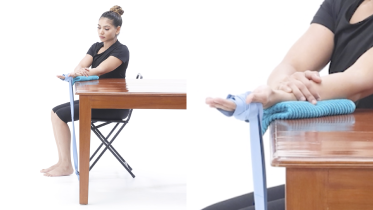
Passive finger extension stretches the finger the other way. Once the finger bends more freely, the putty finger curl builds strength in the muscles that make a fist. A finger that clicks or locks as it bends may be trigger finger, so mention it to your physio.
Written and checked by the PocketPhysio editorial team. Last updated 2026-09-28.
This page is general education, not a diagnosis or a personal treatment plan. If you have pain, an injury or a health condition, see a physiotherapist or doctor before starting new exercises.