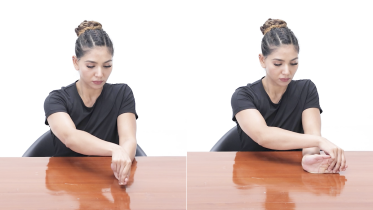
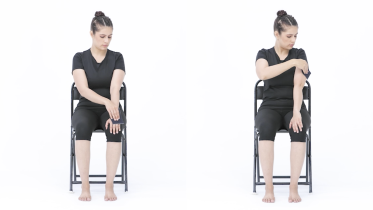
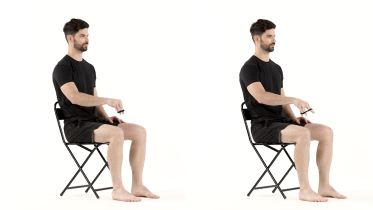
Band wrist curl
The band wrist curl strengthens the muscles on the palm side of your forearm that bend the wrist forward (wrist flexors). You sit with your forearm resting on a table, palm facing up and the hand past the edge, holding a resistance band whose other end is under your foot. Curling the hand up stretches the band, and lowering it slowly keeps the muscles working on the way back. Physios often include it in programs for pain on the inner side of the elbow and in later rehab after wrist and forearm injuries. A band is also an easy swap when there is no dumbbell at home.
How to do the band wrist curl
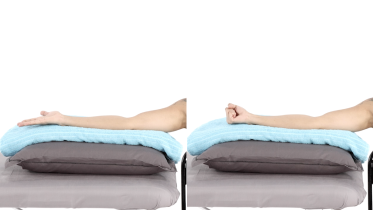
- Sit side-on to a table with both feet flat on the floor. Rest the forearm of your working arm on the tabletop, on a rolled towel as in the video, palm facing up, with the wrist and hand just past the edge.
- Hold one end of a light resistance band in that hand and put the other end under your foot, as in the video, so the band hangs straight down with a little tension. A loop tied in the lower end helps it stay under your foot.
- Rest your other hand on the working forearm to keep it still, as the video shows.
- Curl the hand up toward you by bending the wrist as far as is comfortable. Your forearm stays flat on the towel.
- Pause briefly at the top, then lower the hand slowly against the pull of the band and repeat.
What you should feel
Work along the palm side of your forearm, below the inner elbow. The band pulls harder as the hand rises, so the top of each curl is the hardest part.
Common mistakes
- Lifting the elbow or forearm off the table to help the hand up.
- Letting the band snap the hand back down instead of lowering it with control.
- Choosing a band so firm that you need to jerk the wrist to start the curl.
- Letting the band slide out from under your foot.
How often
A light band for 2 to 3 sets of 10 to 15 slow curls, once a day or every other day, is a typical start. Your physio will adjust this.
Stop and check with your physio if
- Sudden sharp pain in the wrist or at the inner elbow while you curl or lower.
- Any tingling or numbness in the hand or fingers. If one side of your face or body suddenly goes numb or weak, or your speech becomes slurred or muddled, call emergency services, even if it goes away.
- Wrist or inner elbow pain that has not settled by the next morning.
From the clinic
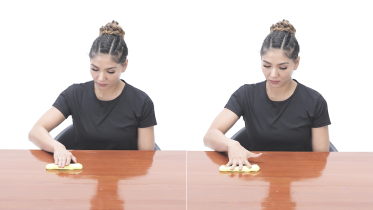
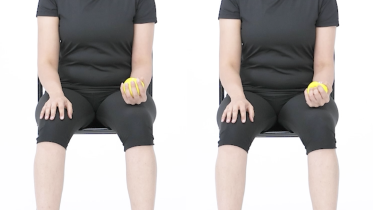
The voice guide describes holding the band with both hands. The video shows the band running from the working hand down under the foot, with the other hand resting on the forearm, so the steps follow the video. Before each set, check the band for nicks or thin patches and keep your foot pressed firmly on it, because a band that slips out can flick up toward your face. For an easier curl, give the band more slack; for a harder one, shorten it or move to a firmer band. The rolled towel under the forearm stops the table edge digging in.
With golfer's elbow, a little soreness on the inside of the elbow during the curls is often acceptable, provided it eases within a few hours and is no worse the following morning. Ask your physio how much soreness is fine in your case. If you have high blood pressure, breathe steadily through every repetition and never hold your breath.
After a broken wrist, hand or forearm, or surgery on any of them such as a tendon repair, start only when your doctor, surgeon, physio or hand therapist says the bone or repair is ready for this, and follow their plan for how much to do. If you have rheumatoid or another inflammatory arthritis in the wrist, ask your physio before adding resistance. Isometric wrist flexion works the same muscles without the wrist moving and often comes first, and the wrist curl does the same job with a light dumbbell.
After a broken or dislocated elbow, or elbow surgery such as a tendon repair, follow your surgeon's or physio's plan, and start this exercise only when they have cleared you. If you have just hurt your arm and have severe pain, cannot move the elbow or heard a snap, do not exercise it. Go to an urgent care center or emergency department the same day. If the arm looks a different shape or sits at an odd angle, a bone is showing, or your arm or hand tingles, feels numb or turns cold, pale or blue, go to an emergency department straight away or call emergency services, and do not drive yourself.
Written and checked by the PocketPhysio editorial team. Last updated 2026-09-28.
This page is general education, not a diagnosis or a personal treatment plan. If you have pain, an injury or a health condition, see a physiotherapist or doctor before starting new exercises.